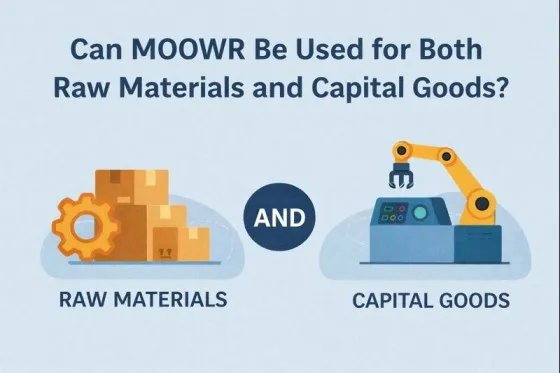
Can MOOWR Be Used for Both Raw Materials and Capital Goods?
Can MOOWR be used for both raw materials and capital goods is the first question most manufacturers ask, and the answer is yes. Under the Manufacture and Other Operations in Warehouse Regulations, 2019, a licensed unit may import raw materials, components, consumables, spares and capital goods into a bonded warehouse without paying Basic Customs Duty or IGST upfront. What very few sources explain clearly is that the two categories are treated very differently when the duty finally becomes payable.
So the useful version of the question is not can MOOWR be used for both raw materials and capital goods, but what happens to each when the goods eventually leave the warehouse. Understanding that difference before you import machinery is worth more than the duty deferment itself.
Can MOOWR Be Used for Both Raw Materials and Capital Goods: The Short Answer
Section 65 of the Customs Act, 1962 permits manufacture and other operations on any warehoused goods. Notification No. 69/2019-Customs (N.T.) and Circular No. 34/2019-Customs draw no distinction at the point of import. Both categories enter the bonded premises on a warehousing bill of entry, filed through ICEGATE, with no duty paid.
The distinction appears at the point of exit. This is where most businesses are caught out.
How Raw Materials Are Treated
On the inputs side, can MOOWR be used for both raw materials and capital goods resolves easily. Imported raw materials, inputs, components and consumables may be used in manufacturing or in approved operations such as assembly, processing, packing, testing, relabelling and repair.
Cleared domestically: duty becomes payable when the resultant finished goods are removed for home consumption. You pay only on the value of the imported inputs actually contained in those goods. No interest is charged on the deferred amount.
Exported: the deferred duty on the imported inputs consumed is remitted entirely. Nothing is payable.
Left in the warehouse: no duty, with no time limit on how long goods may remain bonded.
So a unit that imports 10,000 kg of a bonded input, consumes 6,000 kg, exports the finished goods made from 4,000 kg and sells domestically the goods made from 2,000 kg, pays duty on 2,000 kg only. Export documentation continues to run through the Directorate General of Foreign Trade framework in the normal way.
How Capital Goods Are Treated, and the Rule That Costs Businesses Money
Machinery, plant, equipment, tools, moulds and fixtures may also be imported without upfront duty and installed inside the bonded premises. There is no time limit on their use and no export obligation attaches to them.
The critical point is this. If capital goods are later cleared into the domestic market, customs duty is payable on the original CIF value declared at the time of import. No depreciation is allowed. CBIC has confirmed this position. It applies irrespective of how many years the machine was in use inside the bonded unit.
Several published guides state that duty is payable on the depreciated value. That is incorrect and it materially understates the exit cost of a MOOWR unit. MOOWR is a duty deferment scheme, not an exemption scheme, and no provision permits depreciation of the assessable value. When you ask can MOOWR be used for both raw materials and capital goods, this asymmetry is the answer that matters.
What this looks like in practice
A CNC machine is imported at a CIF value of Rs. 50 lakh. Basic Customs Duty is 7.5 percent. The machine is installed and used inside the bonded factory for seven years. The business then decides to de-bond and sell it domestically for Rs. 10 lakh.
Duty is computed on Rs. 50 lakh, not on Rs. 10 lakh.
IGST and Social Welfare Surcharge, as applicable, are also computed on Rs. 50 lakh.
The IGST paid on removal is generally available as input tax credit, subject to conditions.
The same machine, if exported out of India under Section 69 of the Customs Act, attracts no duty at all.
Customs depreciation and income tax depreciation are different things
The bar on depreciation applies only to the customs assessable value. It does not touch Section 32 of the Income Tax Act, 1961. The asset is capitalised in the books excluding the deferred customs duty, and depreciation continues to be claimed on that capitalised value in the normal way. These two questions are frequently conflated and they should not be.
Can MOOWR Be Used for Both Raw Materials and Capital Goods: A Side by Side View
At import: both enter duty free on a warehousing bill of entry.
Duty trigger: raw materials on removal of the finished goods; capital goods on removal of the machine itself.
Valuation on domestic clearance: raw materials on value of inputs consumed; capital goods on original CIF value with no depreciation.
On export: no duty on either. Deferred duty is remitted.
Interest: none on the deferred amount in either case.
Read that table once more before signing a machinery purchase order. The question can MOOWR be used for both raw materials and capital goods has a yes attached to it, but the two yeses are not the same yes.
Two Limits That Apply to Both Categories
First, goods on the restricted or prohibited import list cannot be brought in under MOOWR. The scheme defers duty; it does not create import eligibility. Where a licence or certification is required, that requirement survives. Our guidance on BIS certification covers one common instance.
Second, no duty drawback and no RoDTEP benefit is available on exports made under MOOWR. A business already claiming drawback should model the comparison rather than assume MOOWR is strictly better. Manufacturers weighing this against other duty schemes should also review the IGCR route, which operates on an exemption rather than a deferment basis.
Neither limit changes the core position. Can MOOWR be used for both raw materials and capital goods remains a yes; these two restrictions govern what you may import and what you may claim afterwards, not which categories qualify.
Note also Section 65A, inserted by the Finance Act, 2023, which would require IGST and compensation cess on deposit rather than on clearance. Its effective date has not been notified. Any cash flow model built on deferred IGST should treat that line as contingent.
Frequently Asked Questions
Q1. Can MOOWR be used for both raw materials and capital goods in the same unit?
Yes. Can MOOWR be used for both raw materials and capital goods within one licence is settled: a single MOOWR unit may import raw materials, components, consumables, spares and capital goods, all without upfront Basic Customs Duty or IGST. Both must be accounted for in the prescribed digital stock records.
Q2. Is depreciation allowed on capital goods when de-bonding under MOOWR?
No. Customs duty is calculated on the original CIF value declared at import, regardless of how long the capital goods were used inside the bonded premises. Depreciation is not permitted for customs valuation purposes.
Q3. Can I still claim income tax depreciation on MOOWR capital goods?
Yes. The customs bar on depreciation does not affect Section 32 of the Income Tax Act, 1961. The asset is capitalised excluding the deferred customs duty and depreciation is claimed on that value.
Q4. What happens if capital goods imported under MOOWR are exported?
No customs duty is payable. Capital goods may be exported under Section 69 of the Customs Act, 1962 and the deferred duty is not recovered.
Q5. Is interest payable on deferred duty under MOOWR?
No. Neither raw materials nor capital goods attract interest on the deferred duty amount, and there is no time limit on how long goods may remain warehoused.
Tell us where you are stuck. We usually reply the same business day.
5.0 ★ · 123 Google reviews · Since 1990
Posted on Google
Vandana Bajaj
Trustindex verifies that the original source of the review is Google.
Very prompt and reliable service by Rahul Kolge and his team. Exceptional and happy experience.
Posted on Google
Supriya Shetye
Trustindex verifies that the original source of the review is Google.
Had a really good experience with JParks India. Rahul sir helped me a lot with my import work and were always active and responsive. Whatever documents or guidance was needed, they handled everything smoothly and explained things clearly. Felt stress-free throughout the process. Very helpful team, definitely recommend them if you’re doing import or export.
Posted on Google
dipali sakpal
Trustindex verifies that the original source of the review is Google.
Very nice people, get the work done in a very short time.
Posted on Google
Satish Bajaj
Trustindex verifies that the original source of the review is Google.
Excellent & Prompt services in all Import Export matters.
Great to work with you
Posted on Google
Bajaj VCPL
Trustindex verifies that the original source of the review is Google.
It was a great experience having work with you.
Posted on Google
Satish Bajaj
Trustindex verifies that the original source of the review is Google.
"Outstanding professiona services, efficient, and gets things done incredibly fast. Highly recommended for anyone needing reliable and prompt assistance
Posted on Google
Nishat fatima
Trustindex verifies that the original source of the review is Google.
excellent service
Posted on Google
farhan sayed
Trustindex verifies that the original source of the review is Google.
JParks Team is Super helpful! Thanks to Rahul and team!
Posted on Google
Sadik Inamdar
Trustindex verifies that the original source of the review is Google.
Good and personal service for import export code
Posted on Google
Maheshwar
Trustindex verifies that the original source of the review is Google.
Had a really good experience with JParks India. Rahul sir helped me a lot with my import work and were always active and responsive. Whatever documents or guidance was needed, they handled everything smoothly and explained things clearly. Felt stress-free throughout the process. Very helpful team, definitely recommend them if you’re doing import or export.
We use cookies to run this site, measure traffic, and track our ads. Essential cookies are always on. Accept all, reject non-essential, or set your preferences.
Cookie Preferences
Manage your cookie preferences below:
Essential cookies enable basic functions and are necessary for the proper function of the website.
Name
Description
Duration
Cookie Preferences
This cookie is used to store the user's cookie consent preferences.
30 days
Google reCAPTCHA helps protect websites from spam and abuse by verifying user interactions through challenges.
Name
Description
Duration
_GRECAPTCHA
Google reCAPTCHA sets a necessary cookie (_GRECAPTCHA) when executed for the purpose of providing its risk analysis.
179 days
Google Tag Manager simplifies the management of marketing tags on your website without code changes.
Name
Description
Duration
cookiePreferences
Registers cookie preferences of a user
2 years
td
Registers statistical data on users' behaviour on the website. Used for internal analytics by the website operator.
session
Statistics cookies collect information anonymously. This information helps us understand how visitors use our website.
Google Analytics is a web analytics service that tracks and reports website traffic. It collects anonymized data on how visitors use the site to help us understand and improve performance.