Rules Under Section 58 and Section 65 of the Customs Act (2026)
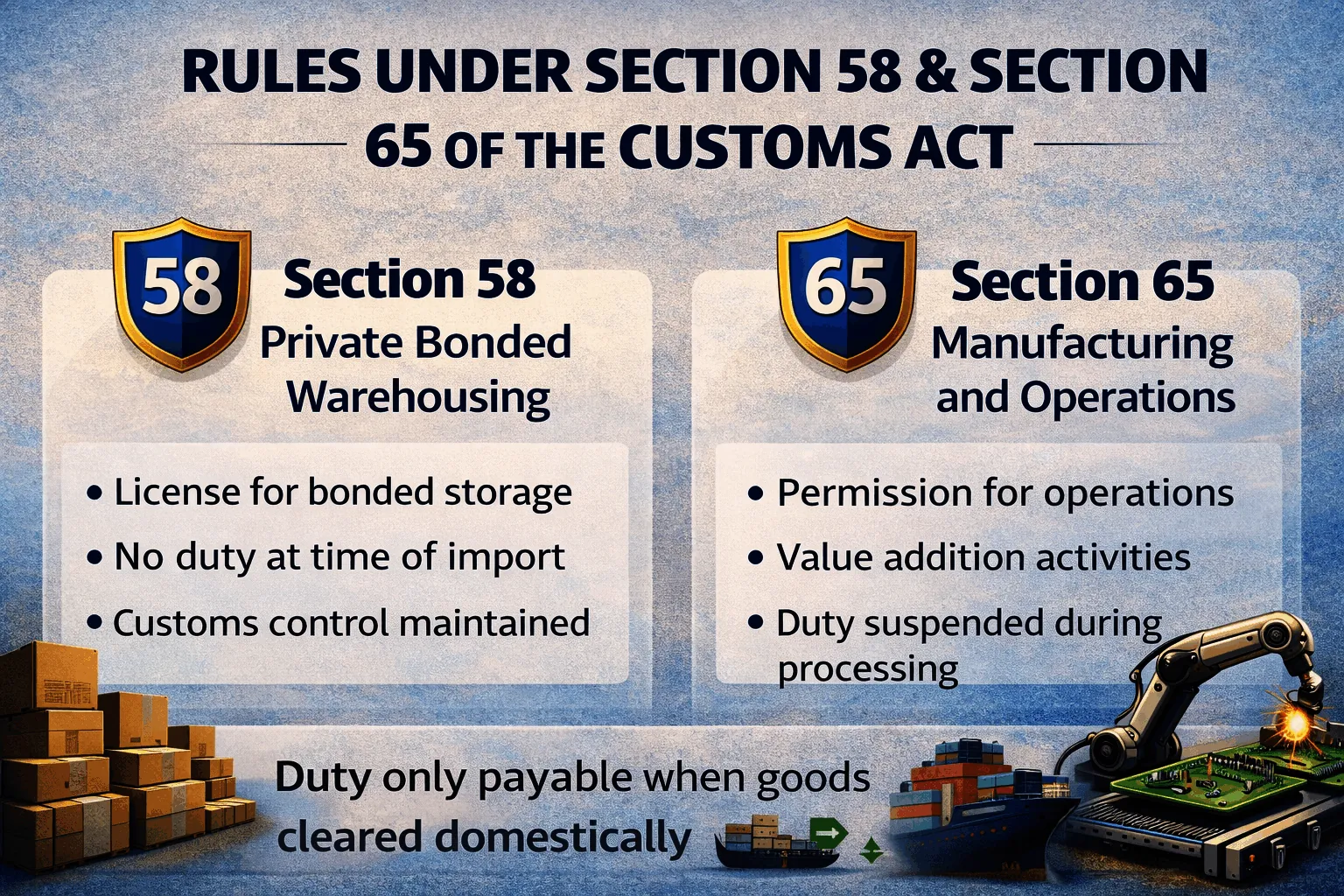
Section 58 and Section 65 of the Customs Act, 1962 sit in Chapter IX and together form the legal basis of the MOOWR scheme. Section 58 licenses a private bonded warehouse. Section 65 permits manufacture and other operations on the goods warehoused in it. A unit needs both.
The two sections do not operate alone. Four instruments govern how they work in practice, and most guidance names none of them.
The Rules Governing Section 58 and Section 65
The operative framework consists of:
Chapter IX of the Customs Act, 1962, containing Sections 57 to 73A on warehousing.
Manufacture and Other Operations in Warehouse (No. 2) Regulations, 2019, notified by Notification No. 69/2019-Customs (N.T.) dated 1 October 2019.
Private Warehouse Licensing Regulations, 2016, governing grant and surrender of the Section 58 licence.
Warehoused Goods (Removal) Regulations, 2016, and the Warehouse (Custody and Handling of Goods) Regulations, 2016.
Circular No. 34/2019-Customs dated 1 October 2019 prescribes the bond format and clarifies duty payment on resultant goods.
Section 58: The Private Bonded Warehouse Licence
Section 58 empowers the Principal Commissioner or Commissioner of Customs to licence a private warehouse where dutiable goods may be deposited without payment of duty at import.
The licensee must provide facilities, equipment, and personnel sufficient to control access and secure the goods, appoint a warehouse keeper with experience in warehousing and customs procedures, and indemnify the Commissioner against loss. A fully enclosed structure is not mandated.
Section 65: Manufacture and Other Operations
Section 65 permits, with the sanction of the proper officer, manufacture and other operations in relation to the warehoused goods. The section contains no words of qualification or limitation on the nature of the goods or the activity.
That was the express holding of the Delhi High Court in ACME Heergarh Powertech. The phrase in relation to conveys a causal link, so capital goods need only contribute to the operation, not themselves be transformed.
Section 61: Why the Combination Matters
This is the provision that makes a Section 65 unit commercially different from a plain bonded warehouse, and it is the one most often left out.
In an ordinary warehouse, goods may remain one year, and interest accrues on the deferred duty beyond 90 days under Section 61(2). In a warehouse where operations are permitted under Section 65, capital goods may remain until clearance and other goods until consumption or clearance. No fixed period. No interest.
Bond and Duty Provisions
Section 59 requires the importer to execute a bond in a sum equal to thrice the duty assessed, binding him to comply with the Act, pay duties and interest under Section 61(2), and pay fines and penalties. The bond format at Annexure C of Circular 34/2019 serves both MOOWR and Section 59.
Under Section 68, goods are cleared for home consumption on an ex-bond Bill of Entry with duty paid. Under Section 69 they may be exported without duty. Section 15 fixes the rate of duty as that in force on the date the ex-bond Bill of Entry is presented.
No Physical Customs Control
A common misconception deserves correcting. Under the 2019 Regulations, there is no physical control or day-to-day presence of customs officers in a Section 65 warehouse.
Supervision was deliberately shifted from the proper officer to a self-appointed warehouse keeper. Units operate on a self-compliance model and are subject to risk-based audits. The obligations are digital accounts furnished monthly to the bond officer under Regulation 17, and reporting discrepancies within 24 hours.
Cancellation and Surrender
Section 58B empowers the Principal Commissioner or Commissioner to cancel a licence granted under Section 57, 58, or 58A where the licensee contravenes the Act, rules or regulations, or breaches a licence condition, after giving an opportunity of being heard. The provision is administered by CBIC. Operations may be suspended pending inquiry.
On cancellation, warehoused goods must be removed within seven days. Voluntary surrender follows the Private Warehouse Licensing Regulations, 2016, by written request, subject to clearing all goods and settling dues.
How JPARKS INDIA Helps
At JPARKS INDIA, we handle combined Section 58 and Section 65 applications, structure the Section 59 bond, set up Regulation 17 digital records, brief the warehouse keeper, and respond to any notice under Section 58B. Having served 500+ importers and exporters since 2018, we keep bonded facilities compliant with Chapter IX end to end. Learn more about our MOOWR scheme services or book a free consultation.
Frequently Asked Questions
Q1. What is Section 65 of the Customs Act, 1962?
Section 65 permits manufacture and other operations in relation to warehoused goods, with the sanction of the proper officer. It contains no limiting words on the nature of the goods or the activity undertaken.
Q2. What is the difference between Section 58 and Section 65?
Section 58 licenses the private bonded warehouse. Section 65 permits manufacture and other operations inside it. A MOOWR unit needs both, and the Section 65 permission is co-terminus with the Section 58 licence.
Q3. Which regulations govern Section 58 and Section 65?
The MOOWR (No. 2) Regulations, 2019, the Private Warehouse Licensing Regulations, 2016, and the Warehoused Goods (Removal) Regulations, 2016, read with Chapter IX of the Customs Act, 1962.
Q4. Are Section 65 units under physical customs control?
No. The 2019 Regulations removed physical control. Supervision shifted to a self-appointed warehouse keeper, with risk-based audits, digital monthly accounts under Regulation 17, and 24-hour discrepancy reporting.
Q5. How long can goods stay in a Section 65 warehouse?
Under Section 61, capital goods may remain until clearance and other goods until consumption or clearance, with no fixed period and no interest. An ordinary bonded warehouse is limited to one year, with interest after 90 days.
Tell us where you are stuck. We usually reply the same business day.
5.0 ★ · 126 Google reviews · Since 1990
Posted on Google
Vandana Bajaj
Trustindex verifies that the original source of the review is Google.
Very prompt and reliable service by Rahul Kolge and his team. Exceptional and happy experience.
Posted on Google
Supriya Shetye
Trustindex verifies that the original source of the review is Google.
Had a really good experience with JParks India. Rahul sir helped me a lot with my import work and were always active and responsive. Whatever documents or guidance was needed, they handled everything smoothly and explained things clearly. Felt stress-free throughout the process. Very helpful team, definitely recommend them if you’re doing import or export.
Posted on Google
dipali sakpal
Trustindex verifies that the original source of the review is Google.
Very nice people, get the work done in a very short time.
Posted on Google
Satish Bajaj
Trustindex verifies that the original source of the review is Google.
Excellent & Prompt services in all Import Export matters.
Great to work with you
Posted on Google
Bajaj VCPL
Trustindex verifies that the original source of the review is Google.
It was a great experience having work with you.
Posted on Google
Satish Bajaj
Trustindex verifies that the original source of the review is Google.
"Outstanding professiona services, efficient, and gets things done incredibly fast. Highly recommended for anyone needing reliable and prompt assistance
Posted on Google
Nishat fatima
Trustindex verifies that the original source of the review is Google.
excellent service
Posted on Google
farhan sayed
Trustindex verifies that the original source of the review is Google.
JParks Team is Super helpful! Thanks to Rahul and team!
Posted on Google
Sadik Inamdar
Trustindex verifies that the original source of the review is Google.
Good and personal service for import export code
Posted on Google
Maheshwar
Trustindex verifies that the original source of the review is Google.
Had a really good experience with JParks India. Rahul sir helped me a lot with my import work and were always active and responsive. Whatever documents or guidance was needed, they handled everything smoothly and explained things clearly. Felt stress-free throughout the process. Very helpful team, definitely recommend them if you’re doing import or export.
Verified by Trustindex
Trustindex verified badge is the Universal Symbol of Trust. Only the greatest companies can get the verified badge who has a review score above 4.5, based on customer reviews over the past 12 months. Read more
We use cookies to run this site, measure traffic, and track our ads. Essential cookies are always on. Accept all, reject non-essential, or set your preferences.
Cookie Preferences
Manage your cookie preferences below:
Essential cookies enable basic functions and are necessary for the proper function of the website.
Name
Description
Duration
Cookie Preferences
This cookie is used to store the user's cookie consent preferences.
30 days
Google reCAPTCHA helps protect websites from spam and abuse by verifying user interactions through challenges.
Name
Description
Duration
_GRECAPTCHA
Google reCAPTCHA sets a necessary cookie (_GRECAPTCHA) when executed for the purpose of providing its risk analysis.
179 days
Google Tag Manager simplifies the management of marketing tags on your website without code changes.
Name
Description
Duration
cookiePreferences
Registers cookie preferences of a user
2 years
td
Registers statistical data on users' behaviour on the website. Used for internal analytics by the website operator.
session
Statistics cookies collect information anonymously. This information helps us understand how visitors use our website.
Google Analytics is a web analytics service that tracks and reports website traffic. It collects anonymized data on how visitors use the site to help us understand and improve performance.