

Explore
- Home
- About Us
- Services
- Blog
- Contact Us
Quick links
- Guide to Import
- Guide to Export
- ICEGATE
- DGFT
- Get DSC
Introduction
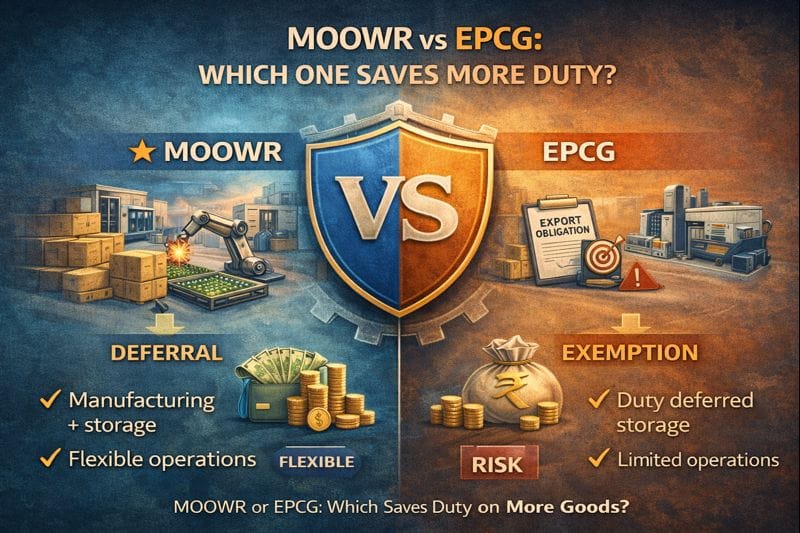
MOOWR and EPCG are both duty saving mechanisms for import of goods used in manufacturing. However, the way duty benefit is achieved and the actual savings differ significantly.
Nature of Duty Benefit
MOOWR works on the principle of duty deferment. Customs duty and IGST are not paid at the time of import and are payable only when goods or finished products are cleared into the domestic market. If goods are exported, no duty is paid.
EPCG provides upfront duty exemption on import of capital goods, but the exemption is conditional.
Export Obligation Impact
MOOWR has no export obligation. Duty saving depends on how much is exported and how long duty payment is deferred, leading to major working capital savings.
EPCG requires fulfillment of a specific export obligation, usually multiple times the duty saved. Failure leads to duty recovery with interest.
Scope of Goods
MOOWR covers both raw materials and capital goods. This widens the duty saving base.
EPCG applies only to capital goods, not consumables or raw materials.
Cash Flow and Risk
MOOWR saves interest cost and improves cash flow by deferring duty indefinitely.
EPCG saves duty upfront but carries compliance risk and long term export pressure.
Which Saves More Duty
In absolute terms, EPCG waives duty only on machinery. MOOWR can save duty on machinery and inputs, making total savings higher, especially for import intensive units.
Conclusion
MOOWR generally saves more duty overall due to wider coverage and flexibility, while EPCG suits exporters confident of meeting export obligations. The better choice depends on business model, not just duty rates.
Learn more about MOOWR scheme at https://www.jparks.co/services/apply-for-moowr-scheme/
EXCELLENTTrustindex verifies that the original source of the review is Google. Had a really good experience with JParks India. Rahul sir helped me a lot with my import work and were always active and responsive. Whatever documents or guidance was needed, they handled everything smoothly and explained things clearly. Felt stress-free throughout the process. Very helpful team, definitely recommend them if you’re doing import or export.Posted onTrustindex verifies that the original source of the review is Google. Quick & reliable servicePosted onTrustindex verifies that the original source of the review is Google. I took import consultancy services from Mr. Rahul at Jparks India Private Limited, and I must say he has excellent knowledge of the process. Really appreciate his professionalism and support. highly recommended!Posted onTrustindex verifies that the original source of the review is Google. very prompt and authentic services. team very responsive and courteous.Posted onTrustindex verifies that the original source of the review is Google. Wonderful Service and Very Fast. Love to recommend everyone. Thank youPosted onTrustindex verifies that the original source of the review is Google. I can get your import and export support in the future and I need it...I hopePosted onTrustindex verifies that the original source of the review is Google. Good service and posstive resposePosted onTrustindex verifies that the original source of the review is Google. Words fastest service for IEC Certificate and many for your Business They really understand client problem.Posted onTrustindex verifies that the original source of the review is Google. I found Mr Rahul Kolge quite professional & ethicalPosted onTrustindex verifies that the original source of the review is Google. Very Good and prompt response by the team and the work was completed in A day Appreciate itVerified by TrustindexTrustindex verified badge is the Universal Symbol of Trust. Only the greatest companies can get the verified badge who has a review score above 4.5, based on customer reviews over the past 12 months. Read more