Certificate of Origin for Import: CAROTAR and Proof of Origin
A certificate of origin for import is the document an Indian importer relies on to claim a preferential duty rate under a trade agreement. Since 18 March 2025 the correct term in Indian customs law is proof of origin, following Notification 14/2025-Customs (NT), with CBIC Circular 14/2025-Customs dated 21 April 2025 aligning the guidance.
The change is not cosmetic. It widens the concept beyond an agency-issued certificate to include self-certified declarations under agreements that allow them.
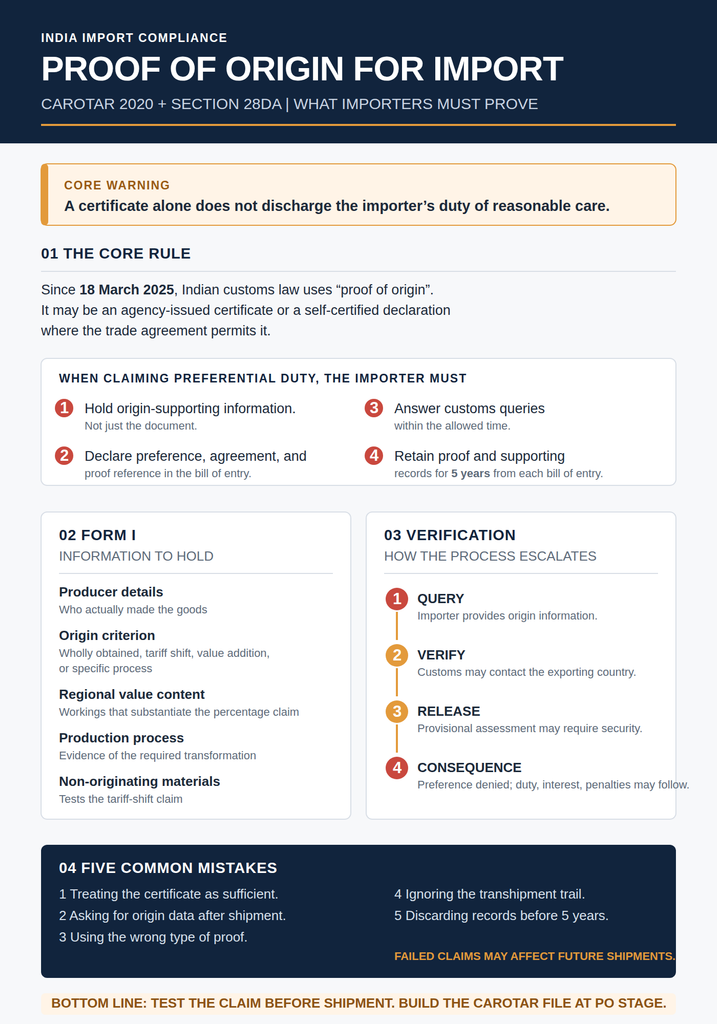
The rule that catches importers, though, is older. Under Section 28DA of the Customs Act and the CAROTAR 2020 rules, producing the document does not discharge your duty of reasonable care. You must satisfy yourself that the origin criteria are actually met.
Certificate of Origin for Import: What the Importer Owes
Reasonable care. You must have information supporting the origin claim, not merely possess a certificate from the supplier.
Correct declaration. The bill of entry must carry the preference claim, the agreement, and the proof of origin reference.
Response to queries. If the proper officer asks for origin information, you supply it within the time allowed.
Record retention. Five years per bill of entry, covering the proof of origin and the supporting information.
The practical consequence is that a supplier who sends a certificate and nothing else has given you half of what you need.
Form I: the information you must hold
CAROTAR 2020 sets out the origin-related information an importer should possess, commonly worked through as Form I. In substance it covers:
Information
Why customs asks
Producer details
Identifies who actually made the goods
Origin criterion claimed
Wholly obtained, tariff shift, value addition or specific process
Regional value content workings
Substantiates a percentage claim
Description of production process
Shows the transformation occurred in the exporting country
Non-originating materials used
Tests the tariff shift claim
Direct consignment evidence
Confirms the goods did not enter commerce in a third country
How verification works
Verification of a certificate of origin for import follows a set sequence.
Query to the importer first. The proper officer asks you for origin information under Section 28DA before going further.
Verification request to the exporting country. If the answer is insufficient, customs can route a verification request to the issuing authority abroad.
Provisional assessment. The consignment can usually be released against security while verification runs, so cash flow rather than clearance is the immediate cost.
Denial of preference. If origin cannot be established, the claim is disallowed, differential duty and interest follow, and penalty provisions can apply.
Suspension of preference for identical goods. Where a claim fails, customs can decline preferential treatment on subsequent identical consignments from the same supplier until the position is resolved.
Retrospective issuance without explanation, or a name or invoice mismatch
No response to verification
The foreign authority does not reply within the prescribed period
The Five Certificate of Origin for Import Mistakes
Treating the certificate as sufficient. Section 28DA says explicitly that it is not.
Not asking the supplier for origin data at PO stage. Once the shipment has sailed your leverage is gone.
Accepting a supplier declaration where the agreement requires an issued proof. The two are not interchangeable.
Ignoring the transhipment trail. Direct consignment has to be evidenced when goods route through a hub port.
Discarding records early. Five years per bill of entry, not five years from the current financial year.
Where duty exposure is significant, price the risk before committing. A preference claim that fails eighteen months later still costs differential duty and interest, and our IGCR clearance work often runs alongside these reviews for importers using multiple concession routes.
How JPARKS INDIA Helps
JPARKS INDIA handles certificate of origin for import compliance from the importer’s side of the transaction, which is where the liability actually sits.
Pre-import origin review so the claim is tested before the goods ship, not after a query.
Supplier information packs, specifying exactly what your exporter must provide and when.
Form I preparation and CAROTAR record files structured for the five-year retention requirement.
Query and verification handling with the assessing group, including provisional assessment and security.
Clearance execution as your customs broker, or through importer of record services where you have no Indian entity.
Q1. Is a certificate of origin for import mandatory in India?
Only where you are claiming preferential duty under a trade agreement. For normal MFN imports it is not required, though a buyer, bank or regulator may ask for one for other reasons.
Q2. What is proof of origin?
The term that replaced “certificate of origin” in Indian customs law from 18 March 2025 under Notification 14/2025-Customs (NT). It covers agency-issued certificates and self-certified declarations where an agreement permits them.
Q3. What is CAROTAR 2020?
The Customs (Administration of Rules of Origin under Trade Agreements) Rules, 2020, which set out the importer’s obligations when claiming preferential duty, including the information you must hold.
Q4. Does submitting the certificate protect me?
No. Section 28DA states that submitting the document does not discharge the importer’s duty of reasonable care regarding the accuracy of the origin claim.
Q5. How long must I keep the records?
Five years from the date of filing each bill of entry, covering the proof of origin and the supporting origin information.
Q6. What happens if I cannot provide the information requested?
The preference claim can be denied, differential duty and interest become payable, and customs can decline preferential treatment on subsequent identical consignments from the same supplier.
Q7. Can a supplier declaration replace a certificate of origin for import?
Only where the specific agreement provides for self-certification. Otherwise an agency-issued proof is required, and substituting one for the other is a common cause of denial.
Need this handled for you?
Tell us where you are stuck. We usually reply the same business day.
5.0 ★ · 126 Google reviews · Since 1990
Posted on Google
Vandana Bajaj
Trustindex verifies that the original source of the review is Google.
Very prompt and reliable service by Rahul Kolge and his team. Exceptional and happy experience.
Posted on Google
Supriya Shetye
Trustindex verifies that the original source of the review is Google.
Had a really good experience with JParks India. Rahul sir helped me a lot with my import work and were always active and responsive. Whatever documents or guidance was needed, they handled everything smoothly and explained things clearly. Felt stress-free throughout the process. Very helpful team, definitely recommend them if you’re doing import or export.
Posted on Google
dipali sakpal
Trustindex verifies that the original source of the review is Google.
Very nice people, get the work done in a very short time.
Posted on Google
Satish Bajaj
Trustindex verifies that the original source of the review is Google.
Excellent & Prompt services in all Import Export matters.
Great to work with you
Posted on Google
Bajaj VCPL
Trustindex verifies that the original source of the review is Google.
It was a great experience having work with you.
Posted on Google
Satish Bajaj
Trustindex verifies that the original source of the review is Google.
"Outstanding professiona services, efficient, and gets things done incredibly fast. Highly recommended for anyone needing reliable and prompt assistance
Posted on Google
Nishat fatima
Trustindex verifies that the original source of the review is Google.
excellent service
Posted on Google
farhan sayed
Trustindex verifies that the original source of the review is Google.
JParks Team is Super helpful! Thanks to Rahul and team!
Posted on Google
Sadik Inamdar
Trustindex verifies that the original source of the review is Google.
Good and personal service for import export code
Posted on Google
Maheshwar
Trustindex verifies that the original source of the review is Google.
Had a really good experience with JParks India. Rahul sir helped me a lot with my import work and were always active and responsive. Whatever documents or guidance was needed, they handled everything smoothly and explained things clearly. Felt stress-free throughout the process. Very helpful team, definitely recommend them if you’re doing import or export.
Verified by Trustindex
Trustindex verified badge is the Universal Symbol of Trust. Only the greatest companies can get the verified badge who has a review score above 4.5, based on customer reviews over the past 12 months. Read more
We use cookies to run this site, measure traffic, and track our ads. Essential cookies are always on. Accept all, reject non-essential, or set your preferences.
Cookie Preferences
Manage your cookie preferences below:
Essential cookies enable basic functions and are necessary for the proper function of the website.
Name
Description
Duration
Cookie Preferences
This cookie is used to store the user's cookie consent preferences.
30 days
Google reCAPTCHA helps protect websites from spam and abuse by verifying user interactions through challenges.
Name
Description
Duration
_GRECAPTCHA
Google reCAPTCHA sets a necessary cookie (_GRECAPTCHA) when executed for the purpose of providing its risk analysis.
179 days
Google Tag Manager simplifies the management of marketing tags on your website without code changes.
Name
Description
Duration
cookiePreferences
Registers cookie preferences of a user
2 years
td
Registers statistical data on users' behaviour on the website. Used for internal analytics by the website operator.
session
Statistics cookies collect information anonymously. This information helps us understand how visitors use our website.
Google Analytics is a web analytics service that tracks and reports website traffic. It collects anonymized data on how visitors use the site to help us understand and improve performance.