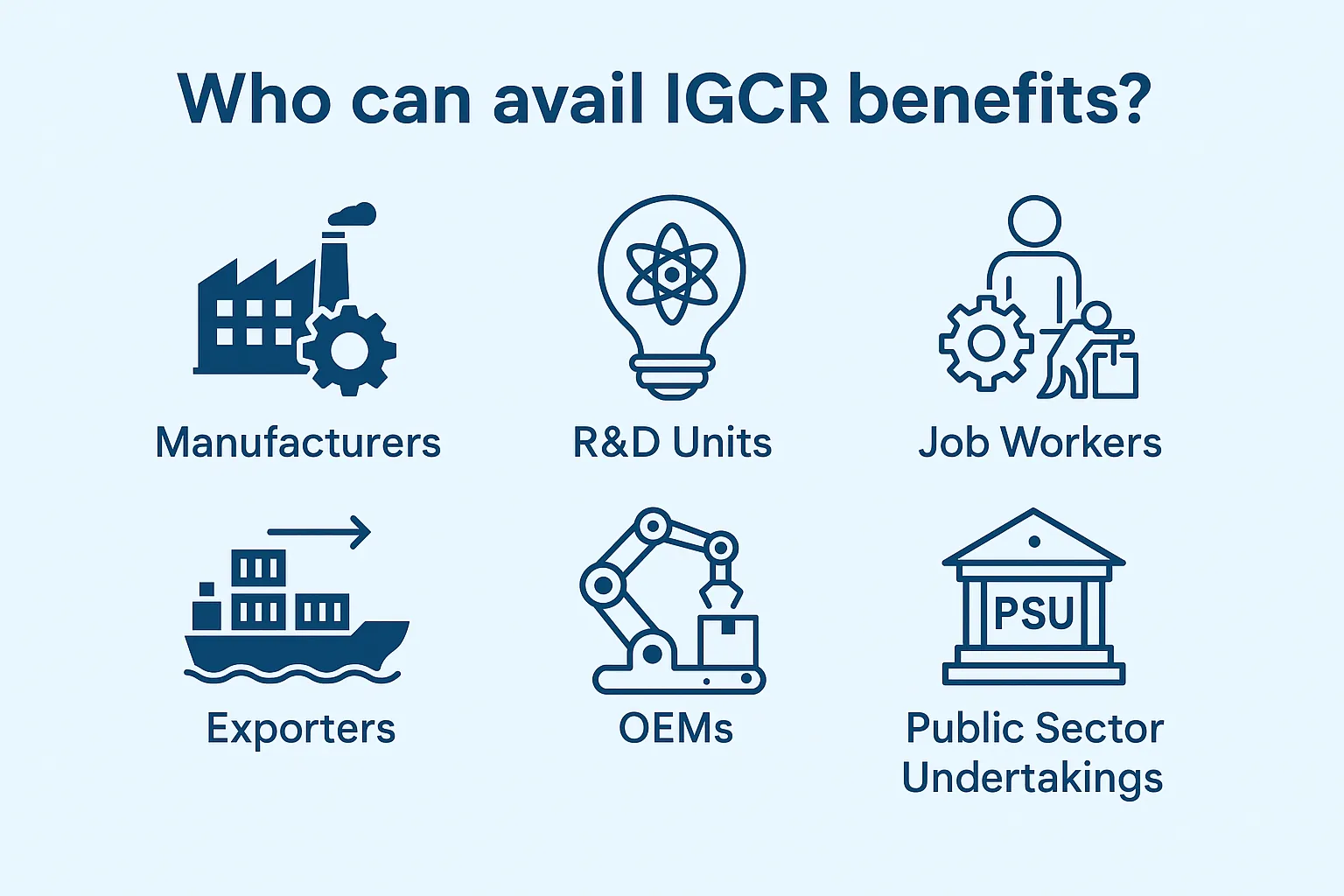
Who Can Avail IGCR Benefits? Conditions Attached to the Concession
To avail IGCR benefits, any importer must satisfy the conditions of the relevant customs notification and the IGCR Rules, 2017. But availing the benefit is different from being eligible to register. Eligibility gets you into the scheme; availing the benefit means actually receiving and keeping the concessional duty, which depends on meeting every condition attached to it. This page focuses on that second part, because it is where importers most often slip.
The benefit is a reduced or nil customs duty on qualifying imports. To avail it and retain it, an importer has to clear a set of conditions before, during, and after import.
The Conditions You Must Meet to Avail IGCR Benefits
Availing IGCR is conditional throughout the lifecycle:
Before import: File a prior intimation, obtain an IGCR Identification Number (IIN), and furnish a continuity bond covering the differential duty.
At import: Quote the IIN on the bill of entry so the concessional rate is applied and linked to your declaration.
After import: Use the goods for the declared end use within the permitted time, maintain consumption records, and file the required returns to prove that use.
Meet all of these and the benefit is fully availed, with the bond re-credited as consumption is proven. Miss one and the benefit can be denied or reversed.
Who Realistically Benefits Most
The importers who get the most from IGCR are those with steady, verifiable end-use consumption: manufacturers drawing down imported inputs into finished goods, and producers or service providers with clear consumption trails. For these businesses the duty saving is real and the compliance is a natural byproduct of operations they already record.
Importers with irregular or hard-to-document consumption can still avail the benefit, but they carry more compliance risk, because the burden of proving end use falls on them.
Conditions That Commonly Trip Importers Up
Three conditions cause most problems. The time limit for using the goods is real, and unused material beyond the period attracts the differential duty with interest. The record-keeping requirement is not optional; weak records undermine bond re-credit even when the goods were genuinely used. And the return filing obligation continues for as long as the IIN is active, so lapsing on returns can suspend the very benefit you registered for.
Availing the Benefit Without Losing It
The gap between availing IGCR and keeping it is compliance discipline. The concession is generous, but it is a conditional one, and customs increasingly uses data analytics to match declared inputs against output. Our team structures the whole cycle so the benefit is availed correctly and defended through proper returns and records. See the IGCR clearance service or contact [email protected] or +91 91673 79073.
How Long You Can Continue to Avail IGCR Benefits
There is no fixed expiry on your ability to avail IGCR benefits, but the right depends entirely on staying compliant. As long as your IGCR Identification Number remains active, your returns are filed, and your imported goods are genuinely consumed for the declared end use, you can keep claiming the concessional rate on new imports indefinitely. Under the current ICEGATE 2.0 position, the IIN also carries forward across financial years, so you no longer lose the benefit simply because a new year begins.
What ends the ability to avail IGCR benefits is non-compliance, not the passage of time. A suspended IIN from unfiled returns, or a demand raised because goods were diverted, interrupts the benefit until the position is regularised. In practice, importers who treat IGCR as a continuing obligation rather than a one-time registration retain the benefit smoothly year after year.
Benefits are claimed on the ICEGATE portal, and the process requires an IEC from the DGFT.
Frequently Asked Questions
Q1. Who can avail IGCR benefits?
Any importer who satisfies the conditions of the relevant notification and the IGCR Rules, 2017, before, during, and after import.
Q2. What conditions must be met before import?
File a prior intimation, obtain an IIN, and furnish a continuity bond covering the differential duty.
Q3. What must be done after import?
Use the goods for the declared purpose within the permitted time, maintain records, and file the quarterly returns.
Q4. What happens if a condition is not met?
The concession can be denied or reversed, and the differential duty becomes recoverable with interest against the bond.
Q5. Who benefits most from IGCR?
Importers with steady, verifiable end-use consumption, such as manufacturers drawing imported inputs into finished goods.
Tell us where you are stuck. We usually reply the same business day.
5.0 ★ · 123 Google reviews · Since 1990
Posted on Google
Vandana Bajaj
Trustindex verifies that the original source of the review is Google.
Very prompt and reliable service by Rahul Kolge and his team. Exceptional and happy experience.
Posted on Google
Supriya Shetye
Trustindex verifies that the original source of the review is Google.
Had a really good experience with JParks India. Rahul sir helped me a lot with my import work and were always active and responsive. Whatever documents or guidance was needed, they handled everything smoothly and explained things clearly. Felt stress-free throughout the process. Very helpful team, definitely recommend them if you’re doing import or export.
Posted on Google
dipali sakpal
Trustindex verifies that the original source of the review is Google.
Very nice people, get the work done in a very short time.
Posted on Google
Satish Bajaj
Trustindex verifies that the original source of the review is Google.
Excellent & Prompt services in all Import Export matters.
Great to work with you
Posted on Google
Bajaj VCPL
Trustindex verifies that the original source of the review is Google.
It was a great experience having work with you.
Posted on Google
Satish Bajaj
Trustindex verifies that the original source of the review is Google.
"Outstanding professiona services, efficient, and gets things done incredibly fast. Highly recommended for anyone needing reliable and prompt assistance
Posted on Google
Nishat fatima
Trustindex verifies that the original source of the review is Google.
excellent service
Posted on Google
farhan sayed
Trustindex verifies that the original source of the review is Google.
JParks Team is Super helpful! Thanks to Rahul and team!
Posted on Google
Sadik Inamdar
Trustindex verifies that the original source of the review is Google.
Good and personal service for import export code
Posted on Google
Maheshwar
Trustindex verifies that the original source of the review is Google.
Had a really good experience with JParks India. Rahul sir helped me a lot with my import work and were always active and responsive. Whatever documents or guidance was needed, they handled everything smoothly and explained things clearly. Felt stress-free throughout the process. Very helpful team, definitely recommend them if you’re doing import or export.
Verified by Trustindex
Trustindex verified badge is the Universal Symbol of Trust. Only the greatest companies can get the verified badge who has a review score above 4.5, based on customer reviews over the past 12 months. Read more
We use cookies to run this site, measure traffic, and track our ads. Essential cookies are always on. Accept all, reject non-essential, or set your preferences.
Cookie Preferences
Manage your cookie preferences below:
Essential cookies enable basic functions and are necessary for the proper function of the website.
Name
Description
Duration
Cookie Preferences
This cookie is used to store the user's cookie consent preferences.
30 days
Google reCAPTCHA helps protect websites from spam and abuse by verifying user interactions through challenges.
Name
Description
Duration
_GRECAPTCHA
Google reCAPTCHA sets a necessary cookie (_GRECAPTCHA) when executed for the purpose of providing its risk analysis.
179 days
Google Tag Manager simplifies the management of marketing tags on your website without code changes.
Name
Description
Duration
cookiePreferences
Registers cookie preferences of a user
2 years
td
Registers statistical data on users' behaviour on the website. Used for internal analytics by the website operator.
session
Statistics cookies collect information anonymously. This information helps us understand how visitors use our website.
Google Analytics is a web analytics service that tracks and reports website traffic. It collects anonymized data on how visitors use the site to help us understand and improve performance.