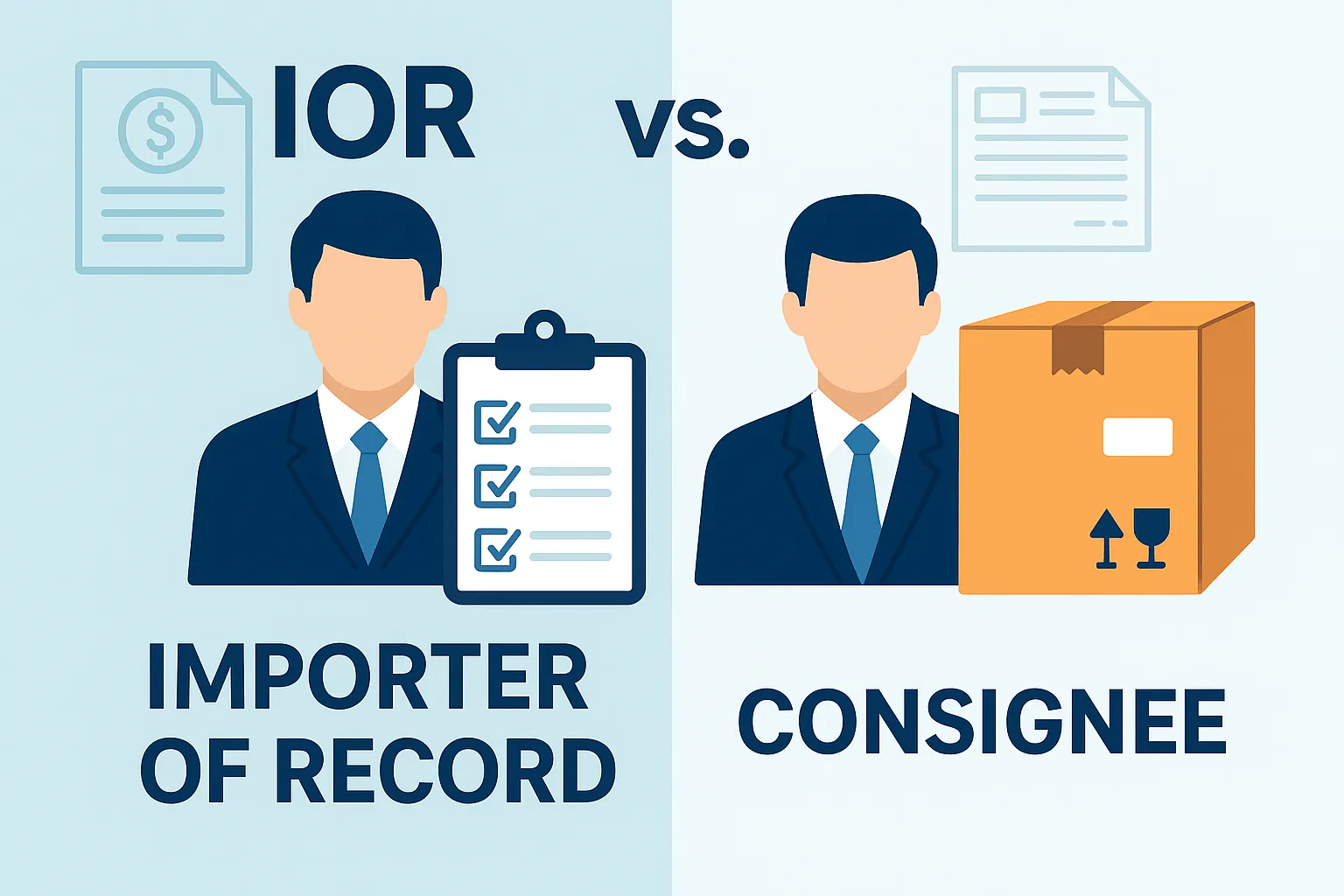
Importer of Record vs Consignee: What Is the Difference?
The core of importer of record vs consignee is liability versus receipt: the importer of record (IOR) is the entity legally responsible for customs clearance, duties, and compliance, while the consignee is the party that receives the goods after clearance. In India, the importer of record is whoever holds the Importer Exporter Code (IEC) and is named on the Bill of Entry filed on ICEGATE. The consignee can be the same entity as the importer of record, but in cross-border trade the two are often different.
Getting importer of record vs consignee right on your paperwork prevents customs holds, penalties, and disputes over who pays duties.
Importer of Record vs Consignee: The Core Difference
The importer of record is the legally responsible party for the import. It files the Bill of Entry, declares the correct value and HS code, pays customs duty and IGST, holds any required licences, and faces audit or penalty if the import is non-compliant. The consignee is the party the goods are consigned to, named on the bill of lading or airway bill, whose role is to take delivery once customs clears the shipment. The IOR carries the compliance liability; the consignee carries the goods.
Comparison Table: Importer of Record vs Consignee
Here is how the two roles compare across the factors that matter in India:
Legal liability to customs: IOR is fully accountable; the consignee usually is not
IEC requirement: IOR must hold a valid IEC; the consignee may not need one
Duties and IGST: IOR calculates and pays them; the consignee generally does not
Customs filing: IOR files the Bill of Entry; the consignee does not
Licences (BIS, WPC, FSSAI): IOR obtains and holds them; the consignee does not
Named on: IOR on the Bill of Entry; consignee on the bill of lading or airway bill
Primary role: IOR ensures compliance; the consignee receives the goods
When Are the Importer of Record and Consignee the Same?
In a straightforward import, the importer of record and consignee are the same entity. An Indian business with its own IEC buys goods, clears them under that IEC, and receives them at its own premises, so it is both the importer of record and the consignee. This is common for direct-to-business imports and goods brought in for internal use, where taking on both roles simplifies the process.
When Are They Different? India Examples
The importer of record and consignee are different in these common situations:
DDP terms: a foreign seller ships to an Indian buyer on Delivered Duty Paid terms. The seller (through its appointed third-party IOR in India) is the importer of record, while the Indian buyer is the consignee.
E-commerce fulfilment: a brand ships inventory into an Indian fulfilment centre. The warehouse is the consignee, but the brand or its third-party IOR is the importer of record.
No local entity: a foreign company with no IEC cannot be the importer of record, so a third-party IOR clears the goods while the goods are delivered to the local consignee.
In each case, listing a consignee who cannot legally clear the goods as the importer would cause the shipment to be held at the port.
Common Mistakes with Importer of Record vs Consignee
The most frequent error is assuming the consignee is automatically the importer of record. A foreign entity named as consignee cannot file a Bill of Entry in India without an IEC, so the shipment stalls. Another mistake is leaving the importer of record undefined until the goods arrive, which invites demurrage and penalties. The fix is simple: confirm who the importer of record is, and that they hold the IEC and any required licences, before the goods ship.
How JPARKS INDIA Helps as Your Importer of Record
At JPARKS INDIA, we act as your importer of record in India while your goods are delivered to any consignee you choose. We hold the IEC, ICEGATE, and AD Code registrations, file the Bill of Entry, pay duty and IGST, obtain BIS and WPC licences, and coordinate delivery. Having served 500+ importers and exporters, we make sure the importer of record and consignee roles are set up correctly so your cargo clears without holds. Learn more about our Importer of Record services or book a free consultation.
Frequently Asked Questions
Q1. What is the difference between importer of record and consignee?
The importer of record is legally liable to customs for clearance, duties, and compliance and holds the IEC, while the consignee is the party that receives the goods after clearance. They can be the same entity but are often different.
Q2. Can the importer of record and consignee be the same?
Yes. In many imports the importer of record and consignee are the same entity, especially when an Indian business with its own IEC buys and receives the goods. Under DDP terms or third-party arrangements they differ.
Q3. Who pays customs duty, the importer of record or the consignee?
The importer of record pays the customs duty and IGST, because it is the party legally responsible for the import. The consignee usually only receives the goods after clearance.
Q4. Does the consignee need an IEC in India?
The consignee does not always need an IEC, but the importer of record must hold a valid IEC to file the Bill of Entry and clear the goods through Indian Customs.
Q5. Is the consignee on the bill of lading the importer of record?
Not necessarily. The consignee is named on the bill of lading as the recipient, but the legal importer of record is confirmed on the Bill of Entry and must hold the IEC. They can be the same or different.
Tell us where you are stuck. We usually reply the same business day.
5.0 ★ · 123 Google reviews · Since 1990
Posted on Google
Vandana Bajaj
Trustindex verifies that the original source of the review is Google.
Very prompt and reliable service by Rahul Kolge and his team. Exceptional and happy experience.
Posted on Google
Supriya Shetye
Trustindex verifies that the original source of the review is Google.
Had a really good experience with JParks India. Rahul sir helped me a lot with my import work and were always active and responsive. Whatever documents or guidance was needed, they handled everything smoothly and explained things clearly. Felt stress-free throughout the process. Very helpful team, definitely recommend them if you’re doing import or export.
Posted on Google
dipali sakpal
Trustindex verifies that the original source of the review is Google.
Very nice people, get the work done in a very short time.
Posted on Google
Satish Bajaj
Trustindex verifies that the original source of the review is Google.
Excellent & Prompt services in all Import Export matters.
Great to work with you
Posted on Google
Bajaj VCPL
Trustindex verifies that the original source of the review is Google.
It was a great experience having work with you.
Posted on Google
Satish Bajaj
Trustindex verifies that the original source of the review is Google.
"Outstanding professiona services, efficient, and gets things done incredibly fast. Highly recommended for anyone needing reliable and prompt assistance
Posted on Google
Nishat fatima
Trustindex verifies that the original source of the review is Google.
excellent service
Posted on Google
farhan sayed
Trustindex verifies that the original source of the review is Google.
JParks Team is Super helpful! Thanks to Rahul and team!
Posted on Google
Sadik Inamdar
Trustindex verifies that the original source of the review is Google.
Good and personal service for import export code
Posted on Google
Maheshwar
Trustindex verifies that the original source of the review is Google.
Had a really good experience with JParks India. Rahul sir helped me a lot with my import work and were always active and responsive. Whatever documents or guidance was needed, they handled everything smoothly and explained things clearly. Felt stress-free throughout the process. Very helpful team, definitely recommend them if you’re doing import or export.
Verified by Trustindex
Trustindex verified badge is the Universal Symbol of Trust. Only the greatest companies can get the verified badge who has a review score above 4.5, based on customer reviews over the past 12 months. Read more
We use cookies to run this site, measure traffic, and track our ads. Essential cookies are always on. Accept all, reject non-essential, or set your preferences.
Cookie Preferences
Manage your cookie preferences below:
Essential cookies enable basic functions and are necessary for the proper function of the website.
Name
Description
Duration
Cookie Preferences
This cookie is used to store the user's cookie consent preferences.
30 days
Google reCAPTCHA helps protect websites from spam and abuse by verifying user interactions through challenges.
Name
Description
Duration
_GRECAPTCHA
Google reCAPTCHA sets a necessary cookie (_GRECAPTCHA) when executed for the purpose of providing its risk analysis.
179 days
Google Tag Manager simplifies the management of marketing tags on your website without code changes.
Name
Description
Duration
cookiePreferences
Registers cookie preferences of a user
2 years
td
Registers statistical data on users' behaviour on the website. Used for internal analytics by the website operator.
session
Statistics cookies collect information anonymously. This information helps us understand how visitors use our website.
Google Analytics is a web analytics service that tracks and reports website traffic. It collects anonymized data on how visitors use the site to help us understand and improve performance.