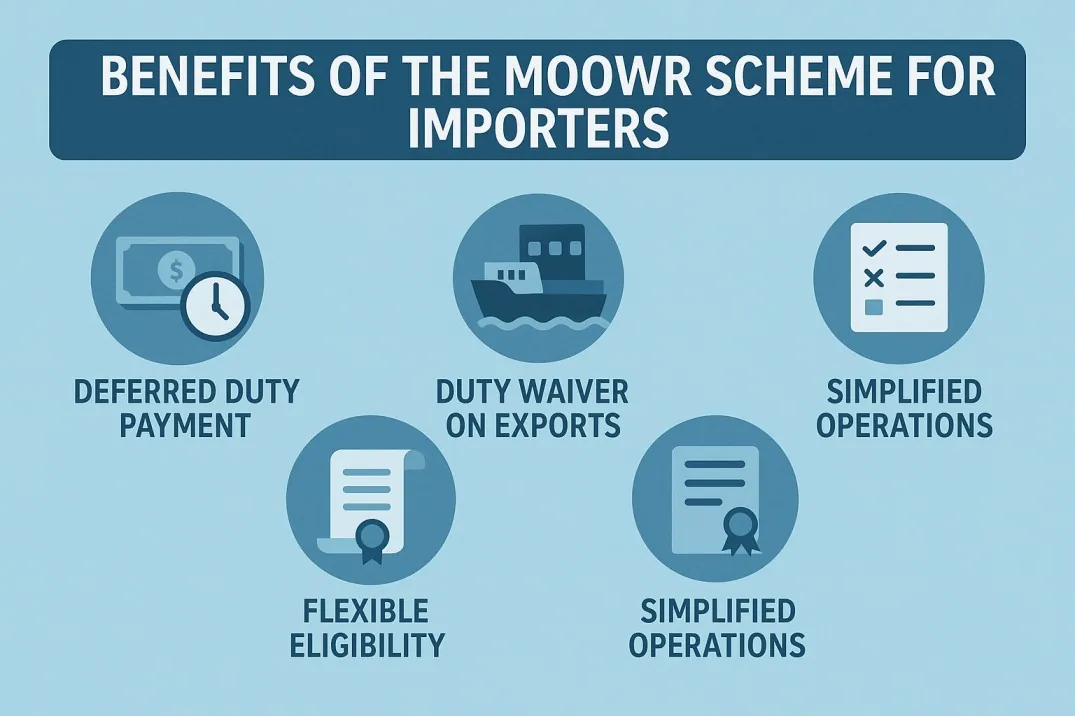
Benefits of MOOWR scheme begin with a single mechanism: customs duty on imported goods is not paid at the port. It is deferred until the goods leave the bonded warehouse for the domestic market, and remitted entirely if they are exported. For an import dependent business, that converts a fixed outflow at clearance into working capital that stays in the business until a sale actually happens.
The benefits of MOOWR scheme are real and substantial. They are also not free, and the honest version of this page has to say what they cost. Most published guidance stops at the upside.
Benefits of MOOWR Scheme: The Seven That Matter
1. Duty deferment with no interest
Basic Customs Duty and IGST stand deferred on import of both inputs and capital goods. No interest accrues on the deferred amount. This is unusual. Most deferment mechanisms charge for the privilege, and MOOWR does not.
2. Full remission on exports
If the resultant goods are exported, the deferred duty on the imported inputs contained in them is remitted. Nothing is payable. Capital goods may likewise be exported after use, without duty, under Section 69 of the Customs Act, 1962.
3. No export obligation
There is no export target, no minimum export performance, no net foreign exchange requirement and no monitoring period. A unit may sell one hundred percent of its output domestically without breaching any condition. EPCG, by contrast, demands exports of six times the duties saved over six years.
4. No warehousing time limit
Goods may remain bonded indefinitely. An importer with seasonal or lumpy demand is not penalised for holding stock, and is not forced into a clearance decision before the market is ready.
5. Flexible eligibility
No minimum turnover, no minimum investment threshold, no employment condition and no locational restriction. An existing factory in the Domestic Tariff Area can be converted. CBIC itself describes the scheme as MSME friendly. Our note on whether MSMEs can apply for MOOWR covers the one practical constraint, which is the solvency certificate.
6. Perpetual licence
The licence under Section 58 and the permission under Section 65 remain valid until cancelled or surrendered. There is no renewal cycle and no expiry date to track.
7. A dual purpose warehouse
This is the benefit almost nobody explains. Because a Section 65 warehouse also functions as a warehouse licensed under Section 58, the licensee may import goods and clear them as such, without any manufacture, either for export under Section 69 or for home consumption under Section 68. The same infrastructure serves both the bonded manufacturing operation and straightforward warehousing.
One trap here. Goods cleared as such for home consumption attract interest under Section 61(2). Resultant goods emerging from manufacture do not. The distinction is easy to miss and expensive to discover late. Where the warehouse is used for non Section 65 purposes, monthly returns in Form B under Circular No. 25/2016-Customs are also required.
What the Benefits of MOOWR Scheme Cost You
Three costs. Each is decisive for some importers and irrelevant to others.
No RoDTEP, no duty drawback. Products manufactured wholly or partly in a Section 65 warehouse are ineligible for RoDTEP, and drawback is likewise barred. Unlike SEZ and EOU, there is no provision contemplating future inclusion. The bar is premises based, so goods produced at a separate non MOOWR factory may still qualify.
No depreciation on capital goods. If machinery is later cleared into the domestic market, duty is computed on the original CIF value declared at import, however many years it was used. IGCR, by contrast, permits depreciation. See our note on raw materials and capital goods.
Duty on waste and refuse. Where waste arising from manufacture is cleared into the domestic market, duty is payable on the quantity of warehoused goods contained in it. If the waste is destroyed, no duty arises. A high scrap process should model this.
An exporter currently earning All Industry Rate drawback should price that income against the deferment before applying. For a heavily export oriented unit the benefits of MOOWR scheme can be worth less than what is surrendered.
Compliance the Benefits Are Attached To
MOOWR is often described as light touch. It is lighter than EOU or SEZ. It is not nil.
Monthly returns to the jurisdictional Bond Officer by the tenth of the following month. These are monthly, not quarterly.
A single digital account recording receipt, consumption, waste and removal.
A triple duty bond backed by a solvency certificate, which caps the duty deferrable at any one time.
A nominated and approved warehouse keeper.
Controlled access, boundary walls, gates and CCTV. A fully enclosed structure is not mandatory, but the site must be suitable for secure storage of dutiable goods.
Risk based audit. There is no day to day physical control of the unit.
Applications are no longer submitted online. The Invest India MOOWR portal stopped accepting them in late 2025. A licence under Section 58 and permission under Section 65 must now be sought directly from the jurisdictional Principal Commissioner or Commissioner of Customs, in the prescribed physical format.
Separately, Budget 2024 inserted a proviso to Section 65(1) empowering the Central Government to notify classes of goods or operations not permitted in a MOOWR unit. Section 65A, inserted by the Finance Act, 2023, would require IGST and compensation cess on deposit rather than on clearance, though its effective date has not been notified. Any cash flow model resting on deferred IGST should treat that line as contingent.
Frequently Asked Questions
Q1. What are the main benefits of MOOWR scheme for importers?
The principal benefits of MOOWR scheme are interest free duty deferment on inputs and capital goods, full remission of duty on exports, no export obligation, no warehousing time limit, no minimum investment or turnover threshold, and a perpetual licence requiring no renewal.
Q2. Is interest charged on deferred duty under MOOWR?
Not on resultant goods emerging from manufacture. However, imported goods cleared as such for home consumption, without any manufacture, attract interest under Section 61(2) of the Customs Act, 1962.
Q3. Can I claim RoDTEP or duty drawback under MOOWR?
No. Products manufactured wholly or partly in a Section 65 warehouse are ineligible for RoDTEP, and duty drawback is unavailable. This is the principal cost of the scheme’s flexibility.
Q4. Is duty payable on waste generated in a MOOWR unit?
Yes, where the waste or refuse is cleared into the domestic market. Duty is payable on the quantity of warehoused goods contained in it. If the waste is destroyed, no duty is required to be paid.
Q5. Can I still apply for MOOWR online?
No. The Invest India MOOWR portal stopped accepting applications in late 2025. Applications now go directly to the jurisdictional Principal Commissioner or Commissioner of Customs in the prescribed physical format.
Tell us where you are stuck. We usually reply the same business day.
5.0 ★ · 123 Google reviews · Since 1990
Posted on Google
Vandana Bajaj
Trustindex verifies that the original source of the review is Google.
Very prompt and reliable service by Rahul Kolge and his team. Exceptional and happy experience.
Posted on Google
Supriya Shetye
Trustindex verifies that the original source of the review is Google.
Had a really good experience with JParks India. Rahul sir helped me a lot with my import work and were always active and responsive. Whatever documents or guidance was needed, they handled everything smoothly and explained things clearly. Felt stress-free throughout the process. Very helpful team, definitely recommend them if you’re doing import or export.
Posted on Google
dipali sakpal
Trustindex verifies that the original source of the review is Google.
Very nice people, get the work done in a very short time.
Posted on Google
Satish Bajaj
Trustindex verifies that the original source of the review is Google.
Excellent & Prompt services in all Import Export matters.
Great to work with you
Posted on Google
Bajaj VCPL
Trustindex verifies that the original source of the review is Google.
It was a great experience having work with you.
Posted on Google
Satish Bajaj
Trustindex verifies that the original source of the review is Google.
"Outstanding professiona services, efficient, and gets things done incredibly fast. Highly recommended for anyone needing reliable and prompt assistance
Posted on Google
Nishat fatima
Trustindex verifies that the original source of the review is Google.
excellent service
Posted on Google
farhan sayed
Trustindex verifies that the original source of the review is Google.
JParks Team is Super helpful! Thanks to Rahul and team!
Posted on Google
Sadik Inamdar
Trustindex verifies that the original source of the review is Google.
Good and personal service for import export code
Posted on Google
Maheshwar
Trustindex verifies that the original source of the review is Google.
Had a really good experience with JParks India. Rahul sir helped me a lot with my import work and were always active and responsive. Whatever documents or guidance was needed, they handled everything smoothly and explained things clearly. Felt stress-free throughout the process. Very helpful team, definitely recommend them if you’re doing import or export.
Verified by Trustindex
Trustindex verified badge is the Universal Symbol of Trust. Only the greatest companies can get the verified badge who has a review score above 4.5, based on customer reviews over the past 12 months. Read more
We use cookies to run this site, measure traffic, and track our ads. Essential cookies are always on. Accept all, reject non-essential, or set your preferences.
Cookie Preferences
Manage your cookie preferences below:
Essential cookies enable basic functions and are necessary for the proper function of the website.
Name
Description
Duration
Cookie Preferences
This cookie is used to store the user's cookie consent preferences.
30 days
Google reCAPTCHA helps protect websites from spam and abuse by verifying user interactions through challenges.
Name
Description
Duration
_GRECAPTCHA
Google reCAPTCHA sets a necessary cookie (_GRECAPTCHA) when executed for the purpose of providing its risk analysis.
179 days
Google Tag Manager simplifies the management of marketing tags on your website without code changes.
Name
Description
Duration
cookiePreferences
Registers cookie preferences of a user
2 years
td
Registers statistical data on users' behaviour on the website. Used for internal analytics by the website operator.
session
Statistics cookies collect information anonymously. This information helps us understand how visitors use our website.
Google Analytics is a web analytics service that tracks and reports website traffic. It collects anonymized data on how visitors use the site to help us understand and improve performance.