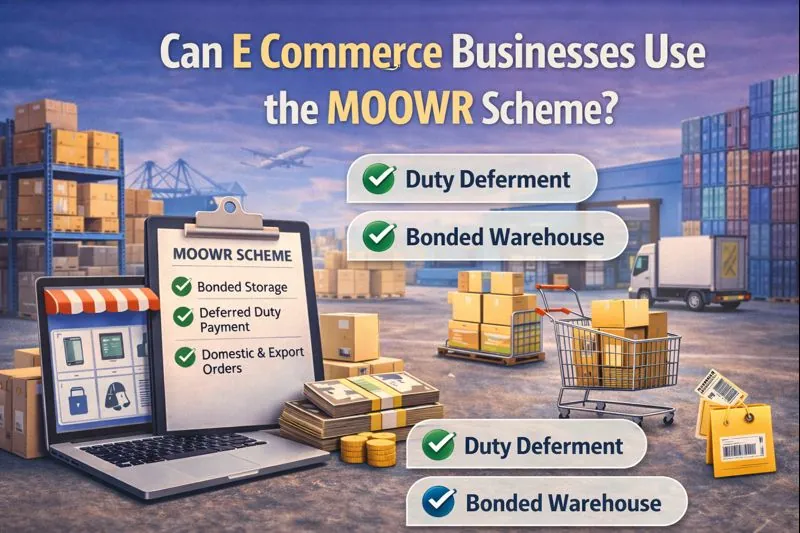
Can E-Commerce Businesses Use the MOOWR Scheme? (2026)
MOOWR for ecommerce works, but only under a condition most guidance omits. Section 65 of the Customs Act, 1962 is a manufacturing and operations scheme. An operator who imports finished goods, stores them, and ships them out unchanged is trading, not manufacturing.
Goods cleared as such attract interest under Section 61(2) once warehoused beyond 90 days. For a marketplace holding slow-moving stock, that interest is the whole economics.
MOOWR for Ecommerce: The 90-Day Interest Rule
Because a Section 65 warehouse also functions as a Section 58 warehouse, the licensee may import goods and clear them as such for home consumption under Section 68. But import duties are then payable along with interest under Section 61(2), as CBIC confirms.
Interest-free deferment attaches to goods consumed in, or emerging from, the Section 65 operation. If your inventory sits untouched for four months before an order arrives, interest has been running for one of them.
How to Make MOOWR for Ecommerce Work
The route is to actually process the goods in bond. Under Section 2(f) of the Central Excise Act, manufacture includes packing or repacking in a unit container, labelling or re-labelling, declaring or altering the retail sale price, and any treatment rendering the product marketable to the consumer.
So bulk-import, then repack into retail units, label with MRP, and kit inside the bonded facility. Those are Section 65 operations. Goods emerging from them carry interest-free deferment. Pure pick-and-pack of already-retail-ready stock does not.
Bonded Labelling Solves a Real Problem
Imported goods whose packaging or labelling does not comply with the Legal Metrology Act, 2009 will not be permitted clearance for home consumption. LMPC registration applies to pre-packaged retail goods.
Performing the labelling and MRP declaration inside the bonded warehouse, before filing the ex-bond Bill of Entry, makes goods compliant without paying duty first. For an importer of consumer goods this is a genuine reason to choose MOOWR.
No Retail Sale from the Warehouse
Goods cannot be sold to a customer directly out of bonded status. They must be cleared for home consumption on an ex-bond Bill of Entry, with duty and IGST paid, before delivery.
That creates an operational question your systems must answer: ex-bond clearance happens per Bill of Entry, while ecommerce fulfilment happens per order. Most operators clear in batches against forecast demand rather than per shipment, which reintroduces the very inventory risk MOOWR was meant to reduce.
Export Orders Clear Duty-Free
Where orders are exported directly from the bonded warehouse under a shipping bill, no import duty is payable on the warehoused goods contained in them. Cross-border sellers shipping out of India benefit most clearly.
Note, though, that RoDTEP and duty drawback are unavailable on goods manufactured wholly or partly in a Section 65 warehouse, and the licence attaches to the facility.
When FTWZ Fits Better
MOOWR for ecommerce is aimed at manufacturing and processing, and may not suit a business engaged purely in trade or warehousing. A Free Trade Warehousing Zone is built for storage, repacking, kitting, labelling, and re-export.
An FTWZ is treated as outside the customs territory, permits foreign-currency billing, and allows re-export without ever attracting Indian customs duty. Many importers run domestic stock through a bonded warehouse, hold export and regional inventory in an FTWZ, and reserve MOOWR for genuine processing.
Systems and Records
Item-level traceability is not optional for MOOWR for ecommerce. Accounts of receipt, processing, and removal are maintained in the form at Annexure B and furnished digitally to the bond officer monthly under Regulation 17. Physical stock must reconcile against those accounts at all times.
Your ERP must segregate bonded from non-bonded stock, attribute duty liability per SKU, and support ex-bond Bill of Entry filing. For high-SKU-count catalogues this accounting discipline, not the customs permission, is the binding constraint.
How JPARKS INDIA Helps
At JPARKS INDIA, we assess whether your ecommerce operation constitutes processing for Section 65 purposes, model the Section 61(2) interest exposure on goods you would clear as such, and compare MOOWR against an FTWZ or plain bonded warehouse on your actual dwell times and duty rates. We also handle LMPC, BIS, and FSSAI approvals. Having served 500+ importers and exporters, we make the structure fit the business. Learn more about our MOOWR scheme services or book a free consultation.
Frequently Asked Questions
Q1. Can e-commerce businesses use the MOOWR scheme?
Yes, where goods are processed in bond, such as repacking, labelling, or kitting, which qualify as manufacture. An operator importing retail-ready finished goods and clearing them unchanged is trading, and interest applies.
Q2. Is interest payable on unsold e-commerce stock in a MOOWR unit?
If goods are cleared as such without being processed, import duties are payable with interest under Section 61(2), which accrues beyond 90 days of warehousing.
Q3. Can I sell directly to customers from a bonded warehouse?
No. Goods must be cleared for home consumption on an ex-bond Bill of Entry, with duty and IGST paid, before delivery to the customer.
Q4. Is FTWZ better than MOOWR for e-commerce?
Often, for pure storage and distribution. An FTWZ is treated as outside the customs territory, is purpose-built for warehousing, repacking, and re-export, and permits foreign-currency billing. MOOWR is aimed at manufacturing and processing.
Q5. Do export orders from a MOOWR unit attract duty?
No. On export under a shipping bill, no import duty is payable on the warehoused goods contained in the resultant product. But RoDTEP and duty drawback are unavailable.
Tell us where you are stuck. We usually reply the same business day.
5.0 ★ · 123 Google reviews · Since 1990
Posted on Google
Vandana Bajaj
Trustindex verifies that the original source of the review is Google.
Very prompt and reliable service by Rahul Kolge and his team. Exceptional and happy experience.
Posted on Google
Supriya Shetye
Trustindex verifies that the original source of the review is Google.
Had a really good experience with JParks India. Rahul sir helped me a lot with my import work and were always active and responsive. Whatever documents or guidance was needed, they handled everything smoothly and explained things clearly. Felt stress-free throughout the process. Very helpful team, definitely recommend them if you’re doing import or export.
Posted on Google
dipali sakpal
Trustindex verifies that the original source of the review is Google.
Very nice people, get the work done in a very short time.
Posted on Google
Satish Bajaj
Trustindex verifies that the original source of the review is Google.
Excellent & Prompt services in all Import Export matters.
Great to work with you
Posted on Google
Bajaj VCPL
Trustindex verifies that the original source of the review is Google.
It was a great experience having work with you.
Posted on Google
Satish Bajaj
Trustindex verifies that the original source of the review is Google.
"Outstanding professiona services, efficient, and gets things done incredibly fast. Highly recommended for anyone needing reliable and prompt assistance
Posted on Google
Nishat fatima
Trustindex verifies that the original source of the review is Google.
excellent service
Posted on Google
farhan sayed
Trustindex verifies that the original source of the review is Google.
JParks Team is Super helpful! Thanks to Rahul and team!
Posted on Google
Sadik Inamdar
Trustindex verifies that the original source of the review is Google.
Good and personal service for import export code
Posted on Google
Maheshwar
Trustindex verifies that the original source of the review is Google.
Had a really good experience with JParks India. Rahul sir helped me a lot with my import work and were always active and responsive. Whatever documents or guidance was needed, they handled everything smoothly and explained things clearly. Felt stress-free throughout the process. Very helpful team, definitely recommend them if you’re doing import or export.
Verified by Trustindex
Trustindex verified badge is the Universal Symbol of Trust. Only the greatest companies can get the verified badge who has a review score above 4.5, based on customer reviews over the past 12 months. Read more
We use cookies to run this site, measure traffic, and track our ads. Essential cookies are always on. Accept all, reject non-essential, or set your preferences.
Cookie Preferences
Manage your cookie preferences below:
Essential cookies enable basic functions and are necessary for the proper function of the website.
Name
Description
Duration
Cookie Preferences
This cookie is used to store the user's cookie consent preferences.
30 days
Google reCAPTCHA helps protect websites from spam and abuse by verifying user interactions through challenges.
Name
Description
Duration
_GRECAPTCHA
Google reCAPTCHA sets a necessary cookie (_GRECAPTCHA) when executed for the purpose of providing its risk analysis.
179 days
Google Tag Manager simplifies the management of marketing tags on your website without code changes.
Name
Description
Duration
cookiePreferences
Registers cookie preferences of a user
2 years
td
Registers statistical data on users' behaviour on the website. Used for internal analytics by the website operator.
session
Statistics cookies collect information anonymously. This information helps us understand how visitors use our website.
Google Analytics is a web analytics service that tracks and reports website traffic. It collects anonymized data on how visitors use the site to help us understand and improve performance.