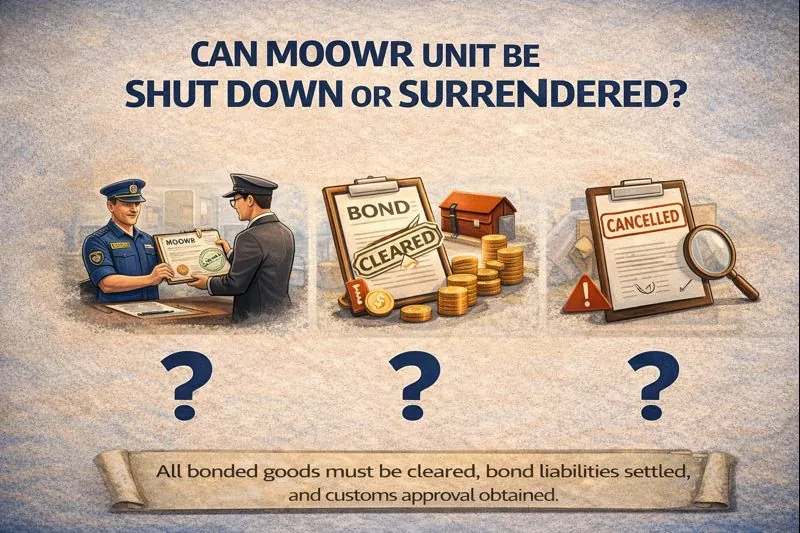
Can a MOOWR Unit Be Shut Down or Surrendered? (2026)
Yes, a MOOWR surrender is permitted, and the procedure is defined under the Customs Act, 1962. Because a Section 65 unit is also licensed as a private bonded warehouse under Section 58, surrender follows the Private Warehouse Licensing Regulations, 2016. A written request to the Principal Commissioner or Commissioner of Customs starts the process.
Before you plan an exit, understand the number that catches most units out. No depreciation is allowed on capital goods.
The Depreciation Trap at Exit
This is the most expensive fact in the whole exit calculation, and it is widely misunderstood. CBIC has confirmed that depreciation is not available where imported capital goods on which duty was deferred are cleared for home consumption after use in a Section 65 warehouse.
You pay duty on the original assessed value of the machinery, not its depreciated value, however long it has been running. Compare IGCR, where capital goods cleared after use attract duty on the depreciated value computed on a straight line basis. MOOWR offers no such relief.
MOOWR Surrender: The Step-by-Step Process
The sequence is straightforward but unforgiving on timing:
Reconcile stock against your prescribed accounts, covering inputs, work in progress, finished goods, scrap, and capital goods.
File all outstanding returns. A missing monthly return will stall the application.
Dispose of bonded inventory before surrender, by export, transfer to another bonded warehouse, or clearance for home consumption on payment of duty.
Submit the written surrender application to the Principal Commissioner or Commissioner of Customs, with inventory schedules, duty computation, and board approval.
Undergo customs verification of stock and records.
Settle the bond. The Section 59 triple duty bond must be discharged, along with any duty, interest, or penalty outstanding.
Export Before You Surrender, Not After
If any bonded goods are intended for export, that export must be completed before the MOOWR surrender takes effect. Once the licence is gone, the duty-free export route closes and the remaining stock can only be cleared on payment of duty.
This single sequencing error is one of the most common and costly mistakes in a MOOWR exit.
Rate of Duty on Exit Clearance
Under Section 15, the rate of duty and tariff value applicable on clearance from a bonded warehouse is the rate in force on the date the Bill of Entry for home consumption is presented under Section 68.
The value is the value assessed on the into-bond Bill of Entry when the goods were originally warehoused. Where goods are cleared as such, without having been put to manufacture, interest under Section 61(2) also applies.
If Customs Cancels the Licence Instead
Cancellation is a different route from MOOWR surrender, with a hard deadline. Where a licence issued under Section 57, 58, or 58A is cancelled by CBIC, the warehoused goods must be removed within seven days of the cancellation order being served, or such extended period as the proper officer allows.
Goods may go to another warehouse, be cleared for home consumption, or be exported. The warehousing provisions continue to apply to those goods until they are removed. Cancellation itself requires notice and a hearing under Section 58B.
GST and Records After Exit
MOOWR governs customs duty, but GST obligations continue. Once goods are ex-bonded and sold in India they become ordinary taxable supplies. Update invoicing, returns, and tax codes from the exit date, and keep the premises registered as a place of business until all stock has moved.
Retain your records after cancellation. Reconciled accounts, ex-bond Bills of Entry, and duty payment evidence should be archived for the period required by law.
Plan the Exit Early
A clean MOOWR surrender takes roughly eight to ten weeks. Begin with stock verification and back-filing of returns, then submit the application with reconciliations six to eight weeks out, and use the final weeks for customs verification, ex-bond Bills of Entry, duty payment, and completing exports or transfers.
How JPARKS INDIA Manages MOOWR Exits
At JPARKS INDIA, we run MOOWR debonding end to end. We reconcile physical stock against the prescribed accounts, clear outstanding returns, compute the exit duty including the capital goods position, sequence exports ahead of surrender, prepare the application, and pursue bond cancellation. Having served 500+ importers and exporters, we close bonded facilities without surprises. Learn more about our MOOWR scheme services or book a free consultation.
Frequently Asked Questions
Q1. Can a MOOWR unit be surrendered voluntarily?
Yes. A licensee may surrender the licence by written request to the Principal Commissioner or Commissioner of Customs. The licence is cancelled subject to payment of all dues and clearance of remaining bonded goods.
Q2. Is depreciation allowed on capital goods when exiting MOOWR?
No. Depreciation is not available where imported capital goods on which duty was deferred are cleared for home consumption after use in a Section 65 warehouse. Duty falls due on the original assessed value.
Q3. Can I export bonded stock after surrendering the licence?
No. Any intended export must be completed before the licence is surrendered. Afterwards the remaining stock can only be cleared on payment of duty.
Q4. What happens if customs cancels the MOOWR licence?
The warehoused goods must be removed within seven days of the cancellation order being served, or an extended period allowed by the proper officer, either to another warehouse, for home consumption, or for export.
Q5. Which bond must be discharged at exit?
The triple duty bond executed under Section 59, in the format at Annexure C of Circular No. 34/2019-Customs. It must be settled along with any outstanding duty, interest, or penalty.
Tell us where you are stuck. We usually reply the same business day.
5.0 ★ · 123 Google reviews · Since 1990
Posted on Google
Vandana Bajaj
Trustindex verifies that the original source of the review is Google.
Very prompt and reliable service by Rahul Kolge and his team. Exceptional and happy experience.
Posted on Google
Supriya Shetye
Trustindex verifies that the original source of the review is Google.
Had a really good experience with JParks India. Rahul sir helped me a lot with my import work and were always active and responsive. Whatever documents or guidance was needed, they handled everything smoothly and explained things clearly. Felt stress-free throughout the process. Very helpful team, definitely recommend them if you’re doing import or export.
Posted on Google
dipali sakpal
Trustindex verifies that the original source of the review is Google.
Very nice people, get the work done in a very short time.
Posted on Google
Satish Bajaj
Trustindex verifies that the original source of the review is Google.
Excellent & Prompt services in all Import Export matters.
Great to work with you
Posted on Google
Bajaj VCPL
Trustindex verifies that the original source of the review is Google.
It was a great experience having work with you.
Posted on Google
Satish Bajaj
Trustindex verifies that the original source of the review is Google.
"Outstanding professiona services, efficient, and gets things done incredibly fast. Highly recommended for anyone needing reliable and prompt assistance
Posted on Google
Nishat fatima
Trustindex verifies that the original source of the review is Google.
excellent service
Posted on Google
farhan sayed
Trustindex verifies that the original source of the review is Google.
JParks Team is Super helpful! Thanks to Rahul and team!
Posted on Google
Sadik Inamdar
Trustindex verifies that the original source of the review is Google.
Good and personal service for import export code
Posted on Google
Maheshwar
Trustindex verifies that the original source of the review is Google.
Had a really good experience with JParks India. Rahul sir helped me a lot with my import work and were always active and responsive. Whatever documents or guidance was needed, they handled everything smoothly and explained things clearly. Felt stress-free throughout the process. Very helpful team, definitely recommend them if you’re doing import or export.
Verified by Trustindex
Trustindex verified badge is the Universal Symbol of Trust. Only the greatest companies can get the verified badge who has a review score above 4.5, based on customer reviews over the past 12 months. Read more
We use cookies to run this site, measure traffic, and track our ads. Essential cookies are always on. Accept all, reject non-essential, or set your preferences.
Cookie Preferences
Manage your cookie preferences below:
Essential cookies enable basic functions and are necessary for the proper function of the website.
Name
Description
Duration
Cookie Preferences
This cookie is used to store the user's cookie consent preferences.
30 days
Google reCAPTCHA helps protect websites from spam and abuse by verifying user interactions through challenges.
Name
Description
Duration
_GRECAPTCHA
Google reCAPTCHA sets a necessary cookie (_GRECAPTCHA) when executed for the purpose of providing its risk analysis.
179 days
Google Tag Manager simplifies the management of marketing tags on your website without code changes.
Name
Description
Duration
cookiePreferences
Registers cookie preferences of a user
2 years
td
Registers statistical data on users' behaviour on the website. Used for internal analytics by the website operator.
session
Statistics cookies collect information anonymously. This information helps us understand how visitors use our website.
Google Analytics is a web analytics service that tracks and reports website traffic. It collects anonymized data on how visitors use the site to help us understand and improve performance.