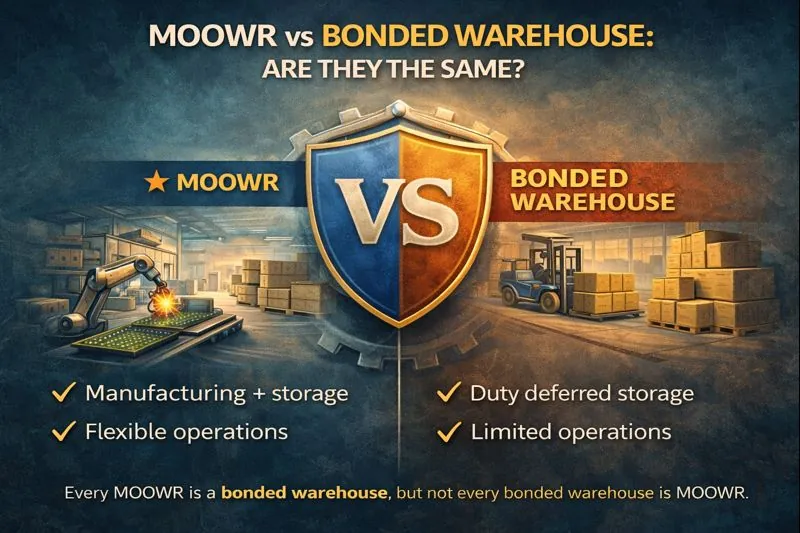
MOOWR vs Bonded Warehouse: Are They the Same? (2026)
In the MOOWR vs bonded warehouse question, the relationship is nested rather than parallel. Every MOOWR unit is a bonded warehouse. Not every bonded warehouse is a MOOWR unit. A bonded warehouse is licensed under Section 58 of the Customs Act, 1962. MOOWR adds a permission under Section 65 to carry out manufacture and other operations on the warehoused goods.
The difference that matters commercially is not manufacturing permission. It is Section 61, which governs how long goods may stay and when interest starts running.
MOOWR vs Bonded Warehouse: The Section 61 Divide
In an ordinary bonded warehouse, goods may remain for one year from the order under Section 60. Critically, interest accrues on the deferred duty once goods have been stored beyond 90 days, under Section 61(2).
In a warehouse where operations are permitted under Section 65, the position changes entirely. Capital goods may remain until their clearance from the warehouse. Other goods may remain until their consumption or clearance. There is no fixed period, and no interest liability on the deferred duty.
What a Bonded Warehouse Allows
A Section 58 private bonded warehouse permits storage of imported goods without immediate payment of customs duty. Permitted activities are limited to storage and light operations such as sorting, repacking, and labelling, which do not amount to manufacture.
The practical advantage is batch-wise clearance. You file an ex-bond bill of entry for the quantity you want to release and pay duty on that portion only, keeping the rest duty-deferred.
What MOOWR Adds
MOOWR, operationalised through the Manufacture and Other Operations in Warehouse (No. 2) Regulations, 2019, permits full manufacturing, assembly, testing, repair, and packaging inside the bonded premises.
Duty is deferred on inputs and capital goods alike, with no interest. Goods exported carry no duty at all. Duty on capital goods falls due only when they are cleared into the domestic market, and they may be exported after use under Section 69 without payment of duty.
A Section 65 Unit Is Still a Section 58 Warehouse
This is the nuance most MOOWR vs bonded warehouse guides miss. Because a warehouse operating under Section 65 also functions as a warehouse licensed under Section 58, the licensee can import goods and clear them as such for home consumption under Section 68, or export them under Section 69.
But when goods are cleared as such, without being put to manufacture, interest under Section 61(2) applies. The interest-free treatment attaches to goods consumed in or cleared from the manufacturing operation, not to pure storage in the same premises.
MOOWR vs Bonded Warehouse: Duty Treatment Compared
Both structures defer duty, but the terms diverge:
Storage period. Bonded warehouse, one year. MOOWR unit, until consumption or clearance.
Interest. Bonded warehouse, accrues after 90 days. MOOWR unit, none on warehoused goods used in operations.
Operations. Bonded warehouse, storage and light handling. MOOWR unit, full manufacture and other operations.
Coverage. Bonded warehouse, imported goods for storage. MOOWR unit, inputs, consumables, spares, and capital goods.
Export obligation. Neither imposes one.
Bond and Compliance in Both
Both require a bond under Section 59 in a sum equal to thrice the duty assessed, binding the importer to comply with the Act, pay duties and interest under Section 61(2), and pay any fines or penalties. The provisions sit in Chapter IX, published by CBIC.
A MOOWR unit carries additional obligations: digital accounts of receipt and removal furnished to the bond officer monthly under Regulation 17, a warehouse keeper with customs experience, and input-output norms declared by the licensee.
Which One Do You Need?
The MOOWR vs bonded warehouse decision turns on what you do with the goods. Choose an ordinary bonded warehouse if you import finished goods for resale, want to release them in batches as demand arrives, and expect to clear them within a year. The 90-day interest trigger is the cost to watch.
Choose MOOWR if you will manufacture, assemble, or process the imported goods, hold capital goods for years, or need duty deferment without interest and without a clearance deadline.
How JPARKS INDIA Helps
At JPARKS INDIA, we advise on whether a Section 58 licence alone suits your operation or whether a combined Section 58 and Section 65 permission is worth the compliance load. We prepare the application, structure the Section 59 bond, set up the Regulation 17 digital records, and keep the facility audit-ready. Having served 500+ importers and exporters, we make bonded operations work. Learn more about our MOOWR scheme services or book a free consultation.
Frequently Asked Questions
Q1. Is MOOWR the same as a bonded warehouse?
No. Every MOOWR unit is a bonded warehouse licensed under Section 58, but MOOWR adds a Section 65 permission to carry out manufacture and other operations on the warehoused goods.
Q2. How long can goods stay in a bonded warehouse?
Ordinarily one year from the order under Section 60, with extensions possible. In a Section 65 warehouse, capital goods may remain until clearance and other goods until consumption or clearance, with no fixed period.
Q3. Is interest payable in a bonded warehouse?
Yes. Under Section 61(2), interest accrues on the deferred duty once goods remain beyond 90 days. A MOOWR unit does not attract interest on goods used in its manufacturing operations.
Q4. Can you manufacture in an ordinary bonded warehouse?
No. Only storage and light operations such as sorting, repacking, and labelling are permitted. Manufacture requires a Section 65 permission under the MOOWR Regulations, 2019.
Q5. Can a MOOWR unit store goods without manufacturing them?
Yes, because it also functions as a Section 58 warehouse. But goods cleared as such without being put to manufacture attract interest under Section 61(2).
Tell us where you are stuck. We usually reply the same business day.
5.0 ★ · 123 Google reviews · Since 1990
Posted on Google
Vandana Bajaj
Trustindex verifies that the original source of the review is Google.
Very prompt and reliable service by Rahul Kolge and his team. Exceptional and happy experience.
Posted on Google
Supriya Shetye
Trustindex verifies that the original source of the review is Google.
Had a really good experience with JParks India. Rahul sir helped me a lot with my import work and were always active and responsive. Whatever documents or guidance was needed, they handled everything smoothly and explained things clearly. Felt stress-free throughout the process. Very helpful team, definitely recommend them if you’re doing import or export.
Posted on Google
dipali sakpal
Trustindex verifies that the original source of the review is Google.
Very nice people, get the work done in a very short time.
Posted on Google
Satish Bajaj
Trustindex verifies that the original source of the review is Google.
Excellent & Prompt services in all Import Export matters.
Great to work with you
Posted on Google
Bajaj VCPL
Trustindex verifies that the original source of the review is Google.
It was a great experience having work with you.
Posted on Google
Satish Bajaj
Trustindex verifies that the original source of the review is Google.
"Outstanding professiona services, efficient, and gets things done incredibly fast. Highly recommended for anyone needing reliable and prompt assistance
Posted on Google
Nishat fatima
Trustindex verifies that the original source of the review is Google.
excellent service
Posted on Google
farhan sayed
Trustindex verifies that the original source of the review is Google.
JParks Team is Super helpful! Thanks to Rahul and team!
Posted on Google
Sadik Inamdar
Trustindex verifies that the original source of the review is Google.
Good and personal service for import export code
Posted on Google
Maheshwar
Trustindex verifies that the original source of the review is Google.
Had a really good experience with JParks India. Rahul sir helped me a lot with my import work and were always active and responsive. Whatever documents or guidance was needed, they handled everything smoothly and explained things clearly. Felt stress-free throughout the process. Very helpful team, definitely recommend them if you’re doing import or export.
Verified by Trustindex
Trustindex verified badge is the Universal Symbol of Trust. Only the greatest companies can get the verified badge who has a review score above 4.5, based on customer reviews over the past 12 months. Read more
We use cookies to run this site, measure traffic, and track our ads. Essential cookies are always on. Accept all, reject non-essential, or set your preferences.
Cookie Preferences
Manage your cookie preferences below:
Essential cookies enable basic functions and are necessary for the proper function of the website.
Name
Description
Duration
Cookie Preferences
This cookie is used to store the user's cookie consent preferences.
30 days
Google reCAPTCHA helps protect websites from spam and abuse by verifying user interactions through challenges.
Name
Description
Duration
_GRECAPTCHA
Google reCAPTCHA sets a necessary cookie (_GRECAPTCHA) when executed for the purpose of providing its risk analysis.
179 days
Google Tag Manager simplifies the management of marketing tags on your website without code changes.
Name
Description
Duration
cookiePreferences
Registers cookie preferences of a user
2 years
td
Registers statistical data on users' behaviour on the website. Used for internal analytics by the website operator.
session
Statistics cookies collect information anonymously. This information helps us understand how visitors use our website.
Google Analytics is a web analytics service that tracks and reports website traffic. It collects anonymized data on how visitors use the site to help us understand and improve performance.