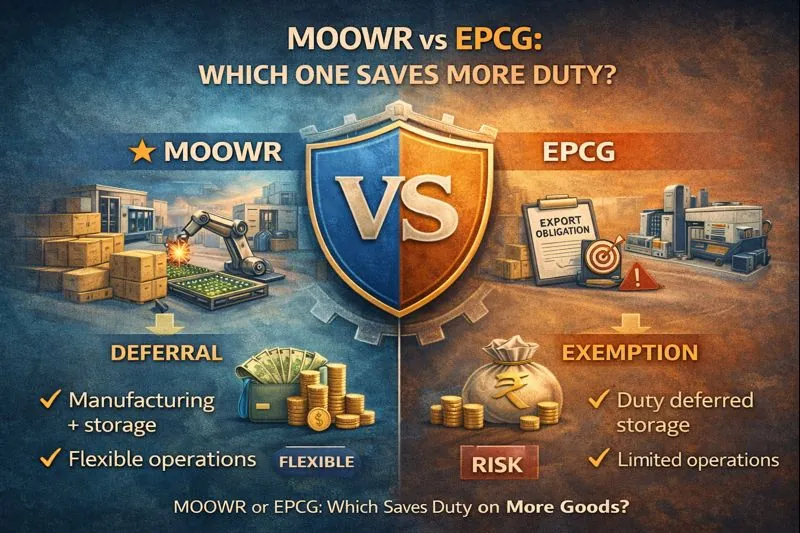
The honest answer to MOOWR vs EPCG is that neither always saves more. MOOWR defers duty on both inputs and capital goods under Sections 58 and 65 of the Customs Act, 1962, with no export obligation. EPCG exempts duty on capital goods only, in exchange for exporting six times the duty saved within six years.
The decisive factor is your export ratio, because a MOOWR unit permanently forfeits RoDTEP and duty drawback. An EPCG holder does not.
MOOWR vs EPCG: The Core Difference
EPCG is a Foreign Trade Policy scheme under Chapter 5, administered by the DGFT. It grants upfront exemption of customs duty on capital goods, conditional on a future export performance.
MOOWR is a Customs Act scheme. It defers duty on everything warehoused, inputs and machinery alike, with no export commitment. Duty is waived only if the goods are exported, and becomes payable if they are cleared into the domestic market.
What EPCG Actually Demands
The EPCG obligation is heavier than most summaries admit. There are two obligations running simultaneously:
Specific Export Obligation. Export goods worth six times the duty saved, within six years of authorisation. Domestic sourcing of the machinery reduces this to 4.5 times.
Average Export Obligation. Separately maintain the average export turnover of the preceding three financial years, every year, for the same or similar products.
Block-wise fulfilment. At least 50 per cent of the specific obligation must be met in the first four years, the balance in years five and six.
Actual user condition. Capital goods cannot be transferred until the obligation is discharged.
Default cost. Failure attracts recovery of the duty saved plus interest, commonly 15 per cent per annum.
What MOOWR Actually Gives
MOOWR imposes no export obligation, no average turnover test, and no time limit on warehousing. Duty is deferred with no interest liability. The coverage is wider: raw materials, consumables, spares, and capital goods all qualify.
A MOOWR unit may sell 100 per cent domestically, paying the deferred duty on the inputs contained in goods cleared for home consumption. Duty on capital goods falls due only when they leave the bonded premises for the domestic market.
The RoDTEP Factor That Decides It
This is where most MOOWR vs EPCG comparisons go wrong, including the common claim that MOOWR always saves more. Goods manufactured wholly or partly in a Section 65 warehouse are ineligible for RoDTEP, and duty drawback is unavailable on them.
Unlike SEZ and EOU, there is no provision for future inclusion of MOOWR units in RoDTEP. An EPCG holder keeps both benefits. For a high-export unit, the RoDTEP and drawback stream can exceed the value of deferring duty on machinery.
MOOWR vs EPCG: Which Saves More Duty?
For an import-intensive unit selling mainly into the domestic market, MOOWR usually wins. It defers duty on inputs as well as machinery, carries no export obligation, and the deferment is interest-free and open-ended.
For a committed exporter, the calculation flips. EPCG waives duty on machinery outright, and the unit retains RoDTEP and drawback on every export shipment. Six times the duty saved over six years is achievable for a unit already exporting at scale.
Working Capital and Risk
MOOWR converts a duty payment into a timing benefit. There is no interest, no obligation, and no clawback, but the liability accrues quietly and crystallises on domestic clearance or exit.
EPCG converts a duty payment into an export commitment. The saving is real and permanent if the obligation is met, and expensive if it is not, since default triggers duty recovery with interest.
Can You Use Both?
Not usefully in the same facility. The MOOWR licence attaches to the factory, so products manufactured there lose RoDTEP regardless of the scheme under which the machinery was imported. Groups sometimes run separate units, keeping export production under EPCG and domestic-facing production under MOOWR.
The Newer Risk in MOOWR
Since the Finance (No.2) Act, 2024, a proviso to Section 65(1) allows the Central Government to notify classes of goods and operations that shall not be permitted in a MOOWR unit. Section 65A, introduced in 2023, provides for withdrawal of the IGST exemption, effective date not yet notified by CBIC. EPCG carries neither exposure.
How JPARKS INDIA Helps You Decide
At JPARKS INDIA, we run the MOOWR vs EPCG numbers on your actual capital goods value, input import volume, export ratio, and domestic sales forecast, including the RoDTEP and drawback forfeiture that most comparisons ignore. Where a split structure is viable, we design it. Having served 500+ importers and exporters, we make the decision quantitative rather than promotional. Learn more about our MOOWR scheme services or book a free consultation.
Frequently Asked Questions
Q1. Which saves more duty, MOOWR or EPCG?
It depends on export ratio. MOOWR usually saves more for domestic-focused, import-intensive units because it covers inputs and machinery with no obligation. EPCG often wins for committed exporters, who keep RoDTEP and drawback that MOOWR units forfeit.
Q2. What is the EPCG export obligation?
Export goods worth six times the duty saved within six years, with at least 50 per cent achieved in the first four years, plus separately maintaining the average export turnover of the preceding three years.
Q3. Does EPCG cover raw materials?
No. EPCG applies only to capital goods, including plant, machinery, equipment, and spares. MOOWR covers raw materials, consumables, spares, and capital goods.
Q4. Can a MOOWR unit claim RoDTEP or drawback?
No. Products manufactured wholly or partly in a Section 65 warehouse are ineligible for RoDTEP, and duty drawback is not available. EPCG holders retain both.
Q5. What happens if I miss the EPCG export obligation?
The duty saved becomes recoverable with interest, commonly at 15 per cent per annum, proportionate to the unfulfilled obligation. Extensions may be sought on payment of composition fees.
Tell us where you are stuck. We usually reply the same business day.
5.0 ★ · 123 Google reviews · Since 1990
Posted on Google
Vandana Bajaj
Trustindex verifies that the original source of the review is Google.
Very prompt and reliable service by Rahul Kolge and his team. Exceptional and happy experience.
Posted on Google
Supriya Shetye
Trustindex verifies that the original source of the review is Google.
Had a really good experience with JParks India. Rahul sir helped me a lot with my import work and were always active and responsive. Whatever documents or guidance was needed, they handled everything smoothly and explained things clearly. Felt stress-free throughout the process. Very helpful team, definitely recommend them if you’re doing import or export.
Posted on Google
dipali sakpal
Trustindex verifies that the original source of the review is Google.
Very nice people, get the work done in a very short time.
Posted on Google
Satish Bajaj
Trustindex verifies that the original source of the review is Google.
Excellent & Prompt services in all Import Export matters.
Great to work with you
Posted on Google
Bajaj VCPL
Trustindex verifies that the original source of the review is Google.
It was a great experience having work with you.
Posted on Google
Satish Bajaj
Trustindex verifies that the original source of the review is Google.
"Outstanding professiona services, efficient, and gets things done incredibly fast. Highly recommended for anyone needing reliable and prompt assistance
Posted on Google
Nishat fatima
Trustindex verifies that the original source of the review is Google.
excellent service
Posted on Google
farhan sayed
Trustindex verifies that the original source of the review is Google.
JParks Team is Super helpful! Thanks to Rahul and team!
Posted on Google
Sadik Inamdar
Trustindex verifies that the original source of the review is Google.
Good and personal service for import export code
Posted on Google
Maheshwar
Trustindex verifies that the original source of the review is Google.
Had a really good experience with JParks India. Rahul sir helped me a lot with my import work and were always active and responsive. Whatever documents or guidance was needed, they handled everything smoothly and explained things clearly. Felt stress-free throughout the process. Very helpful team, definitely recommend them if you’re doing import or export.
Verified by Trustindex
Trustindex verified badge is the Universal Symbol of Trust. Only the greatest companies can get the verified badge who has a review score above 4.5, based on customer reviews over the past 12 months. Read more
We use cookies to run this site, measure traffic, and track our ads. Essential cookies are always on. Accept all, reject non-essential, or set your preferences.
Cookie Preferences
Manage your cookie preferences below:
Essential cookies enable basic functions and are necessary for the proper function of the website.
Name
Description
Duration
Cookie Preferences
This cookie is used to store the user's cookie consent preferences.
30 days
Google reCAPTCHA helps protect websites from spam and abuse by verifying user interactions through challenges.
Name
Description
Duration
_GRECAPTCHA
Google reCAPTCHA sets a necessary cookie (_GRECAPTCHA) when executed for the purpose of providing its risk analysis.
179 days
Google Tag Manager simplifies the management of marketing tags on your website without code changes.
Name
Description
Duration
cookiePreferences
Registers cookie preferences of a user
2 years
td
Registers statistical data on users' behaviour on the website. Used for internal analytics by the website operator.
session
Statistics cookies collect information anonymously. This information helps us understand how visitors use our website.
Google Analytics is a web analytics service that tracks and reports website traffic. It collects anonymized data on how visitors use the site to help us understand and improve performance.