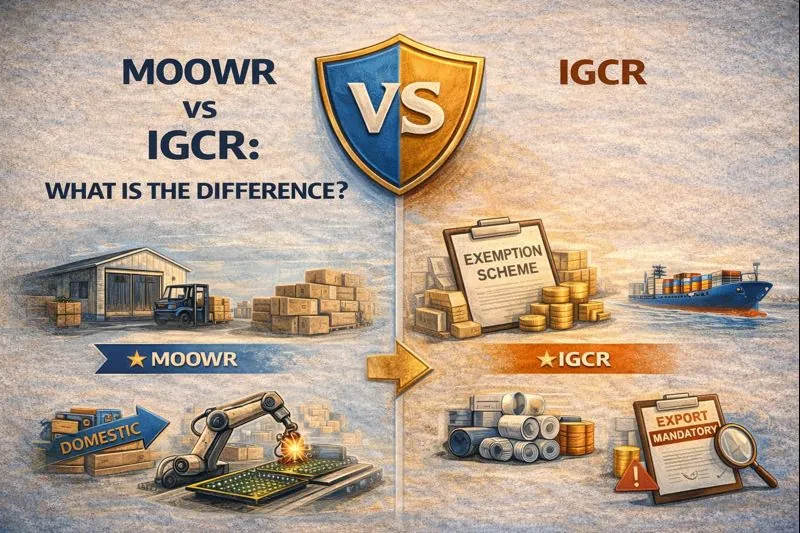
MOOWR vs IGCR: What Is the Difference? (2026 Guide)
The MOOWR vs IGCR comparison is frequently misstated, including the claim that IGCR demands exports. It does not. MOOWR defers customs duty on goods warehoused in a bonded facility under Sections 58 and 65 of the Customs Act, 1962. IGCR grants a concessional or nil rate of duty where imported goods are put to a specified end use under an exemption notification.
The correct framing is deferment versus conditional concession. Neither scheme imposes an export obligation.
IGCR Is an End-Use Scheme, Not an Export Scheme
A core misconception in the MOOWR vs IGCR debate is that IGCR is export-linked. The governing rules are the Customs (Import of Goods at Concessional Rate of Duty or for Specified End Use) Rules, 2022, notified vide Notification 74/2022-Customs (N.T.), and published by CBIC. The title itself makes the point.
In Form IGCR-1, the importer declares the intended purpose by selecting from five options: manufacturing, specified end use, export of goods, supply to an end use recipient, or provision of output service. Export is one permitted purpose among five. The obligation is to use the goods for the declared purpose, not to export them.
IGCR Does Cover Capital Goods
Another common error. Capital goods imported under IGCR may be cleared for home consumption after having been used for the specified purpose, on payment of the differential duty with interest, calculated on the depreciated value using the straight line method.
That provision exists precisely because capital goods fall within the scheme. A full quarter is counted for any part of a quarter when computing depreciation.
MOOWR vs IGCR: How the Duty Benefit Works
The two mechanisms are structurally different:
MOOWR. Duty is deferred, not exempted. It becomes payable when goods are cleared into the domestic market, and is waived on export. No interest accrues.
IGCR. Duty is concessional or nil at import under a notification, conditional on the goods being used for the declared purpose within the prescribed time.
Failure. Under MOOWR, there is nothing to fail; duty simply falls due on domestic clearance. Under IGCR, failure to use goods for the specified purpose triggers recovery of the differential duty with interest, enforced through the bond.
Time Limits and Utilisation
Under IGCR, where the utilisation period is specified in the relevant notification, that period applies. Where it is not specified, a period of six months applies, extendable in certain cases for reasons beyond the importer’s control.
MOOWR imposes no utilisation deadline. Capital goods may remain until clearance, and other goods until consumption or clearance, under Section 61.
MOOWR vs IGCR: Compliance Compared
IGCR requires one-time prior information in Form IGCR-1 to obtain an IGCR Identification Number, a continuity bond with security, and Form IGCR-3 statements. Form IGCR-3A allows immediate re-credit of the bond on confirming consumption, without waiting for the periodic statement. Job work and unit transfers are permitted and must be recorded.
MOOWR requires a Section 59 triple duty bond, digital accounts furnished to the bond officer monthly under Regulation 17, and a warehouse keeper with customs experience. The facility itself must be licensed as a private bonded warehouse.
MOOWR vs IGCR: Which Should You Use?
Use IGCR when a specific exemption notification covers your goods and your intended end use, and you can complete that use within the prescribed period. It requires no bonded facility, no warehouse licence, and no conversion of premises.
Use MOOWR when you need open-ended duty deferment across a broad range of inputs and capital goods, want no utilisation deadline, and are prepared to license the premises as a bonded warehouse. Remember that MOOWR forfeits RoDTEP and duty drawback on goods manufactured there.
Can You Use Both?
In the MOOWR vs IGCR choice, they are not mutually exclusive as schemes, but they attach differently. IGCR attaches to a consignment and a notification. MOOWR attaches to premises. An importer may use IGCR for goods covered by a notification while operating other imports through a separate bonded facility, provided the accounting and bond positions are kept distinct.
How JPARKS INDIA Helps
At JPARKS INDIA, we handle both. We register importers on the IGCR module, obtain the IIN, structure the continuity bond, and file IGCR statements through our IGCR clearance services, and we implement and maintain MOOWR bonded facilities. Where a notification-based concession is cleaner than a warehouse licence, we say so. Having served 500+ importers and exporters, we match the scheme to the operation. Learn more about our MOOWR scheme services or book a free consultation.
Frequently Asked Questions
Q1. What is the difference between MOOWR and IGCR?
MOOWR defers duty on goods warehoused in a licensed bonded facility. IGCR grants concessional or nil duty at import where the goods are used for a specified end use under an exemption notification.
Q2. Does IGCR require exports?
No. IGCR is an end-use scheme. In Form IGCR-1 the importer selects the intended purpose from manufacturing, specified end use, export of goods, supply to an end use recipient, or provision of output service. Export is one option among five.
Q3. Are capital goods covered under IGCR?
Yes. Capital goods used for the specified purpose may be cleared for home consumption on payment of the differential duty with interest, on the depreciated value computed by the straight line method.
Q4. What is the utilisation period under IGCR?
The period stated in the relevant notification applies. Where none is specified, six months applies, extendable in certain cases for reasons beyond the importer’s control.
Q5. Does MOOWR require a bonded warehouse licence?
Yes. The premises must be licensed under Section 58, with permission under Section 65 for manufacture and other operations. IGCR requires no warehouse licence.
Tell us where you are stuck. We usually reply the same business day.
5.0 ★ · 123 Google reviews · Since 1990
Posted on Google
Vandana Bajaj
Trustindex verifies that the original source of the review is Google.
Very prompt and reliable service by Rahul Kolge and his team. Exceptional and happy experience.
Posted on Google
Supriya Shetye
Trustindex verifies that the original source of the review is Google.
Had a really good experience with JParks India. Rahul sir helped me a lot with my import work and were always active and responsive. Whatever documents or guidance was needed, they handled everything smoothly and explained things clearly. Felt stress-free throughout the process. Very helpful team, definitely recommend them if you’re doing import or export.
Posted on Google
dipali sakpal
Trustindex verifies that the original source of the review is Google.
Very nice people, get the work done in a very short time.
Posted on Google
Satish Bajaj
Trustindex verifies that the original source of the review is Google.
Excellent & Prompt services in all Import Export matters.
Great to work with you
Posted on Google
Bajaj VCPL
Trustindex verifies that the original source of the review is Google.
It was a great experience having work with you.
Posted on Google
Satish Bajaj
Trustindex verifies that the original source of the review is Google.
"Outstanding professiona services, efficient, and gets things done incredibly fast. Highly recommended for anyone needing reliable and prompt assistance
Posted on Google
Nishat fatima
Trustindex verifies that the original source of the review is Google.
excellent service
Posted on Google
farhan sayed
Trustindex verifies that the original source of the review is Google.
JParks Team is Super helpful! Thanks to Rahul and team!
Posted on Google
Sadik Inamdar
Trustindex verifies that the original source of the review is Google.
Good and personal service for import export code
Posted on Google
Maheshwar
Trustindex verifies that the original source of the review is Google.
Had a really good experience with JParks India. Rahul sir helped me a lot with my import work and were always active and responsive. Whatever documents or guidance was needed, they handled everything smoothly and explained things clearly. Felt stress-free throughout the process. Very helpful team, definitely recommend them if you’re doing import or export.
Verified by Trustindex
Trustindex verified badge is the Universal Symbol of Trust. Only the greatest companies can get the verified badge who has a review score above 4.5, based on customer reviews over the past 12 months. Read more
We use cookies to run this site, measure traffic, and track our ads. Essential cookies are always on. Accept all, reject non-essential, or set your preferences.
Cookie Preferences
Manage your cookie preferences below:
Essential cookies enable basic functions and are necessary for the proper function of the website.
Name
Description
Duration
Cookie Preferences
This cookie is used to store the user's cookie consent preferences.
30 days
Google reCAPTCHA helps protect websites from spam and abuse by verifying user interactions through challenges.
Name
Description
Duration
_GRECAPTCHA
Google reCAPTCHA sets a necessary cookie (_GRECAPTCHA) when executed for the purpose of providing its risk analysis.
179 days
Google Tag Manager simplifies the management of marketing tags on your website without code changes.
Name
Description
Duration
cookiePreferences
Registers cookie preferences of a user
2 years
td
Registers statistical data on users' behaviour on the website. Used for internal analytics by the website operator.
session
Statistics cookies collect information anonymously. This information helps us understand how visitors use our website.
Google Analytics is a web analytics service that tracks and reports website traffic. It collects anonymized data on how visitors use the site to help us understand and improve performance.