What Manufacturing Operations Are Allowed Under MOOWR? (2026)
MOOWR manufacturing operations are far broader than most guidance suggests. Section 65 of the Customs Act, 1962 permits manufacture and other operations in relation to warehoused goods, and it contains no words of qualification or limitation regarding the nature of the goods or the activity involved.
That is not an interpretation. It is the express holding of the Delhi High Court in ACME Heergarh Powertech, which rejected the argument that Section 65 is confined to a particular genre of goods or manufacturing.
MOOWR Manufacturing Operations Are Not a Closed List
Section 65 uses the word goods, which includes all kinds of goods: raw materials, components, consumables, and capital goods. The phrase manufacturing process or other operations is deliberately wide.
The Court held that reading Section 65 to cover only capital goods that themselves undergo a process of manufacture, or that are consumed in the resultant product, would place an extremely narrow construction on the statutory language. Neither Section 61 nor Section 65 incorporates an implied exclusion for any particular industry.
What In Relation To Actually Means
The expression in relation to, used in Section 65, conveys comprehensiveness. It suggests a causal link between the imported goods and the manufacturing activity undertaken in the warehouse.
Capital goods need not transform themselves. They need only be connected to, or contribute to, the manufacturing process or operations in the warehouse. This is why machinery installed and used inside a bonded facility qualifies, even though the machine itself never becomes part of the finished goods.
MOOWR Manufacturing Operations in Practice
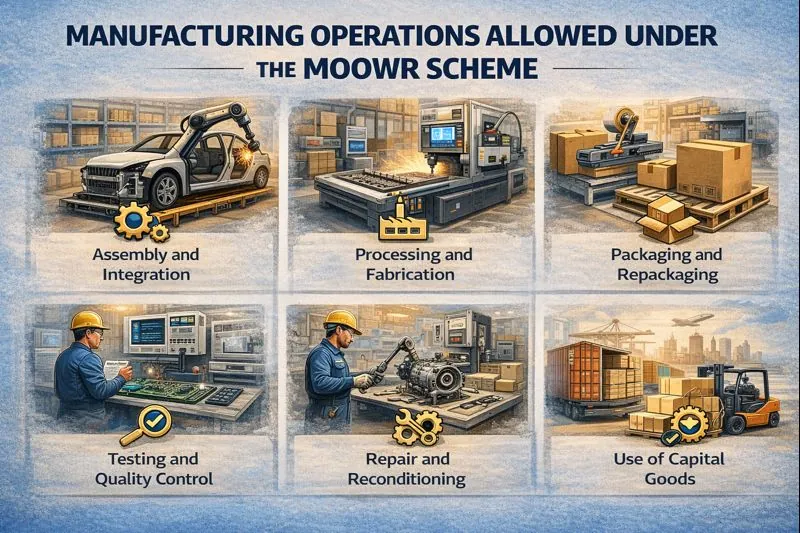
In practice, MOOWR manufacturing operations span the full range of value addition:
Assembly and integration of components and sub-assemblies into finished products, common in electronics and auto components.
Processing, machining, and fabrication transforming imported inputs into new products.
Packaging, repackaging, labelling, and kitting, relevant to distribution-focused units.
Testing, inspection, calibration, and quality control for manufacturing or market readiness.
Repair, refurbishment, and reconditioning of imported goods.
Installation and use of imported capital goods inside the bonded premises without upfront duty.
The Real Restriction: Job Work and Capital Goods
Here is the limit that genuinely bites when planning MOOWR manufacturing operations. Job work is permitted, but only inputs may be sent out to a job worker’s premises.
Imported capital goods cannot be shifted to a job worker. Only tools, moulds, drawings, and similar items may be provided. The main machinery must stay in the bonded facility. Capital goods may, however, be sent outside for repair with the permission of the bond officer.
Declare Your Operations Accurately
The application under Regulation 4 requires the applicant to inform the input-output norms for raw materials and final products, and to report any revision. SION norms do not apply, so you declare your own.
Operating outside the declared scope is a breach of licence conditions and can attract cancellation under Section 58B. The point is not that customs pre-approves a narrow list, but that you must operate within what you declared and report changes.
The Government Can Now Exclude Operations
This changes the picture for MOOWR manufacturing operations going forward. A proviso to Section 65(1), inserted by the Finance (No.2) Act, 2024 and administered by CBIC, empowers the Central Government to notify manufacturing processes and other operations, in relation to a class of goods, that shall not be permitted in a MOOWR unit.
Before that amendment, the breadth of Section 65 was the point, as the Delhi High Court confirmed. Exclusion can now occur by notification. A separate notification effective 17 December 2024 restricts warehousing where electricity is the resultant good.
Scrap, Waste, and Resultant Goods
Duty is payable on the portion of imported inputs attributable to scrap or refuse arising from operations. If scrap is destroyed, no duty is payable. If it is exported, duty is calculated as if the goods were originally imported in that form, on the transaction value of the scrap.
All such activity must be recorded in the prescribed accounts and reflected in the monthly return.
How JPARKS INDIA Helps
At JPARKS INDIA, we scope MOOWR operations correctly at the application stage, declare accurate input-output norms, structure job work within the permitted boundary, and keep the declared activity aligned with what actually happens on the floor. Where the 2024 proviso creates exposure for your class of goods, we say so. Having served 500+ importers and exporters, we keep bonded manufacturing compliant. Learn more about our MOOWR scheme services or book a free consultation.
Frequently Asked Questions
Q1. What manufacturing operations are allowed under MOOWR?
Section 65 contains no words of limitation on the nature of goods or the activity. Assembly, processing, fabrication, packaging, testing, repair, and reconditioning are all undertaken, alongside use of imported capital goods.
Q2. Does MOOWR restrict which industries can apply?
The Delhi High Court in ACME Heergarh Powertech held that Section 65 cannot be read as restricted to a particular genre of goods. However, since 2024 the Central Government may exclude classes of goods and operations by notification.
Q3. Can capital goods be sent to a job worker under MOOWR?
No. Only inputs may be sent for job work. Imported capital goods cannot be shifted to a job worker’s premises, though tools, moulds, and drawings may be. Capital goods can be sent out for repair with the bond officer’s permission.
Q4. What does in relation to mean in Section 65?
It conveys a causal link. Capital goods need not transform themselves, only contribute to or be connected with the manufacturing process or operations carried out in the warehouse.
Q5. Is duty payable on scrap generated in a MOOWR unit?
Yes, on the portion of imported inputs attributable to the scrap. If the scrap is destroyed, no duty is payable. If exported, duty is computed on the transaction value of the scrap as if originally imported in that form.
Tell us where you are stuck. We usually reply the same business day.
5.0 ★ · 123 Google reviews · Since 1990
Posted on Google
Vandana Bajaj
Trustindex verifies that the original source of the review is Google.
Very prompt and reliable service by Rahul Kolge and his team. Exceptional and happy experience.
Posted on Google
Supriya Shetye
Trustindex verifies that the original source of the review is Google.
Had a really good experience with JParks India. Rahul sir helped me a lot with my import work and were always active and responsive. Whatever documents or guidance was needed, they handled everything smoothly and explained things clearly. Felt stress-free throughout the process. Very helpful team, definitely recommend them if you’re doing import or export.
Posted on Google
dipali sakpal
Trustindex verifies that the original source of the review is Google.
Very nice people, get the work done in a very short time.
Posted on Google
Satish Bajaj
Trustindex verifies that the original source of the review is Google.
Excellent & Prompt services in all Import Export matters.
Great to work with you
Posted on Google
Bajaj VCPL
Trustindex verifies that the original source of the review is Google.
It was a great experience having work with you.
Posted on Google
Satish Bajaj
Trustindex verifies that the original source of the review is Google.
"Outstanding professiona services, efficient, and gets things done incredibly fast. Highly recommended for anyone needing reliable and prompt assistance
Posted on Google
Nishat fatima
Trustindex verifies that the original source of the review is Google.
excellent service
Posted on Google
farhan sayed
Trustindex verifies that the original source of the review is Google.
JParks Team is Super helpful! Thanks to Rahul and team!
Posted on Google
Sadik Inamdar
Trustindex verifies that the original source of the review is Google.
Good and personal service for import export code
Posted on Google
Maheshwar
Trustindex verifies that the original source of the review is Google.
Had a really good experience with JParks India. Rahul sir helped me a lot with my import work and were always active and responsive. Whatever documents or guidance was needed, they handled everything smoothly and explained things clearly. Felt stress-free throughout the process. Very helpful team, definitely recommend them if you’re doing import or export.
Verified by Trustindex
Trustindex verified badge is the Universal Symbol of Trust. Only the greatest companies can get the verified badge who has a review score above 4.5, based on customer reviews over the past 12 months. Read more
We use cookies to run this site, measure traffic, and track our ads. Essential cookies are always on. Accept all, reject non-essential, or set your preferences.
Cookie Preferences
Manage your cookie preferences below:
Essential cookies enable basic functions and are necessary for the proper function of the website.
Name
Description
Duration
Cookie Preferences
This cookie is used to store the user's cookie consent preferences.
30 days
Google reCAPTCHA helps protect websites from spam and abuse by verifying user interactions through challenges.
Name
Description
Duration
_GRECAPTCHA
Google reCAPTCHA sets a necessary cookie (_GRECAPTCHA) when executed for the purpose of providing its risk analysis.
179 days
Google Tag Manager simplifies the management of marketing tags on your website without code changes.
Name
Description
Duration
cookiePreferences
Registers cookie preferences of a user
2 years
td
Registers statistical data on users' behaviour on the website. Used for internal analytics by the website operator.
session
Statistics cookies collect information anonymously. This information helps us understand how visitors use our website.
Google Analytics is a web analytics service that tracks and reports website traffic. It collects anonymized data on how visitors use the site to help us understand and improve performance.