Is IEC compulsory in India? Yes, the IEC (Importer Exporter Code) is mandatory for anyone who wants to engage in import or export of goods or services from India, unless specifically exempted. It is a mandatory 10 digit registration issued by the Directorate General of Foreign Trade (DGFT) and serves as the primary authorization for cross border trade.
Whether you are an individual, sole proprietor, partnership firm, company, trust, or any other legal entity, if you wish to import or export goods, you must obtain an IEC. Customs authorities will not clear shipments without a valid IEC, and banks will not process foreign currency transactions for exports or imports unless the IEC is on record.
IEC becomes compulsory at the point you intend to trade, not after your first transaction.
Importing goods: IEC is required for all commercial imports into India, as customs will not clear consignments without it.
Exporting goods: IEC is required for all commercial exports to clear customs and generate shipping bills on ICEGATE. If you have not yet registered for customs filing access, our ICEGATE registration service covers this end to end.
Service exporters: IEC is required for service exporters only when they claim benefits under the Foreign Trade Policy or deal in DGFT specified services. Routine service exports may proceed without it, though banks often request it before processing foreign remittances.
You must hold a valid IEC if you import goods into India for any commercial purpose, export goods from India, receive foreign currency for exported services while claiming Foreign Trade Policy benefits, or sell on international marketplaces like Amazon Global, eBay, or Etsy that require cross border shipping. In each case, customs clearance and trade remittances depend on an active IEC.
If you are unsure whether your situation qualifies, our IEC registration team can confirm your exact requirement before you apply.
This is the most common confusion. Having a GSTIN does not replace your IEC, and having a PAN does not auto generate one. After GST was introduced, your IEC number is issued in the same format as your PAN, but DGFT still issues it separately only after you formally apply on the portal. So yes, even GST registered traders must obtain a distinct IEC before importing or exporting.
A few narrow categories are exempt, and these are tied to the nature of the transaction rather than the product.
| Category | IEC Requirement |
|---|---|
| Central or State Government ministries and departments | Exempt (permanent IEC 0100000011 / 0100000029) |
| Import or export for personal use, not linked to trade, manufacture, or agriculture | Exempt (permanent IEC 0100000053) |
| Notified charitable institutions importing duty exempt relief goods | Permanent IEC 0100000126 |
| Service exporters NOT claiming Foreign Trade Policy benefits | Generally not required |
| Trade with Nepal, Myanmar, or China through specified border ports, single consignment CIF up to Rs. 25,000 | Exempt |
One critical carve out: this exemption does not apply when exporting special chemicals, organisms, materials, equipment, and technologies (SCOMET) listed in Appendix 3 of Schedule 2 of the ITC HS, even for trade with Nepal, Myanmar, or China.
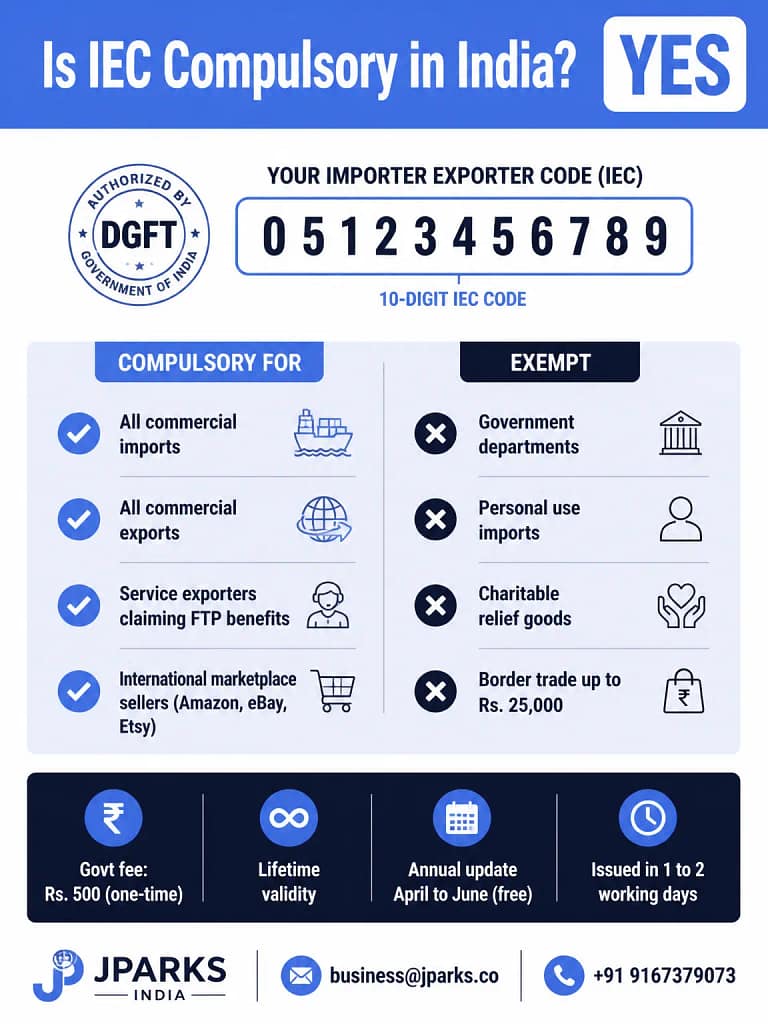
The government fee for a fresh IEC is Rs. 500, paid once on the DGFT portal, and the certificate is typically issued within 1 to 2 working days for error free applications. The IEC carries lifetime validity, so there is no renewal. However, since 2021 it must be confirmed through an annual update between April and June each year. This confirmation is free when no details change, and a modification fee of Rs. 200 applies only if you actually change details. Missing the window deactivates the IEC until you complete the overdue annual update. If your code has already lapsed, see our guide on how to reactivate your IEC.
Without a valid IEC, customs holds your shipment at the port, banks refuse to process your foreign currency payment, and any pending export incentive claims are frozen. In practice this means lost orders, demurrage costs, and cancelled deals, which is why securing your IEC before your first transaction is essential. If you are trading right now without one, our page on whether you can import without an IEC explains the immediate risks in more detail.
For freelancers exporting only services, IEC is not always mandatory. You can often receive foreign payments using PAN, correct RBI purpose codes, and proper export invoices. However, IEC becomes compulsory the moment you ship physical goods, claim Foreign Trade Policy benefits, or when a client or banking partner specifically requires it.
If you miss the annual update window between April and June, your IEC is automatically deactivated. A deactivated IEC means customs will not clear your shipments, banks will not process trade remittances, and pending export incentive claims are frozen. You can reactivate it by completing the overdue update. Our guide on what to do if your IEC is suspended walks through the exact steps.
The government fee for a fresh IEC is Rs. 500, paid once on the DGFT portal. A modification costs Rs. 200, and the annual update is free when no details change. Professional filing assistance is separate and varies by consultant.
Yes. Any individual, sole proprietor, partnership firm, LLP, company, trust, HUF, or society can apply, provided they have a valid PAN, a bank account in the entity name, and a valid address. A sole proprietor can apply on personal PAN and Aadhaar without forming a separate company.
Service exporters generally need IEC only when claiming Foreign Trade Policy benefits or dealing in DGFT specified services. Routine software, consulting, or design exports often proceed without it, though banks may still ask for IEC before crediting foreign remittances.
You need a bank account in the name of the applicant entity to register an IEC, and you must provide a cancelled cheque or bank certificate. The core requirement is a valid bank account matching your IEC details.