IGST Refund Status: 7 Proven Steps to Unblock It in 2026
Table of Contents
IGST refund status is the stage your export refund has reached inside the Indian Customs EDI System, from validation of the shipping bill against your GST return through to the scroll that releases money to your bank. If you exported on payment of IGST and nothing has landed, two enquiry screens tell you exactly where it stopped, and most guides send you to the wrong one.
Nobody at Customs sanctions your claim by hand. Under Rule 96 of the CGST Rules, the shipping bill is itself the refund application, and the system validates it automatically. That is why a clean claim pays in days and a claim with one field out of step sits silently for months.
Everything on this page is checked against the ICEGATE IGST Refund FAQs published by the Directorate General of Systems, the CBIC circulars named in each section, and the judgments cited. Where the widely circulated version of a fact is wrong, this page says so and shows the official position.
This page covers the refund of IGST paid on export of goods, where the shipping bill is the claim. It does not cover the LUT or bond route, where refund of unutilised input tax credit is claimed separately in Form GST RFD-01.
Who This Page Applies To
You will get value from this page if you are:
An exporter who shipped on payment of IGST and the refund has not reached the bank
An exporter whose ICEGATE enquiry shows a response code you do not recognise
A documentation executive reconciling GSTR-1 export invoices against filed shipping bills
An exporter who changed bank account or IFSC and found refunds stopped after that
An ICD exporter whose shipping bills are clean but whose gateway EGM is pending
An exporter carrying an open Rule 96(10) notice and unsure where that now stands
Anyone who has been told their code means one thing and wants the official definition
What IGST Refund Status Actually Means
For goods exported on payment of tax there is no separate refund application. Under Rule 96 of the CGST Rules, the shipping bill is deemed to be the refund application. The system validates it against your GST return, and IGST refund status is simply the point that automated process has reached.
The system does not write to you when it rejects a record. It sets a code and moves on. You have to go and look, which is what the rest of this page is about.
Key related terms
Term
Meaning
ICES
Indian Customs EDI System, the customs system that validates the claim and generates the scroll
ICEGATE
The national trade portal where you check IGST refund status. Now ICEGATE 2.0
EGM
Export General Manifest, filed by the carrier to confirm the goods left India
Gateway EGM
The EGM filed at the gateway port for cargo that started at an ICD
Temporary scroll
The first scroll. The shipping bill is eligible and queued, but not yet payable
Permanent scroll
The final scroll. This is the one that goes to PFMS and pays
PFMS
Public Financial Management System, which validates your bank account before payment
SB000 to SB006
The response codes ICES returns against each shipping bill
Table 6A
The export invoice table in GSTR-1 that ICES matches against your shipping bill
EDPMS
Export Data Processing and Monitoring System, where your export proceeds are tracked
The Four Things That Must Align
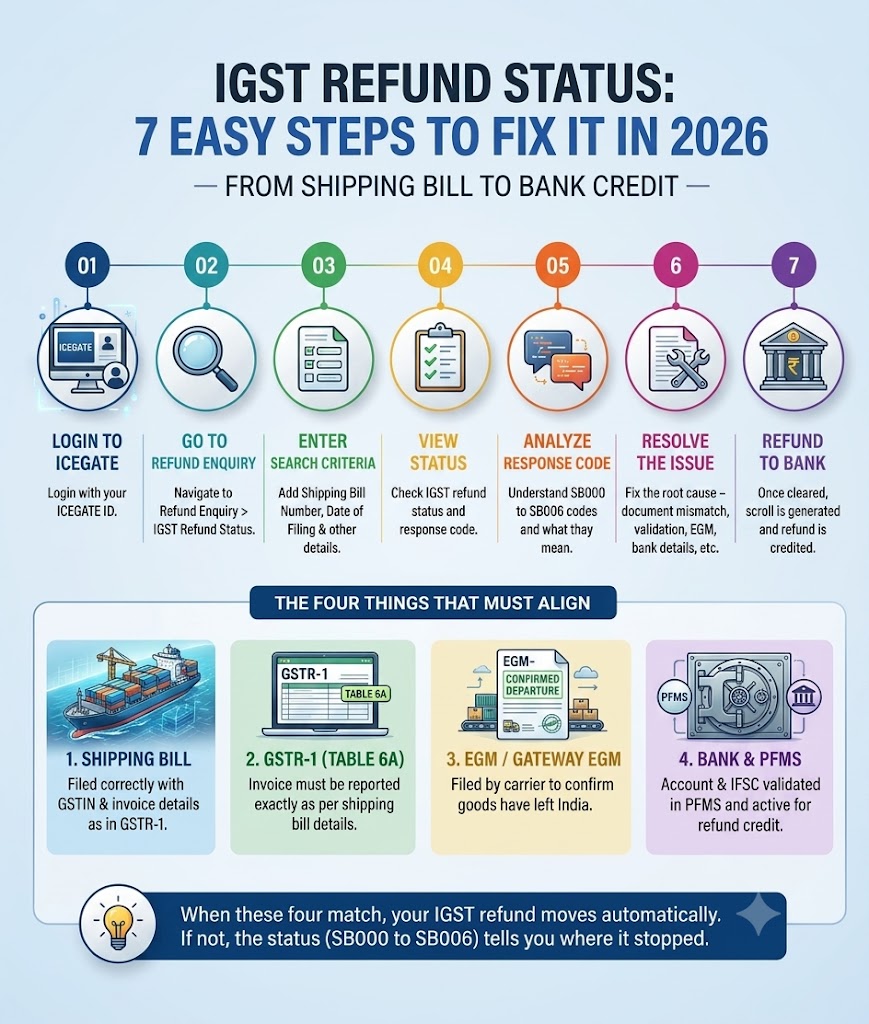
An IGST refund flows only when four records agree. Your IGST refund status is really a report on which of the four is out of step.
The shipping bill. Filed correctly, with the GSTIN and the invoice details exactly as they appear in your GST return.
The EGM. Filed electronically by the carrier. For cargo that starts at an ICD, the gateway EGM has to be filed in ICES at the gateway port. A manually filed gateway EGM does not satisfy the system, and this single point stalls a large share of ICD exports.
GSTR-1 Table 6A and GSTR-3B. The export invoices must carry the shipping bill number and port code exactly as filed, the invoice number must match the shipping bill character for character, and the tax must be shown as paid in GSTR-3B.
A PFMS validated bank account. The account and IFSC registered against your IEC must clear PFMS validation. If they do not, the shipping bill can reach the scroll and still pay nothing.
How to Check IGST Refund Status on ICEGATE in 7 Steps
Two different enquiries do two different jobs here. Confusing them is the single most common reason exporters believe the portal is broken, and most published guides name only one of the two.
Step 1: Log in to ICEGATE 2.0 with your IEC credentials
The refund enquiries sit behind login. If you do not have credentials, ICEGATE registration comes first, and it needs a valid IEC. The legacy portal is retired, so a bookmark to an old enquiry page will not work. Everything runs through ICEGATE 2.0.
Step 2: Open Services, then Enquiries
From the dashboard go to Services, then Enquiries, then the ICEGATE Enquiry Service. Both refund enquiries live inside it.
Step 3: Open IGST Validation Enquiry to read the response code
This is the screen that returns the SB000 to SB006 response code against each shipping bill. The full path is Login 2.0, then dashboard, then Services, then Enquiries, then ICEGATE Enquiry Service, then IGST Validation Enquiry. It is set out at question 18 of the ICEGATE IGST Refund FAQs, which ICEGATE updated in April 2026.
Step 4: Open IGST Scroll Sanctioned Status to see whether money has moved
Same menu, different enquiry, and it is question 19 of the same FAQ. Enter the location code and the shipping bill details and search. A scroll number here means Customs has cleared the claim for payment. Validation and scroll are two separate stages. The scroll screen does not carry the response code, so an exporter who only checks it will never learn why a claim failed.
Step 5: Read the code, then read the absence of a scroll
SB000 means validated. Anything else is a blocker with a specific cause, set out below. A shipping bill sitting at SB000 with no scroll number against it is a different problem entirely, and it has its own section further down.
Step 6: Confirm the gateway EGM position separately
If the cargo moved from an ICD, check the gateway EGM. Gateway EGM pendency is one of the most common reasons an otherwise clean shipping bill sits unpaid. Where it is pending, the shipping line has to file a supplementary EGM at the gateway port.
Step 7: Fix at source, not at the portal
Once you know the code, the correction happens where the data originated. An invoice mismatch is fixed through the customs officer interface at the port. A GSTIN or port code error is fixed on the GST side. Refreshing the ICEGATE screen changes nothing.
Checking the GST Portal Side
Half of all IGST refund failures never reach Customs at all, because the invoice data was never transmitted from GSTN. ICEGATE cannot show you a shipping bill it has not received, so a blank customs enquiry is not proof that Customs is at fault.
On the GST portal, log in and go to Services, then Refunds, then Track status of invoice data to be shared with ICEGATE. Select the financial year and month, and quarterly filers pick the last month of the quarter, then search. This screen reports the transmission status and any validation error raised on the GSTN side before the record left for Customs.
Read the two together. A record that is not transmitted is a GST side fix. A record that is transmitted and carries a customs response code is a customs side fix. A complete IGST refund status check covers both screens, and working the wrong side is how months get lost.
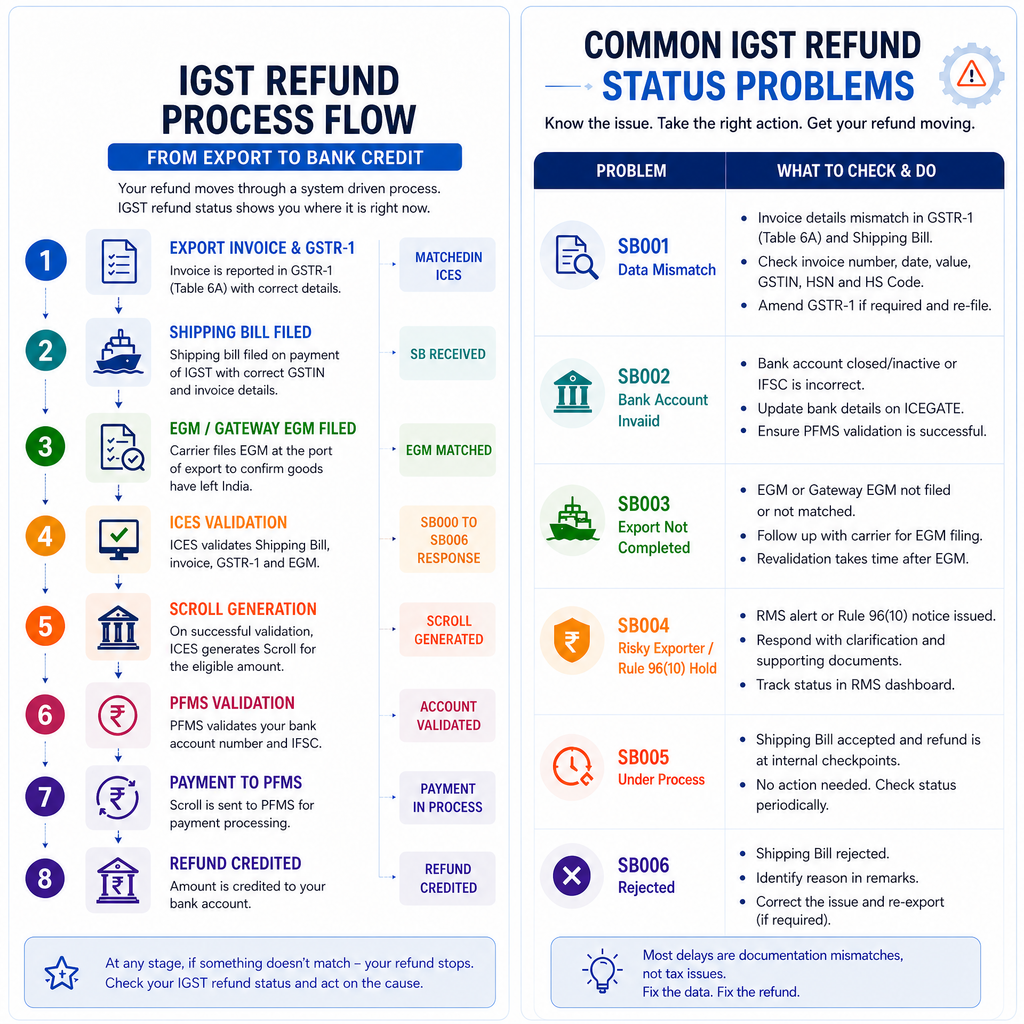
Response Codes From SB000 to SB006
This table is the practical core of any IGST refund status check. The first seven codes are the official ICES validation codes as published by the Directorate General of Systems, and SBV00 is official too. SB009 and SB104 are not in the published ICES code table; both are marked accordingly below. Verified 29-08-2026 against the ICEGATE IGST Refund FAQ of April 2026, the Delhi Customs export FAQ and the DG Systems step by step guide v3.0.
Code
Official meaning
What it takes to clear
SB000
Successfully validated
Nothing. If no money follows, the block is downstream. See the sections below
SB001
Invalid shipping bill details
Correct the shipping bill number, date or port code reported in GSTR-1
SB002
EGM not filed
The carrier files the EGM. For ICD cargo, the gateway EGM must be filed in ICES at the gateway port
SB003
GSTIN mismatch between the shipping bill and the GST return
Correct the GSTIN at source so the two agree. Where the shipping bill cannot be amended, the port of export is approached on the merits
SB004
Record already received, a duplicate transmission from GSTN
Usually no action if the earlier record already validated at SB000. Confirm which record scrolled
SB005
Invalid invoice number
The most common code by far. Permanently rectifiable through the customs officer interface at the port of export
SB006
Gateway EGM not available
Supplementary EGM at the gateway port, filed electronically by the line
SBV00
Shipping bill was already validated successfully
No action. Confirm the scroll position instead
SB104
Port code is not valid
A GST side correction, raised with the GSTN helpdesk. Not part of the official ICES code table but returned in practice
The Three Codes Most Guides Get Wrong
This matters because acting on the wrong definition sends you to the wrong desk. A widely repeated version of this table, which currently feeds several of the top search results and the AI summaries built on them, swaps the meanings of SB001, SB003 and SB005. The official ICEGATE FAQ is unambiguous.
Code
Commonly published, and wrong
Official ICEGATE definition
SB001
Invalid invoice details
Invalid shipping bill details. The shipping bill number, date or port code reported in GSTR-1 does not match
SB003
Rarely listed at all
GSTIN mismatch between the shipping bill and the GST return
SB005
GSTIN mismatch
Invalid invoice number. The invoice number on the shipping bill does not match the one reported in GSTR-1
If you have been chasing a GSTIN correction because someone told you SB005 means a GSTIN mismatch, that is why nothing moved. SB005 is an invoice number problem and it is fixed at the port of export, not with the GSTN helpdesk. fixed at the port of export, not with the GSTN helpdesk.
Fixing SB005, the code that blocks the most money
SB005 is an invoice number mismatch between the shipping bill and GSTR-1, and it is the only code with a permanent statutory fix. Circular No. 05/2021-Customs dated 17 February 2021 made the customs officer interface available for all past shipping bills, irrespective of filing date, on payment of Rs. 1,000 per shipping bill. The document set is not in Circular 05/2021 itself: it comes from Circulars 05/2018-Customs and 08/2018-Customs, which that circular carries forward. The officer needs a self certified copy of GSTR-1 or Table 6A, the corresponding GSTR-3B, and a concordance table tying each shipping bill invoice to the invoice reported in the GST return. The facility is for SB005 alone; it does not extend to any other code.
SB003 is different, and it is worth being precise about it. The officer interface route for GSTIN mismatches came from para 2 of Circular No. 15/2018-Customs, extended by Circular No. 22/2018-Customs dated 18 July 2018 to cases where PAN was quoted in place of GSTIN. Both were date limited. Circular 15/2018-Customs dated 6 June 2018 covered shipping bills filed up to 30 April 2018, and Circular 22/2018-Customs extended that to 30 June 2018. Neither limit has since been lifted. Circular 05/2021 made the interface permanent for SB005 alone. An SB003 case today is corrected at source and taken to the port on the merits.
Temporary Scroll Against Permanent Scroll
Two scrolls exist, and confusing them is why exporters believe a refund has been sanctioned when it has not.
The temporary scroll is generated first. It means the shipping bill is eligible and queued.
The permanent scroll is generated after that, and only the permanent scroll goes to PFMS for payment. Once it is generated, no further action is needed from the sanctioning officer and it transmits automatically, with no separate instruction to the bank.
A shipping bill that appears in the temporary scroll but never in the permanent one almost always has a bank account that has not cleared PFMS validation. Fixing the account registration releases it.
There is one further stage most exporters never hear about. Where PFMS rejects the account after the scroll has been generated, the shipping bill is marked PC, permanently cancelled, in the system and pushed to the SCROLL_PC menu on the dashboard of the customs port officer for re scrolling.
The status remains visible on ICEGATE after login. Correcting the bank registration is what allows the re scroll to happen. Nothing re scrolls on its own, and this is the single most common reason a refund appears to have been sanctioned and then vanishes.
pushed to the SCROLL_PC menu on the dashboard of the customs port officer for re scrolling. The status remains visible on ICEGATE after login. Correcting the bank registration is what allows the re scroll to happen. Nothing re scrolls on its own, and this is the single most common reason a refund appears to have been sanctioned and then vanishes.
PFMS Validation and the Bank Account
PFMS is where a technically perfect claim goes to die, and it is the part exporters have the most direct control over. It is also the reason an IGST refund status can read as sanctioned while the bank shows nothing.
The account registered for refunds and incentives against your IEC on ICEGATE must clear PFMS validation before any scroll can pay. Validation fails for ordinary reasons: the account name does not match the IEC holder exactly, the IFSC changed after a bank merger, the account was closed or converted, or the account was never registered as an export incentive account in the first place.
Three checks worth running before you escalate anything:
Confirm the account and IFSC currently mapped against your IEC on ICEGATE, not the account you assume is mapped
Confirm the IFSC is the post merger code where your bank has been amalgamated. Legacy IFSC codes are a common silent failure
Confirm the AD Code registration at the port of export still points at the same account. A bank change made with the bank alone does not update the customs mapping
Where validation has failed, re-register the account on ICEGATE, confirm PFMS validation has cleared, and then ask the port officer to re-scroll the affected shipping bills from the SCROLL_PC menu. enu.
Why a Validated Shipping Bill Still Shows No Money
SB000 with no payment is the most frustrating IGST refund status of all. There are a limited number of causes.
The export was made under bond or LUT, so it was never eligible for the IGST route
The shipping bill covers several invoices and only some validated, while the rest sit on an error
A higher or composite rate of drawback was claimed on that shipping bill. Circular No. 32/2017-Customs dated 27 July 2017 retained the higher All Industry Rates for the transition window of 1 July to 30 September 2017, against a self declaration that no refund of IGST paid on the export product would be claimed. A shipping bill from that window carrying the higher rate is therefore ineligible for the IGST refund
The IGST claimed on the shipping bill is below Rs. 1,000, which Section 54(14) of the CGST Act excludes from refund
The bank account has not been validated by PFMS
An alert or suspension is running against the IEC in ICES, which holds the refund whatever the response code says
In the first four cases the scroll amount goes to zero automatically and the shipping bill drops out of the scroll. Nothing on the portal tells you which one applies, which is why the shipping bill, the drawback claim and the GST return have to be read together rather than one at a time. to zero automatically and the shipping bill drops out of the scroll.
Nothing on the portal tells you which one applies, which is why the shipping bill, the drawback claim and the GST return have to be read together rather than one at a time.
When the Refund Arrives but the Amount Is Short
A different problem from a blocked claim, and one exporters routinely write off. Where the IGST credited is less than the IGST actually paid, the route depends on why the shortfall arose.
Where the price of the exported goods was revised upward after export and additional IGST was paid on a supplementary invoice or debit note, the refund of that additional tax is claimed in Form GST RFD-01 with your jurisdictional GST officer. Circular No. 226/20/2024-GST dated 11 July 2024 sets out the mechanism.
Until a dedicated category is live on the portal, which was still the position when this was re-checked on 29 August 2026, the claim is filed under “Any other”, with a remark identifying it as a refund of additional IGST paid on upward price revision. It must be filed within two years of the relevant date under clause (a) of Explanation 2 to Section 54.
The claim needs the shipping bill, the original invoices, the contract or document evidencing the revision, the debit note or supplementary invoice, proof of payment of the additional IGST with interest, the FIRC for the additional remittance, a chartered accountant certificate linking the remittance to the revision, and Statements 9A and 9B.
Where the shortfall came instead from a declaration or processing error on the shipping bill itself, note that the Revised Refund Request route under Circular No. 40/2018-Customs dated 24 October 2018 closed for shipping bills filed after 15 November 2018 and has not been reopened.
Circular 26/2019-Customs and Circular 05/2021-Customs extended only the SB005 officer interface, not the Revised Refund Request. Older cases still sitting on a short scroll are pursued with the IGST Refund Cell at the custom house on the merits. A short credit is not the end of the claim.
When the Block Is a Risky Exporter Alert
Not every stalled IGST refund status is a data mismatch. Where the Risk Management Centre for Customs or DGARM flags an exporter as risky, an alert is inserted in the system and the refund scroll is kept in abeyance pending verification. The status screen will not say so in plain language, and in practice exporters find out only when the money never arrives.
Two circulars set the timeframes. Circular No. 16/2019-Customs dated 17 June 2019 requires verification in red flagged cases to be completed within 30 days, with a further 5 working days for the Chief Commissioner to forward the reports to the Risk Management Centre for Customs.
Circular No. 131/1/2020-GST dated 23 January 2020 tightened the process on the GST side: verification is to be completed within 14 working days of the exporter furnishing the prescribed information, and where it is not, the exporter may escalate to the jurisdictional Chief Commissioner, who is to have it completed within a further 7 working days.
Two points matter commercially. First, the alert is not a finding against you, and it is lifted once the No Objection is received. Second, and more useful, being red flagged does not remove your entitlement to interest for the period of the delay.
Rule 96(10): Where It Now Stands
A Rule 96(10) notice is one of the few things that can hold up an IGST refund status even when every code reads clean. The rule restricted the IGST refund route for exporters who had imported inputs under concessional notifications. It was omitted with effect from 8 October 2024 by Notification No. 20/2024-Central Tax, along with Rules 89(4A) and 89(4B), and the omission carried no saving clause.
In M/s Goodluck India Limited v. Union of India, 2026 INSC 821, SLP (C) No. 24550 of 2025, decided on 6 August 2026, the Supreme Court held that the omission applies to proceedings that were still pending, precisely because no saving clause was provided. The Court recorded that the legislature brought in no saving clause and no sunset clause when sub-rule (10) of Rule 96 was omitted. Open notices and unadjudicated demands under the omitted rule are affected.
There is also a route CBIC itself provided a month before the omission. Where the exposure arose because inputs were imported under Notification 78/2017-Customs or 79/2017-Customs without paying IGST and compensation cess, Circular No. 233/27/2024-GST dated 10 September 2024 allows the position to be regularised: if the IGST and compensation cess are subsequently paid with interest and the bill of entry is reassessed by the customs authorities, the benefit of those notifications is treated as not having been availed, and the IGST refund on the export is not hit.
Interest on a Delayed IGST Refund
This is the part most exporters do not know, and it changes how you should read a late IGST refund status: it is worth money.
Because the shipping bill is deemed to be the refund application, the sixty day period runs from the shipping bill itself. Section 56 of the CGST Act then provides interest where the refund is not made within sixty days of the application. The section itself says at a rate not exceeding six percent as may be notified; six percent is the notified rate, under Notification No. 13/2017-Central Tax. Nine percent applies where the refund arises from an order in appeal or from a court.
In Anita Agarwal v. Union of India, Writ Petition No. 1474 of 2023, decided on 14 November 2024, the Bombay High Court held that interest under Section 56 runs from the expiry of sixty days from the date of the shipping bill until the date the refund is granted, and that the exporter having been red flagged in the meantime did not defeat that entitlement.
The Court reasoned that the department had used the exporter’s money throughout and that Section 56 contains no exclusion for periods of investigation. It allowed a deduction only for the thirty day verification window that the 17 June 2019 circular itself permits.
The practical consequence: if your refund sat on a departmental blocker rather than your own error, and the money came late, interest is arguable, and it is statutory rather than discretionary. Keep dated screenshots of the status screen, because the computation depends on establishing when the delay started and who caused it.
The Realisation Side: EDPMS, FIRC and Purpose Codes
A refund that has been paid can still come back to bite you, and reading your IGST refund status as final the day the money lands is a mistake, since this is the half exporters forget.
Export proceeds have to be realised within the FEMA timeline and reported against the correct RBI purpose code, and the inward remittance is tracked in EDPMS against the shipping bill. Where the shipping bill stays open in EDPMS because the remittance was never closed against it, or was closed under the wrong purpose code, the export can be treated as unrealised. Rule 96B of the CGST Rules then allows recovery of a refund already granted where the proceeds are not realised within the period allowed under FEMA.
Keep the FIRC or the bank realisation certificate against each shipping bill, and reconcile EDPMS at the same time as you reconcile the refund. A refund file that is clean on the customs side and open on the realisation side is not finished.
How Long an IGST Refund Should Take
How long an IGST refund status should take to move has a statutory answer and a practical one, and they are different.
The statutory answer: because the shipping bill is the refund application, the sixty day period in Section 54 runs from the date of the shipping bill, and interest under Section 56 accrues from day sixty one.
The practical answer: a clean claim, with the EGM filed and the GST return data transmitted and matched, commonly scrolls within one to three weeks of the EGM. Anything materially beyond that is not slowness, it is a blocker you have not found yet. The right response to a late refund is to pull the IGST refund status and read the code, not to wait another month.
Escalating When Nobody Responds
Escalation only works when it is aimed at the right desk, and the desk depends on where the record actually is. Read your IGST refund status first, then pick the row below that matches it.
Where the record is stuck
Who owns it
How to escalate
Not transmitted from GSTN
GSTN
Raise a ticket with the GSTN helpdesk quoting the return period and the transmission error
SB002 or SB006
The shipping line or carrier
Written request to the line for the EGM or supplementary EGM, copied to the gateway port
SB005 or SB003
The port of export
Officer interface submission to the Assistant or Deputy Commissioner, with the concordance set
Bank or PFMS
ICEGATE and your bank
Update the refund and incentive account on ICEGATE, then ask the port officer to re-scroll
Risky exporter verification
Jurisdictional CGST formation
Escalate to the Chief Commissioner once the 14 working day window in Circular 131/1/2020-GST has passed
No response from anyone
The grievance system
ICEGATE helpdesk ticket first, then a CPGRAMS grievance, and a written representation to the IGST Refund Cell at the custom house
Put every escalation in writing and keep the acknowledgement. If the claim later goes to interest under Section 56, the correspondence is what establishes that the delay was not yours.
Common IGST Refund Status Problems
Problem
Why it happens
What to do
Status stuck at SB005 for months
Invoice number on the shipping bill does not match GSTR-1
Officer interface at the port of export under Circular 05/2021-Customs, with the invoice concordance set
Told SB005 means a GSTIN mismatch
A widely republished error in the code table
Treat it as an invoice number problem and go to the port, not the GSTN helpdesk
Nothing at all on the ICEGATE enquiry
The record was never transmitted from GSTN
Check Services, Refunds, Track status of invoice data to be shared with ICEGATE on the GST portal
SB002 or SB006 on ICD cargo
Gateway EGM not filed in ICES, or filed manually
Ask the shipping line for a supplementary EGM at the gateway port
Scroll generated, no credit
Bank account not validated by PFMS, or account changed after registration
Re-register the account and IFSC on ICEGATE and confirm PFMS validation
Scroll generated, then reversed
PFMS rejected the account after scrolling; shipping bill marked PC
Correct the bank registration and have the port officer re-scroll from the SCROLL_PC menu
SB000 but no scroll number
Ineligible export, partial invoice validation, legacy drawback conflict, claim under Rs. 1,000, or an alert on the IEC
Read the shipping bill, the drawback claim and the GST return together to identify which applies
Refunds stopped after a bank merger
The pre merger IFSC is still mapped against the IEC
Update the IFSC on ICEGATE and re-confirm the AD Code mapping at the port
Refund credited but short of the IGST paid
Upward price revision after export, or a declaration error on the shipping bill
File RFD-01 under Circular 226/20/2024-GST for a price revision. For older declaration errors, take it to the IGST Refund Cell
Rule 96(10) notice still open
Proceedings begun before the rule was omitted
Raise the omission and the Goodluck India judgment, and check whether Circular 233/27/2024-GST regularises the position
Nothing wrong on the data, still no money
Risky exporter alert holding the scroll in abeyance
Pursue verification against the timelines in Circular 16/2019-Customs and Circular 131/1/2020-GST
Refund finally received, months late
Departmental delay rather than exporter error
Compute interest under Section 56 from the 61st day after the shipping bill and claim it
Refund received, then a recovery notice
Export proceeds not realised or not closed in EDPMS
Close the shipping bill in EDPMS against the FIRC and the correct purpose code
How JPARKS INDIA Helps
Reading an IGST refund status correctly is only the first step; JPARKS INDIA has handled EXIM compliance since 2019, backed by S.K. Agency, AEO-LO accredited customs brokers operating since 1990. That combination matters on a refund file, because the fix almost always sits at the port rather than on the portal.
We take the claim set whole. Your IEC and port list produce a shipping bill level status register covering both the GST side and the customs side. Each blocked record gets a written cause and a fix. Where the fix is an officer interface submission we prepare the concordance and file it at the port of export. Where it is a gateway EGM we chase the line. Where it is a bank mapping we correct the registration and get the shipping bill re-scrolled. Where the delay was the department’s, we compute the interest and claim it.
IGST refund status is the stage your export refund has reached inside the customs system, from validation of the shipping bill against your GST return through to the scroll that releases payment. For goods exported on payment of tax the shipping bill is the refund application, so the status is generated automatically rather than against a claim you file.
Q2. Where do I check IGST refund status on ICEGATE?
After logging in with your IEC credentials, go to Services, then Enquiries, then the ICEGATE Enquiry Service. IGST Validation Enquiry gives you the response code. IGST Scroll Sanctioned Status gives you the scroll position. Both paths are set out in the ICEGATE IGST Refund FAQs at questions 18 and 19.
Q3. What is the difference between IGST Validation Enquiry and IGST Scroll Sanctioned Status?
Validation and payment are two separate stages. IGST Validation Enquiry tells you whether the shipping bill matched your GST return and returns the SB000 to SB006 code. IGST Scroll Sanctioned Status tells you whether Customs has generated a scroll to pay it. A claim can pass the first and stall at the second, and the scroll screen never shows you the response code.
Q4. How do I check IGST refund status on the GST portal?
Log in to the GST portal and go to Services, then Refunds, then Track status of invoice data to be shared with ICEGATE. Select the financial year and month, and quarterly filers choose the last month of the quarter. This shows whether your invoice data was transmitted to Customs at all, and any error raised before it left GSTN.
Q5. What does SB005 mean and how is it fixed?
SB005 means the invoice number on the shipping bill does not match the invoice number reported in GSTR-1. It does not mean a GSTIN mismatch, which is SB003, although that error is widely republished. SB005 is corrected through the customs officer interface at the port of export under Circular No. 05/2021-Customs, which made the facility permanent for all past shipping bills on payment of Rs. 1,000 per shipping bill.
Q6. My status shows SB000 but I have not been paid. Why?
SB000 means validated, not paid. The usual causes are an export made under LUT or bond, partial validation where a shipping bill covers several invoices, a legacy higher or composite drawback claim on the same shipping bill, an IGST claim below Rs. 1,000, a bank account that has not cleared PFMS validation, or an alert or suspension running against your IEC.
Q7. Can IGST paid on exports be refunded?
Yes. Where goods are exported on payment of integrated tax, the exporter is entitled to a refund of that tax, and under Rule 96 the shipping bill is deemed to be the refund application. Exports made under a LUT or bond are a different route: no IGST is paid, and the refund claimed is of unutilised input tax credit in Form GST RFD-01.
Q8. Do I need to file GST RFD-01 for an export refund?
Not for goods exported on payment of IGST, because the shipping bill is deemed to be the refund application. RFD-01 applies to the LUT or bond route, and to a refund of additional IGST paid on an upward price revision after export under Circular No. 226/20/2024-GST.
Q9. How many days does an IGST refund take?
The statutory period is sixty days, running from the date of the shipping bill because that is the refund application, after which interest accrues under Section 56. In practice a clean claim scrolls within one to three weeks of the EGM being filed and the GST data matching. If yours is materially beyond that, the cause is a blocker rather than a queue, so check the response code.
Q10. What is PFMS validation and why does it block my refund?
PFMS is the government system that validates your bank account before a scroll can pay. Validation fails when the account name does not match the IEC holder, the IFSC changed after a bank merger, the account was closed, or the account was never registered for refunds and incentives on ICEGATE. Until it clears, a shipping bill can sit in the temporary scroll and never reach the permanent one.
Posted on Google
Vandana Bajaj
Trustindex verifies that the original source of the review is Google.
Very prompt and reliable service by Rahul Kolge and his team. Exceptional and happy experience.
Posted on Google
Supriya Shetye
Trustindex verifies that the original source of the review is Google.
Had a really good experience with JParks India. Rahul sir helped me a lot with my import work and were always active and responsive. Whatever documents or guidance was needed, they handled everything smoothly and explained things clearly. Felt stress-free throughout the process. Very helpful team, definitely recommend them if you’re doing import or export.
Posted on Google
dipali sakpal
Trustindex verifies that the original source of the review is Google.
Very nice people, get the work done in a very short time.
Posted on Google
Satish Bajaj
Trustindex verifies that the original source of the review is Google.
Excellent & Prompt services in all Import Export matters.
Great to work with you
Posted on Google
Bajaj VCPL
Trustindex verifies that the original source of the review is Google.
It was a great experience having work with you.
Posted on Google
Satish Bajaj
Trustindex verifies that the original source of the review is Google.
"Outstanding professiona services, efficient, and gets things done incredibly fast. Highly recommended for anyone needing reliable and prompt assistance
Posted on Google
Nishat fatima
Trustindex verifies that the original source of the review is Google.
excellent service
Posted on Google
farhan sayed
Trustindex verifies that the original source of the review is Google.
JParks Team is Super helpful! Thanks to Rahul and team!
Posted on Google
Sadik Inamdar
Trustindex verifies that the original source of the review is Google.
Good and personal service for import export code
Posted on Google
Maheshwar
Trustindex verifies that the original source of the review is Google.
Had a really good experience with JParks India. Rahul sir helped me a lot with my import work and were always active and responsive. Whatever documents or guidance was needed, they handled everything smoothly and explained things clearly. Felt stress-free throughout the process. Very helpful team, definitely recommend them if you’re doing import or export.
Verified by Trustindex
Trustindex verified badge is the Universal Symbol of Trust. Only the greatest companies can get the verified badge who has a review score above 4.5, based on customer reviews over the past 12 months. Read more
Understand the latest 2026 DGFT rules for Star Export House status. Learn eligibility criteria, export turnover requirements, benefits, documentation, and the 5-step application process to secure your Status Holder Certificate with confidence.
Track your IGST refund status with confidence. Learn the 7 proven steps to identify delays, fix common filing errors, resolve refund issues, and receive your IGST refund faster. A complete guide for exporters, importers, and GST professionals in India.
Understand the 7 categories of deemed exports under FTP 2023. Learn eligibility conditions, available benefits, ANF 7A filing, required documents, 12-month deadlines, eBRC requirements, GST treatment, and common claim mistakes.
Expert MOOWR scheme application support for importers & exporters in India. Complete guide on eligibility, process, benefits & compliance. Get approved fast.
Want to register on the IceGate portal? The smallest mistake can end up in a rejection. To avoid wasting time, get in touch with us and we'll help you get registered on IceGate withing 2-3 working days!
As an importer of record we Import goods into India on your behalf & deliver them to your desired location. We handle everything from legal compliance to last mile delivery to ensure timely & safely clearance of your Imported goods. Ideal service if you are planning to import for the first time.
Learn about SVB registration with our comprehensive guide to the Special Valuation Branch. Simplify the process and ensure compliance with our expert services.
Need to get CPCB EPR Plastic Waste registration for your business in 2026? We help you get it in a hassle free manner so you can stay compliant with the EPR laws! Get in touch now.
Need a Class 3 DSC Digital Signature Certificate for your business? Get it within 24 hours. At JPARKS INDIA we are Emudhra Partners, and can get the DSC for your at the fastest and most affordable rates. Contact us now!
Get Certificate of Origin | Preferential & Non Preferential
Need a Certificate of Origin for your Export or Import? Look no further, at JPARKS we provide preferential and Non preferential COOs at the best rates. Contact us to know more!
Need to reactivate your IEC on the DGFT portal? The IEC Based DGFT DSC is what you need to move forward hassle free. Contact us now to get your DGFT DSC within 24 hours.
Looking to start your Import Export Business? Getting an IEC is mandatory to get into EXIM trade. We help you apply IEC online and get started within 24 hours.
Want to claim benefits of duty drawback and various other schemes under FTP? You need to register your Bank Account for Export Promotion Incentives. Contact us now to register your Bank Account on IceGate Potal.
We use cookies to run this site, measure traffic, and track our ads. Essential cookies are always on. Accept all, reject non-essential, or set your preferences.
Cookie Preferences
Manage your cookie preferences below:
Essential cookies enable basic functions and are necessary for the proper function of the website.
Name
Description
Duration
Cookie Preferences
This cookie is used to store the user's cookie consent preferences.
30 days
Google reCAPTCHA helps protect websites from spam and abuse by verifying user interactions through challenges.
Name
Description
Duration
_GRECAPTCHA
Google reCAPTCHA sets a necessary cookie (_GRECAPTCHA) when executed for the purpose of providing its risk analysis.
179 days
Google Tag Manager simplifies the management of marketing tags on your website without code changes.
Name
Description
Duration
cookiePreferences
Registers cookie preferences of a user
2 years
td
Registers statistical data on users' behaviour on the website. Used for internal analytics by the website operator.
session
Statistics cookies collect information anonymously. This information helps us understand how visitors use our website.
Google Analytics is a web analytics service that tracks and reports website traffic. It collects anonymized data on how visitors use the site to help us understand and improve performance.