Deemed exports are transactions where the goods never leave India, yet the supply qualifies for export benefits. The Foreign Trade Policy grants them because the domestic manufacturer competing for that order is up against an importer who pays no duty.
This page sets out all seven qualifying categories, the three benefits available, which benefit attaches to which category, the conditions that disqualify most failed claims, how to file ANF 7A after the December 2025 procedural changes, where a BRC certificate fits in the file, and how the GST position differs from the Foreign Trade Policy position.
Who This Page Applies To
Manufacturers using Advance Authorisation, DFIA or EPCG
Suppliers to EOU, STP, EHTP or BTP units
Contractors supplying funded projects
Suppliers to mega power, nuclear or UN projects
EOUs procuring fuel
Applicants whose ANF 7A claim was rejected
What Deemed Exports Are
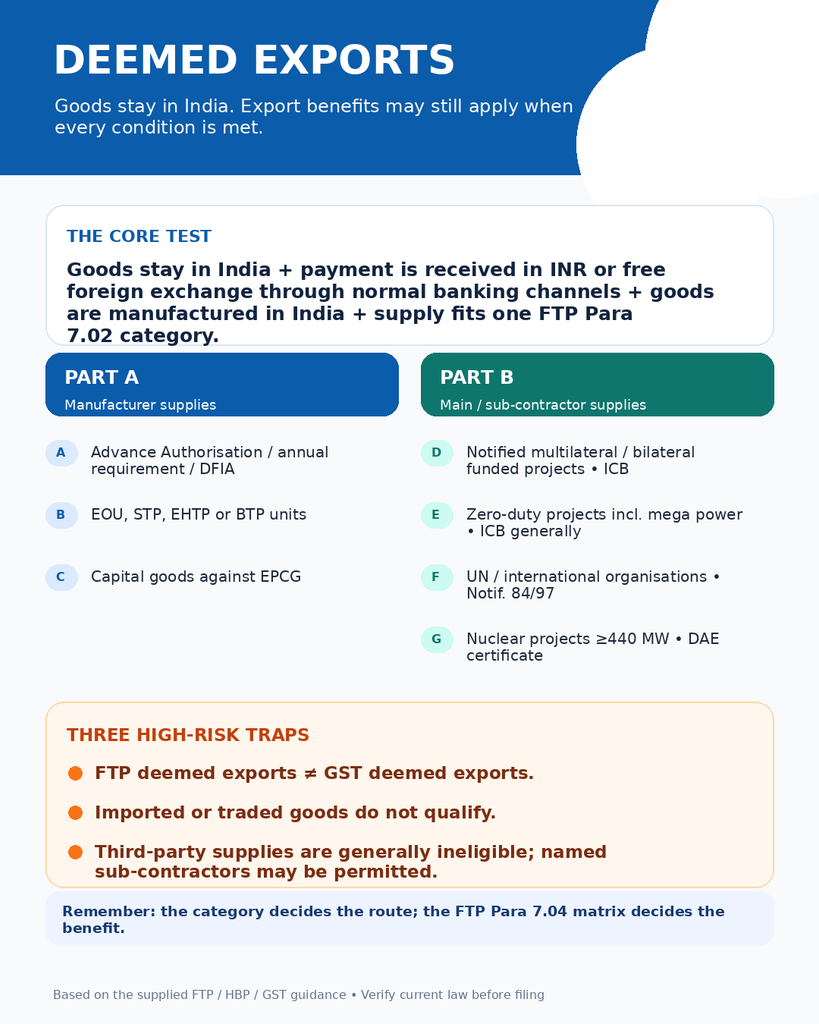
Under Para 7.01 of the Foreign Trade Policy 2023, Chapter 7, deemed exports are transactions in which the goods supplied do not leave the country, and payment is received either in Indian rupees or in free foreign exchange. The supply must fall within one of the categories in FTP Para 7.02, and the goods must be manufactured in India.
That last condition is absolute. Imported goods traded on do not become deemed exports, however the supply is invoiced. The scheme exists to give domestic manufacturers a level playing field and to support Make in India, which is the stated objective in FTP Para 7.00.
The Trap: FTP Deemed Exports and GST Deemed Exports Are Not the Same
This catches people constantly, and it is worth understanding before you build any claim.
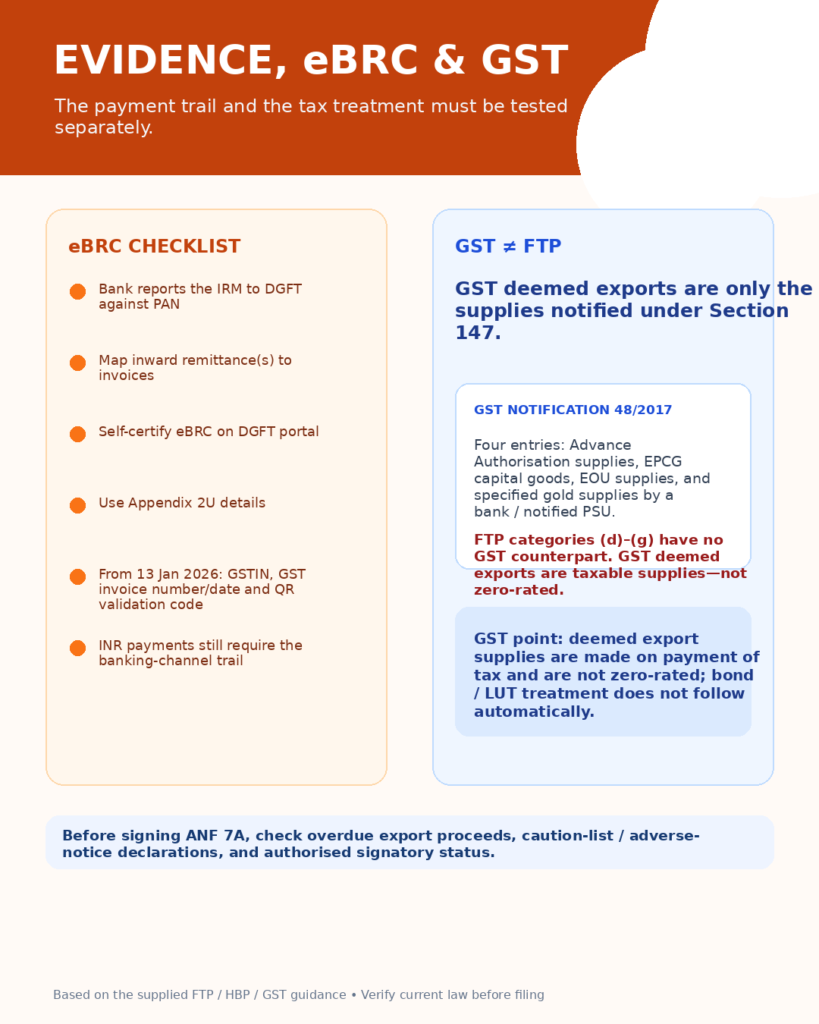
FTP Para 7.01(ii) states plainly that deemed exports for GST purposes include only the supplies notified under Section 147 of the CGST or SGST Act on the recommendations of the GST Council. The GST benefits, and the conditions attached to them, are whatever the GST Council and the relevant rules and notifications specify.
So a supply can be deemed exports under the Foreign Trade Policy and attract FTP benefits, while not being deemed exports for GST. The two lists overlap. They are not identical. Treating an FTP entitlement as a GST entitlement is how a claim becomes a demand notice.
Key Related Terms
Term
Meaning
ARO
Advance Release Order, allowing an Authorisation holder to source domestically
Invalidation letter
Endorsement invalidating an Authorisation for direct import, enabling domestic sourcing. Issued in terms of HBP Para 4.30
TED
Terminal Excise Duty, refundable in limited deemed exports cases
Deemed export drawback
Refund of duty on inputs used in the supplied goods
ANF 7A
The application form for a deemed exports benefit claim, substituted with effect from 10 December 2025
PAC
Project Authority Certificate in Appendix 7C, required for project supplies
ICB
International Competitive Bidding, a condition on several categories
RA
Regional Authority of DGFT, which sanctions the claim
BRC certificate
Bank Realisation Certificate, now self-certified electronically as an eBRC in the Appendix 2U format
The Seven Categories of Supply
FTP Para 7.02 splits the categories by who supplies. Part A, categories (a) to (c), are supplies by a manufacturer. Part B, categories (d) to (g), are supplies by main or sub-contractors. The Handbook works off that split, so quoting a category without its part is how the wrong applicant ends up filing.
Category
Supply
(a)
Goods against Advance Authorisation, Advance Authorisation for annual requirement, or DFIA
(b)
Goods to EOU, STP, EHTP or BTP
(c)
Capital goods against EPCG Authorisation
(d)
Goods to projects financed by multilateral or bilateral agencies or funds notified by the Department of Economic Affairs, where the legal agreement provides for tender evaluation without customs duty, or turnkey supply and installation evaluated on Delivered Duty Paid prices. Supplies must be under International Competitive Bidding. The agency list is Appendix 7A
(e)
Goods to any project permitted zero basic customs duty import under Customs Notification No. 50/2017-Customs, including mega power projects at Sl. No. 598, subject to the conditions there. Benefits apply only where the supply is under ICB, though for mega power projects ICB is not mandatory if the power has been tied up through tariff based competitive bidding, or the project was awarded that way
(f)
Goods to the United Nations or an international organisation for official use, or to projects they finance, under Customs Notification No. 84/97-Customs. The agency list is Appendix 7B
(g)
Goods to nuclear power projects at Sl. No. 602 of Customs Notification No. 50/2017-Customs, where the project capacity is 440 MW or more, certified by an officer not below Joint Secretary in the Department of Atomic Energy, and tendered through National or International Competitive Bidding
The Three Benefits, and Who Gets Which
FTP Para 7.03 allows any or all of three benefits, subject to the conditions in the Handbook and ANF 7A:
Advance Authorisation, Advance Authorisation for annual requirement, or DFIA
Deemed export drawback
Refund of terminal excise duty on excisable goods in Schedule 4 of the Central Excise Act 1944, the Fourth Schedule, where the supply is eligible under that category and no exemption applies
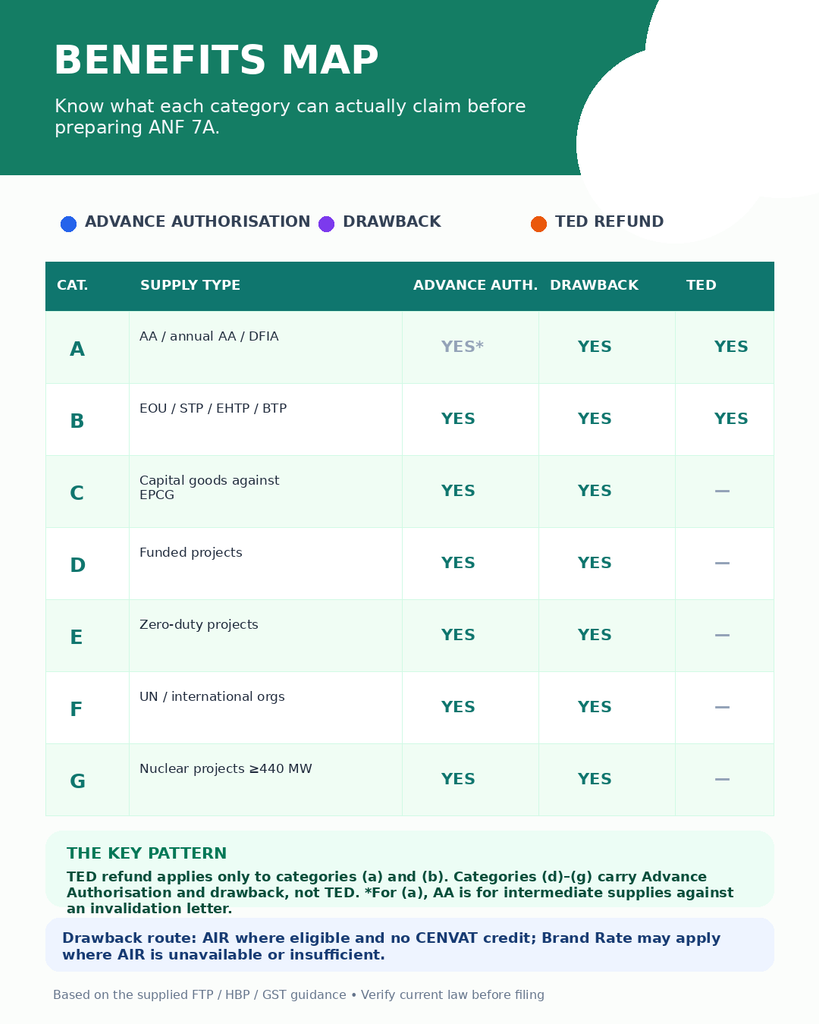
FTP Para 7.04 maps them to categories. This table decides what you can actually claim.
Category
Advance Authorisation
Duty drawback
Terminal excise duty
(a)
Yes, for intermediate supplies against an invalidation letter
Yes, against ARO
Yes
(b)
Yes
Yes
Yes
(c)
Yes
Yes
Not applicable
(d)
Yes
Yes
Not applicable
(e)
Yes
Yes
Not applicable
(f)
Yes
Yes
Not applicable
(g)
Yes
Yes
Not applicable
The pattern to notice: terminal excise duty refund survives only for categories (a) and (b). Every project supply category gets Advance Authorisation and drawback, and nothing on TED.
Conditions That Disqualify a Claim
Most rejections happen because of supply-route or documentation conditions, not basic eligibility.
Goods not manufactured in India: FTP Para 7.01(i) makes domestic manufacture a condition of the definition itself. Traded or imported goods supplied onward do not qualify.
Third-party supplies: Generally not eligible under FTP Para 7.07(i).
Sub-contractors: Permitted, but HBP Para 7.03(g) requires the sub-contractor to be named in the Project Authority Certificate or the contract before the goods are supplied.
TED refund: Recipient must not claim CENVAT credit or rebate, under FTP Para 7.05.
Drawback: Available on All Industry Rate where no CENVAT credit was availed, otherwise on Brand Rate against proof of actual basic customs duty payment, under FTP Para 7.06.
Brand Rate: Consider it where AIR is unavailable or below the required threshold.
Steel through distributors: Eligible only when the prescribed Ministry of Steel procedures and invoice cross-references are followed.
Cement, Steel and Fuel
FTP Para 7.08 restricts three commodities, and this section alone resolves a large share of disputes.
Cement. Deemed exports benefits are available under FTP Para 7.02(d) only, meaning multilateral or bilateral funded projects. No other category.
Steel. Available as an input to an Advance Authorisation, Annual Advance Authorisation or DFIA holder, or an EOU, and on supplies to multilateral or bilateral funded agencies under FTP Para 7.02(d).
Fuel. Available for eligible fuel items covered under Schedule 4 of the Central Excise Act 1944, and only on supplies to EOUs or to Advance Authorisation and Annual Advance Authorisation holders.
If your commodity is one of these three, check the restriction before you check the category.
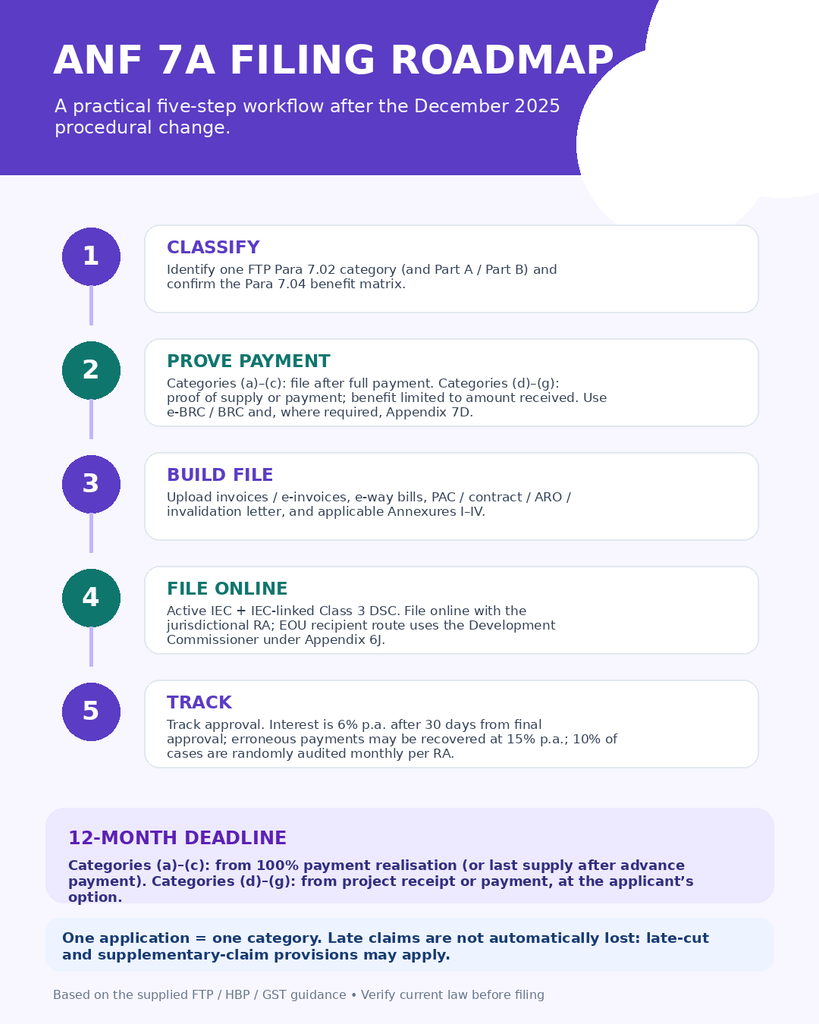
Identify which of the seven deemed export categories your supply falls under, and whether it sits in Part A or Part B of FTP Para 7.02. Then check which benefits apply using the FTP Para 7.04 matrix before filing.
Step 2: Confirm Payment Requirements
Payment must be received in full through normal banking channels, evidenced by the e-BRC, under HBP Para 7.03(f). HBP Para 7.03(e) allows the claim to be filed only after payment is received in full, to the extent of supplies made, for categories 7.02 A (a) to (c).
For project supplies in categories 7.02 B (d) to (g), HBP Para 7.05(b) applies instead: the claim may be filed on proof of supplies effected or of payment received, so a part payment does not block filing once the supplies are complete, with the benefit limited to the amount actually received. A Project Authority payment certificate in Appendix 7D is required in addition.
Step 3: Prepare the Supporting Documents
The revised ANF 7A lists nine documents. Depending on the claim, gather:
Invoices or a statement of invoices certified by the GST or Excise authorities. For non-excisable goods, system generated GST e-invoices with the corresponding e-way bills, or Form A with a recipient endorsed tax invoice for EOU, STP, EHTP and BTP supplies
Self certified copies of Bills of Entry, for brand rate fixation only
e-BRC or Bank Realisation Certificate with the Appendix 2U details, or the original Project Authority payment certificate in Appendix 7D
Project Authority Certificate in Appendix 7C
Contract, digitally signed ARO or invalidation letter
Non-availment of CENVAT credit certificate in Annexure I, from the recipient, where the claim is for TED
Supplier’s certificate in Annexure II, where the claim is for drawback
Declaration or disclaimer certificate in Annexure III, from whichever of supplier and recipient is not filing
Statement of supplies for fixation of drawback rate in Appendix 7E
Where the supply is High Speed Diesel from a public sector oil company depot, the Annexure IV certificate of duty paid is added to the file.
Step 4: File ANF 7A Online, With the Right Authority
HBP Para 7.01, as substituted by Public Notice 35/2025-26, now fixes jurisdiction precisely:
The supplier or the recipient files ANF 7A with the Jurisdictional Regional Authority as per Appendix 1A, for every category except category (b).
For supplies to an EOU, the DTA supplier claims from the Jurisdictional Regional Authority, and the recipient EOU files with the Jurisdictional Development Commissioner of the SEZ as per Appendix 6J, provided the supplier has not already claimed the benefit from the Regional Authority.
Filing is online. HBP Para 7.03(a) requires the application to be filed online by the supplier or the recipient holding an IEC, and HBP Para 7.03(c) requires the documents to be uploaded at the time of filing, with no physical copy submitted to the Regional Authority.
Because the claim now runs entirely on the DGFT portal, two things have to be in place before you start: an active IEC and a valid IEC-linked Class 3 digital signature. If the IEC has lapsed, deal with IEC renewal first, and if the token has expired or was never mapped, get the DGFT digital signature sorted before the deadline rather than after it.
New HBP Para 7.05(c) adds a rule that catches a lot of files: one application, one category. A single ANF 7A covering supplies in more than one FTP Para 7.02 category is not permissible, so mixed files have to be split.
Step 5: Track Approval and Interest
Keep track of the final approval letter, because the interest period under FTP Para 7.09 runs from the date the Regional Authority issues that letter, not from the date you submitted the claim.
The Deemed Exports 12 Month Deadline
The 12-month filing deadline in HBP Para 7.05 is one of the most important points for deemed exports claims.
Categories (a) to (c)
For supplies against Authorisations and to EOU, STP, EHTP and BTP units, file within 12 months from realisation of 100% payment. If payment was received in advance and the supply followed, the period runs from the last date of such supplies. Claims are filed invalidation letter-wise or ARO-wise for each Authorisation.
Categories (d) to (g)
For project supplies, HBP Para 7.05(b) allows the claim to be filed on the basis of proof of supplies effected or of payment received, within 12 months from either:
the date the Project Authority received the supplies, or
the date the supplier received the payment,
at the applicant’s option.
What If You Miss the Deadline?
A late claim is not automatically rejected. HBP Para 7.07 says so directly: where the claim is filed after the prescribed period, the late cut under HBP Para 11.02 and the supplementary claim provision under HBP Para 11.03 apply. ANF 7A carries a column for the applicable late cut rate, and the rate follows how far past the deadline the application is filed.
Deemed Exports Interest, Audit and Recovery
Three provisions matter here: interest payable to you, audit of approved claims, and recovery of excess or ineligible payments.
Interest on Delayed Payment
Under FTP Para 7.09, simple interest at 6% per annum is payable if the claim is not settled within 30 days from the date the Regional Authority issues the final approval letter.
Under HBP Para 7.10, the Regional Authority should calculate and add this interest itself, and the bank mandate should cover both principal and interest. If it does not, there is a hard deadline: file ANF 7B within 30 days from the date you receive the principal amount. No interest is payable after that.
Audit of Deemed Export Claims
Approved claims can still be audited. Under FTP Para 7.10(a), the computer system at DGFT headquarters selects, on a random basis, 10% of cases every month for each Regional Authority. Those cases go to an internal audit team headed by a Joint DGFT in the office of the respective Zonal Additional DGFT. Supporting documents and the basis of the claim therefore need to survive well past approval and payment.
Recovery of Erroneous Payments
Where an erroneous or ineligible payment has been made, FTP Para 7.10(b) allows recovery of the amount with interest at 15% per annum.
The asymmetry is deliberate: DGFT pays 6% on delayed settlement and recovers at 15%. Under FTP Para 7.11, claims involving mis-declaration or misrepresentation also attract penal action under the Foreign Trade (Development and Regulation) Act.
The practical takeaway: track the 30-day interest deadline, retain the complete claim record for audit, and make sure every statement and supporting document is accurate before filing.
Where a BRC Certificate Fits
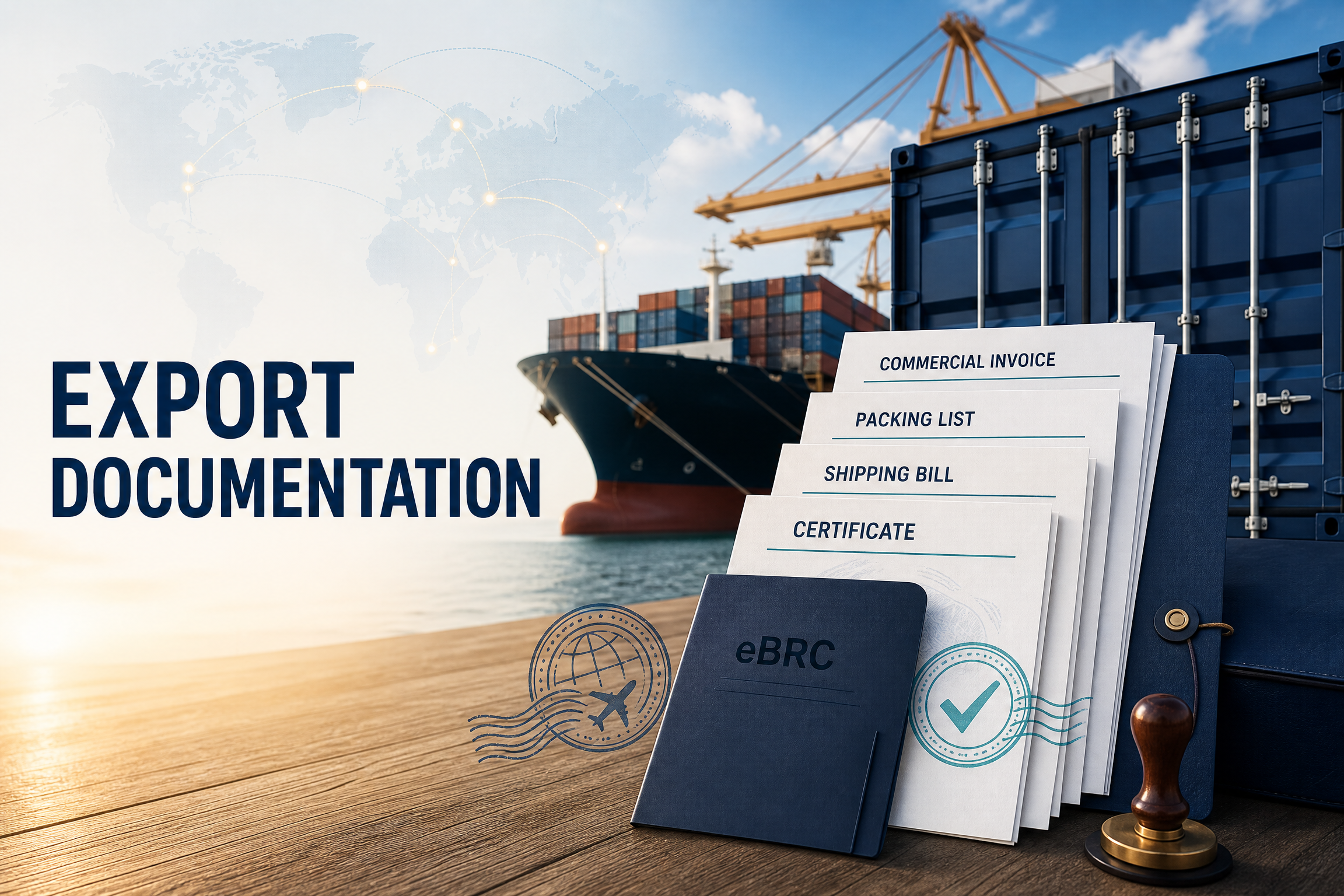
A BRC certificate (Bank Realisation Certificate) is evidence that payment has been realised. For deemed exports it is not merely supporting paperwork. HBP Para 7.03(f) ties eligibility to payment received through the normal banking channel as per the e-BRC, and requires the supply documents to be negotiated through a bank. For supplies in categories (d) to (g), a Project Authority payment certificate in Appendix 7D is submitted as well.
That makes the payment trail decisive. If payment is settled outside the banking channel, the claim may be inadmissible however complete the rest of the file is.
How eBRC Works Today
Under DGFT’s eBRC self-certification system, banks transmit Inward Remittance Messages (IRMs) directly to DGFT, and the exporter self-certifies the eBRC against them. The process is broadly:
Your Authorised Dealer bank transmits the IRM to DGFT against your PAN.
The IRM becomes available in the IRM and ORM repository on the DGFT eBRC portal.
You self-certify the eBRC by mapping one or more inward remittances to the relevant invoices.
You can view or cancel an unused self-certified eBRC and download an IRM utilisation report.
The eBRC Format Changed on 13 January 2026
DGFT Public Notice No. 42/2025-26 dated 9 January 2026 amended Appendix 2U, the prescribed eBRC format, with effect from 13 January 2026. The eBRC now carries the GSTIN, the GST invoice number and the GST invoice date, along with a QR code for validation on the DGFT website. Because ANF 7A asks for the e-BRC “with details as per Appendix 2U”, a claim built on an older format certificate is worth re-checking before it goes in.
Three Practical Checks
1. Check the IRM before generating the eBRC. If the inward remittance does not appear in the DGFT repository, you cannot generate the corresponding eBRC. Go to your AD bank rather than retrying on the portal.
2. Verify the purpose code. The purpose code identifies the nature of the transaction. An incorrect code at the banking stage creates problems when the payment is later mapped or supported for the claim.
3. Check service-export details where applicable. For exports of services, the Mode of Export of Services field is mandatory, and a gap there shows up as a deficiency during processing.
What If Payment Is in Indian Rupees?
A rupee payment does not take the supply outside the banking-channel rule. HBP Para 7.03(f) draws no distinction by currency: the claim is filed against payment received through the normal banking channel, as per e-BRC, whether the deemed export supply was paid for in Indian rupees or in free foreign exchange. The revised ANF 7A checklist says the same, asking for proof of payment through the e-BRC or Bank Realisation Certificate with Appendix 2U details, or the Appendix 7D project authority payment certificate, without a currency carve-out.
Rupee settlements are not outside the eBRC system either. DGFT’s own guidance on eBRC self-certification contemplates INR remittances being reported by the beneficiary bank on the exporter’s declaration, so an IRM and an eBRC can exist for a rupee payment.
The practical rule: route the settlement through a bank, get the IRM reported, self-certify the eBRC, and add the Appendix 7D payment certificate where the category calls for one. Assuming a rupee payment removes the requirement is the fastest way to a deficient file.
The GST Side of a Deemed Export Supply
The Foreign Trade Policy decides your FTP benefits. It does not decide your GST position, and the two have to be taken separately.
The enabling provision is Section 147 of the CGST Act, under which the Government notifies supplies as deemed exports where the goods do not leave India, payment is received in Indian rupees or convertible foreign exchange, and the goods are manufactured in India.
The list is Notification 48/2017-Central Tax dated 18 October 2017, and it runs to four entries only: supply against Advance Authorisation, supply of capital goods against EPCG Authorisation, supply to an Export Oriented Unit, and supply of gold by a bank or notified PSU against Advance Authorisation. Notification 01/2019-Central Tax dated 15 January 2019 later tightened the Advance Authorisation entry with a chartered accountant certificate requirement in defined cases.
FTP categories (d) to (g) have no GST counterpart. Project supplies, UN supplies and nuclear project supplies are deemed exports for the Foreign Trade Policy and are not deemed exports for GST.
A deemed export supply is made on payment of tax. It is not a zero rated supply, so it cannot be made under bond or LUT.
Either side can claim the refund. The third proviso to Rule 89(1) of the CGST Rules allows the recipient to claim, or the supplier to claim where the recipient has not availed input tax credit and gives an undertaking to that effect.
The evidence is prescribed by Notification 49/2017-Central Tax, not by the text of Rule 89(2)(g) itself: acknowledgement by the jurisdictional tax officer of the Advance Authorisation or EPCG holder, an undertaking from the recipient that no input tax credit has been availed, and an undertaking that the recipient will not claim the refund.
Supplies to EOU, STP, EHTP and BTP units follow a prior intimation procedure under Circular 14/14/2017-GST dated 6 November 2017, using Form A before the supply and Form B for the monthly record.
Circular 172/04/2022-GST dated 6 July 2022 confirms that credit taken by a recipient for the purpose of a deemed export refund sits outside Section 17 and outside the Net ITC used for an unutilised credit refund under Section 54(3).
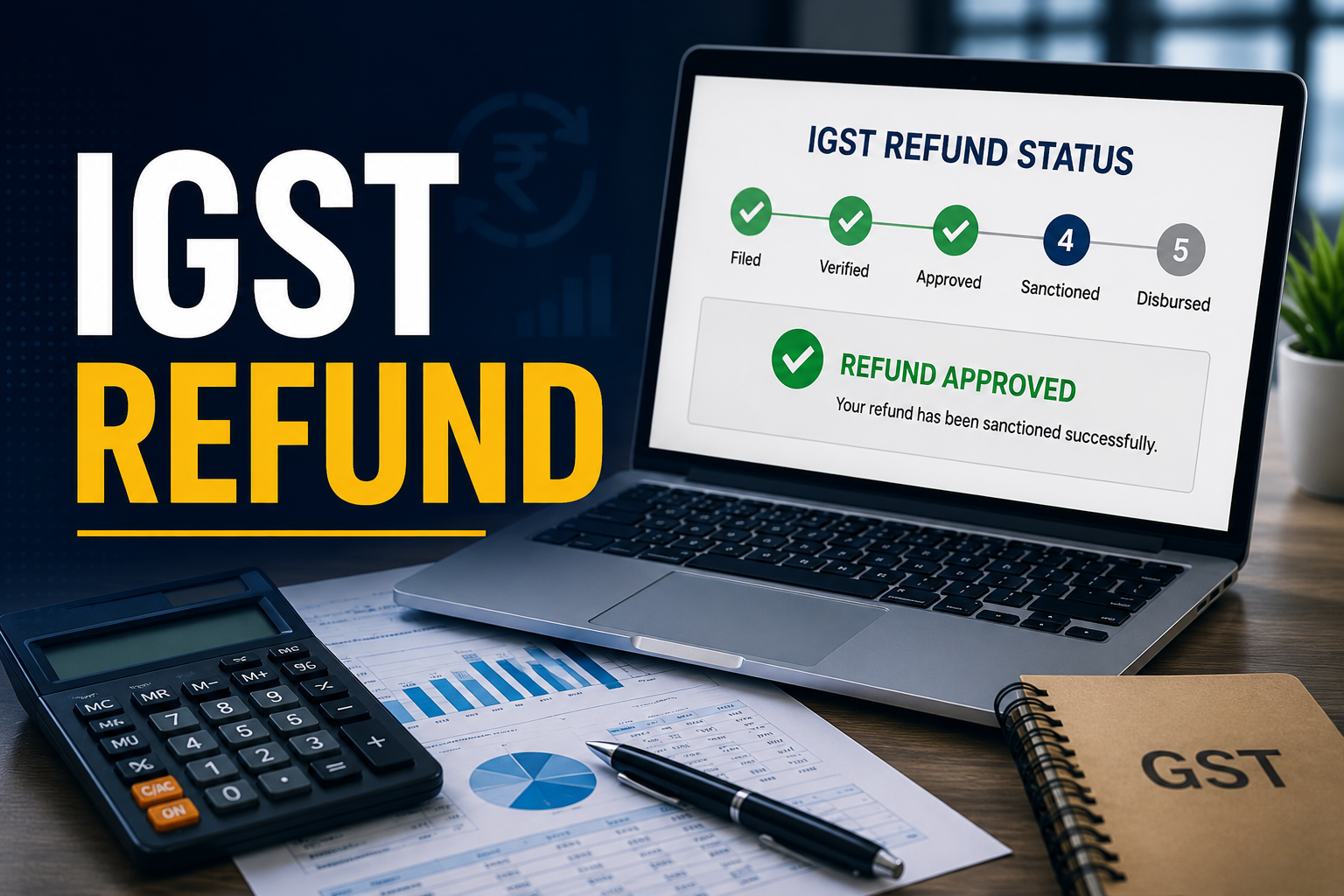
If your question is about IGST paid on physical exports, shipping bill scroll status or SB error codes, that is a different mechanism entirely. See our guide to IGST refund status.
Two Declarations That Can Disqualify You
Buried in the ANF 7A undertaking are two conditions that have nothing to do with the supply itself, and either will sink a claim.
You must declare that no export proceeds are outstanding beyond the period prescribed by the RBI, or beyond any extended period for which AD bank or RBI permission has been obtained. An unrelated overdue realisation elsewhere in the business is enough to make this declaration false.
You must also declare that no proprietor, partner, director, karta or trustee has come under the adverse notice of DGFT or appears in the RBI caution list, and, in a second declaration, that none of them holds the same position in another firm that has. Check both before you sign.
A separate declaration in the same undertaking certifies that the person signing is authorised to verify and sign, as per Para 11.06 of the FTP, which is the paragraph that defines who the applicant is. Signature and contents are two different exposures, and both carry penal consequences under declaration 1 of the form.
Common Deemed Exports Problems
Problem
Why it happens
What to do
Claim refused although the category fits
The goods were imported or traded, not manufactured in India
FTP Para 7.01(i) makes domestic manufacture part of the definition. Check it before the category
Claim rejected on third party supply
Goods routed through an intermediary rather than supplied directly
Restructure so the supply is direct, or use the sub-contractor route with the naming and payment conditions met
Sub-contractor claim refused
The sub-contractor was not named in the PAC or contract before supply
HBP Para 7.03(g) requires the endorsement in advance. Fix it at contract stage, not at claim stage
TED refund refused on a project supply
Only categories (a) and (b) carry TED
Check the FTP Para 7.04 matrix before filing
Drawback refused
CENVAT credit availed on excisable inputs, blocking the All Industry Rate route
Move to Brand Rate with proof of actual basic customs duty payment
Recipient will not give the non-availment certificate
Nobody asked for it at supply stage
Build the Annexure I certificate into the purchase order terms
Application returned for covering two categories
New HBP Para 7.05(c) allows one category per application
Split into separate applications
Application filed with the wrong authority
EOU supplies follow a separate route since December 2025
DTA supplier to the Jurisdictional RA under Appendix 1A, recipient EOU to the Jurisdictional Development Commissioner of SEZ under Appendix 6J
Cement or fuel claim refused
FTP Para 7.08 restricts both to named categories
Check the commodity restriction before the category
GST treatment assumed from FTP eligibility
The GST list is only what is notified under Section 147
Take the GST position separately against Notification 48/2017-Central Tax
No eBRC available
The bank has not reported the IRM
Ask the bank to report it, then self-certify on the DGFT portal
Rupee payment filed without an eBRC
Assumption that INR settlements sit outside the eBRC system
HBP Para 7.03(f) has no currency carve-out. Get the IRM reported and self-certify
Claim filed more than 12 months after payment realisation
The HBP Para 7.05 window closed
Not necessarily dead. Late cut under HBP Para 11.02 and supplementary claim under HBP Para 11.03 may still apply
Payment settled outside banking channels
HBP Para 7.03(f) requires payment through normal banking channel as per e-BRC
No admissible claim. Route the settlement through a bank
Interest not paid on a delayed refund
The Regional Authority did not add it
File ANF 7B within 30 days of receiving the principal. Nothing is payable after that
Part payment assumed to block a project claim
HBP Para 7.05(b) permits filing on part payment for categories (d) to (g)
File, with benefit limited to the payment received, once 100 percent of supplies are made
Drawback claim rejected with all certificates in place
Annexure II, the supplier’s declaration, was not filed
Add it. It is required for drawback and is the annexure most often missed
Invoices not accepted for non-excisable supplies
GST e-invoices and e-way bills not provided
Supply the system generated e-invoice with the matching e-way bill, or Form A with a recipient endorsed tax invoice for EOU, STP, EHTP and BTP supplies
Claim sunk by an unrelated overdue realisation
The ANF 7A undertaking requires no export proceeds outstanding beyond the RBI period
Clear or regularise the outstanding before filing
How JPARKS INDIA Helps
Deemed export claims usually fail on missing certificates, wrong category, weak evidence, or an incomplete file. Our Deemed Exports Advisory fixes that: eligibility assessment, condition checks, ANF 7A documentation, filing with the correct authority under December 2025 jurisdiction rules, brand rate fixation, deadline and claim tracking, Appendix 2U eBRC reconciliation, and an audit-ready file.
You get: a clear eligibility position, a properly filed claim, and complete approval documentation.
Send your supply contract, Authorisation, and payment details. We’ll tell you what you can claim.
Under FTP Para 7.01 of the Foreign Trade Policy 2023, deemed exports are transactions where the goods supplied do not leave India and payment is received in Indian rupees or free foreign exchange. The supply must fall within one of the categories in FTP Para 7.02 and the goods must be manufactured in India.
Q2. What are the categories of deemed exports?
Seven, split into two parts. Part A covers supplies by a manufacturer: against Advance Authorisation or DFIA, to EOU, STP, EHTP or BTP, and capital goods against EPCG. Part B covers supplies by main or sub-contractors: to multilateral or bilateral funded projects, to zero duty projects including mega power projects, to the United Nations or international organisations, and to nuclear power projects of 440 MW or more.
Q3. What benefits do deemed exports carry?
Three. Advance Authorisation or DFIA, deemed export drawback, and refund of terminal excise duty on Schedule 4 goods where eligible and unexempted. Which ones apply depends on the category, and terminal excise duty survives only for supplies against Advance Authorisation or DFIA and supplies to EOU, STP, EHTP and BTP.
Q4. Are deemed exports the same under GST?
No. FTP Para 7.01(ii) states that deemed exports for GST purposes include only supplies notified under Section 147 of the CGST or SGST Act. That notification, 48/2017-Central Tax, lists four entries, so FTP categories (d) to (g) have no GST counterpart at all.
Q5. Can a third party supply claim deemed exports benefits?
No. FTP Para 7.07(i) requires supplies to be made directly to the entities listed in FTP Para 7.02. Sub-contractors have a permitted route, but HBP Para 7.03(g) requires the sub-contractor to be named in the Project Authority Certificate or contract before the goods are supplied.
Q6. Where do I file ANF 7A now?
With the Jurisdictional Regional Authority as per Appendix 1A for every category except supplies to an EOU. For EOU supplies, the DTA supplier claims from the Jurisdictional Regional Authority and the recipient EOU files with the Jurisdictional Development Commissioner of the SEZ as per Appendix 6J, provided the supplier has not already claimed. This is HBP Para 7.01 as substituted by Public Notice 35/2025-26.
Q7. When can I file the claim, and is there a deadline?
For supplies against Authorisations and to EOU, STP, EHTP and BTP, file within 12 months from realisation of 100 percent payment, or from the last date of supply where payment was in advance. For project supplies, file within 12 months from receipt of supplies by the project authority or from receipt of payment, at your option, and part payments do not prevent filing. Since Public Notice No. 35/2025-26 dated 10 December 2025, filing is online, no physical copy goes to the Regional Authority, and each application covers a single category of supply.
Q8. What if the 12 months has already passed?
A time barred claim is not automatically lost. HBP Para 7.07 applies the late cut in HBP Para 11.02 and the supplementary claim provision in HBP Para 11.03.
Q9. Do I get interest if the refund is delayed?
Yes. Simple interest at 6 percent per annum where the claim is not settled within 30 days from the final approval letter issued by the Regional Authority. The Regional Authority should add it automatically. If it does not, file ANF 7B within 30 days of receiving the principal amount, because no interest is paid after that.
Q10. What happens if a claim is wrongly sanctioned?
The Regional Authority recovers the payment with interest at 15 percent per annum under FTP Para 7.10(b). The computer system at DGFT headquarters selects 10 percent of cases for internal audit each month for every Regional Authority, and mis-declaration attracts penal action under the FT (D&R) Act.
Posted on Google
Vandana Bajaj
Trustindex verifies that the original source of the review is Google.
Very prompt and reliable service by Rahul Kolge and his team. Exceptional and happy experience.
Posted on Google
Supriya Shetye
Trustindex verifies that the original source of the review is Google.
Had a really good experience with JParks India. Rahul sir helped me a lot with my import work and were always active and responsive. Whatever documents or guidance was needed, they handled everything smoothly and explained things clearly. Felt stress-free throughout the process. Very helpful team, definitely recommend them if you’re doing import or export.
Posted on Google
dipali sakpal
Trustindex verifies that the original source of the review is Google.
Very nice people, get the work done in a very short time.
Posted on Google
Satish Bajaj
Trustindex verifies that the original source of the review is Google.
Excellent & Prompt services in all Import Export matters.
Great to work with you
Posted on Google
Bajaj VCPL
Trustindex verifies that the original source of the review is Google.
It was a great experience having work with you.
Posted on Google
Satish Bajaj
Trustindex verifies that the original source of the review is Google.
"Outstanding professiona services, efficient, and gets things done incredibly fast. Highly recommended for anyone needing reliable and prompt assistance
Posted on Google
Nishat fatima
Trustindex verifies that the original source of the review is Google.
excellent service
Posted on Google
farhan sayed
Trustindex verifies that the original source of the review is Google.
JParks Team is Super helpful! Thanks to Rahul and team!
Posted on Google
Sadik Inamdar
Trustindex verifies that the original source of the review is Google.
Good and personal service for import export code
Posted on Google
Maheshwar
Trustindex verifies that the original source of the review is Google.
Had a really good experience with JParks India. Rahul sir helped me a lot with my import work and were always active and responsive. Whatever documents or guidance was needed, they handled everything smoothly and explained things clearly. Felt stress-free throughout the process. Very helpful team, definitely recommend them if you’re doing import or export.
Verified by Trustindex
Trustindex verified badge is the Universal Symbol of Trust. Only the greatest companies can get the verified badge who has a review score above 4.5, based on customer reviews over the past 12 months. Read more
Understand the latest 2026 DGFT rules for Star Export House status. Learn eligibility criteria, export turnover requirements, benefits, documentation, and the 5-step application process to secure your Status Holder Certificate with confidence.
Track your IGST refund status with confidence. Learn the 7 proven steps to identify delays, fix common filing errors, resolve refund issues, and receive your IGST refund faster. A complete guide for exporters, importers, and GST professionals in India.
Understand the 7 categories of deemed exports under FTP 2023. Learn eligibility conditions, available benefits, ANF 7A filing, required documents, 12-month deadlines, eBRC requirements, GST treatment, and common claim mistakes.
Expert MOOWR scheme application support for importers & exporters in India. Complete guide on eligibility, process, benefits & compliance. Get approved fast.
Want to register on the IceGate portal? The smallest mistake can end up in a rejection. To avoid wasting time, get in touch with us and we'll help you get registered on IceGate withing 2-3 working days!
As an importer of record we Import goods into India on your behalf & deliver them to your desired location. We handle everything from legal compliance to last mile delivery to ensure timely & safely clearance of your Imported goods. Ideal service if you are planning to import for the first time.
Learn about SVB registration with our comprehensive guide to the Special Valuation Branch. Simplify the process and ensure compliance with our expert services.
Need to get CPCB EPR Plastic Waste registration for your business in 2026? We help you get it in a hassle free manner so you can stay compliant with the EPR laws! Get in touch now.
Need a Class 3 DSC Digital Signature Certificate for your business? Get it within 24 hours. At JPARKS INDIA we are Emudhra Partners, and can get the DSC for your at the fastest and most affordable rates. Contact us now!
Get Certificate of Origin | Preferential & Non Preferential
Need a Certificate of Origin for your Export or Import? Look no further, at JPARKS we provide preferential and Non preferential COOs at the best rates. Contact us to know more!
Need to reactivate your IEC on the DGFT portal? The IEC Based DGFT DSC is what you need to move forward hassle free. Contact us now to get your DGFT DSC within 24 hours.
Looking to start your Import Export Business? Getting an IEC is mandatory to get into EXIM trade. We help you apply IEC online and get started within 24 hours.
Want to claim benefits of duty drawback and various other schemes under FTP? You need to register your Bank Account for Export Promotion Incentives. Contact us now to register your Bank Account on IceGate Potal.
We use cookies to run this site, measure traffic, and track our ads. Essential cookies are always on. Accept all, reject non-essential, or set your preferences.
Cookie Preferences
Manage your cookie preferences below:
Essential cookies enable basic functions and are necessary for the proper function of the website.
Name
Description
Duration
Cookie Preferences
This cookie is used to store the user's cookie consent preferences.
30 days
Google reCAPTCHA helps protect websites from spam and abuse by verifying user interactions through challenges.
Name
Description
Duration
_GRECAPTCHA
Google reCAPTCHA sets a necessary cookie (_GRECAPTCHA) when executed for the purpose of providing its risk analysis.
179 days
Google Tag Manager simplifies the management of marketing tags on your website without code changes.
Name
Description
Duration
cookiePreferences
Registers cookie preferences of a user
2 years
td
Registers statistical data on users' behaviour on the website. Used for internal analytics by the website operator.
session
Statistics cookies collect information anonymously. This information helps us understand how visitors use our website.
Google Analytics is a web analytics service that tracks and reports website traffic. It collects anonymized data on how visitors use the site to help us understand and improve performance.