BIS Certification Processing Time: 3 Critical 2026 Timelines
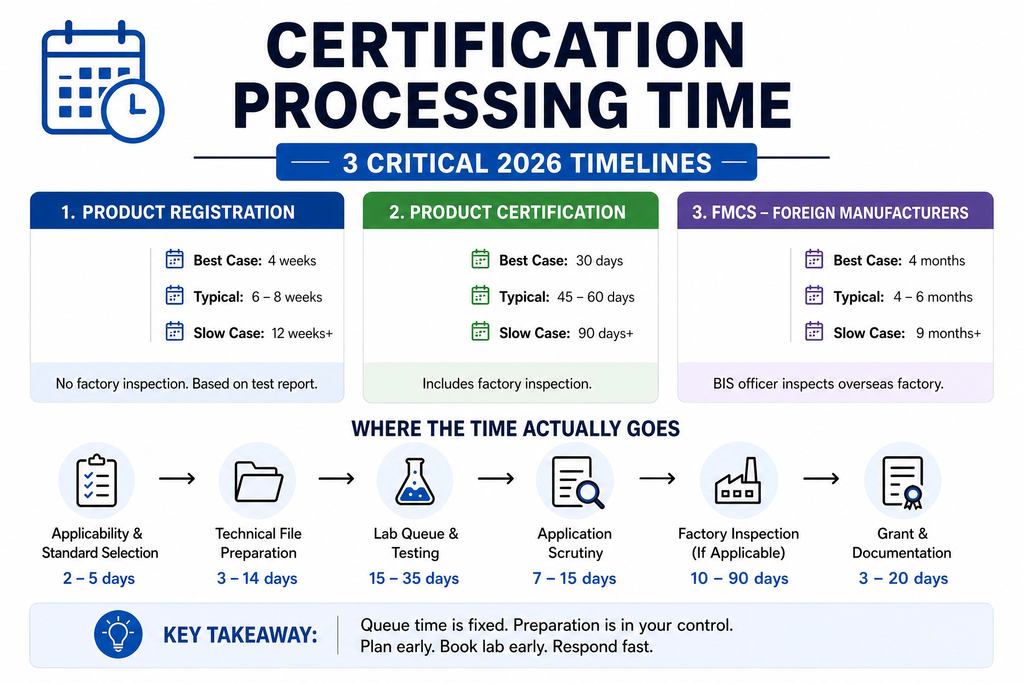
BIS certification processing time depends entirely on the scheme. CRS registration typically takes four to eight weeks. An ISI Mark licence under Scheme I typically takes thirty to sixty days. FMCS for a foreign manufacturer typically takes four to six months, because a BIS officer must inspect the overseas factory. The application form takes an afternoon, and the laboratory takes weeks. If you are working to a vessel date, see our BIS Certification Services.
Roughly half of any timeline is queue time you cannot compress, and understanding that split is the fastest way to read BIS certification processing time correctly. The other half is preparation quality and response speed.
Who This BIS Certification Processing Time Guide Applies To
This guide is for manufacturers and importers planning launches, shipments and tender deadlines around certification. It gives realistic ranges, a stage level breakdown, and the delays you can actually control. The steps themselves are covered in a separate guide. For clearance planning alongside it, see our Import Export Consultancy Services.
BIS Certification Processing Time by Scheme
Scheme
Best case
Typical
Slow case
Scheme II, the CRS
4 weeks
6 to 8 weeks
12 weeks plus
Scheme I, the ISI Mark
30 days
45 to 60 days
90 days plus
FMCS, foreign manufacturers
4 months
4 to 6 months
9 months plus
Best case BIS certification processing time assumes a ready factory, an available laboratory slot and same day responses to BIS. Very few first time applicants hit it. Confirm current scheme conditions on the Bureau of Indian Standards site before planning.
Where the Time Actually Goes
Stage
CRS
Scheme I (ISI)
FMCS
Applicability and standard selection
2 to 5 days
2 to 5 days
3 to 7 days
Technical file preparation
3 to 7 days
7 to 14 days
14 to 21 days
Factory readiness work
Not applicable
0 to 30 days
0 to 45 days
Laboratory queue and testing
15 to 35 days
15 to 30 days
20 to 40 days
Application scrutiny
7 to 15 days
7 to 15 days
15 to 30 days
Factory inspection scheduling
Not applicable
10 to 25 days
30 to 90 days
Grant and documentation
3 to 7 days
5 to 10 days
10 to 20 days
Two rows dominate BIS certification processing time. Laboratory queue dominates the CRS, and inspection scheduling dominates FMCS.
Factory readiness can be zero. A plant with a working in house laboratory skips the longest avoidable delay.
What changed in 2026: longer licence validity under the 25 February 2026 amendment does not shorten grant times. It does add an annual fee deadline, and a suspension for non payment lasts ninety days. A suspended licence stops clearance immediately, which is a delay no schedule absorbs.
Planning Backwards From a Vessel Date
Importers should build the schedule from arrival, not from application, since that is how BIS certification processing time actually gets absorbed into a shipping plan.
Fix the target arrival date at the Indian port.
Subtract transit time to get the required shipping date.
Subtract production and packing time.
Subtract the certification duration for the applicable scheme.
Subtract two weeks of buffer for deficiencies.
The result is your latest safe application start date.
For a CRS product arriving in twelve weeks the window is already tight. For an FMCS product, twelve weeks is not feasible.
A Worked Example
A lighting importer plans a first shipment for a festival launch.
Milestone
Weeks before arrival
Application start
20
Test report expected
14
Registration granted
10
Artwork printed, production starts
9
Goods ready and shipped
4
Arrival and clearance
0
The schedule looks comfortable until the laboratory quotes a five week queue, a reminder that BIS certification processing time rarely follows the paper plan. That single variable consumes the entire buffer.
Booking the laboratory slot at week 20 is what protects the launch.
Where Delays Hide in Your Own Process
Applicants blame the regulator for delays that started internally, but internal habits explain most avoidable BIS certification processing time. Four internal habits cost weeks.
Sequential approvals. Documents wait in a signature queue while a deficiency window closes. Give one person authority to release the same day.
Late specification freezes. Engineering changes a rating after the report is drawn, so testing repeats.
Split ownership. Purchase holds the supplier relationship, quality holds the records, and nobody owns the deadline.
No calibration calendar. An instrument certificate expires the week of the inspection, and a second visit is scheduled.
Fixing these four costs nothing. They routinely remove three to five weeks from a first application.
How to Compress a BIS Timeline
Book the laboratory slot at the start, not after filing, the single biggest lever on BIS certification processing time.
Fix the model list before testing so one report covers the range.
Complete factory readiness before the application, not after scrutiny.
Nominate one internal owner who can release documents the same day.
Prepare labelling artwork in draft so only the number needs inserting.
For FMCS, appoint the Authorized Indian Representative on day one.
Verify laboratory scope for the exact IS code before drawing samples.
How JPARKS Helps With BIS Certification Processing Time
If you take away one thing about BIS certification processing time, let it be this. Three points are worth carrying away. Queue time is fixed and rework time is not, so preparation is the lever. Laboratory capacity, not paperwork, sets the CRS timeline. Goods already at the port cannot be rescued by starting certification now.
JPARKS INDIA handles BIS certification alongside ICEGATE registration, AD Code mapping, IGCR clearance and Importer of Record work. We have served 500+ importers and exporters since 2018. Our team carries 40 years of EXIM experience and a 5.0 Google rating. We plan certification backwards from the clearance date.
Send us your target arrival date and the product, and we will map out the realistic BIS certification processing time before you commit. Visit JPARKS INDIA or use the Contact Page.
Frequently Asked Questions
Q1. How long does BIS certification take in India?
CRS registration typically takes four to eight weeks. ISI Mark licences typically take thirty to sixty days. FMCS typically takes four to six months.
Q2. Why does FMCS take so much longer?
A BIS officer must travel to inspect the overseas factory. Scheduling that visit, plus the bank guarantee and documentation, adds months.
Q3. Can BIS certification be completed in one week?
No. A filing can be made in a week, but a grant cannot. Any one week promise about BIS certification processing time describes the application, not the outcome.
Q4. What is the fastest BIS route?
The Compulsory Registration Scheme, because there is no factory inspection. Timeline then depends almost entirely on the laboratory queue.
Q5. How long does a renewal take?
Far less than a fresh application, provided annual fees and production statements are current. Neglected accounts become recovery exercises.
Q6. Does an MSME concession affect timing?
No. It reduces fees, not processing time, and it must be claimed at filing.
Q7. What is the single biggest cause of delay?
Laboratory queue time, followed closely by deficiency loops caused by inconsistent documents.
Q8. Can paying more speed up BIS approval?
No. Government fees are fixed by notification and buy no priority. Treat any claim of influence as a warning sign.
Need this handled for you?
Tell us where you are stuck. We usually reply the same business day.
5.0 ★ · 126 Google reviews · Since 1990
Posted on Google
Vandana Bajaj
Trustindex verifies that the original source of the review is Google.
Very prompt and reliable service by Rahul Kolge and his team. Exceptional and happy experience.
Posted on Google
Supriya Shetye
Trustindex verifies that the original source of the review is Google.
Had a really good experience with JParks India. Rahul sir helped me a lot with my import work and were always active and responsive. Whatever documents or guidance was needed, they handled everything smoothly and explained things clearly. Felt stress-free throughout the process. Very helpful team, definitely recommend them if you’re doing import or export.
Posted on Google
dipali sakpal
Trustindex verifies that the original source of the review is Google.
Very nice people, get the work done in a very short time.
Posted on Google
Satish Bajaj
Trustindex verifies that the original source of the review is Google.
Excellent & Prompt services in all Import Export matters.
Great to work with you
Posted on Google
Bajaj VCPL
Trustindex verifies that the original source of the review is Google.
It was a great experience having work with you.
Posted on Google
Satish Bajaj
Trustindex verifies that the original source of the review is Google.
"Outstanding professiona services, efficient, and gets things done incredibly fast. Highly recommended for anyone needing reliable and prompt assistance
Posted on Google
Nishat fatima
Trustindex verifies that the original source of the review is Google.
excellent service
Posted on Google
farhan sayed
Trustindex verifies that the original source of the review is Google.
JParks Team is Super helpful! Thanks to Rahul and team!
Posted on Google
Sadik Inamdar
Trustindex verifies that the original source of the review is Google.
Good and personal service for import export code
Posted on Google
Maheshwar
Trustindex verifies that the original source of the review is Google.
Had a really good experience with JParks India. Rahul sir helped me a lot with my import work and were always active and responsive. Whatever documents or guidance was needed, they handled everything smoothly and explained things clearly. Felt stress-free throughout the process. Very helpful team, definitely recommend them if you’re doing import or export.
Verified by Trustindex
Trustindex verified badge is the Universal Symbol of Trust. Only the greatest companies can get the verified badge who has a review score above 4.5, based on customer reviews over the past 12 months. Read more
We use cookies to run this site, measure traffic, and track our ads. Essential cookies are always on. Accept all, reject non-essential, or set your preferences.
Cookie Preferences
Manage your cookie preferences below:
Essential cookies enable basic functions and are necessary for the proper function of the website.
Name
Description
Duration
Cookie Preferences
This cookie is used to store the user's cookie consent preferences.
30 days
Google reCAPTCHA helps protect websites from spam and abuse by verifying user interactions through challenges.
Name
Description
Duration
_GRECAPTCHA
Google reCAPTCHA sets a necessary cookie (_GRECAPTCHA) when executed for the purpose of providing its risk analysis.
179 days
Google Tag Manager simplifies the management of marketing tags on your website without code changes.
Name
Description
Duration
cookiePreferences
Registers cookie preferences of a user
2 years
td
Registers statistical data on users' behaviour on the website. Used for internal analytics by the website operator.
session
Statistics cookies collect information anonymously. This information helps us understand how visitors use our website.
Google Analytics is a web analytics service that tracks and reports website traffic. It collects anonymized data on how visitors use the site to help us understand and improve performance.