BIS Certification for Importers in India: 8 Critical Checks Before You Buy
BIS certification for importers in India works differently from domestic manufacturing, and the difference costs money. An importer cannot hold the licence. The overseas manufacturer must be certified under FMCS, or registered under the Compulsory Registration Scheme. Your job is supplier verification before the purchase order, correct marking on the goods, and licence details that match the bill of entry. If a consignment is already flagged, start with our BIS Certification Services.
Customs checks BIS status the moment a notified product arrives, and that is where the cost starts. Demurrage accrues daily while the factory scrambles for a certificate that takes weeks.
Who This Guide Applies To
This guide is for importers, traders, brand owners and ecommerce sellers buying notified goods from overseas factories. It covers the buyer position, supplier due diligence, the application itself and the customs interface. Penalties are covered separately.
What BIS Certification for Importers in India Actually Requires
The licence belongs to the manufacturer, not to the buyer. Your IEC does not create eligibility. This is the rule most people miss.
You are
Your route
Importer of a notified product made overseas
Source from a certified factory, or get the factory certified
Importer with an exclusive brand
The factory still applies, your brand is recorded on the licence
Trader reselling within India
Rely on the supplier licence, verified before purchase
Indian manufacturer importing components
Your finished goods licence is separate from component coverage
The last row catches manufacturers regularly. Certified components do not certify a finished product. An uncertified component can block a shipment even where the finished product is exempt.
Two Legitimate Routes for Importers
There are two lawful routes to BIS certification for importers in India, and which one you take depends entirely on your supplier.
Route one, buy from an already certified factory. Fastest and cheapest, and usually the first route worth exploring. Verify the licence rather than trusting a scanned copy.
Check the CM/L number for ISI products and the R number for CRS products. The difference between the two is explained in ISI Mark vs BIS Registration. Confirm the factory address on the licence matches the plant that will actually ship. Confirm the exact model is covered.
Route two, get the factory certified. Budget four to six months for FMCS and four to eight weeks for the CRS. Either timeline shapes your production schedule, not just your paperwork. You will usually fund the application and supply an Authorized Indian Representative. See BIS FMCS Registration.
What changed in 2026: the Bureau of Indian Standards (Conformity Assessment) Amendment Regulations, 2026, notified on 25 February 2026, extended licence validity to five years. Fees are now payable annually in advance alongside a production statement. A missed due date suspends the licence automatically for ninety days.
That suspension is recoverable. If the outstanding annual fee and production statement reach BIS within those ninety days, together with a late fee of five thousand rupees, the licence is restored. Miss the ninety day window and the certificate of conformity is cancelled.
The amendment also carries fee concessions valid until 31 May 2029: eighty percent for micro enterprises and startups, fifty percent for small enterprises, twenty percent for medium enterprises, classified under the MSMED Act, 2006. The full text sits with the Bureau of Indian Standards.
The practical consequence for a buyer is simple. A supplier licence you verified last year can be suspended today with nothing wrong technically. Reverification before each shipment is no longer optional.
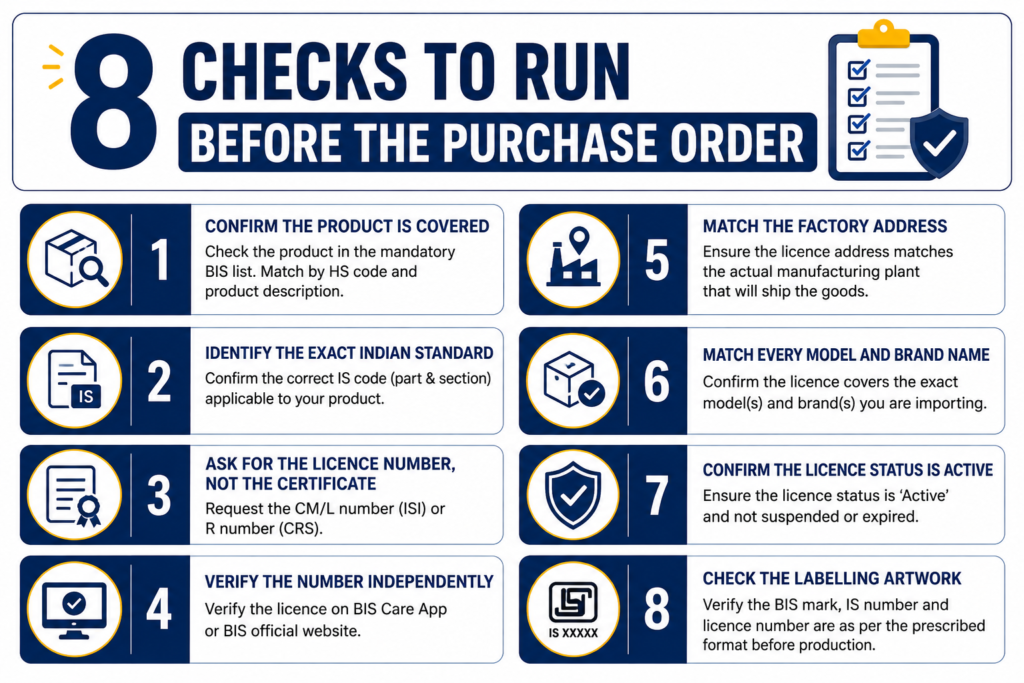
The 8 Checks to Run Before the Purchase Order
From the buyer side, these eight checks are effectively the whole of BIS certification for importers in India. Run them before you sign the order, not after the goods sail.
Match by HS code and by the written description in the order. Both must align, because orders carve out capacity and voltage ranges.
2. Identify the exact Indian Standard
Confirm the IS code, including part and section. Check whether it has been revised recently, because a superseded standard on a licence is a live risk.
3. Ask for the licence number, not the certificate
A scanned PDF proves nothing. The number is what can be verified.
4. Verify the number independently
Use the BIS Care app or the licence search on the BIS website. Manakonline is the portal your supplier applies through, and the same records drive public verification.
5. Match the factory address
Suppliers shift production between plants. A licence covers one location only.
6. Match every model and brand name
A licence for one model does not cover a variant. Customs reads the model.
7. Confirm the licence status is active
Active is not the same as issued. A suspended licence stops clearance the same day. Under the 2026 rules, ask when the next annual fee falls due.
8. Check the labelling artwork
Compare the artwork against the prescribed marking format before mass production begins. Font, size and placement are specified, not left to the factory.
What the Application Actually Requires
Route two is where BIS certification for importers in India stops being a verification exercise and starts being a project. If route one fails and you need the factory certified, this is what you are funding.
Documents the factory must provide
Business registration or manufacturing licence for the overseas plant
Factory layout, list of manufacturing machinery and process flow
List of in house testing equipment with valid calibration certificates
Test reports against the relevant Indian Standard, from a BIS recognised laboratory
Scheme of Inspection and Testing, or the quality control manual
Trademark registration or brand ownership proof
Complete model and variant list, with technical specifications for each
Nomination and authorisation of an Authorized Indian Representative
Undertakings and affidavits in the prescribed formats
Where the money goes
There are four cost blocks, and only one of them is the BIS fee itself.
Product testing at a BIS recognised laboratory is usually the largest single line, and it scales with the number of models. BIS application, grant and annual fees now fall due yearly in advance. For FMCS, the factory audit adds inspector travel and stay, billed at cost to the applicant. Fourth is your Authorized Indian Representative and consultant fee.
Confirm current fee figures against the notification before you budget. The 2026 concessions apply where the applicant qualifies as an MSME or startup under Indian law, which most overseas factories will not.
Common Indian Standards for imported goods
Product group
Indian Standard
Route
IT equipment and power adaptors
IS 13252 (Part 1)
CRS
Audio and video apparatus
IS 616
CRS
Lithium ion cells and batteries
IS 16046
CRS
Household electrical appliances
IS 302 (Part 1)
ISI, FMCS for overseas plants
Toys
IS 9873
ISI, FMCS for overseas plants
Structural steel
IS 2062
ISI, FMCS for overseas plants
Ordinary Portland cement
IS 269
ISI, FMCS for overseas plants
Treat this as a starting point. Verify the exact part and section against the notified order that covers your product, because parts are added and revised.
Contract Clauses Worth Inserting
Most importer losses are contractual failures dressed as regulatory ones, and clean contract language is one of the cheapest ways to protect yourself.
Certification warranty: the supplier warrants a valid licence covering the exact models and the shipping factory.
Model list annexure: any addition requires written confirmation of licence coverage.
Annual fee notice: the supplier notifies you of the next annual fee due date and confirms payment before dispatch.
Payment trigger: final payment falls due on verified licence status, not on a scanned certificate.
Indemnity for detention: the supplier indemnifies demurrage and return shipment costs caused by a certification failure.
Suppliers resist the last clause. That resistance is useful information about their confidence.
Where BIS Meets Customs
Failure point
What customs sees
Result
Licence does not match the bill of entry
Model, brand or manufacturer differs
Detention
Marking absent or wrong
Mark, IS number or licence number missing
Detention
Licence suspended
Portal status is not active
Detention
Product covered, no licence at all
Nothing to verify
Detention, then enforcement
Keep BIS verification in the same file as your shipping documents and ICEGATE registration. A licence check the week before sailing is worth more than a certificate sitting in your inbox.
Common Errors That Hold Importer Consignments
Verifying once, then never again: licences suspend between orders for a missed annual fee.
Accepting a certificate image: always verify the number on the portal instead.
Ignoring the bill of materials: a covered component holds the whole shipment.
Assuming samples are exempt: small quantity does not create an automatic exemption.
Assuming CE marking helps: CE has no legal standing in India.
Certifying after arrival: certification is not retrospective, so goods wait or go back.
Assuming a withdrawn order clears everything: other orders may still cover your components.
How JPARKS Helps With BIS Certification for Importers in India
Three points are worth carrying away. The licence belongs to the manufacturer, so your leverage sits in the purchase contract. Verification must be repeated before each shipment, not performed once. Certification obtained after arrival does not legalise an import already made.
JPARKS INDIA handles BIS work alongside ICEGATE registration, AD Code mapping, IGCR clearance and Importer of Record services. We have served 500+ importers and exporters since 2018. Our team carries over 35 years of EXIM experience and a 5.0 Google rating, and we sit minutes from JNPT in Vashi, Navi Mumbai.
Send us the product, the HS code and the supplier licence number. We will confirm coverage and verify the licence before you commit. Visit JPARKS INDIA or use the Contact Page.
Frequently Asked Questionsions
Q1. Can an importer apply for BIS certification in India?
No. The licence is granted to the manufacturer, which is the single most misunderstood part of BIS certification for importers in India. An importer can fund and coordinate the application but cannot hold the certificate.
Q2. What if my supplier’s licence covers a different model?
Customs treats the shipment as uncertified. Ask the manufacturer to include the model on the licence before the goods ship.
Q3. Do I need BIS if I import only for my own use?
Quality Control Orders generally cover import itself, not only sale, which is a core part of how BIS certification for importers in India actually works. Check the specific order before assuming captive use is exempt.
Q4. How do I verify a foreign supplier’s BIS licence?
Use the BIS Care app or the licence search on the BIS website. Match number, factory address, standard and model.
Q5. Does an IEC allow me to import BIS regulated goods?
No. An IEC allows you to trade. BIS compliance is a separate condition attached to the goods themselves.
Q6. Can I get certification after the goods reach the port?
Certification takes weeks or months and is not retrospective. Goods usually wait, get re exported, or face enforcement.
Q7. Is CE marking accepted at Indian customs?
No. CE is a European mark with no legal standing in India. A separate BIS licence or registration is required.
Q8. How often should I re verify a supplier licence?
Before every shipment. Under the 2026 rules a licence can be suspended for a missed annual fee at any time.
Need this handled for you?
Tell us where you are stuck. We usually reply the same business day.
5.0 ★ · 126 Google reviews · Since 1990
Posted on Google
Vandana Bajaj
Trustindex verifies that the original source of the review is Google.
Very prompt and reliable service by Rahul Kolge and his team. Exceptional and happy experience.
Posted on Google
Supriya Shetye
Trustindex verifies that the original source of the review is Google.
Had a really good experience with JParks India. Rahul sir helped me a lot with my import work and were always active and responsive. Whatever documents or guidance was needed, they handled everything smoothly and explained things clearly. Felt stress-free throughout the process. Very helpful team, definitely recommend them if you’re doing import or export.
Posted on Google
dipali sakpal
Trustindex verifies that the original source of the review is Google.
Very nice people, get the work done in a very short time.
Posted on Google
Satish Bajaj
Trustindex verifies that the original source of the review is Google.
Excellent & Prompt services in all Import Export matters.
Great to work with you
Posted on Google
Bajaj VCPL
Trustindex verifies that the original source of the review is Google.
It was a great experience having work with you.
Posted on Google
Satish Bajaj
Trustindex verifies that the original source of the review is Google.
"Outstanding professiona services, efficient, and gets things done incredibly fast. Highly recommended for anyone needing reliable and prompt assistance
Posted on Google
Nishat fatima
Trustindex verifies that the original source of the review is Google.
excellent service
Posted on Google
farhan sayed
Trustindex verifies that the original source of the review is Google.
JParks Team is Super helpful! Thanks to Rahul and team!
Posted on Google
Sadik Inamdar
Trustindex verifies that the original source of the review is Google.
Good and personal service for import export code
Posted on Google
Maheshwar
Trustindex verifies that the original source of the review is Google.
Had a really good experience with JParks India. Rahul sir helped me a lot with my import work and were always active and responsive. Whatever documents or guidance was needed, they handled everything smoothly and explained things clearly. Felt stress-free throughout the process. Very helpful team, definitely recommend them if you’re doing import or export.
Verified by Trustindex
Trustindex verified badge is the Universal Symbol of Trust. Only the greatest companies can get the verified badge who has a review score above 4.5, based on customer reviews over the past 12 months. Read more
We use cookies to run this site, measure traffic, and track our ads. Essential cookies are always on. Accept all, reject non-essential, or set your preferences.
Cookie Preferences
Manage your cookie preferences below:
Essential cookies enable basic functions and are necessary for the proper function of the website.
Name
Description
Duration
Cookie Preferences
This cookie is used to store the user's cookie consent preferences.
30 days
Google reCAPTCHA helps protect websites from spam and abuse by verifying user interactions through challenges.
Name
Description
Duration
_GRECAPTCHA
Google reCAPTCHA sets a necessary cookie (_GRECAPTCHA) when executed for the purpose of providing its risk analysis.
179 days
Google Tag Manager simplifies the management of marketing tags on your website without code changes.
Name
Description
Duration
cookiePreferences
Registers cookie preferences of a user
2 years
td
Registers statistical data on users' behaviour on the website. Used for internal analytics by the website operator.
session
Statistics cookies collect information anonymously. This information helps us understand how visitors use our website.
Google Analytics is a web analytics service that tracks and reports website traffic. It collects anonymized data on how visitors use the site to help us understand and improve performance.