Products Under Mandatory BIS Certification List: Easy 2026 Guide
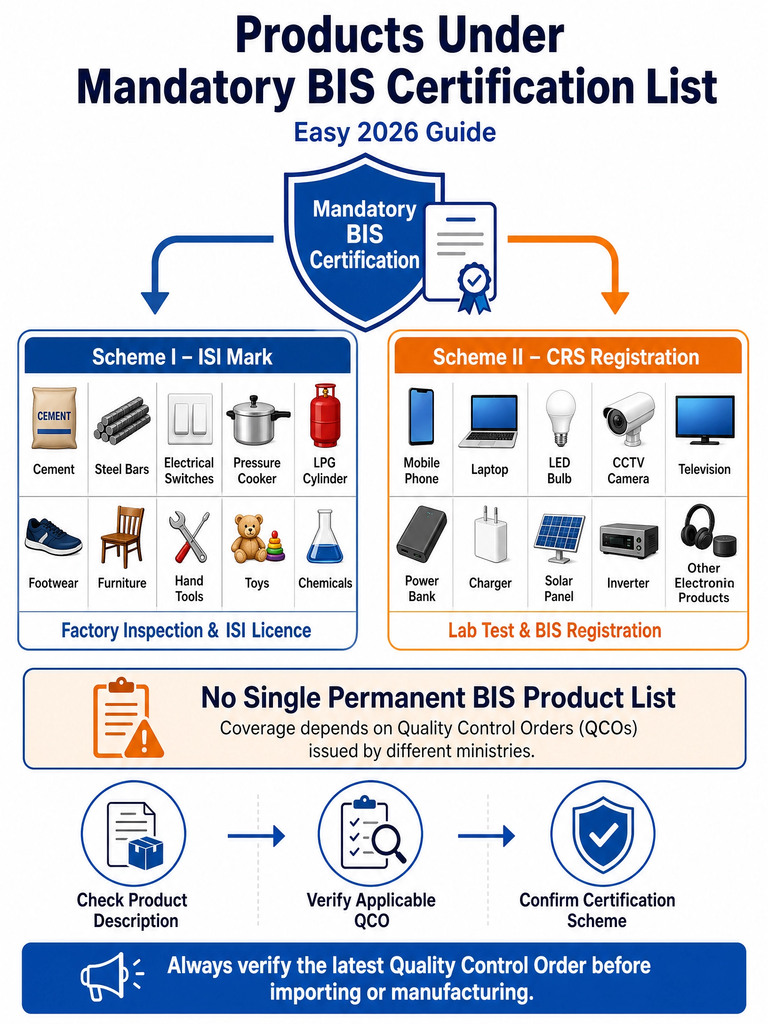
There is no single permanent products under mandatory BIS certification list, and anyone presenting one as fixed is misleading you. Coverage comes from Quality Control Orders issued by line ministries, and those orders are notified, amended and withdrawn continuously. This guide shows the shape of the landscape by sector and scheme. It then gives a reliable method for checking your own product and your components. For an applicability check against your HS codes, see our BIS Certification Services.
The products under mandatory BIS certification list moved in both directions recently. During 2025 and 2026 alone, orders were withdrawn for several metals and for polyester and viscose fibres. Machinery under the Omnibus Technical Regulation was also released.
Who This Products Under Mandatory BIS Certification List Guide Applies To
This guide is for importers, manufacturers and sourcing teams confirming whether a product needs certification. It covers coverage and applicability only. Process, fees and documents each have a dedicated guide linked below. Anyone using a published products under mandatory BIS certification list as a shortcut should still verify the order behind each entry. For clearance support, see our Import Export Consultancy Services.
How the Products Under Mandatory BIS Certification List Works
Three layers decide whether your product sits on the products under mandatory BIS certification list.
A ministry notifies a Quality Control Order, naming products by HS code and description.
The order specifies a scheme, usually Scheme I for the ISI Mark or Scheme II for registration.
BIS administers certification and enforces the mark.
BIS is not the place to check whether you are covered. The notifying ministry’s order is, though the Bureau of Indian Standards administers certification once an order exists.
Never rely on an HS code alone. Orders carve out capacity ranges, voltage ranges, sizes and end uses. Two products can share a code with only one of them on the products under mandatory BIS certification list.
Products Under Mandatory BIS Certification List: ISI Mark Sectors
Phased dates are the trap. Micro and small enterprises frequently receive a later date than medium and large ones, but a phased date still places the product on the products under mandatory BIS certification list.
Products Under Mandatory BIS Certification List: CRS Categories
Family
Typical covered items
IT and computing
Laptops, tablets, monitors, printers, adaptors
Mobile and accessories
Mobile phones, power banks, batteries, chargers
Audio and video
Speakers, amplifiers, televisions, set top boxes
Lighting
LED luminaires, street and road lighting, control gear
What changed in 2026: the Ministry of Heavy Industries rescinded the machinery and electrical equipment Omnibus Technical Regulation through S.O. 239(E) dated 14 January 2026, with immediate effect. Metals orders covering aluminium, copper, nickel, tin and zinc were withdrawn from late 2025. Enforcement dates arrived or were confirmed for furniture, hand tools and certain appliances. Coverage moved in both directions, so treat any published products under mandatory BIS certification list as a snapshot and verify per product rather than per sector.
How to Check Your Product Against the Products Under Mandatory BIS Certification List in 6 Steps
1. Write down the exact specification
Record the HS code plus a full technical description, including rating and capacity.
2. Find the current order
Search Quality Control Orders from the relevant ministry, not from a blog list.
3. Read the scope and the exclusions
Exclusions often cover export production and specified end uses. Reading only the schedule is the common mistake.
4. Identify the named Indian Standard
Note the IS code with its part and section, exactly as the order states.
5. Check for a revision
Confirm whether the standard was revised and whether a concurrent running period is open.
6. Repeat for every component
Break down the bill of materials and run the same check line by line.
Reading a Quality Control Order Correctly
An order is not just a schedule of codes. Five parts decide whether you are covered.
The title and issuing ministry, which confirms the regime.
The commencement clause, which gives the date and may have been amended.
The schedule, listing products, standards and HS codes.
The exclusions, often covering export production and end uses.
Any amendment orders, which change dates and scope repeatedly.
Products That Are Not Covered
Certification is voluntary where the product sits outside the products under mandatory BIS certification list, because no live order names it. That covers most of the Indian Standards catalogue.
Voluntary certification is still used, for tenders, export credibility and buyer confidence. Cost follows the same structure, as set out in BIS certification fees India.
Goods made in India solely for export are generally outside domestic orders. Confirm the wording, since exclusions are drafted order by order.
Common Errors When Checking the Products Under Mandatory BIS Certification List
Relying on an HS code alone: the written description and exclusions decide alongside it.
Treating a withdrawal as permanent: ministries have re notified categories before.
Skipping the bill of materials: a covered component holds an otherwise exempt shipment.
Ignoring phased dates: a later date for small units is still a date.
Missing a standard revision: a licence against a superseded version fails at customs.
Trusting a supplier’s claim: verify the licence on the BIS portal instead.
Three points are worth carrying away about the products under mandatory BIS certification list. Coverage comes from ministry orders, not from BIS, and it moves in both directions. An HS code never decides applicability on its own. Components need their own check, because component orders catch finished goods makers.
JPARKS INDIA handles BIS certification alongside ICEGATE registration, AD Code mapping, IGCR clearance and Importer of Record work. We have served 500+ importers and exporters. Our team carries 35+ years of EXIM experience and a 5.0 Google rating.
Send us your HS codes and bill of materials and we will confirm what is covered today. Visit JPARKS INDIA or use the Contact Page.
Frequently Asked Questions
Q1. How many products are under mandatory BIS certification?
The number changes constantly as orders are notified and withdrawn. Any fixed figure in an article is out of date within months.
Q2. Where is the official list published?
There is no single official products under mandatory BIS certification list. Coverage sits in the Quality Control Orders issued by the notifying ministries, and in the gazette. BIS then administers certification for those products.
Q3. Is machinery still under mandatory BIS certification in 2026?
The machinery Omnibus Technical Regulation was rescinded through S.O. 239(E) dated 14 January 2026. Components inside machinery may still fall under separate orders.
Q4. Does my HS code decide whether BIS applies?
Not by itself. The written description, capacity limits and exclusions decide alongside the code.
Q5. Are components covered separately from finished products?
Often yes. Audit the bill of materials line by line, because a covered component can hold up a shipment.
Q6. Is BIS required for products made only for export?
Generally no, where the order excludes export production. Confirm the specific wording, and remember destination country rules apply separately.
Q7. How do I know if a standard has been revised?
Track revision circulars for every IS code you rely on. A concurrent running period allows both versions temporarily, then closes.
Q8. Can a withdrawn order come back?
Yes. Withdrawal removes one obligation and is not a permanent exemption. Sector specific orders have replaced broader ones before.
Q9. How often does the products under mandatory BIS certification list change?
Several times a year. Ministries notify, amend and rescind orders on their own timetable, so re-check the products under mandatory BIS certification list before every new shipment or product launch.
Need this handled for you?
Tell us where you are stuck. We usually reply the same business day.
5.0 ★ · 123 Google reviews · Since 1990
Posted on Google
Vandana Bajaj
Trustindex verifies that the original source of the review is Google.
Very prompt and reliable service by Rahul Kolge and his team. Exceptional and happy experience.
Posted on Google
Supriya Shetye
Trustindex verifies that the original source of the review is Google.
Had a really good experience with JParks India. Rahul sir helped me a lot with my import work and were always active and responsive. Whatever documents or guidance was needed, they handled everything smoothly and explained things clearly. Felt stress-free throughout the process. Very helpful team, definitely recommend them if you’re doing import or export.
Posted on Google
dipali sakpal
Trustindex verifies that the original source of the review is Google.
Very nice people, get the work done in a very short time.
Posted on Google
Satish Bajaj
Trustindex verifies that the original source of the review is Google.
Excellent & Prompt services in all Import Export matters.
Great to work with you
Posted on Google
Bajaj VCPL
Trustindex verifies that the original source of the review is Google.
It was a great experience having work with you.
Posted on Google
Satish Bajaj
Trustindex verifies that the original source of the review is Google.
"Outstanding professiona services, efficient, and gets things done incredibly fast. Highly recommended for anyone needing reliable and prompt assistance
Posted on Google
Nishat fatima
Trustindex verifies that the original source of the review is Google.
excellent service
Posted on Google
farhan sayed
Trustindex verifies that the original source of the review is Google.
JParks Team is Super helpful! Thanks to Rahul and team!
Posted on Google
Sadik Inamdar
Trustindex verifies that the original source of the review is Google.
Good and personal service for import export code
Posted on Google
Maheshwar
Trustindex verifies that the original source of the review is Google.
Had a really good experience with JParks India. Rahul sir helped me a lot with my import work and were always active and responsive. Whatever documents or guidance was needed, they handled everything smoothly and explained things clearly. Felt stress-free throughout the process. Very helpful team, definitely recommend them if you’re doing import or export.
Verified by Trustindex
Trustindex verified badge is the Universal Symbol of Trust. Only the greatest companies can get the verified badge who has a review score above 4.5, based on customer reviews over the past 12 months. Read more
We use cookies to run this site, measure traffic, and track our ads. Essential cookies are always on. Accept all, reject non-essential, or set your preferences.
Cookie Preferences
Manage your cookie preferences below:
Essential cookies enable basic functions and are necessary for the proper function of the website.
Name
Description
Duration
Cookie Preferences
This cookie is used to store the user's cookie consent preferences.
30 days
Google reCAPTCHA helps protect websites from spam and abuse by verifying user interactions through challenges.
Name
Description
Duration
_GRECAPTCHA
Google reCAPTCHA sets a necessary cookie (_GRECAPTCHA) when executed for the purpose of providing its risk analysis.
179 days
Google Tag Manager simplifies the management of marketing tags on your website without code changes.
Name
Description
Duration
cookiePreferences
Registers cookie preferences of a user
2 years
td
Registers statistical data on users' behaviour on the website. Used for internal analytics by the website operator.
session
Statistics cookies collect information anonymously. This information helps us understand how visitors use our website.
Google Analytics is a web analytics service that tracks and reports website traffic. It collects anonymized data on how visitors use the site to help us understand and improve performance.