Certificate of Origin Required: Which Countries Demand One
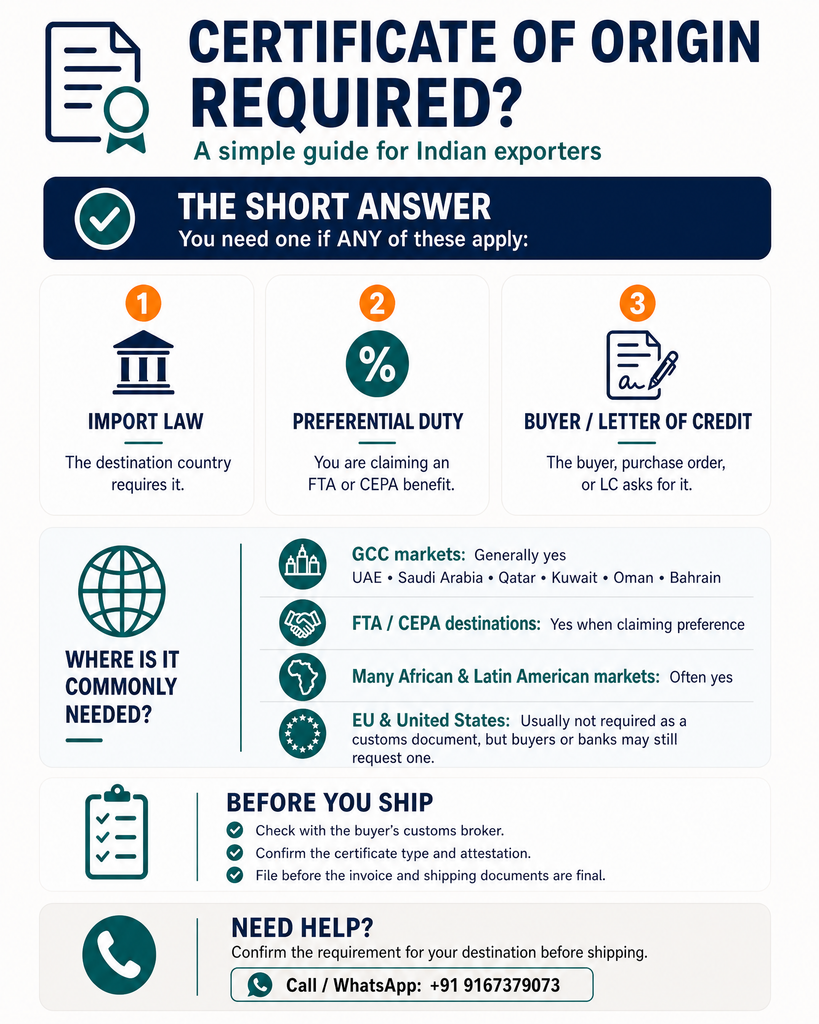
Where a certificate of origin required question comes up, the answer depends on three things: the destination country’s own import rules, whether you are claiming preferential duty, and what your buyer’s bank has written into the letter of credit. Any one of them can make the document mandatory even when the other two do not.
There is no single global list, and any page claiming to give you one is simplifying. What follows is the structure of the answer, plus the country groups where the requirement is consistently strict.
For the Indian import side of the same question, our certificate of origin for import guide covers CAROTAR and proof of origin obligations.
Three Tests That Make a Certificate of Origin Required
Test one: the destination’s import law. In some markets a certificate of origin required by import law applies to all or most commercial consignments, regardless of duty treatment. Gulf states, several African and Latin American markets, and a number of Middle Eastern jurisdictions fall into this group.
Test two: your duty claim. If you or your buyer are claiming preference under a trade agreement notified by DGFT, an appropriate proof of origin is mandatory. Without it the shipment clears at the normal rate.
Test three: the commercial contract. A letter of credit or purchase order that calls for one makes a certificate of origin required as a matter of contract, and the bank will treat its absence as a discrepancy.
If any test is met, raise the certificate. The cost of obtaining one is trivial against the cost of a held consignment, and our certificate of origin filing service covers both types.
Country groups where it is consistently required
Group
Typical position
Notes
GCC states (UAE, Saudi Arabia, Qatar, Kuwait, Oman, Bahrain)
Generally required for commercial imports
Attestation requirements vary and change; verify per shipment
Countries with an FTA or CEPA with India
Required to claim preference, optional otherwise
India-Oman CEPA eCoO live from 1 June 2026
Many African and Latin American markets
Frequently required
Some also require consular or chamber attestation
European Union
Not generally required for MFN entry
Preference runs on REX statements on origin
United States
Not generally required as a customs document
Buyers and banks still ask for one commercially
Treat this certificate of origin required table as a starting point for the conversation with your buyer’s customs broker, not as a substitute for it. Import requirements change without much notice, and attestation rules in particular are revised often.
Preferential and non-preferential: which one is required
Non-preferential
Preferential
Purpose
Proves country of production for customs, banks, quotas
Claims reduced or zero duty under an agreement
When it is required
Destination rule, LC, or trade remedy exposure
Whenever preference is claimed
Issued by
Appendix 2E bodies
Agency notified for that agreement
Evidence burden
Moderate
High, product-specific rules apply
How to Confirm a Certificate of Origin Required Before You Ship
Ask the buyer’s customs broker directly. They clear in that jurisdiction weekly and their answer is current.
Read the letter of credit line by line. Note the certificate type, issuing body, originals required and any attestation.
Check whether an agreement applies to your commodity code and destination, and whether the duty saving justifies the evidence work.
Confirm attestation requirements. Some markets need embassy or consular attestation on top of agency issuance, and that adds days.
Fix the issuing agency early, using the guidance in our chamber of commerce guide.
Q1. Is a certificate of origin required for every export from India?
There is no fixed global list. GCC states, many African and Latin American markets, and any destination where you are claiming preference under a trade agreement are the consistent cases. Confirm per market with the buyer’s broker.
Q2. Is a certificate of origin required for exports to the United States?
Not usually as a customs requirement. Buyers and banks frequently ask for one commercially, and India is no longer eligible for US GSP in any case.
Q3. Is it required for the European Union?
Not for normal MFN entry. Preferential entry from India runs on REX statements on origin rather than an agency-issued certificate.
Q4. Is it required for UAE and other GCC markets?
Generally yes for commercial consignments, and some also require consular or chamber attestation. Verify the current position for each shipment.
Q5. What if my buyer has not asked for one?
Check anyway. The destination’s import law operates independently of your buyer’s instructions, and the buyer is not always the party clearing the goods.
Q6. Do I need one to claim FTA benefits?
Yes. A preference claim needs an appropriate proof of origin issued or self-certified under that specific agreement.
Q7. What happens if the consignment arrives without one?
The likely outcomes are a clearance hold while a certificate is arranged, loss of the preferential rate, and demurrage. Retrospective issuance is sometimes possible but must be marked as such.
Need this handled for you?
Tell us where you are stuck. We usually reply the same business day.
5.0 ★ · 123 Google reviews · Since 1990
Posted on Google
Vandana Bajaj
Trustindex verifies that the original source of the review is Google.
Very prompt and reliable service by Rahul Kolge and his team. Exceptional and happy experience.
Posted on Google
Supriya Shetye
Trustindex verifies that the original source of the review is Google.
Had a really good experience with JParks India. Rahul sir helped me a lot with my import work and were always active and responsive. Whatever documents or guidance was needed, they handled everything smoothly and explained things clearly. Felt stress-free throughout the process. Very helpful team, definitely recommend them if you’re doing import or export.
Posted on Google
dipali sakpal
Trustindex verifies that the original source of the review is Google.
Very nice people, get the work done in a very short time.
Posted on Google
Satish Bajaj
Trustindex verifies that the original source of the review is Google.
Excellent & Prompt services in all Import Export matters.
Great to work with you
Posted on Google
Bajaj VCPL
Trustindex verifies that the original source of the review is Google.
It was a great experience having work with you.
Posted on Google
Satish Bajaj
Trustindex verifies that the original source of the review is Google.
"Outstanding professiona services, efficient, and gets things done incredibly fast. Highly recommended for anyone needing reliable and prompt assistance
Posted on Google
Nishat fatima
Trustindex verifies that the original source of the review is Google.
excellent service
Posted on Google
farhan sayed
Trustindex verifies that the original source of the review is Google.
JParks Team is Super helpful! Thanks to Rahul and team!
Posted on Google
Sadik Inamdar
Trustindex verifies that the original source of the review is Google.
Good and personal service for import export code
Posted on Google
Maheshwar
Trustindex verifies that the original source of the review is Google.
Had a really good experience with JParks India. Rahul sir helped me a lot with my import work and were always active and responsive. Whatever documents or guidance was needed, they handled everything smoothly and explained things clearly. Felt stress-free throughout the process. Very helpful team, definitely recommend them if you’re doing import or export.
Verified by Trustindex
Trustindex verified badge is the Universal Symbol of Trust. Only the greatest companies can get the verified badge who has a review score above 4.5, based on customer reviews over the past 12 months. Read more
We use cookies to run this site, measure traffic, and track our ads. Essential cookies are always on. Accept all, reject non-essential, or set your preferences.
Cookie Preferences
Manage your cookie preferences below:
Essential cookies enable basic functions and are necessary for the proper function of the website.
Name
Description
Duration
Cookie Preferences
This cookie is used to store the user's cookie consent preferences.
30 days
Google reCAPTCHA helps protect websites from spam and abuse by verifying user interactions through challenges.
Name
Description
Duration
_GRECAPTCHA
Google reCAPTCHA sets a necessary cookie (_GRECAPTCHA) when executed for the purpose of providing its risk analysis.
179 days
Google Tag Manager simplifies the management of marketing tags on your website without code changes.
Name
Description
Duration
cookiePreferences
Registers cookie preferences of a user
2 years
td
Registers statistical data on users' behaviour on the website. Used for internal analytics by the website operator.
session
Statistics cookies collect information anonymously. This information helps us understand how visitors use our website.
Google Analytics is a web analytics service that tracks and reports website traffic. It collects anonymized data on how visitors use the site to help us understand and improve performance.