ISI Mark vs BIS Registration: 7 Easy Differences for 2026
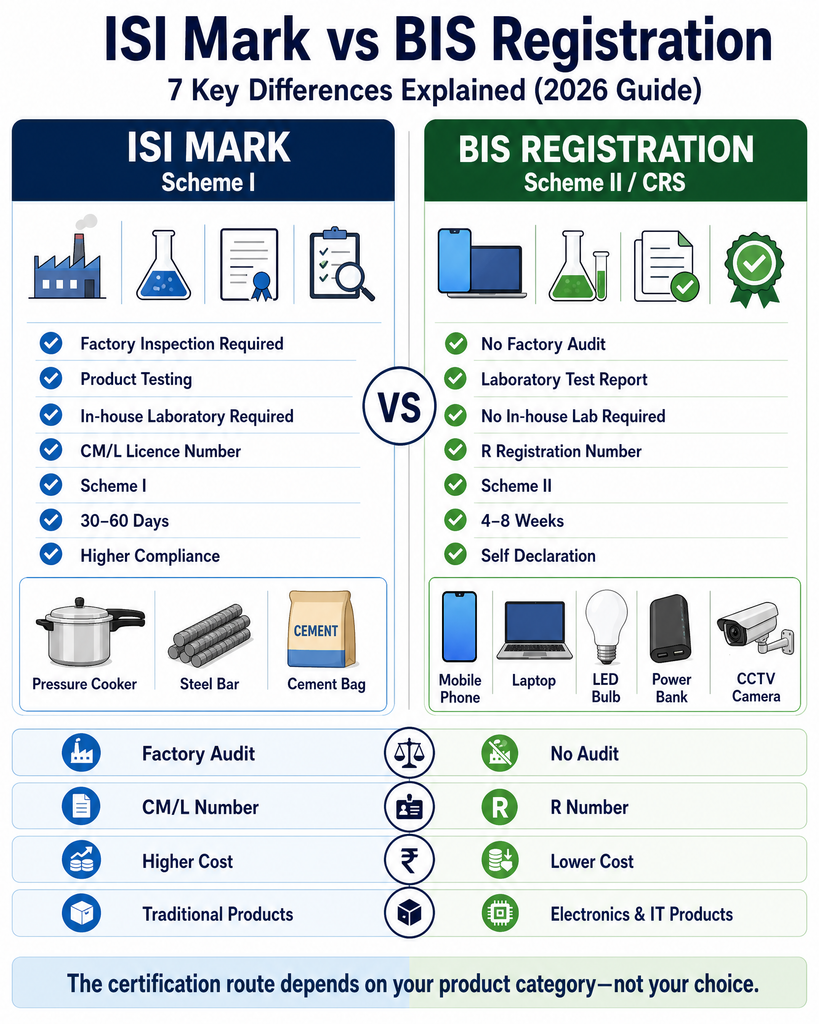
ISI Mark vs BIS registration comes down to one thing: the factory inspection. The ISI Mark is granted under Scheme I after product testing and a factory audit, and carries a CM/L number. BIS registration is granted under Scheme II on a laboratory test report, with no audit, and carries an R number. You rarely choose between them, because the notified product category decides. For help confirming which route applies, see our BIS Certification Services.
Where ISI Mark vs BIS registration really matters is planning. One route needs an in house laboratory at the plant, and the other does not.
Who This ISI Mark vs BIS Registration Guide Applies To
This guide is for manufacturers and importers deciding how to certify a product, and for buyers reading a supplier’s certificate. It compares the two routes across every dimension that affects cost, timing and eligibility. Deep rules for each scheme sit in separate guides. If you are weighing ISI Mark vs BIS registration for the first time, start with the comparison table below. For wider help, review our Import Export Consultancy Services.
ISI Mark vs BIS Registration in One Table
Dimension
ISI Mark, Scheme I
BIS Registration, Scheme II
Legal instrument
Licence
Registration
Mark
ISI Mark
Standard Mark
Number format
CM/L and ten digits
R and digits
Factory inspection
Required
Not required
In house laboratory
Required
Not required
Basis of grant
Testing plus factory assessment
Test report and declaration
Foreign factories
Must apply through FMCS
Apply directly under Scheme II
Typical timeline
30 to 60 days
4 to 8 weeks
Relative cost
Higher
Lower
Surveillance
Factory inspection and market samples
Market and customs samples
Everything else in ISI Mark vs BIS registration follows from one row. The factory inspection is the fork in the road.
ISI Mark vs BIS Registration: Which Route Applies to Your Product
Product family
Route
Cement, steel, pressure cookers, cylinders
ISI Mark
Household electrical appliances under their orders
ISI Mark
Footwear, furniture, hand tools under their orders
ISI Mark vs BIS Registration: Why the Marks Are Not Interchangeable
An ISI Mark implies a factory has been assessed. A registration does not.
That is why a CM/L number carries more weight in tenders and in business to business supply. The law treats both as valid compliance.
It also explains a common mistake. A manufacturer with an R number sometimes advertises the product as ISI certified, which creates enforcement risk.
What changed in 2026: the BIS (Conformity Assessment) Amendment Regulations, 2026, notified on 25 February 2026, applied to both sides of ISI Mark vs BIS registration. Validity extended to up to five years, fees became payable annually in advance, and non payment now triggers a ninety day suspension. Scheme II was also framed around self declaration of conformity, with electronic labelling permitted for products with an integrated display.
ISI Mark vs BIS Registration: Cost and Effort Compared
Registration costs you a test report. A licence costs you a test report plus a factory that can pass an audit.
Under Scheme I you need manufacturing machinery, in house test equipment with current calibration, quality personnel and records. Building that capability is often larger than the certification cost itself.
Under Scheme II the outcome rests on the test report and the model list. Fee detail sits in BIS certification fees India.
Foreign Manufacturers Face a Split
If the product is an ISI category, the foreign factory must use FMCS. That means an Authorized Indian Representative, a Performance Bank Guarantee of USD 10,000, and an overseas inspection.
If the product is a CRS category, the foreign factory applies under Scheme II directly. The basis is the same as for an Indian factory, so ISI Mark vs BIS registration turns on the category, not on where the plant sits.
One company can therefore face a four to six month route for one product. Another of its products may take four to eight weeks. See BIS FMCS Registration.
ISI Mark vs BIS Registration: Surveillance Compared
Aspect
ISI Mark, Scheme I
BIS Registration, Scheme II
Routine oversight
Surveillance inspections at the factory
Market and customs sampling
Trigger for action
Inspection findings or complaints
Sample failure or complaint
Practical exposure
Continuous factory discipline
Production consistency against the tested sample
Registration looks lighter at application stage. It is not lighter afterwards, because a market sample can be drawn at any time.
Reading a Supplier Certificate Correctly
Buyers are shown certificates constantly, and most never read them properly. Four fields decide whether the document means anything.
The number format. A CM/L prefix means a licence with a factory audit behind it. An R prefix means a registration on a test report.
The factory address. The certificate covers one plant. Goods shipped from a second plant are not covered by it.
The standard reference. Confirm the IS number, including part and section, and check it has not been superseded.
The model list. A certificate naming one model does not extend to a variant, however similar.
Verify the number itself rather than the image. A scanned certificate proves only that a scanner was used, and the prefix settles ISI Mark vs BIS registration faster than any logo on the page.
ISI Mark vs BIS Registration Decision Table
If this is true
Then
Product is in a MeitY notified electronics or IT category
Scheme II registration
Product is in another ministry’s Quality Control Order
Scheme I ISI Mark
Factory is outside India and product is an ISI category
FMCS
Factory is outside India and product is a CRS category
Three points are worth carrying away from ISI Mark vs BIS registration. The category decides the route, not your preference. The factory audit is the real difference, and it drives both cost and timeline. Foreign manufacturers can face both routes across a single product range.
JPARKS INDIA handles BIS certification alongside ICEGATE registration, AD Code mapping, IGCR clearance and Importer of Record work. We have served 500+ importers and exporters since 2018. Our team carries 40 years of EXIM experience and a 5.0 Google rating.
Send us the product description and the HS code and we will confirm the route before you spend anything. Visit JPARKS INDIA or use the Contact Page.
Frequently Asked Questions
Q1. Is the ISI Mark the same as BIS certification?
No. The ISI Mark is one output of BIS certification. Registration under the CRS is another. Both are BIS certification.
Q2. Can I choose between the ISI Mark and BIS registration?
Generally no. In ISI Mark vs BIS registration the notified category decides the route. Where a product is voluntary, the scheme still follows the standard and product type.
Q3. Which is cheaper, ISI or CRS registration?
Registration, because it removes factory inspection and the in house laboratory requirement.
Q4. Which is faster?
Registration, typically four to eight weeks against thirty to sixty days for an ISI licence.
Q5. Does an R number allow me to print the ISI Mark?
No. The marks and the numbers are different. Using an ISI Mark without an ISI licence is a contravention.
Q6. Do both routes need annual fees now?
Yes. Following the 2026 amendment, both carry annual advance fee payment and production statement obligations.
Q7. Which one do tenders prefer?
Many tenders name the ISI Mark specifically, because it implies a factory assessment. Check the tender wording rather than assuming equivalence.
Q8. How do I confirm ISI Mark vs BIS registration for my product?
Send the product description and the HS code. The live Quality Control Order or CRS notification settles ISI Mark vs BIS registration before any test report is booked.
Need this handled for you?
Tell us where you are stuck. We usually reply the same business day.
5.0 ★ · 126 Google reviews · Since 1990
Posted on Google
Vandana Bajaj
Trustindex verifies that the original source of the review is Google.
Very prompt and reliable service by Rahul Kolge and his team. Exceptional and happy experience.
Posted on Google
Supriya Shetye
Trustindex verifies that the original source of the review is Google.
Had a really good experience with JParks India. Rahul sir helped me a lot with my import work and were always active and responsive. Whatever documents or guidance was needed, they handled everything smoothly and explained things clearly. Felt stress-free throughout the process. Very helpful team, definitely recommend them if you’re doing import or export.
Posted on Google
dipali sakpal
Trustindex verifies that the original source of the review is Google.
Very nice people, get the work done in a very short time.
Posted on Google
Satish Bajaj
Trustindex verifies that the original source of the review is Google.
Excellent & Prompt services in all Import Export matters.
Great to work with you
Posted on Google
Bajaj VCPL
Trustindex verifies that the original source of the review is Google.
It was a great experience having work with you.
Posted on Google
Satish Bajaj
Trustindex verifies that the original source of the review is Google.
"Outstanding professiona services, efficient, and gets things done incredibly fast. Highly recommended for anyone needing reliable and prompt assistance
Posted on Google
Nishat fatima
Trustindex verifies that the original source of the review is Google.
excellent service
Posted on Google
farhan sayed
Trustindex verifies that the original source of the review is Google.
JParks Team is Super helpful! Thanks to Rahul and team!
Posted on Google
Sadik Inamdar
Trustindex verifies that the original source of the review is Google.
Good and personal service for import export code
Posted on Google
Maheshwar
Trustindex verifies that the original source of the review is Google.
Had a really good experience with JParks India. Rahul sir helped me a lot with my import work and were always active and responsive. Whatever documents or guidance was needed, they handled everything smoothly and explained things clearly. Felt stress-free throughout the process. Very helpful team, definitely recommend them if you’re doing import or export.
Verified by Trustindex
Trustindex verified badge is the Universal Symbol of Trust. Only the greatest companies can get the verified badge who has a review score above 4.5, based on customer reviews over the past 12 months. Read more
We use cookies to run this site, measure traffic, and track our ads. Essential cookies are always on. Accept all, reject non-essential, or set your preferences.
Cookie Preferences
Manage your cookie preferences below:
Essential cookies enable basic functions and are necessary for the proper function of the website.
Name
Description
Duration
Cookie Preferences
This cookie is used to store the user's cookie consent preferences.
30 days
Google reCAPTCHA helps protect websites from spam and abuse by verifying user interactions through challenges.
Name
Description
Duration
_GRECAPTCHA
Google reCAPTCHA sets a necessary cookie (_GRECAPTCHA) when executed for the purpose of providing its risk analysis.
179 days
Google Tag Manager simplifies the management of marketing tags on your website without code changes.
Name
Description
Duration
cookiePreferences
Registers cookie preferences of a user
2 years
td
Registers statistical data on users' behaviour on the website. Used for internal analytics by the website operator.
session
Statistics cookies collect information anonymously. This information helps us understand how visitors use our website.
Google Analytics is a web analytics service that tracks and reports website traffic. It collects anonymized data on how visitors use the site to help us understand and improve performance.