Certificate of Origin Format: Every Box Explained for 2026
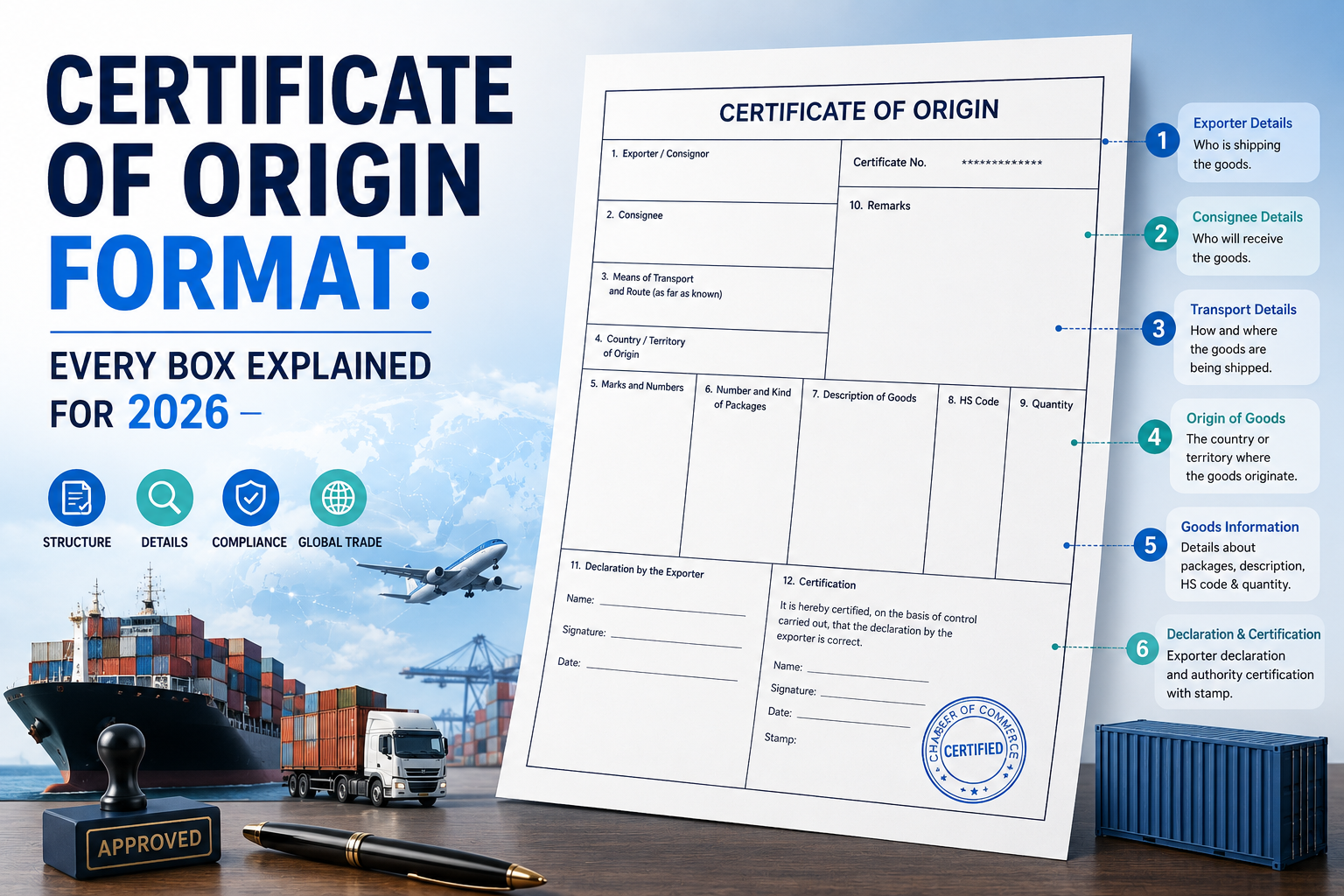
The certificate of origin format used in India follows a standard twelve-box layout covering the consignor, consignee, route, goods description, origin criteria, quantity, invoice reference and two declarations. The layout is now generated by the Trade Connect ePlatform rather than typed onto a printed blank, because DGFT withdrew printed blank certificates in January 2025.
That change removed a whole class of errors and created a new one. You no longer control the layout, but you do control every field that feeds it, and the platform will not fix a description you wrote badly.
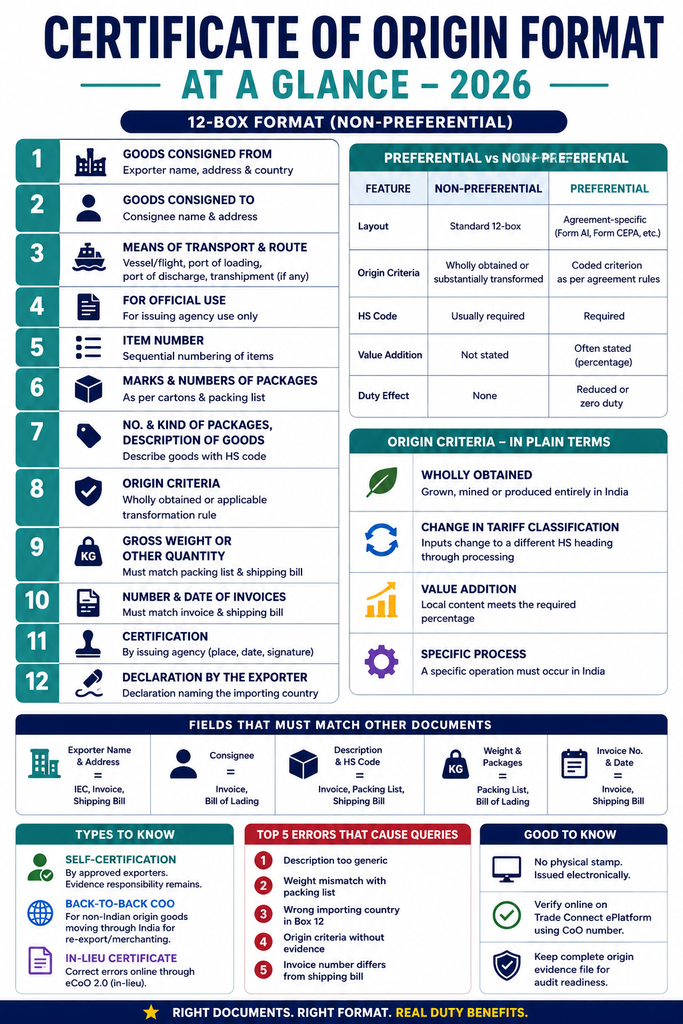
The certificate of origin ormat Differs for Preferential Claims
Feature
Non-preferential
Preferential
Layout
Standard twelve-box format
Agreement-specific form (Form AI, Form CEPA, and so on)
Origin criteria box
Simple “wholly obtained” or “substantially transformed”
Coded criterion tied to the agreement’s rules
HS code
Usually required
Required, and drives the applicable rule
Value addition
Not stated
Often stated as a percentage
Duty effect
None
Reduced or zero duty if accepted
The Certificate of Origin Format: Twelve Boxes, One by One
Box 1, goods consigned from. Exporter’s name, full address and country. This must match the IEC record, because the platform pulls it forward.
Box 2, goods consigned to. Consignee’s name and address in the destination country. If the buyer and the consignee differ, name the consignee and reflect the buyer in the invoice.
Box 3, means of transport and route. Vessel or flight, port of loading and port of discharge. Name any transhipment point, because an unexplained third-country route is a standard trigger for verification.
Box 4, for official use. Left blank by the exporter. The agency uses it.
Box 5, item number. Sequential line numbering where you have multiple products.
Box 6, marks and numbers of packages. Copy exactly what appears on the cartons and the packing list.
Box 7, number and kind of packages, description of goods. The field that causes most rejections. Describe the goods the way the tariff describes them, include the HS code, and avoid trade shorthand.
Box 8, origin criteria. Either wholly obtained, or the applicable substantial transformation rule. Under a preferential claim this is a coded entry, not free text.
Box 9, gross weight or other quantity. Must agree with the packing list and the shipping bill.
Box 10, number and date of invoices. The invoice number here must match the shipping bill. Notification 05/2026-27 made this an automated verification point.
Box 11, certification. Completed by the issuing agency with place, date and signature.
Box 12, declaration by the exporter. Your declaration naming the importing country. Naming the wrong country is a surprisingly common and entirely avoidable defect.
Origin criteria, in plain terms
Criterion
What it means
Evidence you must hold
Wholly obtained
Grown, mined, or produced entirely in India
Production records, procurement trail
Change in tariff classification
Inputs shift heading or subheading through processing
Input HS codes, output HS code, process note
Value addition
Local content meets the agreement’s threshold
Costed bill of materials
Specific process
A named operation must occur in India
Process description, plant records
Certificate of Origin Format Fields That Must Match Other Documents
Origin verification is now largely a matching exercise, so build the document set from one source of truth.
Certificate field
Must agree with
Exporter name and address
IEC record, invoice, shipping bill
Consignee
Invoice, bill of lading
Goods description and HS code
Invoice, packing list, shipping bill
Gross weight and package count
Packing list, bill of lading
Invoice number and date
Commercial invoice, shipping bill
The HSN code entry deserves particular attention, because it determines which origin rule applies as well as which duty line the buyer pays.
Self-certification and back-to-back certificates
Self-certification. Notification 05/2026-27 provides for self-certification by approved exporters. It removes the agency step but not the evidence burden, and the origin file still has to stand up.
Back-to-back non-preferential certificates. Introduced by Public Notice 43/2024-25 dated 27 January 2025, these cover goods that are not of Indian origin moving through India for re-export, transhipment or merchanting trade. The certificate explicitly records the foreign country of origin and the supporting documents relied on. Do not use a standard Indian-origin certificate for this.
In-lieu certificates. Where a certificate has already been issued with an error, the platform allows an online in-lieu correction rather than a fresh application.
The five certificate of origin format errors that cause queries
Description too generic. “Spare parts” or “chemicals” will not survive scrutiny. Use tariff language.
Weight disagreeing with the packing list. Gross and net get swapped more often than you would think.
Wrong importing country in Box 12. Usually a copy-paste from the previous shipment.
Origin criteria asserted without evidence. Especially value addition claimed without a costed bill of materials.
Invoice number differing from the shipping bill. Now caught automatically rather than at inspection.
How JPARKS INDIA Helps
JPARKS INDIA prepares origin documentation alongside the customs clearance it feeds, so the certificate, the invoice and the shipping bill are built to agree from the start.
Field-by-field preparation of the certificate of origin format against your invoice and packing list.
Origin criteria assessment and evidence file build, including costed bills of materials.
Classification review so the HS code on the certificate matches the one on the shipping bill.
Q1. How many fields does the certificate of origin format have?
The standard non-preferential layout has twelve boxes. Preferential certificates follow agreement-specific forms with broadly similar fields plus coded origin criteria.
Q2. Is the certificate of origin format the same for preferential and non-preferential certificates?
No. Non-preferential uses the standard twelve-box layout. Preferential uses the form prescribed by the relevant agreement, with a coded origin criterion and often a value-addition figure.
Q3. Do I need to put the HS code on the certificate?
Yes in practice, and always for a preferential claim, because the HS code determines which product-specific origin rule applies.
Q4. How detailed must the goods description be?
Detailed enough to match the tariff heading and the invoice. Generic commercial shorthand is the most frequent cause of queries at the destination.
Q5. Can I correct a certificate after issuance?
Yes. eCoO 2.0 supports an in-lieu certificate, applied for online, rather than requiring a fresh application.
Q6. What is a back-to-back certificate of origin?
A non-preferential certificate for goods that are not of Indian origin, moving through India for re-export or merchanting trade. It names the actual foreign country of origin.
Q7. Does the certificate still need a physical stamp?
No. Issuance is electronic and verification is done by entering the CoO number on the Trade Connect ePlatform.
Need this handled for you?
Tell us where you are stuck. We usually reply the same business day.
5.0 ★ · 126 Google reviews · Since 1990
Posted on Google
Vandana Bajaj
Trustindex verifies that the original source of the review is Google.
Very prompt and reliable service by Rahul Kolge and his team. Exceptional and happy experience.
Posted on Google
Supriya Shetye
Trustindex verifies that the original source of the review is Google.
Had a really good experience with JParks India. Rahul sir helped me a lot with my import work and were always active and responsive. Whatever documents or guidance was needed, they handled everything smoothly and explained things clearly. Felt stress-free throughout the process. Very helpful team, definitely recommend them if you’re doing import or export.
Posted on Google
dipali sakpal
Trustindex verifies that the original source of the review is Google.
Very nice people, get the work done in a very short time.
Posted on Google
Satish Bajaj
Trustindex verifies that the original source of the review is Google.
Excellent & Prompt services in all Import Export matters.
Great to work with you
Posted on Google
Bajaj VCPL
Trustindex verifies that the original source of the review is Google.
It was a great experience having work with you.
Posted on Google
Satish Bajaj
Trustindex verifies that the original source of the review is Google.
"Outstanding professiona services, efficient, and gets things done incredibly fast. Highly recommended for anyone needing reliable and prompt assistance
Posted on Google
Nishat fatima
Trustindex verifies that the original source of the review is Google.
excellent service
Posted on Google
farhan sayed
Trustindex verifies that the original source of the review is Google.
JParks Team is Super helpful! Thanks to Rahul and team!
Posted on Google
Sadik Inamdar
Trustindex verifies that the original source of the review is Google.
Good and personal service for import export code
Posted on Google
Maheshwar
Trustindex verifies that the original source of the review is Google.
Had a really good experience with JParks India. Rahul sir helped me a lot with my import work and were always active and responsive. Whatever documents or guidance was needed, they handled everything smoothly and explained things clearly. Felt stress-free throughout the process. Very helpful team, definitely recommend them if you’re doing import or export.
Verified by Trustindex
Trustindex verified badge is the Universal Symbol of Trust. Only the greatest companies can get the verified badge who has a review score above 4.5, based on customer reviews over the past 12 months. Read more
We use cookies to run this site, measure traffic, and track our ads. Essential cookies are always on. Accept all, reject non-essential, or set your preferences.
Cookie Preferences
Manage your cookie preferences below:
Essential cookies enable basic functions and are necessary for the proper function of the website.
Name
Description
Duration
Cookie Preferences
This cookie is used to store the user's cookie consent preferences.
30 days
Google reCAPTCHA helps protect websites from spam and abuse by verifying user interactions through challenges.
Name
Description
Duration
_GRECAPTCHA
Google reCAPTCHA sets a necessary cookie (_GRECAPTCHA) when executed for the purpose of providing its risk analysis.
179 days
Google Tag Manager simplifies the management of marketing tags on your website without code changes.
Name
Description
Duration
cookiePreferences
Registers cookie preferences of a user
2 years
td
Registers statistical data on users' behaviour on the website. Used for internal analytics by the website operator.
session
Statistics cookies collect information anonymously. This information helps us understand how visitors use our website.
Google Analytics is a web analytics service that tracks and reports website traffic. It collects anonymized data on how visitors use the site to help us understand and improve performance.