Certificate of Origin HSN Code: The Best Guide to Getting Classification Right
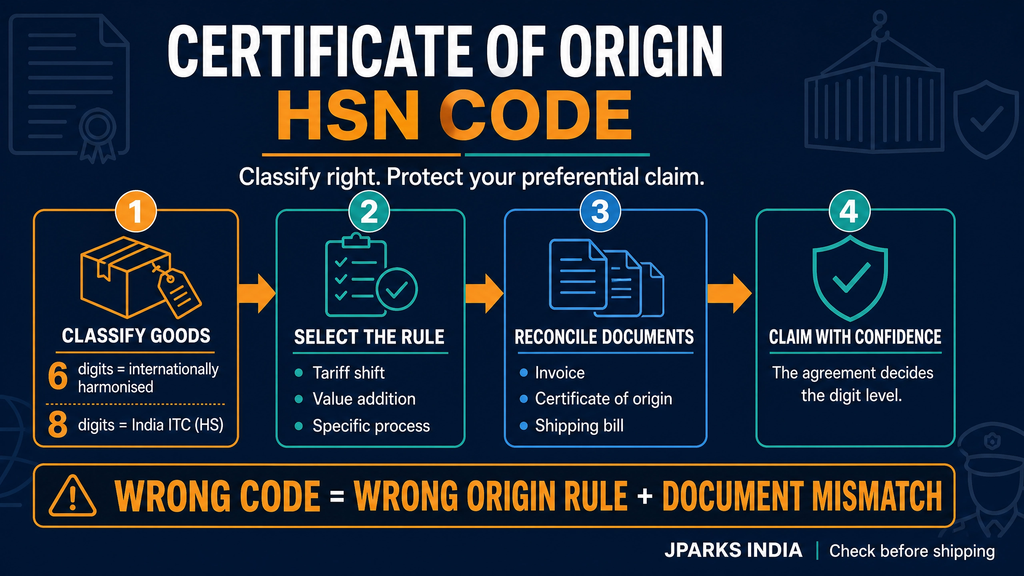
The certificate of origin HSN code is the tariff classification entered against your goods on the certificate, and it does far more than describe them. It selects the product-specific rule of origin that your preference claim will be judged against, and it has to agree with the code on your invoice and shipping bill.
HSN full form: Harmonised System of Nomenclature. India’s national tariff, ITC (HS), extends the international six-digit Harmonised System code to eight digits and is administered by DGFT and CBIC.
Get the code wrong and two things happen at once. The wrong origin rule is applied, and the mismatch between your documents surfaces automatically, because Notification 05/2026-27 built invoice matching into the verification process.
Which Certificate of Origin HSN Code Level Goes on the Form
Level
Digits
Set by
Use
HS heading
4
World Customs Organization
Broad category, internationally common
HS subheading
6
World Customs Organization
The internationally harmonised level
ITC (HS)
8
DGFT and CBIC
India’s national tariff line
The first six digits are internationally common. Beyond six, countries diverge, which is why an Indian eight-digit code will not always map neatly onto the buyer’s national code.
Most origin rules operate at four or six digits. Product-specific rules in trade agreements are written against headings and subheadings, so the six-digit level is usually the one that decides your claim.
Enter what the agreement requires. Where the agreement calls for six digits, six digits is correct. Truncating an eight-digit code to fit a field is not the same thing as classifying at six digits, though the result often looks identical.
How the Certificate of Origin HSN Code Selects Your Origin Rule
Product-specific rules of origin are indexed by tariff classification. Once the code is fixed, so is the test.
Rule type
What it requires
Where the code matters
Change in tariff classification
Non-originating inputs must shift heading or subheading
Both input and output codes decide the answer
Value addition
Local content must meet a threshold
The code selects which threshold applies
Specific process
A named operation must occur in India
The code selects the prescribed process
Combination
Two of the above together
Both tests keyed to the same code
A change in tariff classification claim fails whenever the imported input already sits in the same heading as the finished good. Assembling components from heading 8409 into a product that also classifies in 8409 gives you no tariff shift, however much work was involved.
Where the Certificate of Origin HSN Code Has to Match
Document
Code appears as
Commercial invoice
Usually six or eight digit
Packing list
Often omitted, but should agree if present
Certificate of origin
Six or eight digit per the agreement
Shipping bill
Eight digit ITC (HS)
Bill of entry at destination
The buyer’s national code
The one you cannot control is the last. Your buyer’s broker may classify differently, and if that difference crosses a heading boundary the origin rule changes with it. Agree the classification with the buyer before shipping on any preference claim of real value.
The Five Certificate of Origin HSN Code Mistakes to Avoid
Copying the supplier’s or buyer’s foreign code. Beyond six digits it is not your code, and past six digits the tariffs diverge.
Classifying from the commercial description. Trade names and catalogue categories do not follow the tariff. Classify from the General Rules of Interpretation.
Reading the wrong product-specific rule. Each agreement has its own annex, and the rule for the same code differs between agreements.
Claiming tariff shift where inputs share the heading. The most common failed claim we see.
Truncating the code to fit. If the field takes six digits, classify at six digits deliberately rather than dropping the last two.
When entries conflict
If the code on the certificate and the code on the shipping bill differ, expect a query. The fix depends on which one is wrong.
If the shipping bill is wrong, amend it before the certificate is used. If the certificate is wrong, use the in-lieu certificate facility on the platform rather than issuing a fresh one. If the buyer’s broker disagrees, provide the classification reasoning and the origin workings rather than simply restating the code.
Where a classification is genuinely arguable, document the reasoning at the time. A contemporaneous note explaining why heading X applies is worth considerably more than the same argument reconstructed two years later.
How JPARKS INDIA Helps
JPARKS INDIA has been classifying goods for Indian customs since 1990, and we treat the certificate of origin HSN code and the shipping bill code as one decision rather than two.
Classification opinions grounded in the General Rules of Interpretation, with written reasoning you can produce later.
Product-specific rule mapping for the specific agreement you are claiming under.
Tariff shift and value addition workings from your costed bill of materials.
Document reconciliation across invoice, certificate and shipping bill.
Q1. Which certificate of origin HSN code should I use?
The code that correctly classifies your goods under the Harmonised System, at the digit level the relevant agreement requires. Six digits is the usual internationally comparable level.
Q2. Should I use six or eight digits?
Follow the agreement. Where it specifies six, classify at six. Indian eight-digit ITC (HS) codes are national extensions and will not always match the buyer’s tariff.
Q3. Can I use my supplier’s HS code?
Only up to six digits, and even then verify it. Beyond six digits, national tariffs diverge and a borrowed code can point at the wrong origin rule.
Q4. What happens if the code on the certificate differs from the shipping bill?
Expect a query. Correct whichever document is wrong, using the platform’s in-lieu facility if the certificate is the one at fault.
Q5. Does the HSN code decide whether I get preference?
Indirectly, yes. It selects the product-specific rule of origin your claim is tested against, so a classification error can defeat an otherwise sound claim.
Q6. What is change in tariff classification?
An origin rule requiring that non-originating inputs classify in a different heading or subheading from the finished product, evidencing that substantial transformation occurred.
Q7. Who is responsible if the classification is wrong?
The exporter for the certificate, and the importer for the bill of entry. Under Section 28DA the importer’s duty of reasonable care is not discharged by relying on the exporter’s code.
Need this handled for you?
Tell us where you are stuck. We usually reply the same business day.
5.0 ★ · 123 Google reviews · Since 1990
Posted on Google
Vandana Bajaj
Trustindex verifies that the original source of the review is Google.
Very prompt and reliable service by Rahul Kolge and his team. Exceptional and happy experience.
Posted on Google
Supriya Shetye
Trustindex verifies that the original source of the review is Google.
Had a really good experience with JParks India. Rahul sir helped me a lot with my import work and were always active and responsive. Whatever documents or guidance was needed, they handled everything smoothly and explained things clearly. Felt stress-free throughout the process. Very helpful team, definitely recommend them if you’re doing import or export.
Posted on Google
dipali sakpal
Trustindex verifies that the original source of the review is Google.
Very nice people, get the work done in a very short time.
Posted on Google
Satish Bajaj
Trustindex verifies that the original source of the review is Google.
Excellent & Prompt services in all Import Export matters.
Great to work with you
Posted on Google
Bajaj VCPL
Trustindex verifies that the original source of the review is Google.
It was a great experience having work with you.
Posted on Google
Satish Bajaj
Trustindex verifies that the original source of the review is Google.
"Outstanding professiona services, efficient, and gets things done incredibly fast. Highly recommended for anyone needing reliable and prompt assistance
Posted on Google
Nishat fatima
Trustindex verifies that the original source of the review is Google.
excellent service
Posted on Google
farhan sayed
Trustindex verifies that the original source of the review is Google.
JParks Team is Super helpful! Thanks to Rahul and team!
Posted on Google
Sadik Inamdar
Trustindex verifies that the original source of the review is Google.
Good and personal service for import export code
Posted on Google
Maheshwar
Trustindex verifies that the original source of the review is Google.
Had a really good experience with JParks India. Rahul sir helped me a lot with my import work and were always active and responsive. Whatever documents or guidance was needed, they handled everything smoothly and explained things clearly. Felt stress-free throughout the process. Very helpful team, definitely recommend them if you’re doing import or export.
Verified by Trustindex
Trustindex verified badge is the Universal Symbol of Trust. Only the greatest companies can get the verified badge who has a review score above 4.5, based on customer reviews over the past 12 months. Read more
We use cookies to run this site, measure traffic, and track our ads. Essential cookies are always on. Accept all, reject non-essential, or set your preferences.
Cookie Preferences
Manage your cookie preferences below:
Essential cookies enable basic functions and are necessary for the proper function of the website.
Name
Description
Duration
Cookie Preferences
This cookie is used to store the user's cookie consent preferences.
30 days
Google reCAPTCHA helps protect websites from spam and abuse by verifying user interactions through challenges.
Name
Description
Duration
_GRECAPTCHA
Google reCAPTCHA sets a necessary cookie (_GRECAPTCHA) when executed for the purpose of providing its risk analysis.
179 days
Google Tag Manager simplifies the management of marketing tags on your website without code changes.
Name
Description
Duration
cookiePreferences
Registers cookie preferences of a user
2 years
td
Registers statistical data on users' behaviour on the website. Used for internal analytics by the website operator.
session
Statistics cookies collect information anonymously. This information helps us understand how visitors use our website.
Google Analytics is a web analytics service that tracks and reports website traffic. It collects anonymized data on how visitors use the site to help us understand and improve performance.