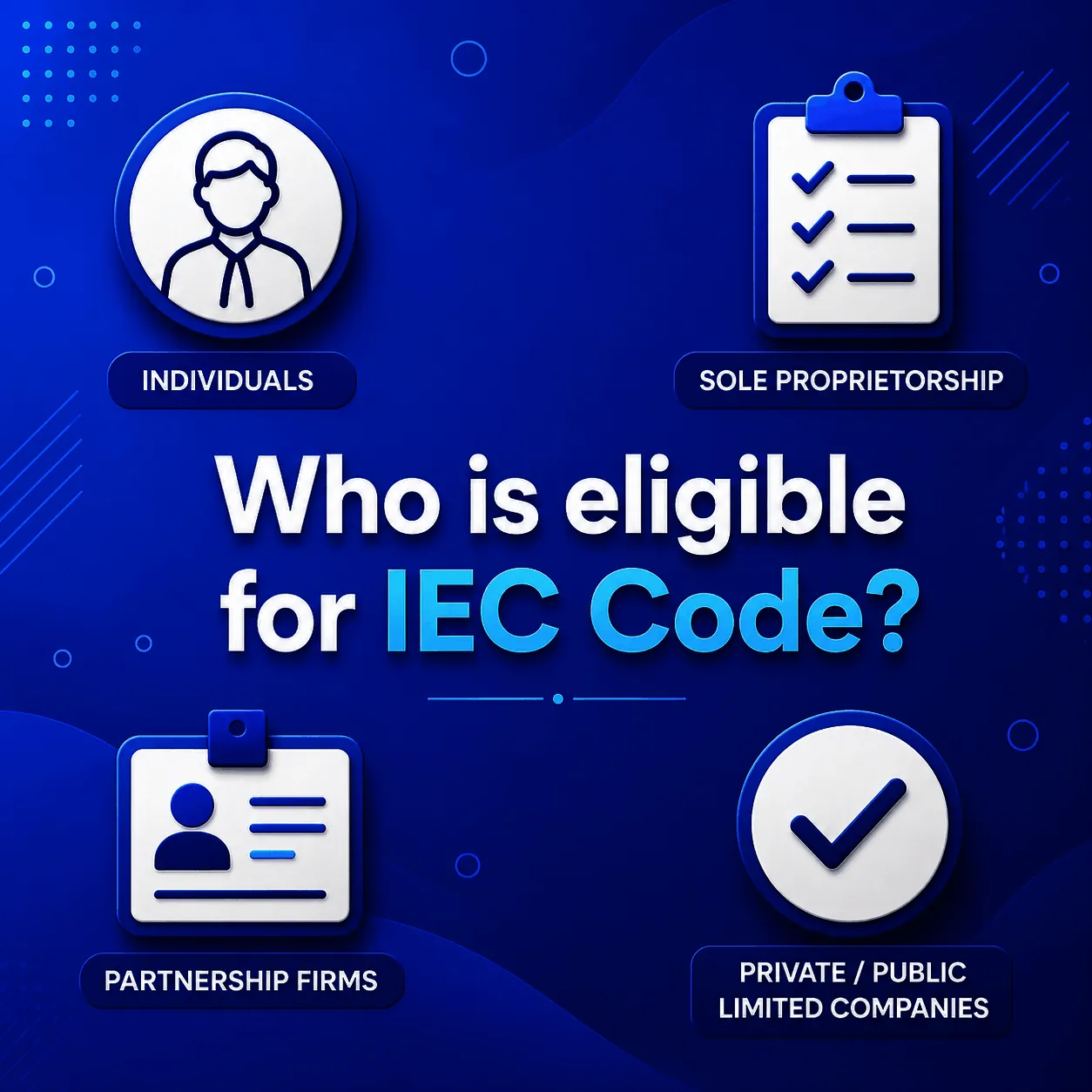
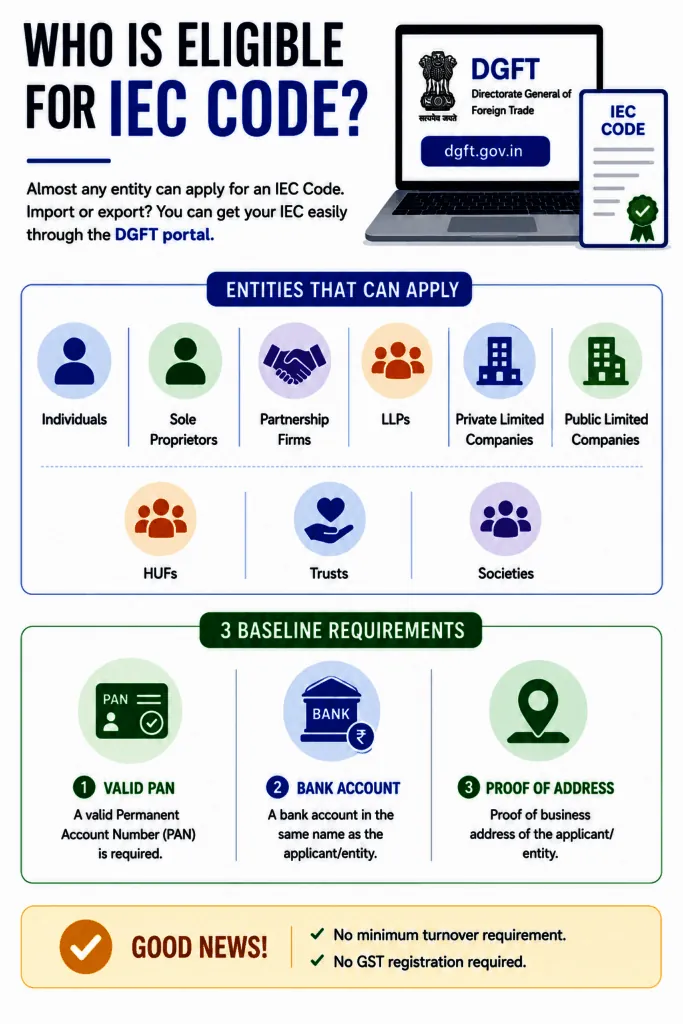
Find out who is eligible for IEC code in India. Almost any individual or business entity can apply for an Importer Exporter Code (IEC), with no minimum turnover, education level, or company size required. The IEC is issued by the Directorate General of Foreign Trade (DGFT) and is mandatory for anyone who wants to legally import or export goods or services from India. Below is the complete eligibility breakdown by entity type, the documents you will need, and who is exempt.
Who is Eligible for IEC Code??
The eligibility criteria for IEC registration are intentionally broad. You qualify if you fall into any of the following categories.
Individuals and sole proprietors, even without a registered business, using a personal PAN card.
Partnership firms.
Limited Liability Partnerships (LLPs).
Private Limited Companies and Public Limited Companies.
Hindu Undivided Families (HUFs).
Trusts and Societies, including educational and charitable institutions.
Startups and MSMEs entering international trade for the first time.
Freelancers and service exporters such as IT, consulting, and design professionals billed to overseas clients.
Minimum Requirements to Qualify.
Regardless of entity type, every applicant must meet three baseline conditions before applying on the DGFT portal.
A valid PAN card in the name of the individual or the business entity.
A bank account, savings or current, in the same name as the PAN.
Proof of business or residential address such as a utility bill, rent agreement, or sale deed.
There is no requirement to prove past import or export activity, and no minimum capital requirement. GST registration is not required before applying. Minors cannot apply directly and must be represented by a legal guardian.
Eligibility Checklist by Entity Type.
Entity Type
Key Requirement
PAN Used
Individual or Proprietor
Personal PAN plus bank account in own name
Individual PAN
Partnership Firm
Partnership deed plus firm PAN
Firm PAN
LLP
LLP incorporation certificate
LLP PAN
Private or Public Limited Company
Certificate of Incorporation
Company PAN
HUF
HUF PAN plus Karta identity proof
HUF PAN
Trust or Society
Trust deed or registration certificate
Trust or Society PAN
Who is Exempt from IEC Registration?
Not everyone needs an IEC. You are generally exempt if you fall under one of these categories.
Import or export of goods strictly for personal use, not connected to any trade, manufacture, or agriculture.
Government departments and ministries of the Government of India.
Notified charitable institutions, as specified by DGFT.
Traders already registered under GST, where PAN itself is treated as the IEC for most purposes following the GST and IEC integration.
If you fall into one of these categories but plan to claim export incentives, duty drawbacks, or DGFT scheme benefits, you will still need to register for an IEC separately.
Documents You Will Need to Apply.
PAN card of the applicant or business entity.
Identity proof such as Aadhaar, Voter ID, or Passport for individuals and proprietors.
Address proof such as an electricity bill, rent agreement, or sale deed.
Cancelled cheque or bank certificate showing account name and IFSC.
Certificate of incorporation, partnership deed, or trust deed where applicable.
Passport size photograph of the applicant.
Once you have confirmed you are eligible, the next step is the actual application. You can read our complete guide on how to apply for IEC online, or if you already hold an IEC, check our guide on IEC renewal and the annual update. Businesses also dealing with customs clearance may need to register an AD Code alongside their IEC.
Frequently Asked Questions.
Q1. Can an individual without a registered business apply for IEC?
Yes. An individual can apply in their own name as a proprietor, using their personal PAN card. No business registration is required.
Q2. Is a minimum turnover required to apply for IEC?
No. There is no turnover, capital, or revenue threshold. Even a first time exporter with no prior trade history can apply.
Q3. Do service exporters such as IT or consulting freelancers need an IEC?
Generally yes, especially if you want to claim Foreign Trade Policy benefits or receive payments through schemes that require IEC verification. Regular service exports without scheme benefits may not strictly require it, but most banks and clients now expect one.
Q4. Can a minor apply for an IEC code?
Not directly. A minor can hold an IEC only through a legal guardian who applies and signs on their behalf.
Q5. Is GST registration required before applying for IEC?
No. GST registration and IEC registration are independent. You can apply for an IEC without GST registration, though most established businesses hold both.
Q6. How long does it take to find out if I am eligible?
There is no separate eligibility check. If you meet the PAN, bank account, and address proof requirements, you can apply directly. DGFT typically issues the IEC within one to three working days of submission.
Tell us where you are stuck. We usually reply the same business day.
5.0 ★ · 123 Google reviews · Since 1990
Posted on Google
Vandana Bajaj
Trustindex verifies that the original source of the review is Google.
Very prompt and reliable service by Rahul Kolge and his team. Exceptional and happy experience.
Posted on Google
Supriya Shetye
Trustindex verifies that the original source of the review is Google.
Had a really good experience with JParks India. Rahul sir helped me a lot with my import work and were always active and responsive. Whatever documents or guidance was needed, they handled everything smoothly and explained things clearly. Felt stress-free throughout the process. Very helpful team, definitely recommend them if you’re doing import or export.
Posted on Google
dipali sakpal
Trustindex verifies that the original source of the review is Google.
Very nice people, get the work done in a very short time.
Posted on Google
Satish Bajaj
Trustindex verifies that the original source of the review is Google.
Excellent & Prompt services in all Import Export matters.
Great to work with you
Posted on Google
Bajaj VCPL
Trustindex verifies that the original source of the review is Google.
It was a great experience having work with you.
Posted on Google
Satish Bajaj
Trustindex verifies that the original source of the review is Google.
"Outstanding professiona services, efficient, and gets things done incredibly fast. Highly recommended for anyone needing reliable and prompt assistance
Posted on Google
Nishat fatima
Trustindex verifies that the original source of the review is Google.
excellent service
Posted on Google
farhan sayed
Trustindex verifies that the original source of the review is Google.
JParks Team is Super helpful! Thanks to Rahul and team!
Posted on Google
Sadik Inamdar
Trustindex verifies that the original source of the review is Google.
Good and personal service for import export code
Posted on Google
Maheshwar
Trustindex verifies that the original source of the review is Google.
Had a really good experience with JParks India. Rahul sir helped me a lot with my import work and were always active and responsive. Whatever documents or guidance was needed, they handled everything smoothly and explained things clearly. Felt stress-free throughout the process. Very helpful team, definitely recommend them if you’re doing import or export.
Verified by Trustindex
Trustindex verified badge is the Universal Symbol of Trust. Only the greatest companies can get the verified badge who has a review score above 4.5, based on customer reviews over the past 12 months. Read more
We use cookies to run this site, measure traffic, and track our ads. Essential cookies are always on. Accept all, reject non-essential, or set your preferences.
Cookie Preferences
Manage your cookie preferences below:
Essential cookies enable basic functions and are necessary for the proper function of the website.
Name
Description
Duration
Cookie Preferences
This cookie is used to store the user's cookie consent preferences.
30 days
Google reCAPTCHA helps protect websites from spam and abuse by verifying user interactions through challenges.
Name
Description
Duration
_GRECAPTCHA
Google reCAPTCHA sets a necessary cookie (_GRECAPTCHA) when executed for the purpose of providing its risk analysis.
179 days
Google Tag Manager simplifies the management of marketing tags on your website without code changes.
Name
Description
Duration
cookiePreferences
Registers cookie preferences of a user
2 years
td
Registers statistical data on users' behaviour on the website. Used for internal analytics by the website operator.
session
Statistics cookies collect information anonymously. This information helps us understand how visitors use our website.
Google Analytics is a web analytics service that tracks and reports website traffic. It collects anonymized data on how visitors use the site to help us understand and improve performance.