Bank Realisation Certificate: How Exporters Self-Generate an eBRC
Table of Contents
A bank realisation certificate is the proof that an export has actually been paid for. It closes the loop between the shipping bill you filed and the money that arrived, and without it most export benefit claims cannot be settled. The important thing to know in 2026 is that your bank no longer issues it. You generate it yourself on the DGFT portal, from the remittance data your bank reports.
This guide covers what changed, how the inward remittance message controls the whole process, the five steps to generate an eBRC, and the clubbing rules that stop most first attempts.
The old way
Now
Who issues it
Your bank issued the eBRC
You generate it yourself on the DGFT portal
What the bank does
Everything
Reports the inward remittance message to DGFT through an API
What you need first
A request to the branch
The IRM sitting against your IEC
Where it lives
Bank records
My Dashboard, Repository, bill type e-BRC
BRC Certificate or eBRC? What Changed
The terms are used interchangeably, and the paper BRC certificate is long gone. What is newer is who signs it.
DGFT moved the bank realisation certificate system to self-certification. Once a bank completes its API integration with DGFT, that bank stops issuing eBRCs for any inward remittance message dated on or after its cutoff date. Those become yours to generate. For remittances dated before the bank’s cutoff, the bank can still issue an eBRC under the legacy route, so for a period you will have both kinds in your records.
Banks did not disappear from the process. They became the data source, reporting remittances to DGFT and retaining view and download access for reconciliation. The certificate itself is now your declaration.
The IRM Decides Everything
The inward remittance message is the record your bank pushes to DGFT when foreign currency lands in your account. Everything about a bank realisation certificate follows from it, and DGFT’s own FAQ on self-certification is built around that point.
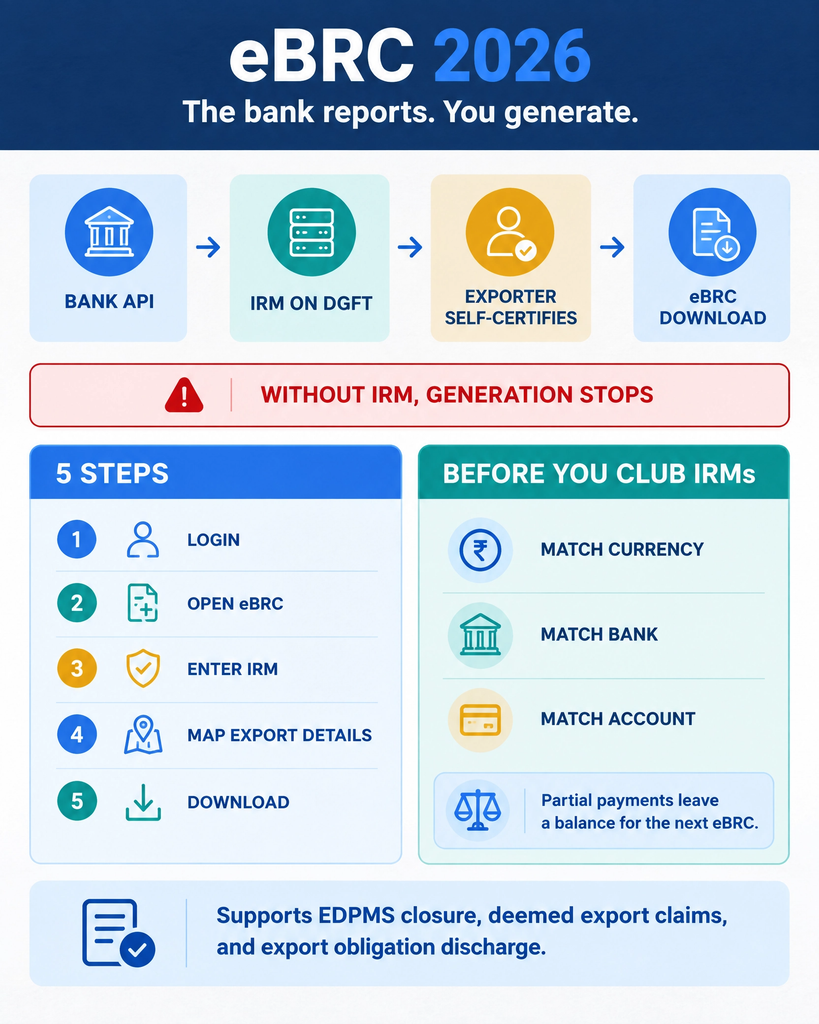
DGFT’s position is blunt: an exporter cannot generate an eBRC without an IRM. If the remittance is not showing on the portal, there is nothing to certify, and the fix is with your bank rather than with DGFT. That single fact resolves most of the panic around a missing BRC certificate, because the answer is almost always that the bank has not reported the remittance, not that DGFT has lost it.
So the first move on any missing certificate is to ask the branch whether the IRM has been transmitted, quoting the date and amount.
Generate a Bank Realisation Certificate in 5 Steps
Step 1: Log in to the DGFT portal with the account your IEC is linked to. If the code is inactive or unlinked, deal with that first, since our guide on checking that an IEC is active explains.
Step 2: Open Services, then eBRC, then Generate e-BRC. DGFT’s exporter manual walks through the same screens.
Step 3: Enter the IRM number. The system fills in the bank name, purpose code, currency and remittance amount for you. You can add more than one IRM, within the rules in the next section.
Step 4: Enter the export details. For goods, the shipping bill number and date, the port code, the bill currency and value, the AD code, the branch, the GSTIN benefit choice and any deductions. For a service export, the invoice number and date instead.
Step 5: Generate and download. The finished bank realisation certificate sits under My Dashboard, then Repository, with bill type set to e-BRC. Click the e-BRC number to print or download it.
Bank Realisation Certificate Clubbing Rules
Most failed bank realisation certificate attempts come down to combining remittances that DGFT will not let you combine.
Only IRMs in the same currency can be clubbed. A dollar remittance and a euro remittance cannot sit on one certificate.
Only IRMs from the same bank name and the same account number can be clubbed. Two banks means two certificates.
One shipping bill can be used across two or more eBRCs of different banks. Split payments from different banking channels are fine, they just produce separate certificates.
Plan the mapping before you start rather than in the form. Where a buyer has paid in instalments through different banks, you are producing several certificates against one shipping bill, and that is normal.
Partial Settlement and the Balance IRM
One remittance rarely matches one shipping bill exactly, and the bank realisation certificate screen is built for that.
Against each IRM you enter the amount of the eBRC, meaning the portion of the available remittance you are using now. DGFT then calculates the balance as the remittance amount, less amounts already attached to other eBRCs, less any outward remittance amounts, less what you are using here. That balance stays available for the next certificate.
Watch that running balance. An IRM quietly consumed by an earlier certificate is the usual reason a later one will not generate for the amount you expect.
Amending or Cancelling a Bank Realisation Certificate
You can amend a bank realisation certificate you generated, and you can cancel one that was issued through DGFT. What you cannot do is cancel a certificate your bank issued under the legacy route. Those stay with the bank, and corrections have to go through the branch.
Bulk generation is available where you have many remittances to process, which is worth setting up if you are clearing a backlog rather than working certificate by certificate.
Why the Bank Realisation Certificate Matters Downstream
It is not paperwork for its own sake. Several things wait on it:
Your AD bank cannot close the export entry in EDPMS without evidence of realisation, and an open entry eventually becomes a compliance problem.
Deemed exportsclaims require it. The Handbook of Procedures requires payment through normal banking channels as per e-BRC before a claim can be filed at all.
Export obligation discharge against an authorisation is evidenced with realisation proof.
Star export houseapplications rest on export performance that has to be certified from your records.
How JPARKS INDIA Helps With eBRC Work
Three things to carry away. Your bank no longer issues the certificate for current remittances, you do. Nothing can be generated until the IRM is on the portal, so a missing bank realisation certificate is usually a bank reporting problem. And the clubbing rules on currency and account decide how many certificates one payment produces.
JPARKS INDIA handles export documentation, backed by S.K. Agency, AEO-LO customs brokers since 1990. We generate and reconcile eBRCs in bulk, chase branches for IRMs that were never transmitted, map part payments across shipping bills correctly, and clear the backlogs that hold up benefit claims.
Remittances received but no certificate showing? Send us the IEC and the remittance dates through our contact page.
Sitting on unrealised entries or a pile of ungenerated certificates? Book a free consultation with the JPARKS INDIA EXIM compliance team.
Frequently Asked Questions
Q1. Who issues the bank realisation certificate now?
You do. After a bank completes API integration with DGFT, it stops issuing eBRCs for remittances dated on or after its cutoff, and the exporter self-generates them on the DGFT portal.
Q2. Can I generate an eBRC without the IRM?
No. DGFT states plainly that an exporter cannot generate an eBRC without an inward remittance message. Ask your bank to transmit it.
Q3. Where do I find the bank realisation certificate once it is generated?
My Dashboard, then Repository, with bill type set to e-BRC. Click the number to print or download it.
Q4. Can two remittances be combined on one certificate?
Only if they are in the same currency and from the same bank name and account number.
Q5. Can one shipping bill appear on more than one eBRC?
Yes. A single shipping bill can be used across two or more eBRCs of different banks, which is what happens when a buyer pays through more than one channel.
Q6. What if the payment is only partial?
Enter the amount you are using now. The portal tracks the balance remaining on that IRM for later certificates.
Q7. Can I cancel a bank realisation certificate?
You can cancel one issued through DGFT. Certificates issued by a bank under the legacy route have to be dealt with by the bank.
Q8. Is a BRC certificate the same as an eBRC?
Yes in everyday use. The certificate has been electronic for years, and what changed recently is that the exporter generates it rather than the bank.
Posted on Google
Vandana Bajaj
Trustindex verifies that the original source of the review is Google.
Very prompt and reliable service by Rahul Kolge and his team. Exceptional and happy experience.
Posted on Google
Supriya Shetye
Trustindex verifies that the original source of the review is Google.
Had a really good experience with JParks India. Rahul sir helped me a lot with my import work and were always active and responsive. Whatever documents or guidance was needed, they handled everything smoothly and explained things clearly. Felt stress-free throughout the process. Very helpful team, definitely recommend them if you’re doing import or export.
Posted on Google
dipali sakpal
Trustindex verifies that the original source of the review is Google.
Very nice people, get the work done in a very short time.
Posted on Google
Satish Bajaj
Trustindex verifies that the original source of the review is Google.
Excellent & Prompt services in all Import Export matters.
Great to work with you
Posted on Google
Bajaj VCPL
Trustindex verifies that the original source of the review is Google.
It was a great experience having work with you.
Posted on Google
Satish Bajaj
Trustindex verifies that the original source of the review is Google.
"Outstanding professiona services, efficient, and gets things done incredibly fast. Highly recommended for anyone needing reliable and prompt assistance
Posted on Google
Nishat fatima
Trustindex verifies that the original source of the review is Google.
excellent service
Posted on Google
farhan sayed
Trustindex verifies that the original source of the review is Google.
JParks Team is Super helpful! Thanks to Rahul and team!
Posted on Google
Sadik Inamdar
Trustindex verifies that the original source of the review is Google.
Good and personal service for import export code
Posted on Google
Maheshwar
Trustindex verifies that the original source of the review is Google.
Had a really good experience with JParks India. Rahul sir helped me a lot with my import work and were always active and responsive. Whatever documents or guidance was needed, they handled everything smoothly and explained things clearly. Felt stress-free throughout the process. Very helpful team, definitely recommend them if you’re doing import or export.
Verified by Trustindex
Trustindex verified badge is the Universal Symbol of Trust. Only the greatest companies can get the verified badge who has a review score above 4.5, based on customer reviews over the past 12 months. Read more
PIMS registration is mandatory before notified paper and paperboard imports arrive in India. We file it inside the 75-to-5-day window, so your URN matches the Bill of Entry and customs clears without fines.
As your Exporter of Record, we export goods out of India in our name, with the IEC, AD Code and filings the shipment needs, and our sister concern S. K. Agency clears it at the port.
Shipping fundamentals cover Incoterms freight mode export documents ICEGATE customs and tracking so you can reduce delays avoid penalties and ship faster from India
Star Export House is DGFT recognition for top Indian exporters that unlocks EPCG duty-free capital goods imports faster customs clearance and stronger buyer and bank credibility.
IGST Refund Status is the live tracking of your export IGST refund claim on the GST portal using ARN or shipping bill number to see if it is pending approved rejected or under scrutiny.
Deemed Exports are domestic supplies to EOU SEZ UN or government projects that qualify for export benefits like IGST refund and duty drawback even though goods stay in India.
Expert MOOWR scheme application support for importers & exporters in India. Complete guide on eligibility, process, benefits & compliance. Get approved fast.
Want to register on the IceGate portal? The smallest mistake can end up in a rejection. To avoid wasting time, get in touch with us and we'll help you get registered on IceGate within 2 to 3 working days!
As an importer of record we Import goods into India on your behalf & deliver them to your desired location. We handle everything from legal compliance to last mile delivery to ensure timely & safely clearance of your Imported goods. Ideal service if you are planning to import for the first time.
We check your goods against the notification, file IGCR-1 on ICEGATE, get your IIN, set up the continuity bond and keep your quarterly IGCR-3 returns on time.
Learn about SVB registration with our comprehensive guide to the Special Valuation Branch. Simplify the process and ensure compliance with our expert services.
Unable to Import or Export due to a deactivated IEC? We have helped 500+ Importers & Exporters renew their IEC within 24 hours of a complete document set.
Need to get CPCB EPR Plastic Waste registration for your business in 2026? We help you get it in a hassle free manner so you can stay compliant with the EPR laws! Get in touch now.
Need a Class 3 DSC Digital Signature Certificate for your business? Get it in 1 to 2 days. At JPARKS INDIA we are Emudhra Partners, and can get the DSC for your at the fastest and most affordable rates. Contact us now!
Get Certificate of Origin | Preferential & Non Preferential
Need a Certificate of Origin for your Export or Import? Look no further, at JPARKS we provide preferential and Non preferential COOs at the best rates. Contact us to know more!
Need to reactivate your IEC on the DGFT portal? The IEC Based DGFT DSC is what you need to move forward hassle free. Contact us now to get your DGFT DSC in 1 to 2 days.
Looking to start your Import Export Business? Getting an IEC is mandatory to get into EXIM trade. We help you apply IEC online and get started within 24 hours.
Want to claim benefits of duty drawback and various other schemes under FTP? You need to register your Bank Account for Export Promotion Incentives. Contact us now to register your Bank Account on IceGate Potal.
We use cookies to run this site, measure traffic, and track our ads. Essential cookies are always on. Accept all, reject non-essential, or set your preferences.
Cookie Preferences
Manage your cookie preferences below:
Essential cookies enable basic functions and are necessary for the proper function of the website.
Name
Description
Duration
Cookie Preferences
This cookie is used to store the user's cookie consent preferences.
30 days
Google reCAPTCHA helps protect websites from spam and abuse by verifying user interactions through challenges.
Name
Description
Duration
_GRECAPTCHA
Google reCAPTCHA sets a necessary cookie (_GRECAPTCHA) when executed for the purpose of providing its risk analysis.
179 days
Google Tag Manager simplifies the management of marketing tags on your website without code changes.
Name
Description
Duration
cookiePreferences
Registers cookie preferences of a user
2 years
td
Registers statistical data on users' behaviour on the website. Used for internal analytics by the website operator.
session
Statistics cookies collect information anonymously. This information helps us understand how visitors use our website.
Google Analytics is a web analytics service that tracks and reports website traffic. It collects anonymized data on how visitors use the site to help us understand and improve performance.