An Exporter of Record (EOR) is the person or company named as the exporter on the shipping bill. It exports under its own IEC, answers to Customs for every declaration on the shipping bill, and receives any IGST refund or drawback. If your goods have to leave India and you have no Indian entity, or no Indian exporter willing to stand on the shipping bill, JPARKS INDIA can be your Exporter of Record: the goods are exported in our name, under our IEC, AD Code and ICEGATE registration, and a licensed customs broker files the shipping bill.
Our EOR fee is quoted per shipment, in writing, before anything is booked. We have served 500+ clients, are rated 5.0 from 123 Google reviews, and come from a family that has worked in EXIM since 1990.
What an Exporter of Record is in India
Indian customs law defines the exporter, not the “exporter of record”. Under Section 2(20) of the Customs Act, 1962, the exporter of goods, between their entry for export and the time they are exported, includes any owner, beneficial owner or person holding himself out to be the exporter. The party that presents the shipping bill (Section 50) and self-assesses any duty on it (Section 17) is what the trade calls the Exporter of Record.
That party needs an Importer Exporter Code (IEC): the Foreign Trade Policy says no export or import of goods shall be made without one unless specifically exempted. The IEC is a 10-character code, the same as the entity’s PAN, and it is what identifies the exporter on the shipping bill. EOR here means Exporter of Record, the customs role, not an Employer of Record, the payroll service with the same short form.
Who is the exporter of record on Ex Works terms?
The Incoterm splits costs and risks between buyer and seller; it does not change Indian law. Whatever the Incoterm, the exporter on an Indian shipping bill must hold an IEC, so on an Ex Works sale either the Indian seller stands on the shipping bill or the buyer appoints an Exporter of Record.
Who needs an Exporter of Record
Anyone whose goods have to leave India with no Indian exporter able or willing to stand on the shipping bill:
Foreign companies with no Indian entity. An IEC needs a PAN, a bank account in the applicant’s name and a valid address, a large step for one shipment.
Demo, project and leased equipment going back. Machinery, test rigs or demo units came in for a project, a trial or a lease and now return. Keep the Bill of Entry: duty-paid goods re-exported within two years can earn drawback.
Repair and return. Imported goods found defective after clearance, or not as per specifications, may be re-exported as per the Customs Act (FTP para 2.50).
Contract manufacturing pickups. Your Indian contract manufacturer sells only in India or will not take on the export. The EOR buys and exports, or exports as a third-party exporter, with the shipping bill naming both the manufacturer and the third-party exporter (FTP para 2.42).
Goods from several Indian suppliers consolidated into one export.
Samples. Bona fide trade and technical samples of freely exportable items can be exported without any limit (FTP para 2.43), but still need an exporter with an IEC.
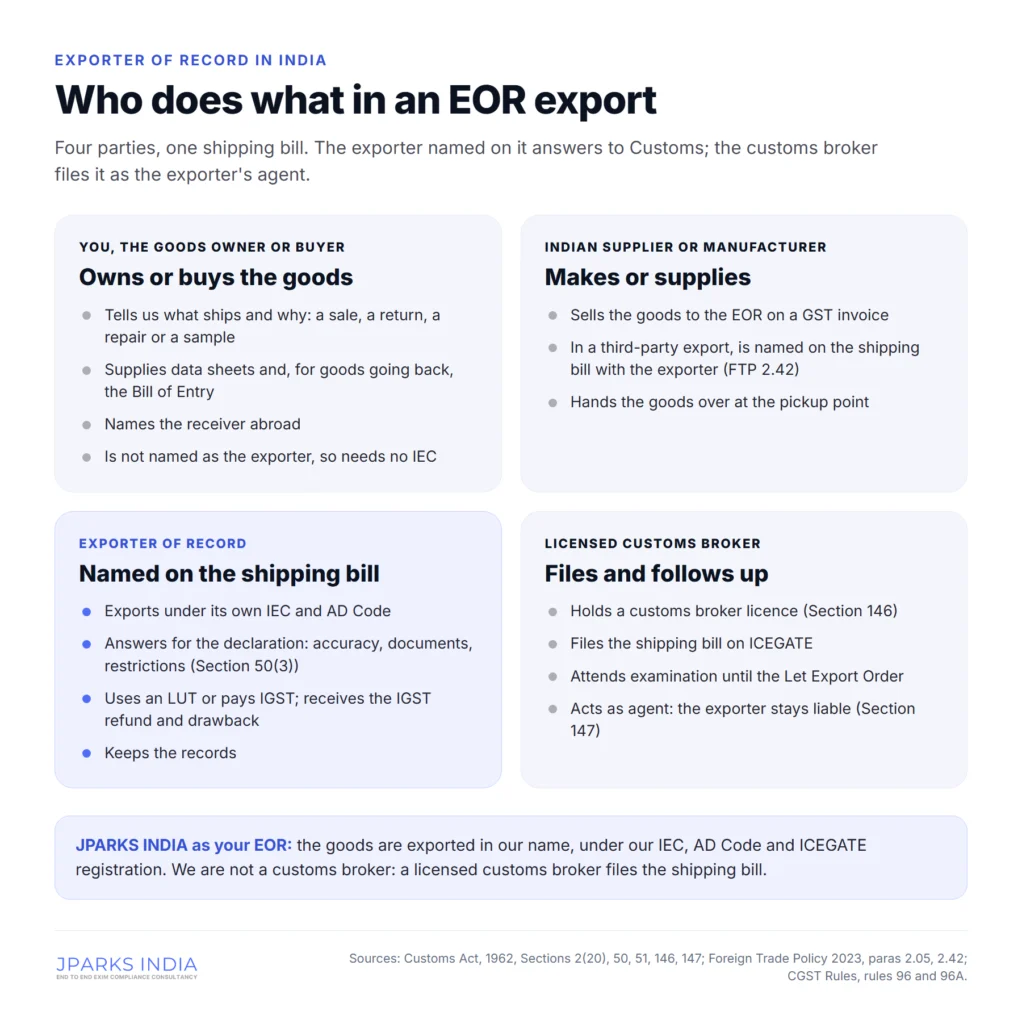
Four parties, each with its own job. Customs verifies the self-assessment, examines the goods when it selects them, then permits clearance and loading: the Let Export Order.
Party
What it does
What it does not do
You, the goods owner or buyer
Tells us what is shipping and why; supplies data sheets and, for goods going back, the Bill of Entry; names the receiver abroad
Appear as the exporter, so it needs no IEC
Indian supplier or contract manufacturer
Makes or supplies the goods; sells them to the EOR on a GST invoice; is also named on the shipping bill in a third-party export
Take on the export, unless it chooses to
Exporter of Record
Is named on the shipping bill under its IEC and AD Code; answers for the declaration; issues the export invoice; uses an LUT or pays IGST; receives refunds and drawback; keeps the records
Act as a customs broker without a broker licence
Licensed customs broker
Files the shipping bill as the exporter’s agent; attends examination until the Let Export Order
Take over the exporter’s liability (Section 147)
What the exporter is legally responsible for
The obligations sit on the exporter, so they sit on the EOR. Under the Customs Act, 1962, the exporter must:
present the shipping bill electronically on the customs automated system (Section 50(1)), under the Shipping Bill (Electronic Integrated Declaration and Paperless Processing) Regulations, 2019, and declare that its contents are true (Section 50(2));
ensure the information is accurate and complete, every supporting document is authentic and valid, and any restriction or prohibition on the goods under any law is complied with (Section 50(3));
self-assess any duty (Section 17(1)) and pay any export duty and charges before Customs permits clearance and loading (Section 51(1)).
Export goods are liable to confiscation if exported contrary to a prohibition, if they are not included in or exceed the shipping bill, or if they do not correspond with it in value or any material particular (Section 113(d), (h) and (i)), and the person responsible faces a penalty under Section 114. Because Section 2(20) keeps the owner and beneficial owner inside the definition of exporter, an EOR does not take every customs risk off the owner of the goods.
Export controls: restricted items and SCOMET
An IEC lets you export; it does not make every item exportable. Exports are “Free” unless regulated by prohibition, restriction or State Trading Enterprises; Schedule 2 of ITC(HS) sets the export policy for each item, and some free items carry conditions under other laws (FTP paras 2.01 and 2.40). Every EOR job starts with the export policy for the HS code.
SCOMET (Special Chemicals, Organisms, Materials, Equipment and Technologies) is India’s export control list of dual-use items, munitions and nuclear-related items, including software and technology. Items on it are prohibited or exportable only against an authorisation, unless specifically exempted (FTP para 10.02). For an EOR:
Imported goods count too. Imported SCOMET items may not be exported, even from a customs bonded warehouse, without an authorisation unless exempted (para 10.07). Equipment going back after a project or demo needs the check.
There are authorisations for these cases, including temporary export for demo or exhibition, return abroad after a demo or exhibition in India, export of imported items to the same foreign entity or its OEM, and a General Authorisation for export after repair in India (para 10.08).
Who issues them: DGFT headquarters, centrally (para 10.09); Category 0, nuclear items, goes to the Department of Atomic Energy (paras 10.03, 10.04).
Items off the list can still be caught. If DGFT has notified the exporter, or the exporter has reason to believe an item may be diverted to weapons of mass destruction or military end use, the export may be denied or need a licence (para 10.05).
We check the export policy and the SCOMET list before we quote; any authorisation must be in place before the shipping bill is filed.
How an EOR export works, step by step
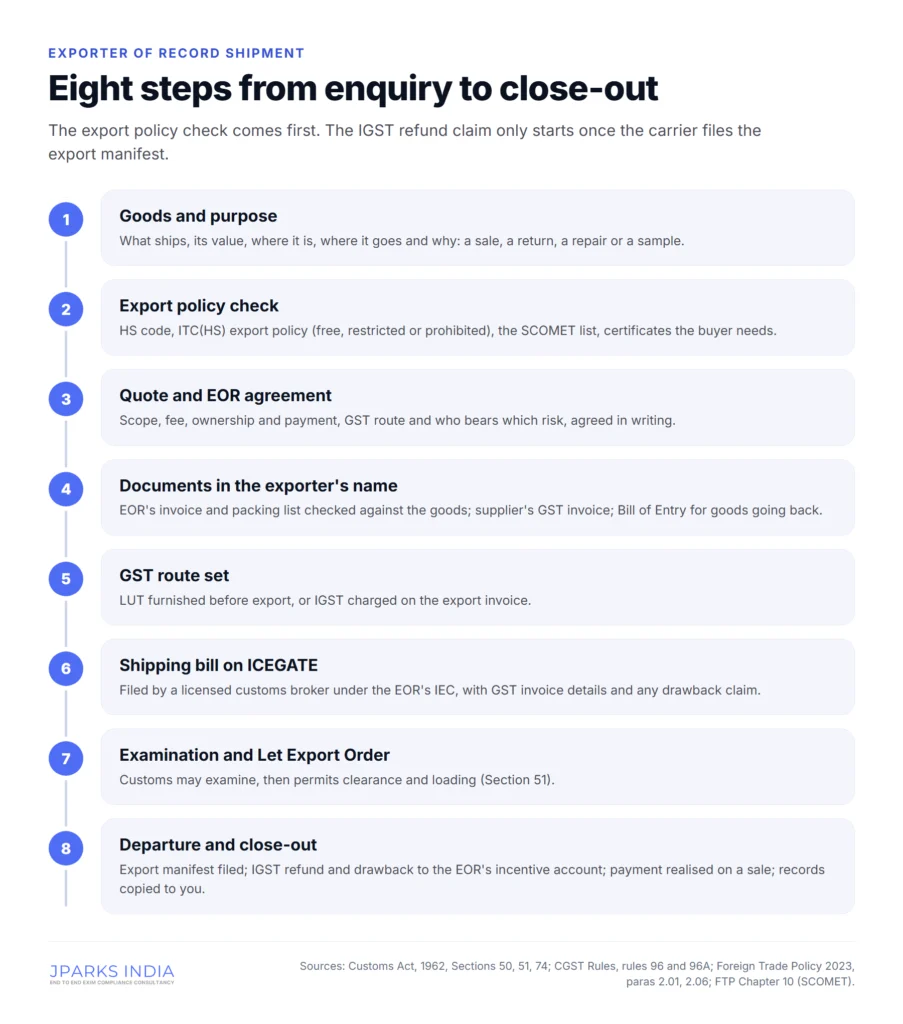
Goods and purpose. What is shipping, its value, where it is, where it goes and why: a sale, a return, a repair or a sample.
Export policy check. HS code, ITC(HS) export policy, the SCOMET list and any certificate the buyer needs.
Quote and EOR agreement. Scope, fee, ownership and payment, the GST route and who bears which risk, agreed in writing.
Documents in the exporter’s name. The EOR’s invoice and packing list, checked against the goods; the supplier’s GST invoice where we buy; the Bill of Entry for goods going back.
GST route. An LUT furnished before export, or IGST charged on the export invoice.
Shipping bill. A licensed customs broker files it on ICEGATE under the EOR’s IEC, with the GST invoice details and any drawback claim.
Examination and Let Export Order. Once Customs is satisfied the goods are not prohibited and any duty is paid, it permits clearance and loading, also electronically on risk evaluation (Section 51). Follow it with our shipping bill status guide.
Departure and close-out. The carrier files the export manifest, which turns the shipping bill into the IGST refund claim. Refunds and drawback reach the EOR’s incentive account, a sale is paid for, and the records are copied to you.
Documents for an EOR export
For every shipment
The Foreign Trade Policy lists three mandatory export documents: the bill of lading, air waybill, lorry receipt, railway receipt or postal receipt; the commercial invoice cum packing list; and the shipping bill or bill of export (para 2.06(a)). Under GST, the shipping bill also carries the GST invoice details, whichever route is used.
When the goods or the deal need more
Restricted or SCOMET items: the export authorisation.
Goods with product-specific compliance: any extra documents the regulator notifies or asks for (para 2.06(c), (d)).
Goods going back: the Bill of Entry and import invoice, so Customs can identify them as the goods imported, which Section 74 drawback needs.
A third-party export: the manufacturer’s details for the shipping bill.
Proof of origin for the buyer: a Certificate of Origin (from Rs 2,000 + GST, 1 to 2 days).
What we need from you for a first look
The goods with quantity, value and HS code if known; a data sheet; the supplier invoice or the Bill of Entry, as the case may be; the receiver abroad; any licence the goods already have; the pickup address and ready date; and your company details.
GST on exports: LUT or IGST paid
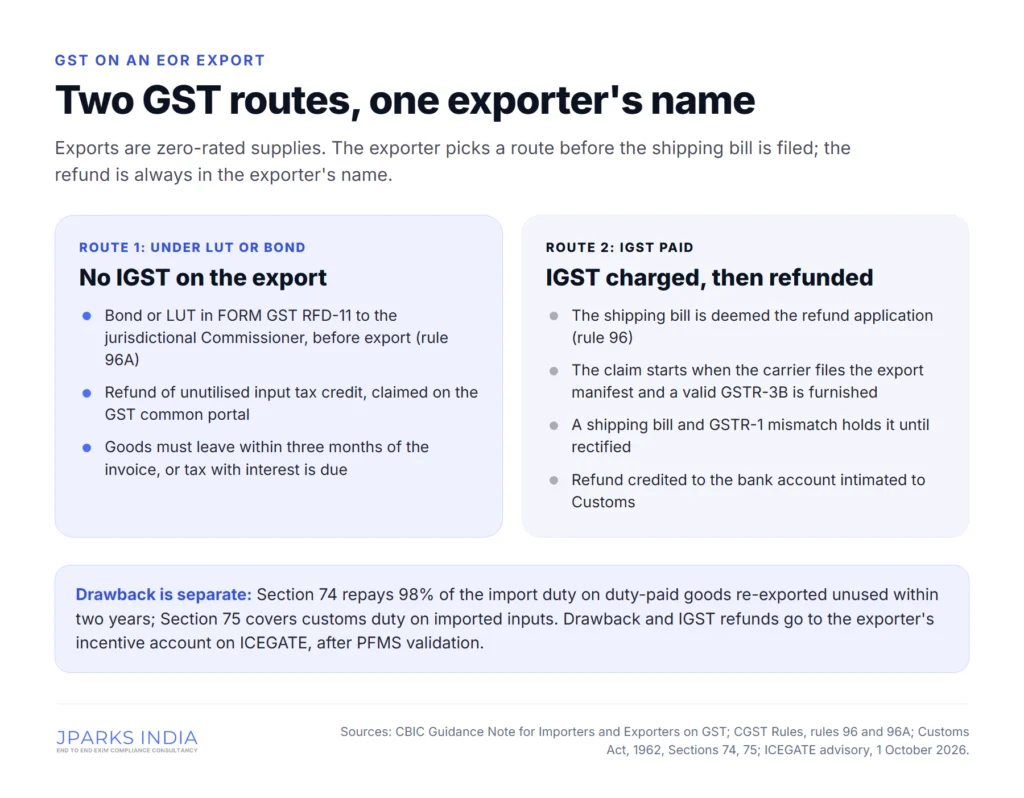
Exports are zero-rated supplies under GST. CBIC’s guidance gives every exporter two routes: export under a bond or Letter of Undertaking (LUT) without paying IGST and claim a refund of unutilised input tax credit, or pay IGST and claim a refund of that tax.
Point
Under LUT or bond
With IGST paid
IGST on the export invoice
None
Charged
Before export
Bond or LUT in FORM GST RFD-11 to the jurisdictional Commissioner (rule 96A)
Nothing extra
What is refunded
Unutilised input tax credit, on an application through the GST common portal
The IGST paid on each shipping bill
How the claim starts
Filed after the export manifest or export report is delivered
The shipping bill is deemed the refund application once the carrier files the export manifest and a valid GSTR-3B is furnished (rule 96)
Main risk
Goods not exported within three months of the invoice: tax with interest is due
A shipping bill and GSTR-1 mismatch delays the claim until rectified
In an EOR export:
Whose name: the export invoice, the LUT and the refund are the exporter’s, so they are the EOR’s.
Where the IGST refund lands: it is credited to the bank account in the applicant’s registration particulars and as intimated to Customs (rule 96(3)), the exporter’s Export Promotion (incentive) account on ICEGATE.
When it can be held: on a request from the GST Commissioner, if Customs finds the export violated the Customs Act, or for verification on risk parameters (rule 96(4)). See IGST refund status.
Goods bought in India: the supplier charges GST to the EOR; under an LUT that is the input tax credit the EOR claims back.
How it reaches you: the EOR agreement says how refunds received in the EOR’s name are passed on.
Drawback and the incentive account
Drawback repays customs duty linked to exported goods, and CBIC’s GST guidance confirms both drawback provisions continued under GST:
Section 74, duty-paid goods re-exported. 98% of the import duty is repaid if Customs identifies the goods as those imported and they are entered for export within two years of the duty payment, which the Board can extend. Goods used in India get a lower notified rate. Per CBIC, this drawback covers the customs duties and the IGST and compensation cess paid on import.
Section 75, imported materials in exported goods. Drawback at notified rates of the customs duty on imported materials used to make the export goods; under GST, limited to customs duties on imported inputs and Central Excise duty on a few specified items.
Drawback and IGST refunds are paid into the exporter’s Export Promotion (incentive) account on ICEGATE once PFMS has validated it. With an EOR, that account is ours; for your own, see AD Code registration.
Timelines and deadlines
The official time limits that shape an EOR export:
Stage
Official time limit
Source
Exporting under an LUT
Goods leave India within three months of the export invoice, or a longer period the Commissioner allows; otherwise tax with interest within fifteen days after that
CGST Rules, rule 96A(1)(a)
IGST refund claim
Deemed filed when the export manifest and a valid GSTR-3B are in; a GSTR-1 mismatch moves the date to when it is rectified
CGST Rules, rule 96(1)
Re-export drawback
Entered for export within two years of paying import duty, for 98% on unused goods; the Board can extend
Customs Act, Section 74
Payment on a sale
Realised within the time the RBI specifies, in freely convertible currency or as the Policy allows; otherwise export benefits are returned
FTP paras 2.52, 2.54
Our side has no fixed turnaround: it depends on the goods, any authorisation and the port, so the plan comes with the quote.
Why EOR exports get held up, and the fix
Problem
What happens
Fix
No AD Code registered for the exporter’s IEC
Customs needs it when the shipping bill is filed
Register once at one port; it then works at every customs location
Incentive account rejected by PFMS
IGST refunds and drawback are held up
Check the PFMS status on ICEGATE and re-submit the bank details
Shipping bill and GSTR-1 do not match
The IGST refund claim waits until the mismatch is rectified
Match invoice number, value and IGST before filing
No LUT in place
The goods cannot go without IGST
Furnish the LUT first, or charge IGST and claim the refund
Restricted or SCOMET item without authorisation
Goods liable to confiscation, exporter to a penalty
Check the policy before booking
Equipment re-exported after two years
The 98% Section 74 drawback is lost unless the Board extends
Plan the return within two years of the duty payment
EOR fee: quoted per shipment
Every EOR job is quoted per shipment: a test rig going back with its Bill of Entry is not the same job as an export bought from three Indian suppliers. Any export duty and freight are separate. What changes a quote:
the goods and their export policy, since restricted and SCOMET items need more checks;
the structure: buy and resell, third-party export, return or repair;
the GST route, and any refund or drawback to follow up;
the number of product lines, suppliers and pickup points.
Your own exporter or an EOR: two routes
Point
Become your own exporter
Appoint an Exporter of Record
Who it suits
An Indian entity that exports regularly
A foreign company with no Indian entity, a one-off export, equipment going back or a contract manufacturing pickup
What you need
IEC, AD Code, Export Promotion account, GST registration and LUT, a customs broker
An EOR agreement and your shipment details
Who is liable to Customs
You
The EOR, with the owner and beneficial owner still inside the definition of exporter
Who receives refunds and drawback
You
The EOR, passing them on as agreed
To export in your own name:
get an IEC: we file IEC registration for Rs 2,860 all inclusive, within 24 hours of a complete document set;
register your AD Code and Export Promotion account: Rs 4,500 + GST for both, about 4 working days;
register for GST and furnish an LUT before exporting without IGST;
appoint a licensed customs broker.
Many clients start with an EOR and move to their own IEC once volumes justify it; we set up both.
What an Exporter of Record cannot do
An EOR puts the export in its own name. It does not change what the law allows:
Make prohibited goods exportable, or ship restricted or SCOMET items, imported ones included, without the authorisation.
Declare a value or description that suits a refund. Goods that do not match the shipping bill are liable to confiscation.
Act as a customs broker without a licence (Section 146). JPARKS INDIA does not hold one; a licensed customs broker files the shipping bill.
Take every customs risk off the owner, who stays inside the definition of exporter (Section 2(20)).
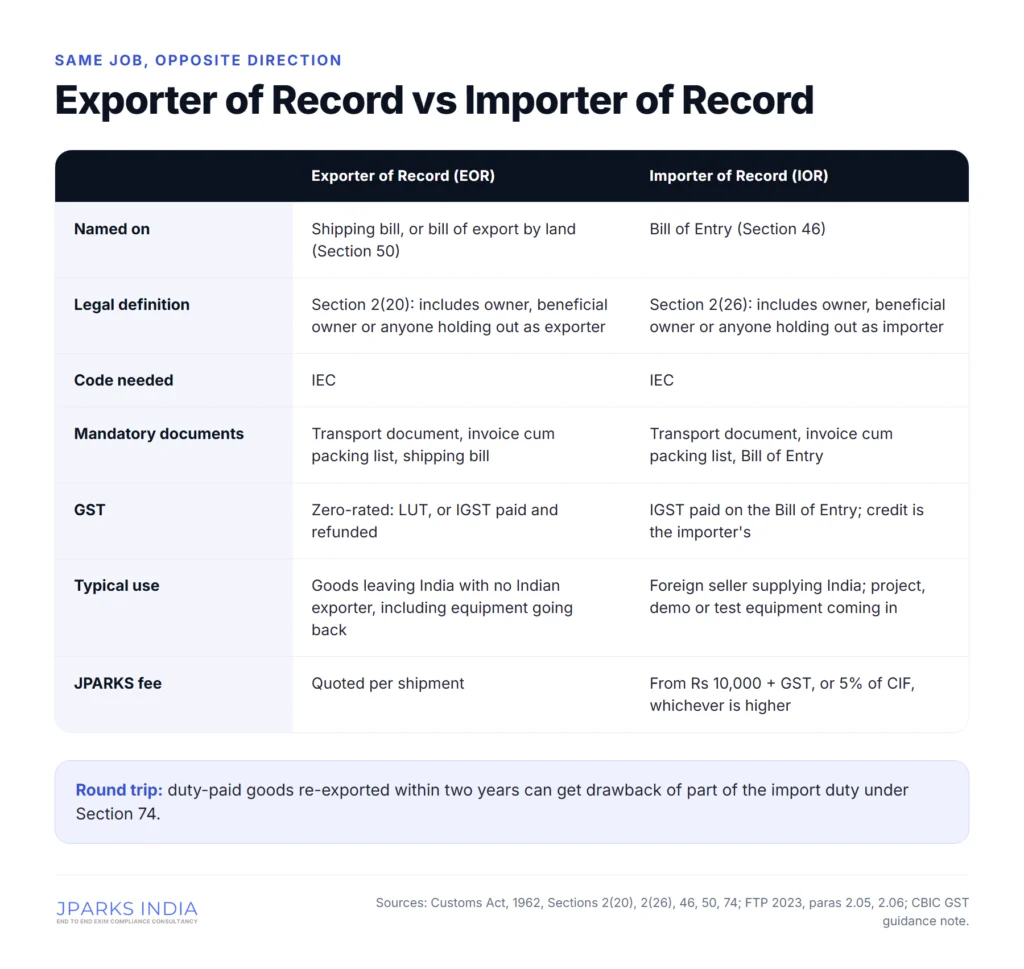
Exporter of Record vs Importer of Record
Same job, opposite direction. The Exporter of Record is named on the shipping bill for goods leaving India; the Importer of Record is named on the Bill of Entry for goods coming in.
Point
Exporter of Record
Importer of Record
Named on
Shipping bill, or bill of export by land (Section 50)
Bill of Entry (Section 46)
Legal definition
Section 2(20): includes owner, beneficial owner, anyone holding out as exporter
Section 2(26): includes owner, beneficial owner, anyone holding out as importer
Mandatory documents
Transport document, invoice cum packing list, shipping bill
Transport document, invoice cum packing list, Bill of Entry
GST
Zero-rated: LUT, or IGST paid and refunded
IGST paid on the Bill of Entry; the credit is the importer’s
Typical use
Goods leaving India with no Indian exporter, including equipment going back
Foreign seller supplying India; project, demo or test equipment coming in
JPARKS fee
Quoted per shipment
From Rs 10,000 + GST, or 5% of CIF, whichever is higher
Many foreign companies need both: equipment comes in through an IOR for a project or trial and goes back out through an EOR, with Section 74 drawback if it leaves within two years. Our Importer of Record services handle the import side in our name.
JPARKS INDIA is an EXIM compliance consultancy in Vashi, Navi Mumbai, with 500+ clients and a 5.0 rating from 123 Google reviews. We are not a customs broker: our sister concern S. K. Agency, a licensed customs broker, clears the cargo, while we stand on the shipping bill as the exporter. As your EOR we:
export the goods in our name, under our IEC, AD Code, GSTIN and ICEGATE registration;
check the HS code, export policy, SCOMET list and documents before anything is booked;
structure the shipment as a sale, a third-party export, a return, a repair or a no-charge shipment, with the GST route that fits;
prepare the export invoice and packing list against what is in the boxes, and a Certificate of Origin where needed;
follow up the IGST refund or drawback and, on a sale, the realisation and e-BRC;
keep the shipping bill, Let Export Order and export records on file, with copies to you.
Need help with an export from India?
Tell us what is shipping, from where, to where and why. We check the goods and the route and send a written quote before anything is booked. Prefer to talk? Call +91 91673 79073, Monday to Saturday, 10:30 AM to 7 PM.
Bengaluru City Customs, Public Notice 16/2022, on ICES Advisory 10/2022 (one AD Code registration for all ports)
Jawaharlal Nehru Custom House, Public Notice 85/2023, IECs with PFMS account status appearing as Rejected
Frequently asked questions
Straight answers, before you even ask
What is an Exporter of Record (EOR) in India?
The Exporter of Record is the person or company named as the exporter on the shipping bill. It exports under its own IEC, answers to Customs for the accuracy of the declaration and any export restriction, and receives any IGST refund or drawback on the export.
Is there a legal definition of exporter of record?
Indian law defines the exporter rather than the exporter of record. Under Section 2(20) of the Customs Act, 1962, the exporter includes any owner, beneficial owner or person holding himself out to be the exporter, between entry for export and the time the goods are exported.
Is an Exporter of Record the same as an Employer of Record?
No. Both are shortened to EOR, but an Exporter of Record is the customs role of the party named on the shipping bill, while an Employer of Record is a payroll and HR service. This page is about the Exporter of Record.
Who is the exporter of record on Ex Works terms?
The Incoterm does not change Indian law: the exporter on an Indian shipping bill must hold an IEC. A foreign buyer without one cannot be that party, so either the Indian seller stands on the shipping bill or the buyer appoints an Exporter of Record.
Can a foreign company export goods from India without an Indian entity?
Yes, through an Exporter of Record. The shipping bill is filed under the EOR's IEC and AD Code, so you do not need an Indian company or an IEC of your own for the shipment.
Do I need my own IEC if I use an Exporter of Record?
No. The export goes under the EOR's IEC. If you plan to export regularly in your own name, JPARKS INDIA files IEC registration for Rs 2,860 all inclusive, within 24 hours of a complete document set.
Can equipment imported into India earlier be exported through an EOR?
Yes. Keep the Bill of Entry: if duty-paid goods are identified and entered for export within two years of the duty payment, Section 74 of the Customs Act allows drawback of 98% of the import duty on unused goods, with lower rates for used goods. Imported SCOMET items still need an export authorisation unless exempted.
Can an Exporter of Record export without paying IGST?
Yes, under a bond or Letter of Undertaking in FORM GST RFD-11 furnished to the jurisdictional Commissioner before export (rule 96A of the CGST Rules). The goods must then leave India within three months of the invoice, or the tax is due with interest.
Who receives the IGST refund or drawback on an EOR export?
The exporter named on the shipping bill. The IGST refund is credited to the bank account registered with Customs, the exporter's incentive account on ICEGATE, so with an EOR it reaches the EOR first and is passed on as the agreement says.
Does my export need a SCOMET authorisation?
Only if the item is on India's SCOMET list of dual-use items, munitions and nuclear-related items, or DGFT has notified you under the catch-all control. SCOMET items are prohibited or exportable only against an authorisation, and imported SCOMET items need one to go back too.
Is JPARKS INDIA a customs broker?
No. JPARKS INDIA acts as Exporter of Record in its own name, under its IEC, AD Code and ICEGATE registration, but does not hold a customs broker licence. A licensed customs broker files the shipping bill.
How much do Exporter of Record services cost?
JPARKS INDIA quotes EOR services per shipment, in writing, before anything is booked. The quote depends on the goods and their export policy, the structure of the export, the GST route and the number of suppliers and pickup points.
Posted on Google
Vandana Bajaj
Trustindex verifies that the original source of the review is Google.
Very prompt and reliable service by Rahul Kolge and his team. Exceptional and happy experience.
Posted on Google
Supriya Shetye
Trustindex verifies that the original source of the review is Google.
Had a really good experience with JParks India. Rahul sir helped me a lot with my import work and were always active and responsive. Whatever documents or guidance was needed, they handled everything smoothly and explained things clearly. Felt stress-free throughout the process. Very helpful team, definitely recommend them if you’re doing import or export.
Posted on Google
dipali sakpal
Trustindex verifies that the original source of the review is Google.
Very nice people, get the work done in a very short time.
Posted on Google
Satish Bajaj
Trustindex verifies that the original source of the review is Google.
Excellent & Prompt services in all Import Export matters.
Great to work with you
Posted on Google
Bajaj VCPL
Trustindex verifies that the original source of the review is Google.
It was a great experience having work with you.
Posted on Google
Satish Bajaj
Trustindex verifies that the original source of the review is Google.
"Outstanding professiona services, efficient, and gets things done incredibly fast. Highly recommended for anyone needing reliable and prompt assistance
Posted on Google
Nishat fatima
Trustindex verifies that the original source of the review is Google.
excellent service
Posted on Google
farhan sayed
Trustindex verifies that the original source of the review is Google.
JParks Team is Super helpful! Thanks to Rahul and team!
Posted on Google
Sadik Inamdar
Trustindex verifies that the original source of the review is Google.
Good and personal service for import export code
Posted on Google
Maheshwar
Trustindex verifies that the original source of the review is Google.
Had a really good experience with JParks India. Rahul sir helped me a lot with my import work and were always active and responsive. Whatever documents or guidance was needed, they handled everything smoothly and explained things clearly. Felt stress-free throughout the process. Very helpful team, definitely recommend them if you’re doing import or export.
PIMS registration is mandatory before notified paper and paperboard imports arrive in India. We file it inside the 75-to-5-day window, so your URN matches the Bill of Entry and customs clears without fines.
As your Exporter of Record, we export goods out of India in our name, with the IEC, AD Code and filings the shipment needs, and our sister concern S. K. Agency clears it at the port.
Shipping fundamentals cover Incoterms freight mode export documents ICEGATE customs and tracking so you can reduce delays avoid penalties and ship faster from India
Star Export House is DGFT recognition for top Indian exporters that unlocks EPCG duty-free capital goods imports faster customs clearance and stronger buyer and bank credibility.
IGST Refund Status is the live tracking of your export IGST refund claim on the GST portal using ARN or shipping bill number to see if it is pending approved rejected or under scrutiny.
Deemed Exports are domestic supplies to EOU SEZ UN or government projects that qualify for export benefits like IGST refund and duty drawback even though goods stay in India.
Expert MOOWR scheme application support for importers & exporters in India. Complete guide on eligibility, process, benefits & compliance. Get approved fast.
Want to register on the IceGate portal? The smallest mistake can end up in a rejection. To avoid wasting time, get in touch with us and we'll help you get registered on IceGate within 2 to 3 working days!
As an importer of record we Import goods into India on your behalf & deliver them to your desired location. We handle everything from legal compliance to last mile delivery to ensure timely & safely clearance of your Imported goods. Ideal service if you are planning to import for the first time.
We check your goods against the notification, file IGCR-1 on ICEGATE, get your IIN, set up the continuity bond and keep your quarterly IGCR-3 returns on time.
Learn about SVB registration with our comprehensive guide to the Special Valuation Branch. Simplify the process and ensure compliance with our expert services.
Unable to Import or Export due to a deactivated IEC? We have helped 500+ Importers & Exporters renew their IEC within 24 hours of a complete document set.
Need to get CPCB EPR Plastic Waste registration for your business in 2026? We help you get it in a hassle free manner so you can stay compliant with the EPR laws! Get in touch now.
Need a Class 3 DSC Digital Signature Certificate for your business? Get it in 1 to 2 days. At JPARKS INDIA we are Emudhra Partners, and can get the DSC for your at the fastest and most affordable rates. Contact us now!
Get Certificate of Origin | Preferential & Non Preferential
Need a Certificate of Origin for your Export or Import? Look no further, at JPARKS we provide preferential and Non preferential COOs at the best rates. Contact us to know more!
Need to reactivate your IEC on the DGFT portal? The IEC Based DGFT DSC is what you need to move forward hassle free. Contact us now to get your DGFT DSC in 1 to 2 days.
Looking to start your Import Export Business? Getting an IEC is mandatory to get into EXIM trade. We help you apply IEC online and get started within 24 hours.
Want to claim benefits of duty drawback and various other schemes under FTP? You need to register your Bank Account for Export Promotion Incentives. Contact us now to register your Bank Account on IceGate Potal.
We use cookies to run this site, measure traffic, and track our ads. Essential cookies are always on. Accept all, reject non-essential, or set your preferences.
Cookie Preferences
Manage your cookie preferences below:
Essential cookies enable basic functions and are necessary for the proper function of the website.
Name
Description
Duration
Cookie Preferences
This cookie is used to store the user's cookie consent preferences.
30 days
Google reCAPTCHA helps protect websites from spam and abuse by verifying user interactions through challenges.
Name
Description
Duration
_GRECAPTCHA
Google reCAPTCHA sets a necessary cookie (_GRECAPTCHA) when executed for the purpose of providing its risk analysis.
179 days
Google Tag Manager simplifies the management of marketing tags on your website without code changes.
Name
Description
Duration
cookiePreferences
Registers cookie preferences of a user
2 years
td
Registers statistical data on users' behaviour on the website. Used for internal analytics by the website operator.
session
Statistics cookies collect information anonymously. This information helps us understand how visitors use our website.
Google Analytics is a web analytics service that tracks and reports website traffic. It collects anonymized data on how visitors use the site to help us understand and improve performance.