CBM Full Form: Cubic Meter, Formula, Calculator and Shipping Guide
CBM full form is Cubic Meter. In shipping and logistics, CBM measures the volume of cargo and helps importers and exporters estimate freight costs, calculate chargeable weight, plan container loading, and maintain accurate packing details. Whether goods move by air, sea, courier, or road, correct CBM data is essential before a freight quotation or shipment booking is confirmed.
CBM Full Form Calculator
The CBM full form is cubic metre, and this is the arithmetic in one box. Enter the outer dimensions of each packed carton, including the pallet if there is one, and add a line for every different carton size in the shipment.
CBM Calculator
Enter the outer carton dimensions. Add a line for each carton size in the shipment.
Total volume0.000CBM (cubic metres)
Total pieces0cartons
Volumetric weight0kg
Chargeable weight0kg, the greater of the two
Container fill appears once you enter dimensions.
Volumetric divisors vary by carrier, service, route and contract, and some carriers round each dimension up before calculating. Treat the result as a planning figure and confirm the basis with your forwarder before you quote a customer. Container fill is measured against usable planning ranges, not the full internal volume of the box.
CBM Full Form in Shipping
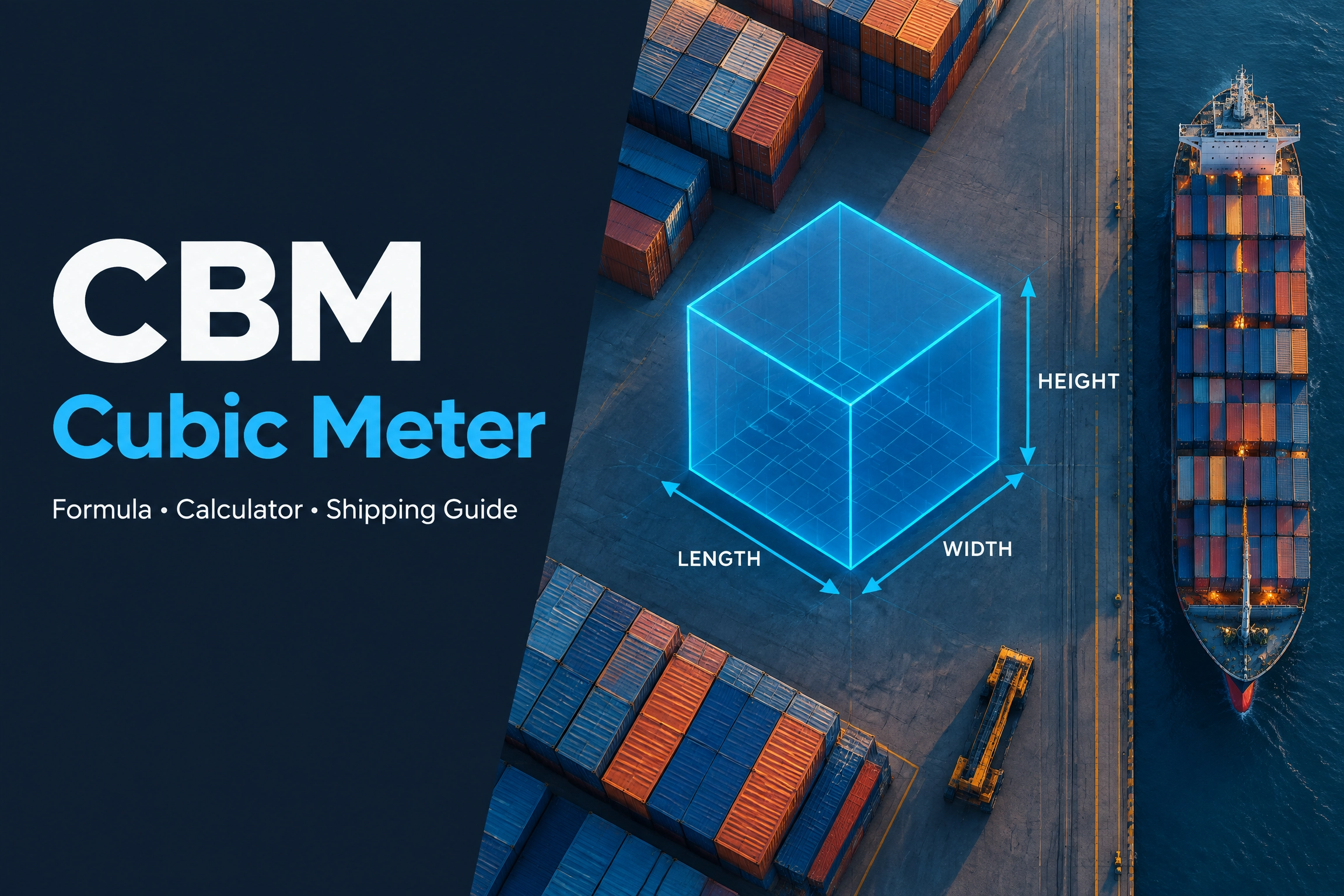
The CBM full form is Cubic Meter, written as m³. It measures the physical space occupied by a shipment. One cubic metre is a cube measuring one metre in length, one metre in width, and one metre in height.
CBM is different from actual weight. A shipment may be light but bulky, meaning it takes substantial transport space. Freight providers therefore use volume together with gross weight when pricing cargo. CBM is used for cartons, pallets, crates, drums, rolls, furniture, machinery, and other packed goods.
The final dimensions must be the external dimensions of the cargo after packing. Include pallets, wooden bases, outer cartons, stretch wrap, protective material, and any overhang. Product catalogue dimensions may not reflect the space required once cargo is ready for dispatch.
How to Calculate CBM by Hand
Measure the final outer length, width, and height of one packed unit.
Use one measurement unit consistently across all dimensions.
Multiply length, width, and height to calculate the CBM of one unit.
Multiply the result by the number of identical units.
Calculate each different carton or pallet size separately, then add the results.
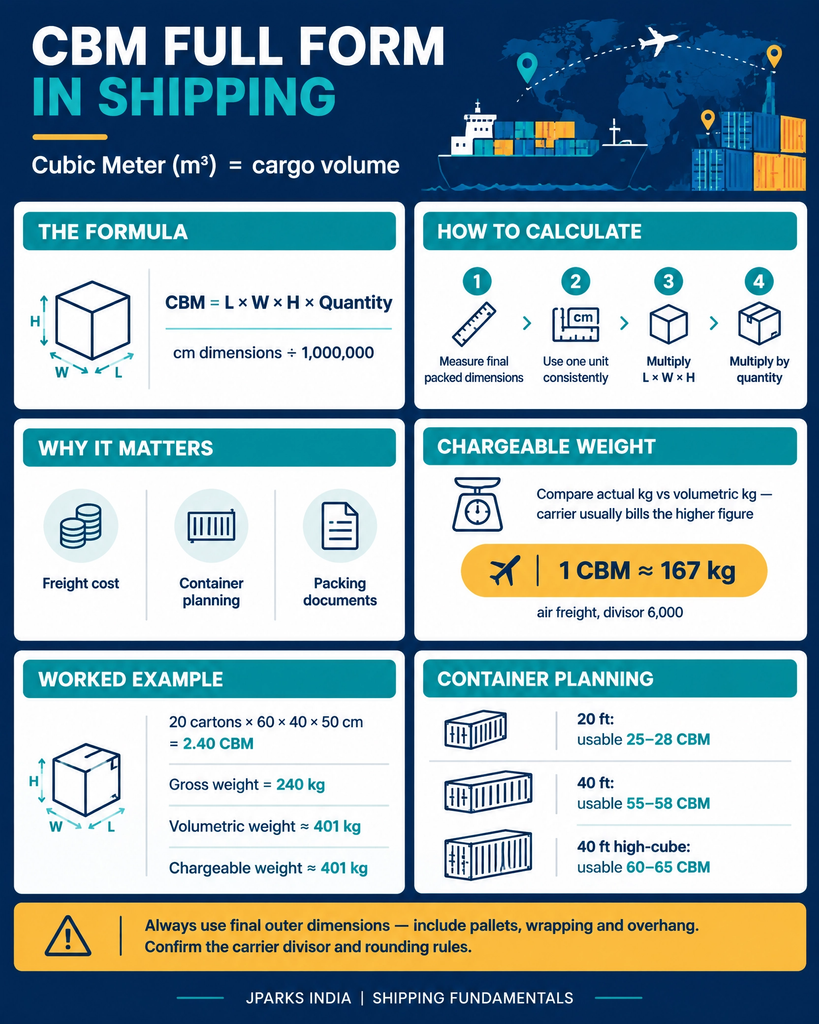
Example: A carton measures 60 cm × 40 cm × 50 cm. Convert centimetres to metres: 0.60 m × 0.40 m × 0.50 m. The volume of one carton is 0.12 CBM. If there are 20 cartons, the shipment volume is 2.40 CBM.
CBM for Pallets and Special Cargo
For palletised shipments, calculate the full external length, width, and loaded height, including the pallet base. Calculating cartons without the pallet can understate the cargo volume and result in a revised freight charge.
For cylindrical cargo, such as drums or fabric rolls, use: CBM = 3.14 × radius² × height. The radius is half of the diameter. For irregular machinery or shaped cargo, freight providers commonly use the longest length, widest width, and highest point as a practical bounding box because this represents the space required for safe handling and transport.
CBM and Chargeable Weight
This is where the CBM full form stops being a measurement and starts being a cost. Chargeable weight is the weight used to bill freight. The carrier normally compares the cargo’s actual gross weight with its volumetric weight and charges the higher figure. Actual gross weight comes from a scale. Volumetric weight is calculated from dimensions.
Courier services may apply a 5,000 divisor, while air freight commonly applies a 6,000 divisor. Divisors and rounding rules can vary by carrier, service, route, and contract. Confirm the applicable basis before agreeing to a freight cost or quoting a customer.
Why 1 CBM Equals About 167 kg
One cubic metre equals 1,000,000 cubic centimetres. When the air-freight volumetric divisor is 6,000 cm³ per kilogram, 1,000,000 ÷ 6,000 equals 166.67 kg. This is why the common air-freight conversion is approximately 167 kg per CBM.
This is a freight-rating conversion, not the physical weight of all cargo occupying one cubic metre. If cargo is light and bulky, its volumetric weight may exceed its gross weight. If cargo is dense, its actual gross weight may be higher and become the chargeable weight.
Worked Shipping Example
A worked example makes the CBM full form arithmetic concrete. Assume a shipment contains 20 cartons. Each carton measures 60 cm × 40 cm × 50 cm and weighs 12 kg. The cargo volume per carton is 0.12 CBM, so the total shipment volume is 2.40 CBM. The total gross weight is 20 × 12 kg, or 240 kg.
For air freight using the 167 kg per CBM conversion, the volumetric weight is 2.40 × 167 = 400.8 kg. Since 400.8 kg is higher than the actual weight of 240 kg, the carrier would usually use approximately 401 kg as the chargeable weight, subject to its rounding method.
CBM by Freight Mode
For LCL sea freight, CBM is an important pricing measurement because multiple consignments share container space. A forwarder may also apply a minimum charge, which is why small LCL shipments should be quoted based on complete packing data.
For FCL freight, CBM helps estimate whether cargo can fit into the selected container. For air freight and courier, CBM is converted into volumetric weight. Road transport may use a combination of cargo volume, gross weight, vehicle type, route, handling requirements, and delivery timeline.
Container Capacity
Container volume is a planning benchmark, not a guaranteed loadable amount. Actual usable space can be reduced by pallet dimensions, lashing, dunnage, door clearance, cargo shape, load distribution, and unavoidable gaps between packages.
Container type
Approximate internal volume
Typical usable planning range
20-foot standard container
About 33 CBM
About 25 to 28 CBM
40-foot standard container
About 68 CBM
About 55 to 58 CBM
40-foot high-cube container
About 76 CBM
About 60 to 65 CBM
Heavy cargo may reach the container payload limit before the container is full. Light but bulky cargo may fill the available space first. Both volume and gross cargo weight should be reviewed before equipment is selected.
CBM on Indian Export Documents
CBM commonly appears as supporting shipment information on the packing list, commercial invoice, freight booking instruction, bill of lading, and air waybill. It should match the final package quantity, outer dimensions, net weight, gross weight, and packaging description.
Maintaining accurate carton-level data helps prevent operational disputes and rate amendments. CBM does not replace the required customs declaration, but consistent packing information supports document quality and improves shipment readiness.
CBM and Import Customs Value
CBM does not directly decide customs duty or assessable value. Customs valuation is based on the relevant transaction-value framework and other applicable valuation elements. However, shipment volume can affect freight charges, and freight is relevant when estimating the landed cost of imported goods.
Using product dimensions instead of final packed dimensions.
Mixing centimetres, metres, inches, or feet in the same calculation.
Forgetting to multiply the volume by the package quantity.
Leaving out pallets, wooden cases, wrapping, or cargo overhang.
Rounding each package volume before calculating the shipment total.
Assuming one CBM always equals 167 kg across every transport mode.
Choosing a container based on CBM alone without checking payload and loadability.
Using estimated dimensions after final packing has changed the shipment size.
Other Meanings of CBM
The CBM full form is not unique to freight. Outside logistics, CBM can refer to Coal Bed Methane in the energy sector, Condition-Based Maintenance in engineering, or Curriculum-Based Measurement in education. In freight, shipping, and international trade, CBM normally means Cubic Meter.
How JPARKS INDIA Helps
The CBM full form is cubic metre, but CBM is more than a volume figure. It affects freight quotations, air-freight chargeable weight, container planning, packing-list accuracy, and overall shipment cost control. By measuring final packed cargo correctly and sharing complete dimensions and weights before booking, businesses can reduce freight revisions, avoid document discrepancies, and make better transport decisions.
For support with shipment planning and shipping documentation, see our shipping fundamentals guide. Businesses seeking broader customs, documentation, and compliance support can explore our import export consultancy services. JPARKS INDIA handles export documentation, backed by S.K. Agency, AEO-LO customs brokers since 1990.
Need support with shipment planning, freight documentation, or CBM calculations? Talk to our team for practical guidance on your import-export requirements.
Frequently Asked Questions
Q1. What is the CBM full form?
CBM full form is Cubic Meter. It measures the volume or physical space occupied by cargo.
Q2. How do I calculate CBM from centimetres?
Multiply length × width × height × quantity, then divide the result by 1,000,000.
Q3. Is CBM the same as actual weight?
No. CBM measures volume. Actual weight is measured in kilograms or tonnes.
Q4. Does CBM include a pallet and outer packaging?
Yes. Use the final external dimensions, including pallets, skids, wooden packaging, outer cartons, wrapping, and any overhang.
Q5. Why is 1 CBM equal to about 167 kg?
For air freight using a 6,000 cm³ per kg divisor, one cubic metre converts to approximately 166.67 kg of volumetric weight, generally rounded to 167 kg.
Q6. Why is chargeable weight higher than actual weight?
The cargo is bulky enough that its volumetric weight is higher than its scale weight.
Q7. Is CBM used for LCL sea freight?
Yes. CBM is an important measurement for LCL cargo because the shipment shares container space with other consignments.
Q8. Does CBM determine customs duty?
No. CBM does not determine customs duty. Duty depends on factors such as classification, customs value, policy conditions, and applicable rules.
Need this handled for you?
Tell us where you are stuck. We usually reply the same business day.
5.0 ★ · 123 Google reviews · Since 1990
Posted on Google
Vandana Bajaj
Trustindex verifies that the original source of the review is Google.
Very prompt and reliable service by Rahul Kolge and his team. Exceptional and happy experience.
Posted on Google
Supriya Shetye
Trustindex verifies that the original source of the review is Google.
Had a really good experience with JParks India. Rahul sir helped me a lot with my import work and were always active and responsive. Whatever documents or guidance was needed, they handled everything smoothly and explained things clearly. Felt stress-free throughout the process. Very helpful team, definitely recommend them if you’re doing import or export.
Posted on Google
dipali sakpal
Trustindex verifies that the original source of the review is Google.
Very nice people, get the work done in a very short time.
Posted on Google
Satish Bajaj
Trustindex verifies that the original source of the review is Google.
Excellent & Prompt services in all Import Export matters.
Great to work with you
Posted on Google
Bajaj VCPL
Trustindex verifies that the original source of the review is Google.
It was a great experience having work with you.
Posted on Google
Satish Bajaj
Trustindex verifies that the original source of the review is Google.
"Outstanding professiona services, efficient, and gets things done incredibly fast. Highly recommended for anyone needing reliable and prompt assistance
Posted on Google
Nishat fatima
Trustindex verifies that the original source of the review is Google.
excellent service
Posted on Google
farhan sayed
Trustindex verifies that the original source of the review is Google.
JParks Team is Super helpful! Thanks to Rahul and team!
Posted on Google
Sadik Inamdar
Trustindex verifies that the original source of the review is Google.
Good and personal service for import export code
Posted on Google
Maheshwar
Trustindex verifies that the original source of the review is Google.
Had a really good experience with JParks India. Rahul sir helped me a lot with my import work and were always active and responsive. Whatever documents or guidance was needed, they handled everything smoothly and explained things clearly. Felt stress-free throughout the process. Very helpful team, definitely recommend them if you’re doing import or export.
Verified by Trustindex
Trustindex verified badge is the Universal Symbol of Trust. Only the greatest companies can get the verified badge who has a review score above 4.5, based on customer reviews over the past 12 months. Read more
We use cookies to run this site, measure traffic, and track our ads. Essential cookies are always on. Accept all, reject non-essential, or set your preferences.
Cookie Preferences
Manage your cookie preferences below:
Essential cookies enable basic functions and are necessary for the proper function of the website.
Name
Description
Duration
Cookie Preferences
This cookie is used to store the user's cookie consent preferences.
30 days
Google reCAPTCHA helps protect websites from spam and abuse by verifying user interactions through challenges.
Name
Description
Duration
_GRECAPTCHA
Google reCAPTCHA sets a necessary cookie (_GRECAPTCHA) when executed for the purpose of providing its risk analysis.
179 days
Google Tag Manager simplifies the management of marketing tags on your website without code changes.
Name
Description
Duration
cookiePreferences
Registers cookie preferences of a user
2 years
td
Registers statistical data on users' behaviour on the website. Used for internal analytics by the website operator.
session
Statistics cookies collect information anonymously. This information helps us understand how visitors use our website.
Google Analytics is a web analytics service that tracks and reports website traffic. It collects anonymized data on how visitors use the site to help us understand and improve performance.