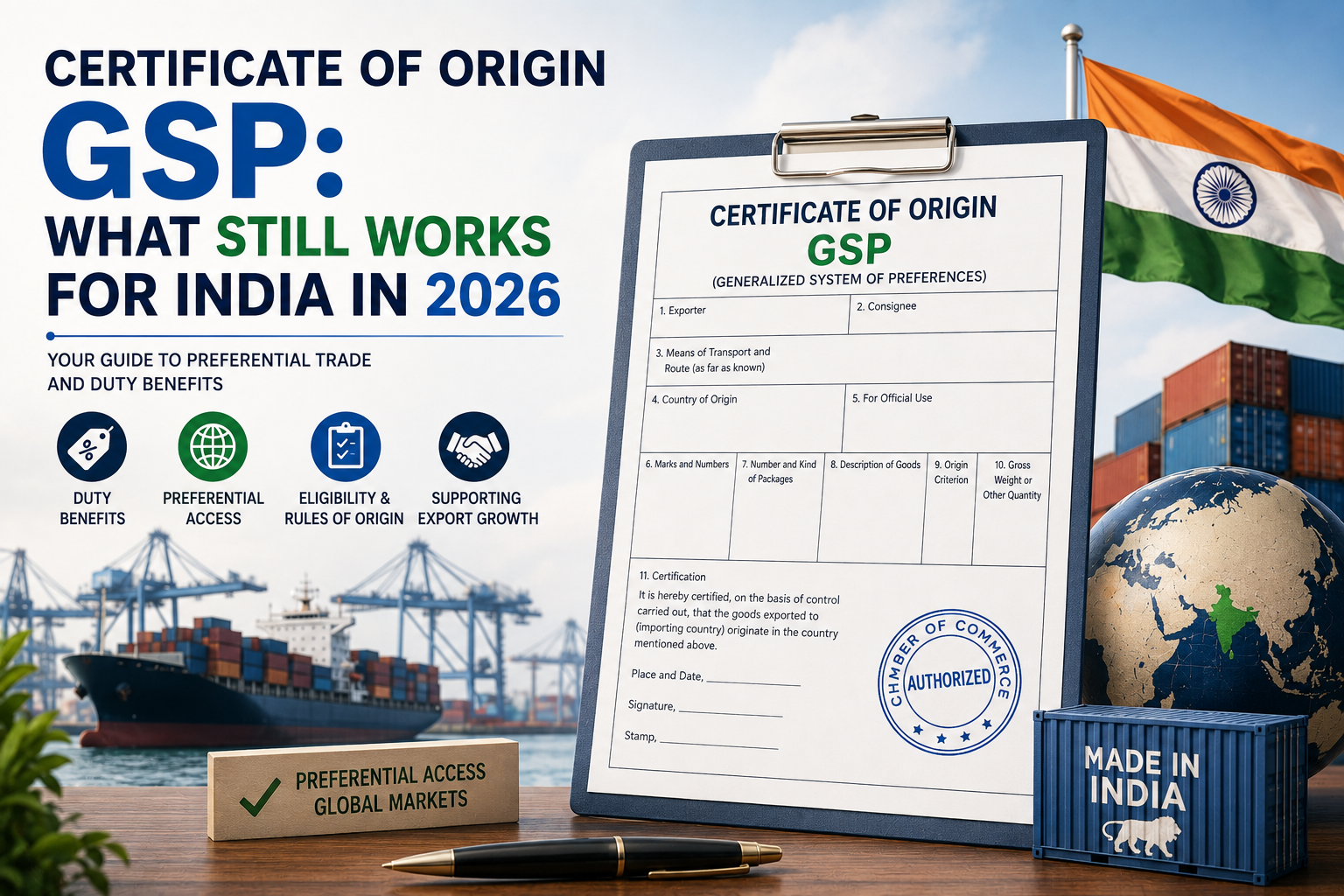
Certificate of Origin GSP: What Still Works for India in 2026
A certificate of origin GSP is the document used to claim preference under a Generalised System of Preferences, a unilateral scheme in which a developed country grants lower duties to goods from developing countries. GSP full form: Generalised System of Preferences.
For Indian exporters the honest answer in 2026 is that most of this has moved on. DGFT no longer issues Form A to the markets that mattered most. The United States removed India from its GSP scheme in 2019 and the programme itself has lapsed. The European Union no longer uses Form A from India. The United Kingdom replaced GSP with a different scheme in 2023 and is trimming India’s coverage.
If a buyer or a freight forwarder is still asking you for a GSP Form A, they are working from old guidance. This page sets out what actually applies market by market.
Certificate of Origin GSP: Where India Stands, Market by Market
Market
Status in 2026
What you actually use
United States
India removed from GSP effective 5 June 2019; the programme lapsed on 31 December 2020 and remained unrenewed as of mid-2026
No GSP claim. Normal MFN duty applies
European Union
Standard GSP only, not GSP+ or EBA
REX self-certified statement on origin, not Form A
United Kingdom
UK GSP replaced by the Developing Countries Trading Scheme on 19 June 2023
DCTS rules; certain India goods lose preference 1 Jan 2026 to 31 Dec 2028
Japan, Australia, others
Scheme-specific and periodically revised
Confirm with the buyer’s customs broker before shipping
United States. There is no US GSP claim available to India. Occasionally an American buyer still asks for a Form A out of habit. The correct response is to explain the position rather than obtain a document that has no effect.
European Union. India sits in the Standard GSP arrangement. Since the EU moved to the Registered Exporter system, preference is claimed through a statement on origin made by an exporter registered in the REX database, not through an agency-issued Form A. Regulation (EU) 2026/1395 was published on 22 June 2026 and applies from 1 January 2027.
United Kingdom. The DCTS carries India in its Standard Preferences tier. From 1 January 2026 to 31 December 2028 certain Indian and Indonesian goods lose DCTS preferential rates and face the UK Global Tariff instead. Check your specific commodity code rather than assuming continuity.
Certificate of Origin GSP Forms: Form A, REX and Self-Declaration
Form A
REX statement on origin
FTA certificate
Issued by
Authorised agency
The registered exporter
Authorised agency, or approved exporter
Still used from India
Largely superseded
Yes, for EU preference
Yes, for CEPA, CECA and similar
Registration needed
Agency registration
REX registration
Platform registration
Evidence burden
On exporter
On exporter
On exporter
Rules of origin still apply, whatever the scheme
A certificate of origin GSP claim, like any preference claim, needs origin established on one of the usual bases:
Wholly obtained. Grown, mined or produced entirely in India.
Sufficient working or processing. Typically a change in tariff classification, a value-addition threshold, or a named process.
Cumulation. Where the scheme permits inputs from certain other countries to count as originating.
Direct consignment. Goods must reach the destination without entering commerce in a third country. Transhipment is usually fine if documented.
Two assumptions cause most failed claims. Buying an input in India does not make it Indian-originating if it was imported. And meeting a value threshold requires a costed bill of materials, not an estimate.
How to claim preference from India in 2026
Confirm the destination still grants preference for your specific commodity code, this financial year.
Identify the right instrument. REX statement for the EU, DCTS treatment for the UK, an FTA certificate where an agreement exists, or no preference at all.
Check the origin rule that applies to your HS code under that scheme, working from your HSN classification.
Build the evidence file before you apply, not after a query arrives.
Retain records. Five years is the safe default across schemes.
Where an FTA gives you a better outcome than a lapsed GSP scheme, use the FTA. The India-Oman CEPA, in force from 1 June 2026 with eCoO live on Trade Connect from that date, is a recent example of preference moving in the opposite direction to GSP.
The Five Certificate of Origin GSP Mistakes That Cost Money
Applying for a US GSP certificate. There is nothing to claim. The scheme lapsed and India was removed before that.
Sending Form A to an EU buyer. EU preference from India runs on REX statements on origin.
Assuming UK preference is unchanged. Certain Indian goods lose DCTS rates from 1 January 2026.
Treating a locally purchased input as Indian. Origin follows production, not the place of purchase.
Claiming preference where an FTA route is better. Compare the agreement rate against the scheme rate before choosing.
How JPARKS INDIA Helps
JPARKS INDIA works out whether a certificate of origin GSP claim is actually available for your product and destination, then files the right instrument. In several cases the useful answer has been that no GSP claim exists and an FTA claim does.
Preference eligibility check by commodity code and destination, before the shipment is booked.
Origin rule analysis and costed value-addition workings where a threshold applies.
Q1. Does a certificate of origin GSP still bring benefits in the United States?
No. India was removed from US GSP effective 5 June 2019, and the US programme itself expired on 31 December 2020 and remained unrenewed as of mid-2026.
Q2. Does the EU still accept Form A from India?
EU preference from India is claimed through a REX statement on origin rather than an agency-issued Form A.
Q3. Is India eligible for EU GSP+?
No. India is in the Standard GSP arrangement, not GSP+ or Everything But Arms.
Q4. What replaced UK GSP?
The Developing Countries Trading Scheme, from 19 June 2023. Certain Indian goods lose DCTS preference from 1 January 2026 to 31 December 2028.
Q5. Is a certificate of origin GSP the same as an FTA certificate?
No. GSP is a unilateral concession by the importing country. An FTA certificate claims preference under a reciprocal agreement, and the two have different rules and different forms.
Q6. Does buying inputs in India make them Indian-originating?
No. Origin follows where the goods were produced or substantially transformed, not where you bought them.
Q7. How long must I keep GSP records?
Treat five years as the minimum. It aligns with the record retention period Indian customs applies to origin claims under Section 28DA.
Need this handled for you?
Tell us where you are stuck. We usually reply the same business day.
5.0 ★ · 126 Google reviews · Since 1990
Posted on Google
Vandana Bajaj
Trustindex verifies that the original source of the review is Google.
Very prompt and reliable service by Rahul Kolge and his team. Exceptional and happy experience.
Posted on Google
Supriya Shetye
Trustindex verifies that the original source of the review is Google.
Had a really good experience with JParks India. Rahul sir helped me a lot with my import work and were always active and responsive. Whatever documents or guidance was needed, they handled everything smoothly and explained things clearly. Felt stress-free throughout the process. Very helpful team, definitely recommend them if you’re doing import or export.
Posted on Google
dipali sakpal
Trustindex verifies that the original source of the review is Google.
Very nice people, get the work done in a very short time.
Posted on Google
Satish Bajaj
Trustindex verifies that the original source of the review is Google.
Excellent & Prompt services in all Import Export matters.
Great to work with you
Posted on Google
Bajaj VCPL
Trustindex verifies that the original source of the review is Google.
It was a great experience having work with you.
Posted on Google
Satish Bajaj
Trustindex verifies that the original source of the review is Google.
"Outstanding professiona services, efficient, and gets things done incredibly fast. Highly recommended for anyone needing reliable and prompt assistance
Posted on Google
Nishat fatima
Trustindex verifies that the original source of the review is Google.
excellent service
Posted on Google
farhan sayed
Trustindex verifies that the original source of the review is Google.
JParks Team is Super helpful! Thanks to Rahul and team!
Posted on Google
Sadik Inamdar
Trustindex verifies that the original source of the review is Google.
Good and personal service for import export code
Posted on Google
Maheshwar
Trustindex verifies that the original source of the review is Google.
Had a really good experience with JParks India. Rahul sir helped me a lot with my import work and were always active and responsive. Whatever documents or guidance was needed, they handled everything smoothly and explained things clearly. Felt stress-free throughout the process. Very helpful team, definitely recommend them if you’re doing import or export.
Verified by Trustindex
Trustindex verified badge is the Universal Symbol of Trust. Only the greatest companies can get the verified badge who has a review score above 4.5, based on customer reviews over the past 12 months. Read more
We use cookies to run this site, measure traffic, and track our ads. Essential cookies are always on. Accept all, reject non-essential, or set your preferences.
Cookie Preferences
Manage your cookie preferences below:
Essential cookies enable basic functions and are necessary for the proper function of the website.
Name
Description
Duration
Cookie Preferences
This cookie is used to store the user's cookie consent preferences.
30 days
Google reCAPTCHA helps protect websites from spam and abuse by verifying user interactions through challenges.
Name
Description
Duration
_GRECAPTCHA
Google reCAPTCHA sets a necessary cookie (_GRECAPTCHA) when executed for the purpose of providing its risk analysis.
179 days
Google Tag Manager simplifies the management of marketing tags on your website without code changes.
Name
Description
Duration
cookiePreferences
Registers cookie preferences of a user
2 years
td
Registers statistical data on users' behaviour on the website. Used for internal analytics by the website operator.
session
Statistics cookies collect information anonymously. This information helps us understand how visitors use our website.
Google Analytics is a web analytics service that tracks and reports website traffic. It collects anonymized data on how visitors use the site to help us understand and improve performance.