ICEGATE Exchange Rate: 5 Costly Mistakes to Avoid When Filing
If you’re importing or exporting goods through Indian customs, one number quietly controls your duty bill more than almost anything else: the ICEGATE exchange rate. Get it wrong, and you’re looking at miscalculated IGST, delayed clearance, or an awkward reconciliation with your finance team. This guide covers what it is, how it’s set, and exactly how to apply it correctly on your next filing.
Who This Guide Is For
This is for importers, exporters, and the customs brokers (CHAs) filing on their behalf who need to confirm the correct conversion rate before or during Bill of Entry or Shipping Bill filing. It is not a general currency converter for commercial remittance. If you’re setting up ICEGATE access for the first time, see JPARKS India’s ICEGATE registration guide.
What Is the ICEGATE Exchange Rate?
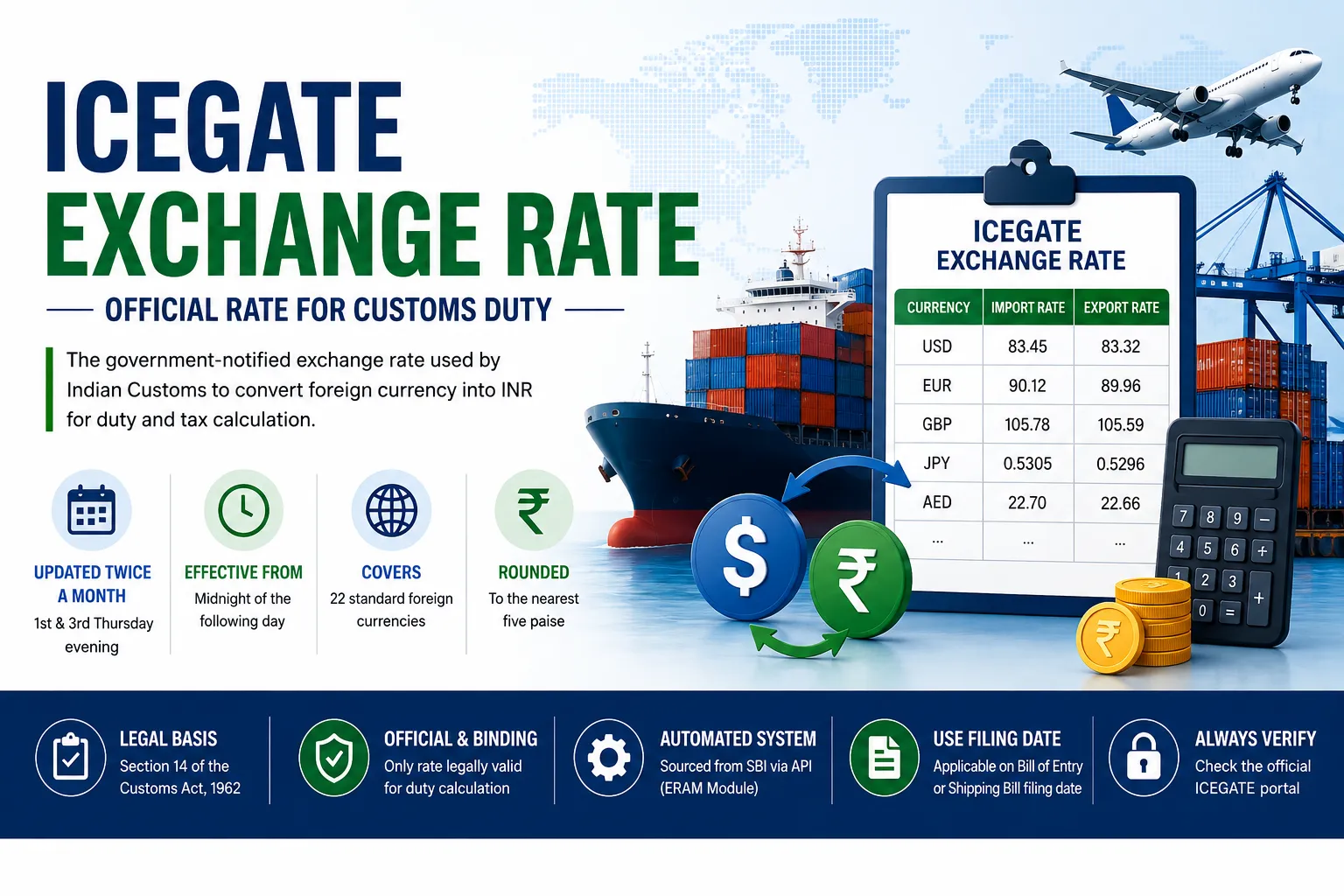
The ICEGATE exchange rate is the official, government-notified currency conversion rate used to calculate customs duty on imported and exported goods in India. It’s published on the ICEGATE portal, the Indian Customs Electronic Data Interchange Gateway, and is legally mandated under Section 14 of the Customs Act, 1962.
This is not a live market rate, and it’s not your bank’s forex quote. It’s a fixed, notified figure that customs authorities use to convert your invoice value into Indian Rupees for the purpose of assessing duty and tax, and it’s the only rate that’s legally valid for that purpose.
Why It’s Different From Your Bank’s Rate
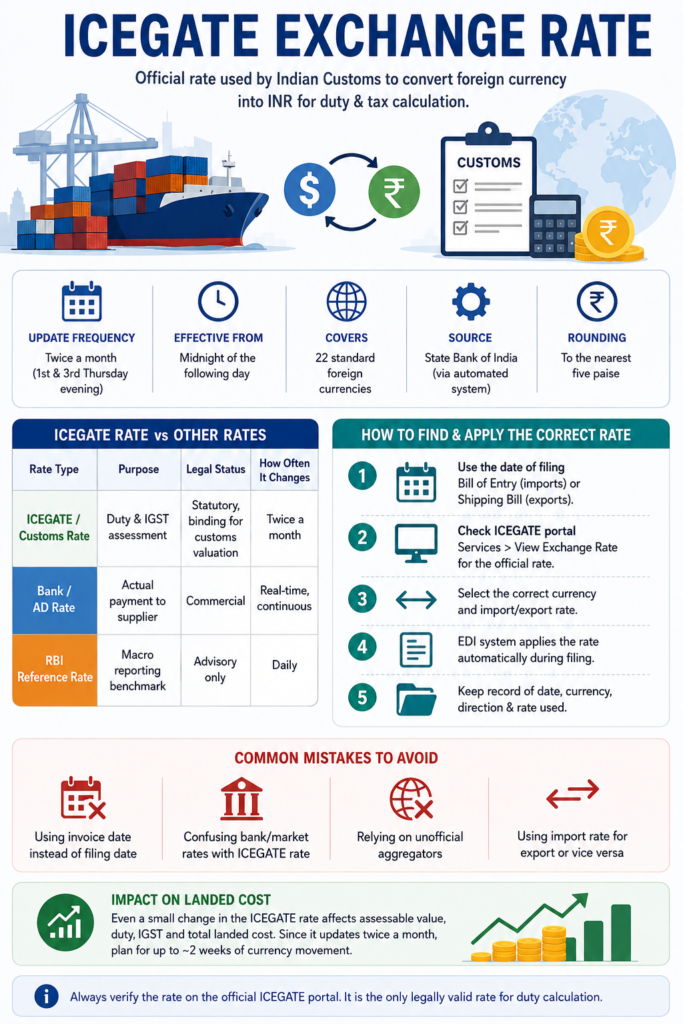
New importers are often confused the first time they notice their bank’s exchange rate doesn’t match the customs rate used on their Bill of Entry. This is expected, not an error. Here’s the distinction:
Rate Type
Purpose
Legal Status
How Often It Changes
ICEGATE / Customs Rate
Duty and IGST assessment
Statutory, binding for customs valuation
Twice a month
Bank / AD Rate
Actual payment to your supplier
Commercial
Real-time, continuous
RBI Reference Rate
Macro reporting benchmark
Advisory only
Daily
Because the customs rate stays fixed for roughly two weeks at a time, the ICEGATE exchange rate deliberately doesn’t chase daily market volatility. That’s a feature, not a flaw: it gives importers and exporters a stable, predictable figure to plan landed costs around, rather than recalculating duty exposure every time the rupee moves.
Rates are sourced directly from the State Bank of India via API integration.
Figures are rounded to the nearest five paise.
Rates are published for 22 standard foreign currencies.
Publication happens twice monthly, on the evenings of the first and third Thursday of each month, and take effect from midnight the following day.
A manual contingency process exists with designated nodal officers in case the automated feed fails. A September 2024 amendment further clarified that if a scheduled Thursday falls on a holiday, the most recently received SBI rate is published that same day rather than deferred.
This replaced the older system of ad hoc government notifications. Always confirm the current publication schedule and process on the official ICEGATE portal, as procedural details like this are subject to further circulars and can change.
Step-by-Step: Finding and Applying the Correct Rate
Step 1: Identify the operative date
Use the date your Bill of Entry is filed (imports, under Section 46) or your Shipping Bill is filed (exports, under Section 50), not your invoice date and not your shipment date. This is the single most common source of valuation errors.
Step 2: Check the official source
Go to the ICEGATE View Exchange Rate page under Services. This is the only place to get the authoritative figure. Third-party tools and vendor APIs may mirror this data for convenience, but none of them are official. Always verify against ICEGATE directly for anything duty-critical.
Step 3: Match the correct currency and direction
Each currency has a separate import rate and export rate. Using the wrong one, which is easy to do when processing both flows, will throw off your assessable value calculation.
Step 4: Let the EDI system apply it automatically
When you file electronically, the Indian Customs EDI System pulls the correct notified rate itself. Manual lookup mainly matters for pre-filing budgeting, quotes, and internal cost estimates, so make sure those match what the system will actually apply. Once the Bill of Entry is assessed, you’ll move to duty payment; see JPARKS India’s ICEGATE duty payment guide for that next step.
Step 5: Keep a record
Log the date, currency, direction, and rate used for each shipment. With rates changing fortnightly, a stale cached figure in an ERP or spreadsheet is a real and avoidable risk.
What This Means for Your Landed Cost
Even a small movement in the ICEGATE exchange rate changes your assessable value, and by extension your basic customs duty, IGST, and total landed cost. Because the rate only updates twice a month, large or time-sensitive shipments can be affected by up to roughly two weeks of currency movement that hasn’t yet been reflected. For high-value consignments, it’s worth factoring this lag into your procurement and budgeting, rather than assuming the customs rate always tracks the live market. If you may qualify for concessional duty rates instead, review JPARKS India’s IGCR Clearance services.
Common Mistakes to Avoid
Using the invoice date instead of the filing date to determine which rate applies.
Confusing bank or market rates with the ICEGATE exchange rate when estimating landed cost ahead of filing.
Relying on unofficial aggregators for figures used in actual duty calculation, rather than confirming the ICEGATE exchange rate directly on the portal.
Applying the import rate to an export shipment, or vice versa.
How JPARKS India Helps
JPARKS India is an EXIM compliance consultancy that helps importers and exporters manage ICEGATE registration, AD Code linking, duty payment troubleshooting, and broader customs clearance requirements. If your business regularly imports or exports and wants the exchange rate, duty assessment, and filing process handled correctly the first time, visit JPARKS India’s full service list or their contact page to get started.
Frequently Asked Questions
Q1. How often does the ICEGATE exchange rate update?
Twice a month, on the evenings of the first and third Thursday, effective from midnight the following day. Confirm the current schedule on the official ICEGATE portal, as this is a procedural detail that can change.
Q2. Why is the ICEGATE rate different from my bank’s exchange rate?
Your bank quotes a live, continuously moving commercial rate for settling payment with your supplier. The ICEGATE rate is a fixed, notified rate used only for customs valuation under Section 14 of the Customs Act, 1962. The two serve different legal purposes and will rarely match exactly.
Q3. Which rate applies, the date on my invoice or the date I file?
Neither. The applicable rate is the one in force on the date the Bill of Entry (imports) or Shipping Bill (exports) is filed.
Q4. Can I use a live market rate instead of the ICEGATE rate for customs duty?
No. Only the customs-notified rate is legally valid for computing assessable value and duty. A live or bank rate cannot be substituted, even if it’s more current.
Q5. Is there an official ICEGATE exchange rate API?
Not currently. Third-party vendors offer APIs that mirror the published data for automation convenience, but none are official. For anything duty-critical, verify directly against the ICEGATE portal.
Need this handled for you?
Tell us where you are stuck. We usually reply the same business day.
5.0 ★ · 123 Google reviews · Since 1990
Posted on Google
Vandana Bajaj
Trustindex verifies that the original source of the review is Google.
Very prompt and reliable service by Rahul Kolge and his team. Exceptional and happy experience.
Posted on Google
Supriya Shetye
Trustindex verifies that the original source of the review is Google.
Had a really good experience with JParks India. Rahul sir helped me a lot with my import work and were always active and responsive. Whatever documents or guidance was needed, they handled everything smoothly and explained things clearly. Felt stress-free throughout the process. Very helpful team, definitely recommend them if you’re doing import or export.
Posted on Google
dipali sakpal
Trustindex verifies that the original source of the review is Google.
Very nice people, get the work done in a very short time.
Posted on Google
Satish Bajaj
Trustindex verifies that the original source of the review is Google.
Excellent & Prompt services in all Import Export matters.
Great to work with you
Posted on Google
Bajaj VCPL
Trustindex verifies that the original source of the review is Google.
It was a great experience having work with you.
Posted on Google
Satish Bajaj
Trustindex verifies that the original source of the review is Google.
"Outstanding professiona services, efficient, and gets things done incredibly fast. Highly recommended for anyone needing reliable and prompt assistance
Posted on Google
Nishat fatima
Trustindex verifies that the original source of the review is Google.
excellent service
Posted on Google
farhan sayed
Trustindex verifies that the original source of the review is Google.
JParks Team is Super helpful! Thanks to Rahul and team!
Posted on Google
Sadik Inamdar
Trustindex verifies that the original source of the review is Google.
Good and personal service for import export code
Posted on Google
Maheshwar
Trustindex verifies that the original source of the review is Google.
Had a really good experience with JParks India. Rahul sir helped me a lot with my import work and were always active and responsive. Whatever documents or guidance was needed, they handled everything smoothly and explained things clearly. Felt stress-free throughout the process. Very helpful team, definitely recommend them if you’re doing import or export.
Verified by Trustindex
Trustindex verified badge is the Universal Symbol of Trust. Only the greatest companies can get the verified badge who has a review score above 4.5, based on customer reviews over the past 12 months. Read more
We use cookies to run this site, measure traffic, and track our ads. Essential cookies are always on. Accept all, reject non-essential, or set your preferences.
Cookie Preferences
Manage your cookie preferences below:
Essential cookies enable basic functions and are necessary for the proper function of the website.
Name
Description
Duration
Cookie Preferences
This cookie is used to store the user's cookie consent preferences.
30 days
Google reCAPTCHA helps protect websites from spam and abuse by verifying user interactions through challenges.
Name
Description
Duration
_GRECAPTCHA
Google reCAPTCHA sets a necessary cookie (_GRECAPTCHA) when executed for the purpose of providing its risk analysis.
179 days
Google Tag Manager simplifies the management of marketing tags on your website without code changes.
Name
Description
Duration
cookiePreferences
Registers cookie preferences of a user
2 years
td
Registers statistical data on users' behaviour on the website. Used for internal analytics by the website operator.
session
Statistics cookies collect information anonymously. This information helps us understand how visitors use our website.
Google Analytics is a web analytics service that tracks and reports website traffic. It collects anonymized data on how visitors use the site to help us understand and improve performance.