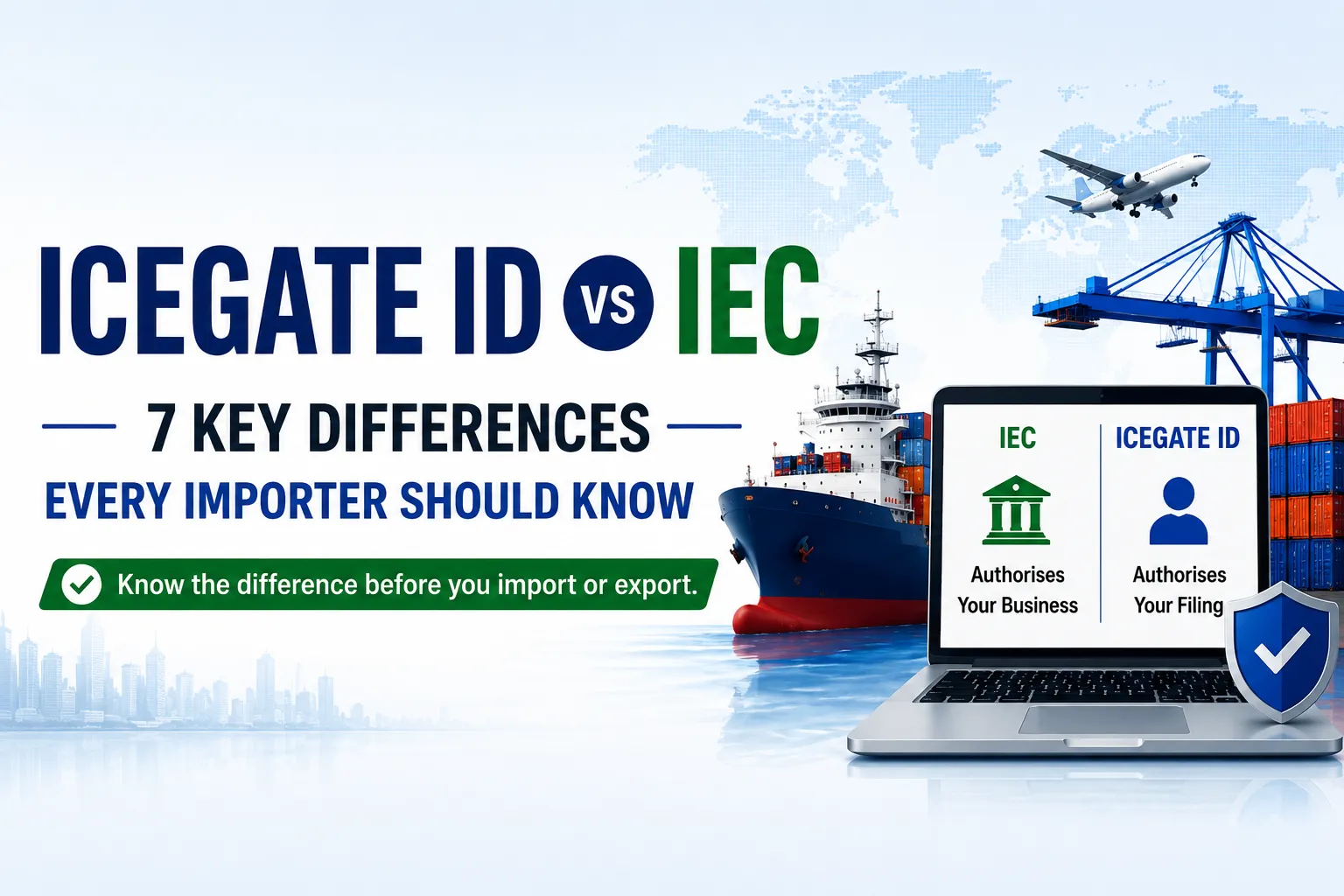
ICEGATE ID vs IEC: 7 Key Differences Every Importer Should Know
ICEGATE ID vs IEC is not a choice between two things. You need both, and they do different jobs. The IEC is your licence to trade, issued by DGFT. The ICEGATE ID is your login to customs, created on the CBIC portal. One authorises the business, the other authenticates the person filing.
Treat the ICEGATE ID vs IEC pair as interchangeable and cargo waits. This guide gives the legal basis for each, the seven differences that matter in live filing, and the order you must follow.
ICEGATE ID vs IEC at a Glance
IEC
ICEGATE ID
Full form
Importer Exporter Code
Indian Customs Electronic Gateway user ID
Issued by
DGFT
Created on the CBIC portal
Governing law
Foreign Trade Act, 1992
Customs Act, 1962
Identifies
The business entity
The individual filing
Format
10 character alphanumeric, same as PAN
Self chosen, up to 25 characters
How many
One per entity
One per authorised signatory
Changeable
Details can be amended
ID string is permanent
Upkeep
Annual confirmation, April to June
Keep the Class 3 DSC valid
Enables
Legal right to import and export
Electronic filing and duty payment
The ICEGATE ID vs IEC split comes down to this: one is a licence tied to a company, the other is a login tied to a person. Everything else follows.
What an IEC Is
The Importer Exporter Code is issued by the Directorate General of Foreign Trade under Section 7 of the Foreign Trade (Development and Regulation) Act, 1992. Without one you cannot legally import or export goods from India, and no broker can file for you.
It is not a 10 digit number
Almost every guide online gets this wrong. The IEC is a 10 character alphanumeric code, and since DGFT moved to PAN based issuance it is identical to your firm’s PAN. If your PAN reads AABCJ1234K, that string is your IEC.
This anchors the entire ICEGATE ID vs IEC comparison. The IEC is welded to the PAN of the legal entity, so it can never belong to an employee.
Validity
The IEC does not expire, but it must be confirmed on the DGFT portal every year between April and June even when nothing has changed. Miss the window and it is deactivated.
Confirmation with no changes is free. The Rs. 200 fee applies only when you modify details. If yours has lapsed, our IEC renewal service covers reactivation.
Anyone can verify a code on the DGFT public lookup at dgft.gov.in/CP/?opt=view-any-ice. Note the spelling: DGFT’s own live link reads “ice”, and the intuitive version returns a 404.
What an ICEGATE ID Is
Your ICEGATE ID is the username you hold on the Common Customs Electronic Portal.
CBIC notified icegate.gov.in as that portal under Section 154C of the Customs Act, 1962, read with clause (7B) of Section 2, through Notification G.S.R. 217(E). Published by CBIC, it makes the portal the statutory channel for filing and duty payment. The ID is how customs knows who submitted a document.
Format and permanence
You choose the ID during registration. Alphanumeric, up to 25 characters, hyphen and underscore only. Once created it cannot be changed by you or the helpdesk, so pick something institutional rather than personal.
One IEC, many IDs
The authorised representative registers as the parent user. Additional staff are added as child users under the same IEC with defined permissions. This is the structural point behind the ICEGATE ID vs IEC distinction: one code, several logins.
Class 3 DSC
The current module requires a Class 3 Digital Signature Certificate. Guides still citing the 2019 advisory that a DSC is optional are describing a module that has been withdrawn. Setup is covered in our Class 3 DSC guide, and the full sequence in our walkthrough on how to register on ICEGATE. The portal moved to ICEGATE 2.0 in April 2026, so older screenshots will not match.
ICEGATE ID vs IEC: The 7 Differences That Matter
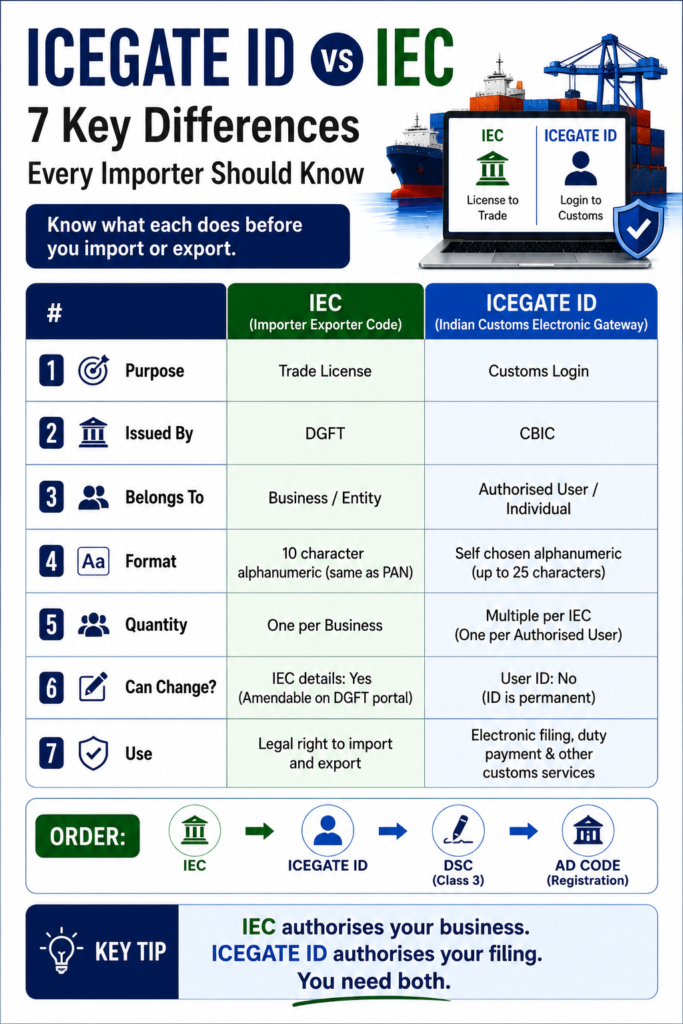
1. Issuing authority. DGFT issues the IEC under the Ministry of Commerce. The ICEGATE ID is created on the CBIC portal under the Ministry of Finance. Two systems, two records, both of which must agree.
2. Legal basis. The IEC flows from the Foreign Trade Act, 1992. The ICEGATE ID flows from the Customs Act, 1962. That is why amending one does not amend the other.
3. What it identifies. The IEC identifies the business. The ICEGATE ID identifies the person filing. Customs attributes every Bill of Entry to the ID that submitted it.
4. Format. The IEC is fixed at 10 alphanumeric characters and equals your PAN. The ICEGATE ID is self chosen, up to 25 characters, subject to availability.
5. Quantity. One IEC per entity, always. One ICEGATE ID per authorised signatory. Three branch offices can run three IDs against a single IEC.
6. Changeability. IEC details can be amended on the DGFT portal. An ICEGATE ID is permanent. You can update the linked email and mobile, never the ID string.
7. What it enables. The IEC lets you trade. The ICEGATE ID lets you file: Bills of Entry, Shipping Bills, e-Sanchit uploads, duty payment, IGST refund tracking, and RoDTEP scrip applications.
In practice, every ICEGATE ID vs IEC interaction follows the same pattern. The IEC is the subject of the transaction. The ICEGATE ID is the actor performing it.
Why the ICEGATE ID vs IEC Mix Up Costs Money
Four ICEGATE ID vs IEC failures show up repeatedly in real files.
Assuming an IEC alone permits filing. It does not. Cargo lands, the Bill of Entry cannot be filed electronically, and demurrage runs while the registration sits in the approval queue. This is the costliest version of the mistake.
Registering before records are clean. The portal validates against live DGFT and GSTN data. A name or address differing by a comma fails validation. Reconcile at source first.
Losing the ID when a signatory leaves. Because the ID is personal and unchangeable, a departure can strand filing access. Register a backup signatory before you need one.
Letting the DSC lapse. The ID stays active indefinitely, so the certificate behind it gets forgotten. Filings stop the day it expires.
Error on screen
What it means
Fix
Invalid IEC
Failed live DGFT validation
Confirm the IEC is active and the PAN matches
GSTIN mismatch
Name or address differs across records
Amend at DGFT or GSTN, then retry
DSC not detected
emSigner not running or token unseated
Restart emSigner, reseat the token
User ID not available
That ICEGATE ID is already taken
Choose a different string
OTP expired
More than 600 seconds elapsed
Request a fresh OTP
ICEGATE ID vs IEC: Which Comes First
Always the IEC. In the ICEGATE ID vs IEC sequence the code comes before the login, and the order is fixed:
Obtain the IEC from DGFT, typically in 24 to 48 hours with complete documents.
Confirm your GSTIN records match the IEC exactly, since the portal pulls contact details from GSTN.
Create the ICEGATE ID and register your Class 3 DSC.
Complete AD Code registration so duty payments and refunds flow. Under CBIC Instruction No. 25/2023-Customs this is a single registration valid at all Indian ports under the same IEC.
You cannot invert steps one and three. The portal will not issue an ID against an IEC that fails DGFT validation.
How JPARKS India Helps
JPARKS INDIA handles IEC, ICEGATE, DSC, and AD Code registrations end to end, serving 500+ importers and exporters with 35+ years of EXIM compliance experience and a 5.0 Google rating. We reconcile DGFT and GSTN records before touching the portal, which is where most rejections are prevented. If the ICEGATE ID vs IEC sequence is holding up a shipment, talk to us.
Frequently Asked Questions
Q1. ICEGATE ID vs IEC, do I need both?
Yes. The IEC authorises your business to trade and the ICEGATE ID lets an authorised person file electronically. Neither substitutes for the other, and you cannot file a Bill of Entry or Shipping Bill with an IEC alone.
Q2. Is my IEC really the same as my PAN?
Yes. DGFT issues the IEC as a PAN based code, so the 10 character alphanumeric string on your certificate matches your firm’s PAN exactly. Guides calling it a 10 digit number are outdated.
Q3. In ICEGATE ID vs IEC terms, can one IEC have more than one ID?
Yes. A single IEC supports a parent user plus multiple child users, each with their own ID and permissions. That is the intended structure for firms with several branches or filing staff.
Q4. Can I change my ICEGATE ID later?
No. It is permanent once generated. You can update the email address and mobile number attached to it, but not the ID string.
Q5. In the ICEGATE ID vs IEC pair, does either expire?
The IEC does not expire but must be confirmed annually on the DGFT portal between April and June, or it is deactivated. The ICEGATE ID does not expire either, though filings stop the day the linked Class 3 DSC lapses.
Q6. My IEC is active but I cannot log in. Why?
Active status at DGFT says nothing about your portal account. Check whether the ICEGATE registration was ever approved, whether the DSC is current, and whether the email on the profile still exists.
Q7. Do customs brokers use my ICEGATE ID?
No. Your broker files under their own licensed ID and quotes your IEC as the importer. Never share credentials with a broker or anyone else.
Need this handled for you?
Tell us where you are stuck. We usually reply the same business day.
5.0 ★ · 123 Google reviews · Since 1990
Posted on Google
Vandana Bajaj
Trustindex verifies that the original source of the review is Google.
Very prompt and reliable service by Rahul Kolge and his team. Exceptional and happy experience.
Posted on Google
Supriya Shetye
Trustindex verifies that the original source of the review is Google.
Had a really good experience with JParks India. Rahul sir helped me a lot with my import work and were always active and responsive. Whatever documents or guidance was needed, they handled everything smoothly and explained things clearly. Felt stress-free throughout the process. Very helpful team, definitely recommend them if you’re doing import or export.
Posted on Google
dipali sakpal
Trustindex verifies that the original source of the review is Google.
Very nice people, get the work done in a very short time.
Posted on Google
Satish Bajaj
Trustindex verifies that the original source of the review is Google.
Excellent & Prompt services in all Import Export matters.
Great to work with you
Posted on Google
Bajaj VCPL
Trustindex verifies that the original source of the review is Google.
It was a great experience having work with you.
Posted on Google
Satish Bajaj
Trustindex verifies that the original source of the review is Google.
"Outstanding professiona services, efficient, and gets things done incredibly fast. Highly recommended for anyone needing reliable and prompt assistance
Posted on Google
Nishat fatima
Trustindex verifies that the original source of the review is Google.
excellent service
Posted on Google
farhan sayed
Trustindex verifies that the original source of the review is Google.
JParks Team is Super helpful! Thanks to Rahul and team!
Posted on Google
Sadik Inamdar
Trustindex verifies that the original source of the review is Google.
Good and personal service for import export code
Posted on Google
Maheshwar
Trustindex verifies that the original source of the review is Google.
Had a really good experience with JParks India. Rahul sir helped me a lot with my import work and were always active and responsive. Whatever documents or guidance was needed, they handled everything smoothly and explained things clearly. Felt stress-free throughout the process. Very helpful team, definitely recommend them if you’re doing import or export.
Verified by Trustindex
Trustindex verified badge is the Universal Symbol of Trust. Only the greatest companies can get the verified badge who has a review score above 4.5, based on customer reviews over the past 12 months. Read more
We use cookies to run this site, measure traffic, and track our ads. Essential cookies are always on. Accept all, reject non-essential, or set your preferences.
Cookie Preferences
Manage your cookie preferences below:
Essential cookies enable basic functions and are necessary for the proper function of the website.
Name
Description
Duration
Cookie Preferences
This cookie is used to store the user's cookie consent preferences.
30 days
Google reCAPTCHA helps protect websites from spam and abuse by verifying user interactions through challenges.
Name
Description
Duration
_GRECAPTCHA
Google reCAPTCHA sets a necessary cookie (_GRECAPTCHA) when executed for the purpose of providing its risk analysis.
179 days
Google Tag Manager simplifies the management of marketing tags on your website without code changes.
Name
Description
Duration
cookiePreferences
Registers cookie preferences of a user
2 years
td
Registers statistical data on users' behaviour on the website. Used for internal analytics by the website operator.
session
Statistics cookies collect information anonymously. This information helps us understand how visitors use our website.
Google Analytics is a web analytics service that tracks and reports website traffic. It collects anonymized data on how visitors use the site to help us understand and improve performance.