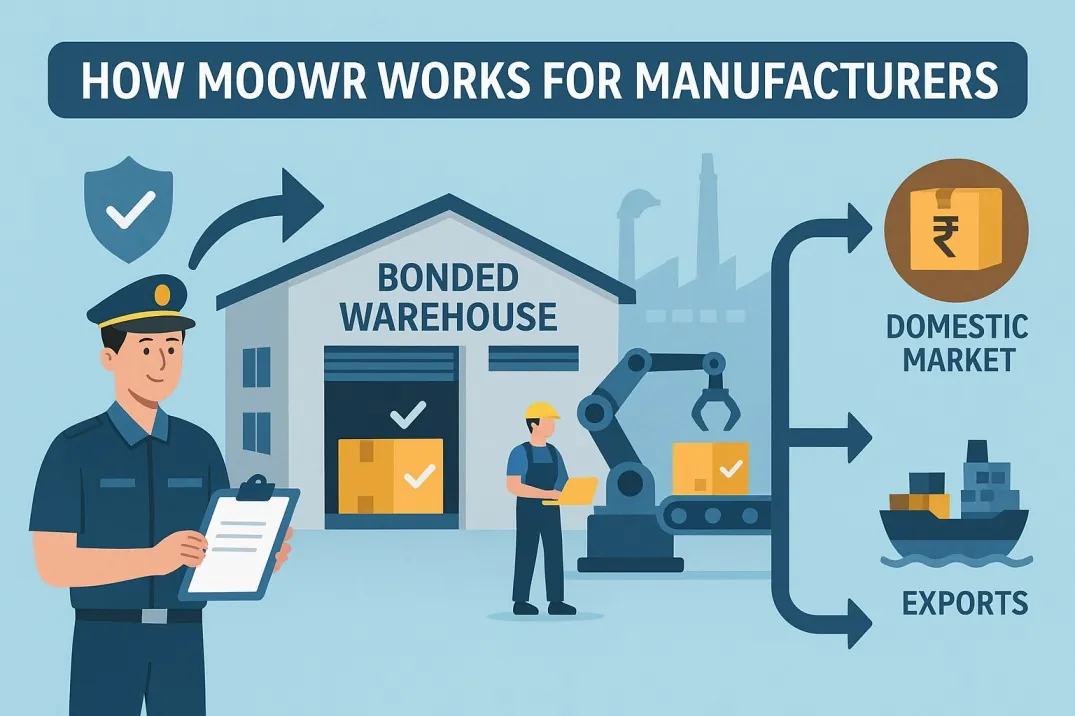
How MOOWR works for manufacturers comes down to one shift: your factory becomes a private customs bonded warehouse. Imported inputs and capital goods enter it without Basic Customs Duty or IGST. Duty is deferred, not waived, and crystallises only when goods leave for the domestic market. If the finished goods are exported, it is remitted entirely.
What follows is the actual sequence, with the forms named. Most explanations of how MOOWR works for manufacturers describe the concept and skip the paperwork, which is where applications stall.
How MOOWR Works for Manufacturers: The Six Steps
Step 1. Apply in Annexure A
A single integrated form covers both the licence for a private bonded warehouse under Section 58 and permission for manufacture and other operations under Section 65. Applicants already holding a Section 58 licence request only the Section 65 permission. Part II carries the declaration under the Private Warehouse Licensing Regulations, 2016 and the undertaking under Regulation 4 of MOOWR, 2019.
The application is no longer submitted online. The Invest India MOOWR portal stopped accepting applications in late 2025. Annexure A now goes directly to the jurisdictional Principal Commissioner or Commissioner of Customs in physical format. Licensing typically takes two to three months.
Step 2. Declare the warehouse under GST
The premises granted Section 65 permission must be declared as the principal or additional place of business for GST purposes. This is a genuine requirement, easily missed, and it holds up units that treat the licence as a customs matter alone.
Step 3. Execute the bond and get a warehouse code
A triple duty bond is executed in Annexure C. It satisfies both Regulation 4 of MOOWR, 2019 and Section 59 of the Customs Act, 1962. The bond value is three times the duty, supported by a solvency certificate, and the certificate effectively caps the duty you may defer at any one time.
On licensing, the jurisdictional officer generates a warehouse code. That code is what lets the unit file a warehousing bill of entry at the port of import.
Step 4. Import duty deferred
Goods move from the customs station into the unit on a bill of entry for warehousing. No separate transfer form is prescribed for that leg. Both inputs and capital goods enter without Basic Customs Duty and without IGST. No interest accrues, and there is no time limit on how long goods may remain bonded.
An applicant must also inform the input-output norms for raw materials and final products where considered necessary, and inform revised norms if consumption changes. Filings run through ICEGATE.
Step 5. Manufacture, and record everything in Annexure B
Assembly, processing, testing, packing, labelling and repair are all permitted, alongside manufacture proper. Records of receipt, processing and removal are maintained in the form prescribed at Annexure B, kept updated, preserved for five years, and mirrored digitally at a location away from the warehouse to survive fire, theft or computer failure.
Step 6. Clear the goods, and file the right document
This is where how MOOWR works for manufacturers becomes concrete. The document depends on the destination.
Domestic sale: file an ex-bond Bill of Entry and pay import duty on the warehoused goods contained in the resultant product. Issue a GST invoice, since removal to the Domestic Tariff Area is a supply under Section 7 of the CGST Act, 2017. Rate of duty and exchange rate are those applicable on the date the ex-bond Bill of Entry is filed.
Export: file a shipping bill and issue a GST invoice. No duty is payable on the imported goods contained in the resultant product, under Section 69 of the Customs Act.
Transfer to another warehouse: use the prescribed transfer Form, Part A at the dispatch warehouse and Part B by the recipient. Goods travel without customs escort. The receiving warehouse need not be a Section 65 unit.
There Is No Customs Officer on Your Floor
The single most misunderstood point about how MOOWR works for manufacturers is the degree of supervision. There is none, day to day.
No physical control of the unit by the bond officer.
The warehouse keeper is appointed by the licensee, not by customs, and signs accounts and declarations on the licensee’s behalf.
Bond officer approval is not required to clear goods from the warehouse.
Inspection at ex-bonding happens only where risk is indicated, not as routine.
Audit is risk based, with no prescribed frequency.
The scheme trades supervision for self declaration. That is a real operational benefit and a real exposure. Everything rests on Annexure B being accurate, because nobody is checking it in real time.
Waste, Repair and Re-import
Three situations the live guidance rarely covers.
Waste and refuse. Where the resultant product is cleared domestically, duty is payable on the quantity of warehoused goods contained in the waste. If the waste is destroyed, that duty is remitted. If the waste is exported, duty is computed as if it had been imported in that form, on its transaction value. GST applies on local supply of waste, not on destruction.
Repair. Goods brought in for repair are entered in Annexure B and entered again on clearance.
Re-import. Exported goods rejected or returned for repair are recorded as import receipts in Annexure B, and the relevant re-import notification governs the Bill of Entry.
Ongoing Compliance
Monthly return to the bond officer covering receipt, storage, operations and removal. Due by the tenth of the following month. Monthly, not periodic.
Annexure B accounts kept current, preserved five years, backed up off site.
All risk insurance covering the goods, including the deferred customs duty amount.
Physical security: controlled access, boundary walls, gates, CCTV. A fully enclosed structure is not mandatory where the nature of the goods does not require it.
Licence validity: perpetual. No renewal. Surrender is by written request under Regulation 8 of the Private Warehouse Licensing Regulations, 2016.
Note one limit. Being a Section 65 unit does not entitle you to procure goods domestically without payment of taxes. Applicable rates apply to domestic procurement, exemptions aside.
Two Amendments to Track
Budget 2024 inserted a proviso to Section 65(1) empowering the Central Government to notify classes of goods or operations not permitted in a MOOWR unit. Section 65A, inserted by the Finance Act, 2023, would require IGST and compensation cess on deposit rather than on clearance. Its effective date has not been notified, so cash flow models resting on deferred IGST should treat that line as contingent.
Note also that no duty drawback and no RoDTEP is available on exports from a Section 65 warehouse. Our note on whether MOOWR carries an export obligation works through what that costs.
Frequently Asked Questions
Q1. How does MOOWR work for manufacturers in practice?
How MOOWR works for manufacturers is straightforward: the factory is licensed as a private bonded warehouse under Section 58 with permission under Section 65, imports enter duty deferred on a warehousing bill of entry, manufacture happens inside, and duty is paid via an ex-bond Bill of Entry only on domestic clearance.
Q2. Which forms does a MOOWR unit use?
Annexure A for the combined application, Annexure B for records of receipt, processing and removal, and Annexure C for the triple duty bond. Clearance uses an ex-bond Bill of Entry domestically, or a shipping bill for export.
Q3. Does a customs officer supervise a MOOWR unit?
No. There is no day to day physical control. The warehouse keeper is appointed by the licensee, bond officer approval is not needed to clear goods, and audit is risk based with no prescribed frequency.
Q4. Are MOOWR returns monthly or periodic?
Monthly. The return of receipt, storage, operations and removal must be filed with the bond officer by the tenth day of the month following the month to which it relates.
Q5. Is duty payable on waste from a MOOWR unit?
Where the resultant product is cleared domestically, duty is payable on the warehoused goods contained in the waste. If the waste is destroyed, that duty is remitted. If exported, duty is computed as if the waste had been imported in that form.
Tell us where you are stuck. We usually reply the same business day.
5.0 ★ · 123 Google reviews · Since 1990
Posted on Google
Vandana Bajaj
Trustindex verifies that the original source of the review is Google.
Very prompt and reliable service by Rahul Kolge and his team. Exceptional and happy experience.
Posted on Google
Supriya Shetye
Trustindex verifies that the original source of the review is Google.
Had a really good experience with JParks India. Rahul sir helped me a lot with my import work and were always active and responsive. Whatever documents or guidance was needed, they handled everything smoothly and explained things clearly. Felt stress-free throughout the process. Very helpful team, definitely recommend them if you’re doing import or export.
Posted on Google
dipali sakpal
Trustindex verifies that the original source of the review is Google.
Very nice people, get the work done in a very short time.
Posted on Google
Satish Bajaj
Trustindex verifies that the original source of the review is Google.
Excellent & Prompt services in all Import Export matters.
Great to work with you
Posted on Google
Bajaj VCPL
Trustindex verifies that the original source of the review is Google.
It was a great experience having work with you.
Posted on Google
Satish Bajaj
Trustindex verifies that the original source of the review is Google.
"Outstanding professiona services, efficient, and gets things done incredibly fast. Highly recommended for anyone needing reliable and prompt assistance
Posted on Google
Nishat fatima
Trustindex verifies that the original source of the review is Google.
excellent service
Posted on Google
farhan sayed
Trustindex verifies that the original source of the review is Google.
JParks Team is Super helpful! Thanks to Rahul and team!
Posted on Google
Sadik Inamdar
Trustindex verifies that the original source of the review is Google.
Good and personal service for import export code
Posted on Google
Maheshwar
Trustindex verifies that the original source of the review is Google.
Had a really good experience with JParks India. Rahul sir helped me a lot with my import work and were always active and responsive. Whatever documents or guidance was needed, they handled everything smoothly and explained things clearly. Felt stress-free throughout the process. Very helpful team, definitely recommend them if you’re doing import or export.
Verified by Trustindex
Trustindex verified badge is the Universal Symbol of Trust. Only the greatest companies can get the verified badge who has a review score above 4.5, based on customer reviews over the past 12 months. Read more
We use cookies to run this site, measure traffic, and track our ads. Essential cookies are always on. Accept all, reject non-essential, or set your preferences.
Cookie Preferences
Manage your cookie preferences below:
Essential cookies enable basic functions and are necessary for the proper function of the website.
Name
Description
Duration
Cookie Preferences
This cookie is used to store the user's cookie consent preferences.
30 days
Google reCAPTCHA helps protect websites from spam and abuse by verifying user interactions through challenges.
Name
Description
Duration
_GRECAPTCHA
Google reCAPTCHA sets a necessary cookie (_GRECAPTCHA) when executed for the purpose of providing its risk analysis.
179 days
Google Tag Manager simplifies the management of marketing tags on your website without code changes.
Name
Description
Duration
cookiePreferences
Registers cookie preferences of a user
2 years
td
Registers statistical data on users' behaviour on the website. Used for internal analytics by the website operator.
session
Statistics cookies collect information anonymously. This information helps us understand how visitors use our website.
Google Analytics is a web analytics service that tracks and reports website traffic. It collects anonymized data on how visitors use the site to help us understand and improve performance.