Deemed Exports: The Two Regimes, What You Can Claim and When
Table of Contents
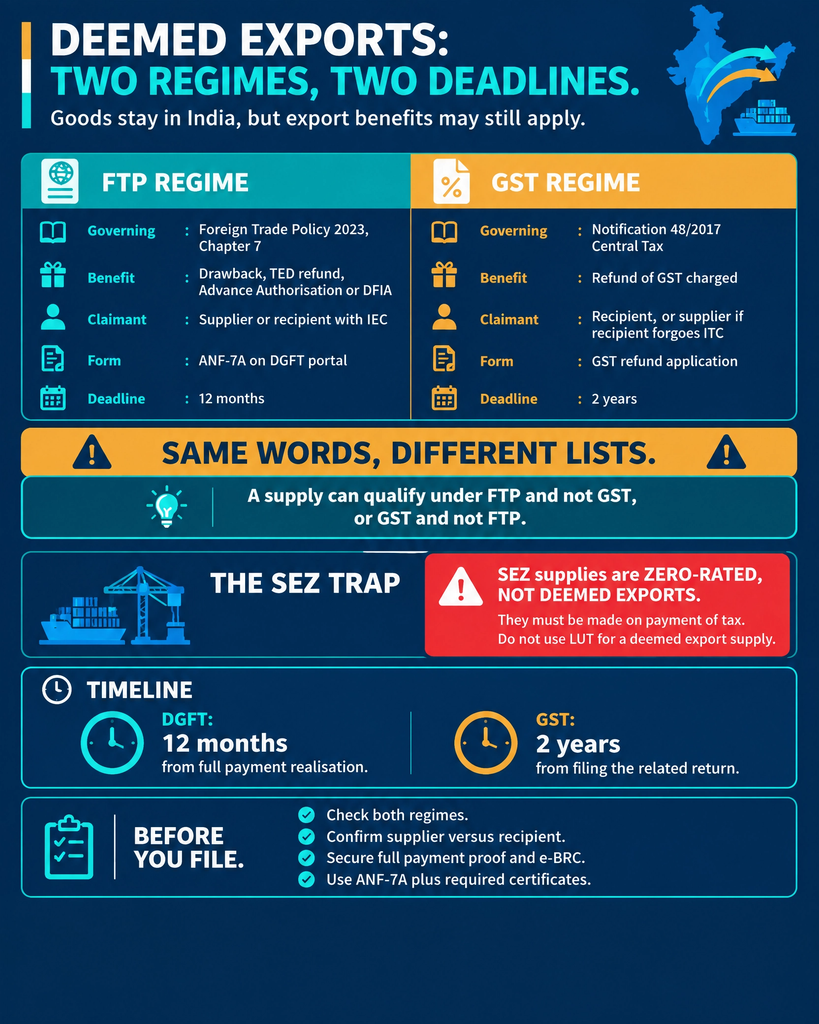
Deemed exports are supplies where the goods never leave India, but the transaction is treated as an export for benefit purposes. The catch that costs exporters money is that there are two separate deemed exports regimes running side by side, one under the Foreign Trade Policy and one under GST. They have different lists, different claimants, different forms and different deadlines, and a claim filed under the wrong one is simply late.
This guide sets out both lists, who claims what, the two time limits, and the one supply type that everybody wrongly assumes is covered.
Recipient, or supplier where the recipient forgoes the credit
Form
ANF-7A on the DGFT portal
GST refund application
Deadline
12 months
2 years
Deemed Exports Under FTP and Under GST Are Not the Same List
This is the whole problem in one sentence. A supply can be deemed exports under the Foreign Trade Policy and give you nothing under GST, or the reverse.
The FTP list, at Para 7.02 of Chapter 7, covers supplies by a manufacturer against an Advance Authorisation, Advance Authorisation for annual requirement or DFIA, supplies to an EOU, STP, EHTP or BTP, and supplies of capital goods against an EPCG Authorisation. It then adds supplies by main or sub-contractors to projects financed by multilateral or bilateral agencies, to the United Nations and other international organisations, and to nuclear power projects above the specified capacity.
The GST list is shorter and closed. Notification 48/2017-Central Tax notifies exactly four: supply against an Advance Authorisation, supply of capital goods against an EPCG Authorisation, supply to an EOU, and supply of gold by a bank or notified PSU against an Advance Authorisation.
Read those two lists side by side and the gaps appear. A supply to a UN-financed project is deemed exports under FTP and not under GST. Neither is an error, they are different statutes with different purposes.
Why SEZ Supplies Are Not Deemed Exports
This is the single most common misunderstanding, and it is expensive because it sends people to the wrong refund route.
A supply to a unit or developer in a Special Economic Zone is a zero-rated supply under Section 16 of the IGST Act. It is not deemed exports. That distinction is not academic: a zero-rated supply can be made under a bond or LUT without paying tax, while deemed exports cannot.
Such supplies are taxable. GSTN puts it plainly: such supplies can be made only on payment of tax and cannot be supplied under a bond or LUT. You charge the tax, and then somebody claims it back. Anyone who has issued an LUT-backed invoice for an EOU supply has a correction to make.
Deemed Export Benefits Under the FTP Regime
Para 7.03 lists the deemed export benefits available on a qualifying supply:
Advance Authorisation, Advance Authorisation for annual requirement, or DFIA.
Deemed export drawback.
Refund of terminal excise duty, for excisable goods in Schedule 4 of the Central Excise Act, 1944.
Two conditions from the Handbook of Procedures decide whether the claim is even admissible. The claim can be filed only after payment has been received in full for the supplies made, and the payment has to come through the normal banking channel, evidenced by e-BRC. Part payment does not start the clock, it stops it.
The GST Refund: Supplier or Recipient?
Under Rule 89(1) of the CGST Rules, the refund can be claimed by either side, but not both:
The recipient claims it, as the default route.
The supplier claims it instead, but only where the recipient does not take input tax credit on that supply and furnishes an undertaking saying so.
Settle this before the invoice is raised, not after. When both parties assume the other is claiming, the refund is usually time-barred before anyone notices. Put the undertaking in the purchase order.
The Two Deadlines That Kill These Claims
Claim
Time limit
Runs from
FTP claims on supplies under Para 7.02(a) to (c)
12 months
The date of realisation of 100 per cent payment
FTP claims on project supplies under Para 7.02(d) to (g)
12 months
Receipt of supplies by the project authority, or receipt of payment
GST refund on such a supply
2 years
The date the return relating to the supply is furnished
The twelve-month DGFT window is the one that catches people, because it runs from full realisation rather than from the invoice or the supply. A buyer who holds back five per cent retention for a year can quietly consume your entire claim period.
Documents the DGFT Claim Needs
The FTP claim is filed in ANF-7A on the DGFT portal, by whichever party is claiming, and that party must hold an IEC. Our guide on checking that an IEC is active is worth running first, because a deactivated code stops the filing.
Proof of full payment through banking channels, as per e-BRC.
A non-availment of CENVAT credit certificate, Annexure-I to ANF-7A.
A disclaimer certificate from the recipient, Annexure-III to ANF-7A, where the supplier is claiming.
A payment certificate from the project authority, Appendix-7D, for the project supply categories.
The disclaimer certificate is the document most often missing. It is the recipient’s written confirmation that they are not claiming, and without it the supplier’s claim has no standing.
How JPARKS INDIA Helps With Deemed Exports
Three things to carry away. The FTP list and the GST list are not the same, so check your supply against both. SEZ supplies are zero-rated, not deemed exports, and cannot be treated as such. And the DGFT clock runs twelve months from full payment realisation, not from the invoice.
JPARKS INDIA handles deemed exports work, backed by S.K. Agency, AEO-LO customs brokers since 1990. We test each supply against both regimes, work out which deemed export benefits are actually claimable, file ANF-7A with the annexures that actually get accepted, settle supplier versus recipient before the invoicing starts, and chase project authority certificates that are holding claims up.
Supplying an EOU, an EPCG holder or a funded project? Send us the supply details through our contact page and we will tell you which regime it falls under and what is claimable.
Not sure which regime your supply falls under? Book a free consultation with the JPARKS INDIA EXIM compliance team.
Frequently Asked Questions
Q1. What are deemed exports in simple terms?
Supplies where the goods do not leave India but are treated as exports for benefit purposes. The supplier is paid in Indian rupees or foreign exchange, and the goods stay in the country.
Q2. Are supplies to an SEZ deemed exports?
No. Supplies to an SEZ unit or developer are zero-rated under Section 16 of the IGST Act. Deemed exports is a different category with different rules.
Q3. Can a deemed exports supply be made under an LUT without paying GST?
No. Such supplies must be made on payment of tax. The tax is then refunded to whichever party is eligible.
Q4. Who claims the GST refund, the supplier or the buyer?
The recipient by default. The supplier can claim instead where the recipient does not take input tax credit on the supply and gives an undertaking to that effect.
Q5. Which supplies are notified as deemed exports under GST?
Four: supply against an Advance Authorisation, capital goods against an EPCG Authorisation, supply to an EOU, and supply of gold by a bank or notified PSU against an Advance Authorisation, under Notification 48/2017-Central Tax.
Q6. What is the time limit for a DGFT deemed exports claim?
Twelve months from the date of realisation of full payment for supplies under Para 7.02(a) to (c), and twelve months from receipt of supplies by the project authority or receipt of payment for the project categories.
Q7. Which form is used for the DGFT claim?
ANF-7A, filed online, with the non-availment of CENVAT credit certificate and, where the supplier claims, a disclaimer certificate from the recipient.
Q8. Can the claim be filed before the buyer has paid in full?
No. The claim can be filed only once payment has been received in full for the supplies made, through normal banking channels.
Posted on Google
Vandana Bajaj
Trustindex verifies that the original source of the review is Google.
Very prompt and reliable service by Rahul Kolge and his team. Exceptional and happy experience.
Posted on Google
Supriya Shetye
Trustindex verifies that the original source of the review is Google.
Had a really good experience with JParks India. Rahul sir helped me a lot with my import work and were always active and responsive. Whatever documents or guidance was needed, they handled everything smoothly and explained things clearly. Felt stress-free throughout the process. Very helpful team, definitely recommend them if you’re doing import or export.
Posted on Google
dipali sakpal
Trustindex verifies that the original source of the review is Google.
Very nice people, get the work done in a very short time.
Posted on Google
Satish Bajaj
Trustindex verifies that the original source of the review is Google.
Excellent & Prompt services in all Import Export matters.
Great to work with you
Posted on Google
Bajaj VCPL
Trustindex verifies that the original source of the review is Google.
It was a great experience having work with you.
Posted on Google
Satish Bajaj
Trustindex verifies that the original source of the review is Google.
"Outstanding professiona services, efficient, and gets things done incredibly fast. Highly recommended for anyone needing reliable and prompt assistance
Posted on Google
Nishat fatima
Trustindex verifies that the original source of the review is Google.
excellent service
Posted on Google
farhan sayed
Trustindex verifies that the original source of the review is Google.
JParks Team is Super helpful! Thanks to Rahul and team!
Posted on Google
Sadik Inamdar
Trustindex verifies that the original source of the review is Google.
Good and personal service for import export code
Posted on Google
Maheshwar
Trustindex verifies that the original source of the review is Google.
Had a really good experience with JParks India. Rahul sir helped me a lot with my import work and were always active and responsive. Whatever documents or guidance was needed, they handled everything smoothly and explained things clearly. Felt stress-free throughout the process. Very helpful team, definitely recommend them if you’re doing import or export.
Verified by Trustindex
Trustindex verified badge is the Universal Symbol of Trust. Only the greatest companies can get the verified badge who has a review score above 4.5, based on customer reviews over the past 12 months. Read more
As your Exporter of Record, we export goods out of India in our name, with the IEC, AD Code and filings the shipment needs, and our sister concern S. K. Agency clears it at the port.
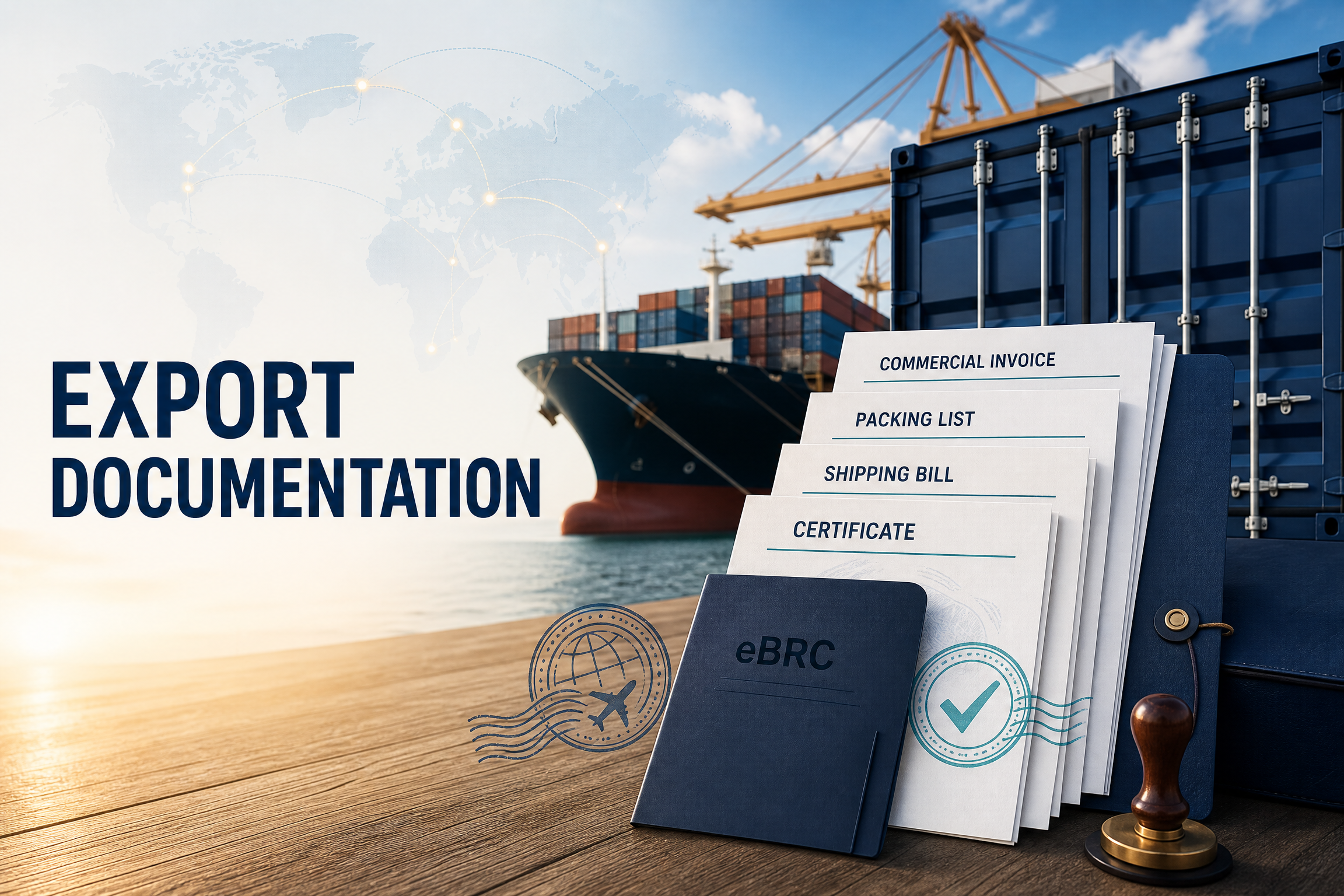
Shipping fundamentals cover Incoterms freight mode export documents ICEGATE customs and tracking so you can reduce delays avoid penalties and ship faster from India
Star Export House is DGFT recognition for top Indian exporters that unlocks EPCG duty-free capital goods imports faster customs clearance and stronger buyer and bank credibility.
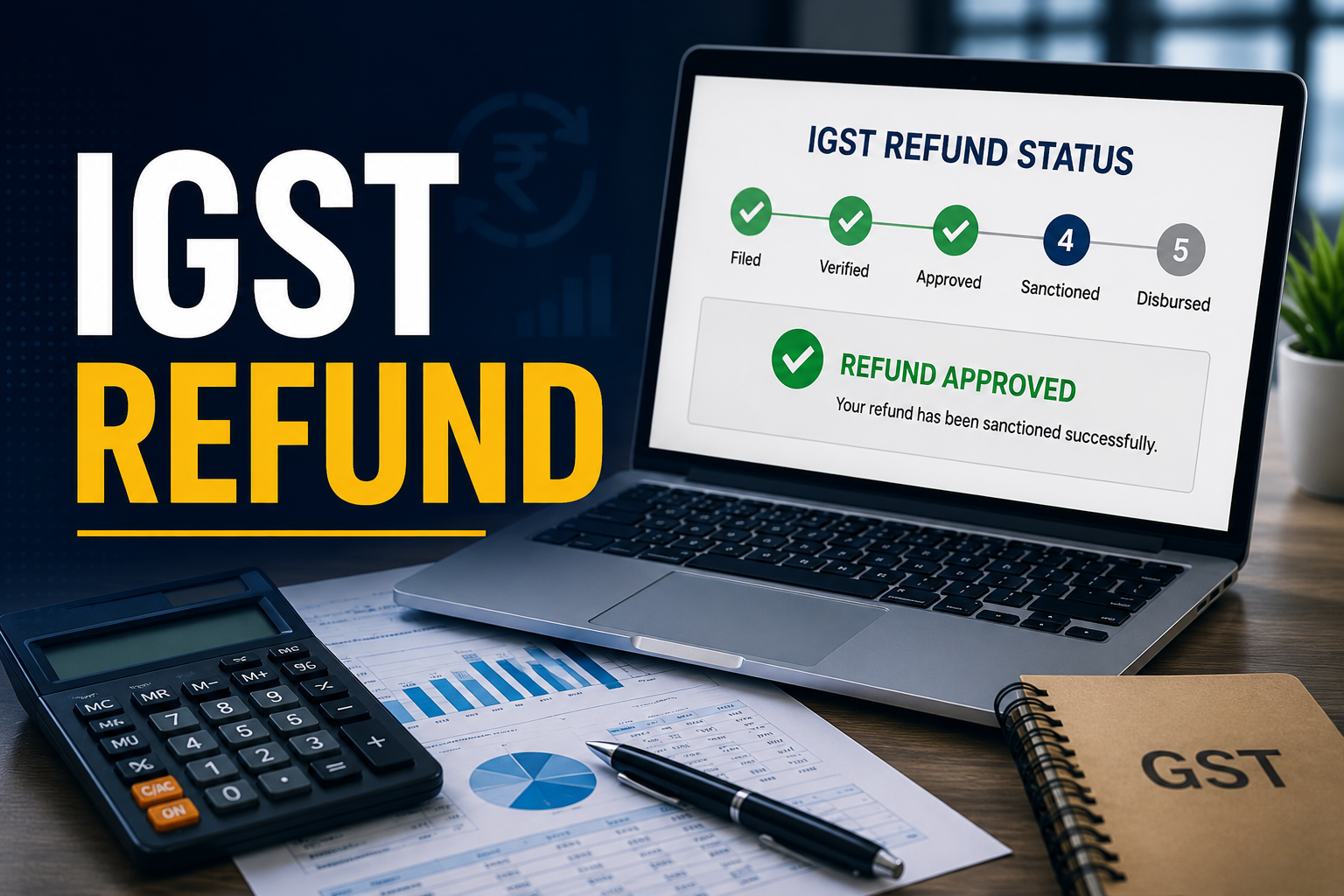
IGST Refund Status is the live tracking of your export IGST refund claim on the GST portal using ARN or shipping bill number to see if it is pending approved rejected or under scrutiny.
Deemed Exports are domestic supplies to EOU SEZ UN or government projects that qualify for export benefits like IGST refund and duty drawback even though goods stay in India.
Expert MOOWR scheme application support for importers & exporters in India. Complete guide on eligibility, process, benefits & compliance. Get approved fast.
Want to register on the IceGate portal? The smallest mistake can end up in a rejection. To avoid wasting time, get in touch with us and we'll help you get registered on IceGate within 2 to 3 working days!
As an importer of record we Import goods into India on your behalf & deliver them to your desired location. We handle everything from legal compliance to last mile delivery to ensure timely & safely clearance of your Imported goods. Ideal service if you are planning to import for the first time.
Learn about SVB registration with our comprehensive guide to the Special Valuation Branch. Simplify the process and ensure compliance with our expert services.
Unable to Import or Export due to a deactivated IEC? We have helped 500+ Importers & Exporters renew their IEC within 24 hours of a complete document set.
Need to get CPCB EPR Plastic Waste registration for your business in 2026? We help you get it in a hassle free manner so you can stay compliant with the EPR laws! Get in touch now.
Need a Class 3 DSC Digital Signature Certificate for your business? Get it in 1 to 2 days. At JPARKS INDIA we are Emudhra Partners, and can get the DSC for your at the fastest and most affordable rates. Contact us now!
Get Certificate of Origin | Preferential & Non Preferential
Need a Certificate of Origin for your Export or Import? Look no further, at JPARKS we provide preferential and Non preferential COOs at the best rates. Contact us to know more!
Need to reactivate your IEC on the DGFT portal? The IEC Based DGFT DSC is what you need to move forward hassle free. Contact us now to get your DGFT DSC in 1 to 2 days.
Looking to start your Import Export Business? Getting an IEC is mandatory to get into EXIM trade. We help you apply IEC online and get started within 24 hours.
Want to claim benefits of duty drawback and various other schemes under FTP? You need to register your Bank Account for Export Promotion Incentives. Contact us now to register your Bank Account on IceGate Potal.
We use cookies to run this site, measure traffic, and track our ads. Essential cookies are always on. Accept all, reject non-essential, or set your preferences.
Cookie Preferences
Manage your cookie preferences below:
Essential cookies enable basic functions and are necessary for the proper function of the website.
Name
Description
Duration
Cookie Preferences
This cookie is used to store the user's cookie consent preferences.
30 days
Google reCAPTCHA helps protect websites from spam and abuse by verifying user interactions through challenges.
Name
Description
Duration
_GRECAPTCHA
Google reCAPTCHA sets a necessary cookie (_GRECAPTCHA) when executed for the purpose of providing its risk analysis.
179 days
Google Tag Manager simplifies the management of marketing tags on your website without code changes.
Name
Description
Duration
cookiePreferences
Registers cookie preferences of a user
2 years
td
Registers statistical data on users' behaviour on the website. Used for internal analytics by the website operator.
session
Statistics cookies collect information anonymously. This information helps us understand how visitors use our website.
Google Analytics is a web analytics service that tracks and reports website traffic. It collects anonymized data on how visitors use the site to help us understand and improve performance.