Certificate of Origin in Shipping Documents: Where It Fits
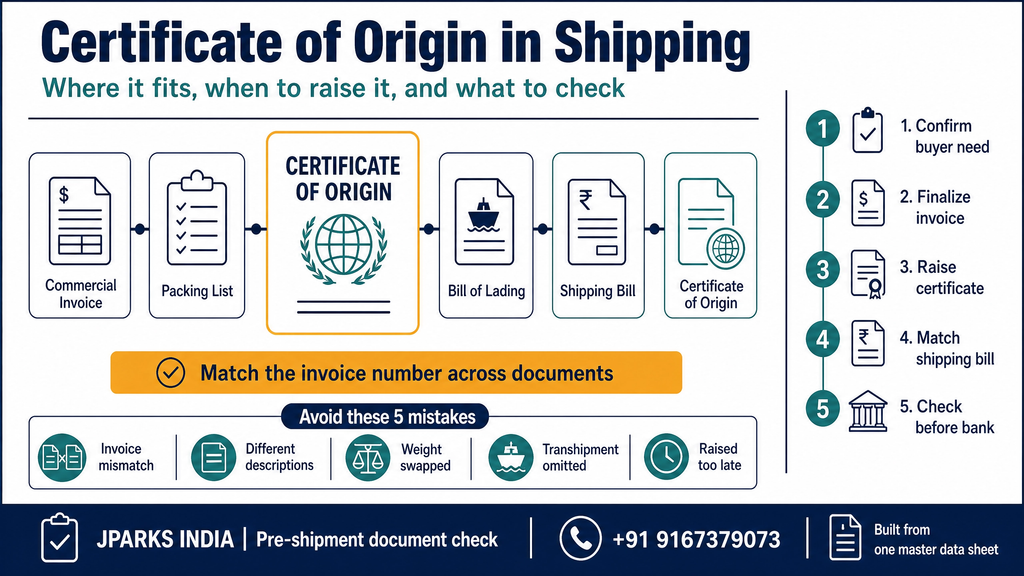
The certificate of origin in shipping sits alongside the commercial invoice, packing list and bill of lading as one of the core export documents, and it is the only one that speaks to where the goods were made. The others describe what is in the box, what it costs and who is carrying it.
Understanding where it fits in the document set matters because origin verification is now largely a matching exercise. DGFT Notification 05/2026-27 requires the invoice number on the certificate to match the shipping bill, which means a document set assembled from different sources will fail before anyone reads it.
This guide covers the document set, who needs which copy, when the certificate has to be raised, and how it interacts with the letter of credit. It does not cover what a Certificate of Origin is or how to obtain one; our certificate of origin filing service page covers that.
The Certificate of Origin in Shipping: The Document Set
Document
Answers
Raised by
Commercial invoice
What is sold, at what price, on what terms
Exporter
Packing list
How it is packed, weights, marks, package count
Exporter
Bill of lading or air waybill
Who carries it, from where to where
Carrier
Shipping bill
What is declared to Indian customs on export
Exporter or broker
Certificate of origin
Where the goods were produced
DGFT-authorised agency, or self-certified
Insurance certificate
What cover applies in transit
Insurer
Inspection or regulatory certificates
Product-specific compliance
Relevant authority
The certificate is the one document in that list that a third party issues on the strength of your declaration. That is why it carries an evidence burden the others do not.
Who Needs the Certificate of Origin in Shipping, and Why
Foreign customs use it to apply the correct duty rate and any origin-based restriction, including quotas, anti-dumping duty and trade remedies.
The buyer uses it to claim preferential duty where an agreement applies, which is often the whole commercial point of asking for it.
The buyer’s bank checks it against the letter of credit terms. A discrepancy here delays payment even when the shipment itself is fine.
Your own records carry it for the retention period, because an origin claim can be questioned long after the goods are consumed.
When the Certificate of Origin in Shipping Is Raised
At order confirmation, establish whether the buyer needs a preferential or non-preferential certificate, and check the letter of credit wording for a named issuing agency.
Before invoicing, fix the goods description and HS code that will run through every document.
After the commercial invoice is final, apply on the platform. The invoice number is a field on the certificate and cannot be added later without a correction.
Before or alongside the shipping bill, so the invoice numbers agree. You can track filing progress through the ICEGATE shipping bill status service.
Before the documents go to the bank, so any discrepancy is caught while it is still cheap to fix.
Raising the certificate after the shipping bill has been filed is where mismatches originate. The invoice gets revised, the certificate carries the old number, and the automated check flags it.
How it interacts with the letter of credit
An LC will typically specify the certificate type, the issuing body, the number of originals and copies, and any required wording. Three points repeatedly cause discrepancies:
A named chamber. If the LC names an issuing body, that instruction governs, whatever your usual practice. Our guide on choosing a chamber of commerce covers the selection.
Description wording. The description on the certificate must be consistent with the LC, which is not always the same as consistent with the tariff. Draft once, reconcile both.
Electronic issuance. Certificates are now issued electronically. If an LC still demands a manually signed original, raise it with the buyer before shipment rather than at presentation.
Invoice number mismatch between the certificate and the shipping bill. Now checked automatically.
Different goods descriptions on the invoice, certificate and shipping bill.
Gross and net weight swapped between the packing list and the certificate.
Transhipment not disclosed in the transport box, which undermines a direct consignment claim.
Certificate raised too late, after the invoice has been revised.
Each of these is a reconciliation failure rather than a knowledge failure. Building the set from one master data sheet eliminates most of them.
How JPARKS INDIA Helps
JPARKS INDIA prepares the certificate of origin in shipping document set as one job, not as separate forms, from our Vashi, Navi Mumbai office. Because we file the shipping bill as well, we catch mismatches before customs does.
Document set preparation, invoice through certificate, built from one master data sheet.
Q1. Is the certificate of origin in shipping documents mandatory?
Yes, for most international shipments. It sits alongside the commercial invoice, packing list and transport document, and it is the document that establishes where the goods were produced.
Q2. Who issues it, the exporter or the carrier?
Neither. A DGFT-authorised agency issues it on the strength of your declaration, or an approved exporter self-certifies where the agreement allows.
Q3. When should I raise it?
After the commercial invoice is final and before or alongside the shipping bill, so the invoice numbers agree.
Q4. What happens if the invoice number does not match the shipping bill?
The mismatch is picked up by automated verification introduced under Notification 05/2026-27, and the certificate can be queried or rejected.
Q5. Does the bank check the certificate?
Yes, against the letter of credit terms. A wording or issuing-body discrepancy delays payment even where the shipment itself is compliant.
Q6. How many originals do I need?
Follow the letter of credit or the buyer’s instruction. Certificates are issued electronically, so print requirements are set by the buyer rather than by the platform.
Q7. Do I need one if my buyer has not asked for it?
Often yes. Destination customs may require it independently of the buyer, so confirm the importing country’s rules rather than relying on silence.
Need this handled for you?
Tell us where you are stuck. We usually reply the same business day.
5.0 ★ · 123 Google reviews · Since 1990
Posted on Google
Vandana Bajaj
Trustindex verifies that the original source of the review is Google.
Very prompt and reliable service by Rahul Kolge and his team. Exceptional and happy experience.
Posted on Google
Supriya Shetye
Trustindex verifies that the original source of the review is Google.
Had a really good experience with JParks India. Rahul sir helped me a lot with my import work and were always active and responsive. Whatever documents or guidance was needed, they handled everything smoothly and explained things clearly. Felt stress-free throughout the process. Very helpful team, definitely recommend them if you’re doing import or export.
Posted on Google
dipali sakpal
Trustindex verifies that the original source of the review is Google.
Very nice people, get the work done in a very short time.
Posted on Google
Satish Bajaj
Trustindex verifies that the original source of the review is Google.
Excellent & Prompt services in all Import Export matters.
Great to work with you
Posted on Google
Bajaj VCPL
Trustindex verifies that the original source of the review is Google.
It was a great experience having work with you.
Posted on Google
Satish Bajaj
Trustindex verifies that the original source of the review is Google.
"Outstanding professiona services, efficient, and gets things done incredibly fast. Highly recommended for anyone needing reliable and prompt assistance
Posted on Google
Nishat fatima
Trustindex verifies that the original source of the review is Google.
excellent service
Posted on Google
farhan sayed
Trustindex verifies that the original source of the review is Google.
JParks Team is Super helpful! Thanks to Rahul and team!
Posted on Google
Sadik Inamdar
Trustindex verifies that the original source of the review is Google.
Good and personal service for import export code
Posted on Google
Maheshwar
Trustindex verifies that the original source of the review is Google.
Had a really good experience with JParks India. Rahul sir helped me a lot with my import work and were always active and responsive. Whatever documents or guidance was needed, they handled everything smoothly and explained things clearly. Felt stress-free throughout the process. Very helpful team, definitely recommend them if you’re doing import or export.
Verified by Trustindex
Trustindex verified badge is the Universal Symbol of Trust. Only the greatest companies can get the verified badge who has a review score above 4.5, based on customer reviews over the past 12 months. Read more
We use cookies to run this site, measure traffic, and track our ads. Essential cookies are always on. Accept all, reject non-essential, or set your preferences.
Cookie Preferences
Manage your cookie preferences below:
Essential cookies enable basic functions and are necessary for the proper function of the website.
Name
Description
Duration
Cookie Preferences
This cookie is used to store the user's cookie consent preferences.
30 days
Google reCAPTCHA helps protect websites from spam and abuse by verifying user interactions through challenges.
Name
Description
Duration
_GRECAPTCHA
Google reCAPTCHA sets a necessary cookie (_GRECAPTCHA) when executed for the purpose of providing its risk analysis.
179 days
Google Tag Manager simplifies the management of marketing tags on your website without code changes.
Name
Description
Duration
cookiePreferences
Registers cookie preferences of a user
2 years
td
Registers statistical data on users' behaviour on the website. Used for internal analytics by the website operator.
session
Statistics cookies collect information anonymously. This information helps us understand how visitors use our website.
Google Analytics is a web analytics service that tracks and reports website traffic. It collects anonymized data on how visitors use the site to help us understand and improve performance.