MOOWR Documents Required for Section 58 and Section 65 Approval
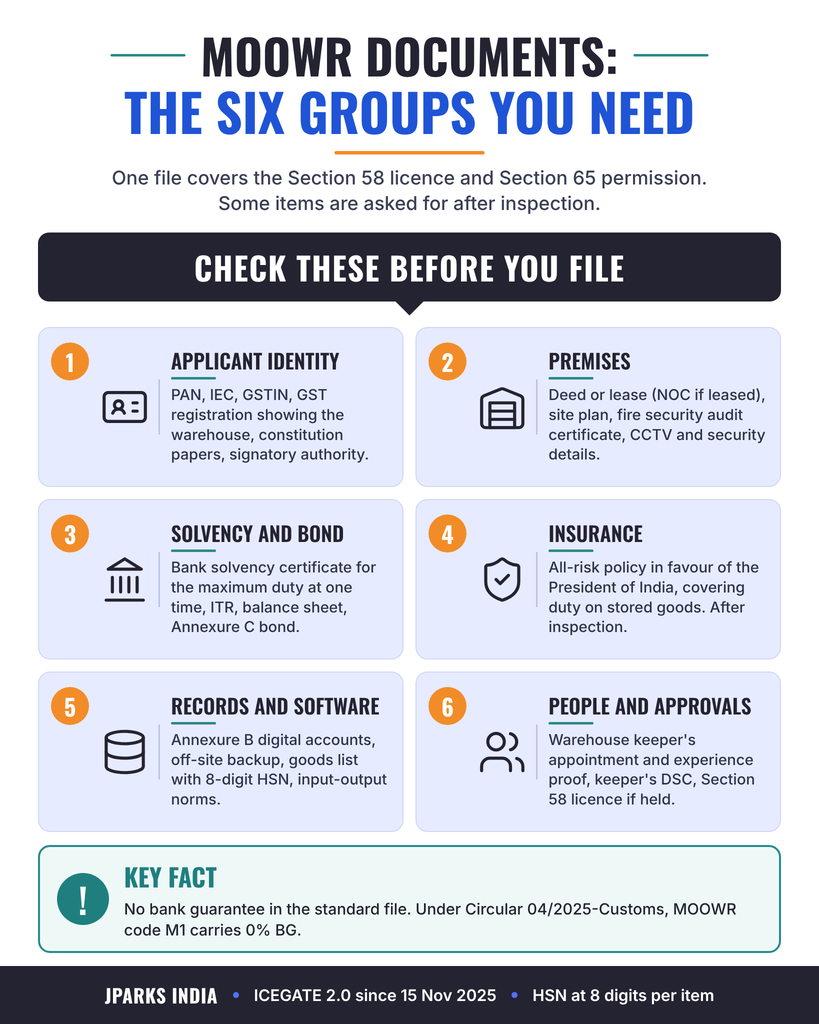
The MOOWR documents required fall into six groups: proof of who the applicant is, proof of the premises, financial standing and the bond, insurance, the records system, and the people who will run the bonded unit. One application covers both the private warehouse licence under Section 58 and the permission to manufacture under Section 65 of the Customs Act, so you prepare one file, not two.
Not every one of the MOOWR documents required is uploaded on day one. Some items, such as the insurance policy and the warehouse keeper’s appointment, are asked for after Customs inspects the site. This page lists each document, the rule behind it, and when it is normally needed.
What the MOOWR application consists of
MOOWR stands for the Manufacture and Other Operations in Warehouse (No. 2) Regulations, 2019. Circular 34/2019-Customs prescribed a single integrated application form (Annexure A) for the Section 58 licence and the Section 65 permission together. If you already hold a Section 58 licence, you apply only for the Section 65 permission. The legal background is on our page on the rules under Section 58 and Section 65.
Since 15 November 2025 the application is filed online on the ICEGATE 2.0 warehouse module under Circular 28/2025-Customs. The form has six segments: instructions, Part I (two pages), Part II (two pages) and a declaration. The portal steps, the port code and the query process are covered in our guide on how to apply for the MOOWR scheme online.
MOOWR documents required: the checklist
The table groups the documents and shows where each requirement comes from. Where the source is a regulation or circular, it is a legal requirement. Where the source is the Invest India form or checklist, the item was mandatory on the online form Customs used until November 2025; it is not written into the regulations, but expect the Commissionerate to ask for it. Items marked “may be asked” depend on your facts.
Group
Document
Rule or source
1. Applicant identity
PAN, IEC and GSTIN of the applicant
ICEGATE 2.0 form starts from the GSTIN; contact details are pulled from GSTN or DGFT records
GST registration showing the warehouse as principal or additional place of business
Circular 34/2019-Customs
Certificate of incorporation, MoA and AoA (company), partnership deed (firm)
Invest India form; PWLR 2016 Reg 3 (Indian citizen or registered entity)
List of directors or partners with ID proof
Invest India form and checklist
Board resolution or authority letter for the authorised signatory
Invest India checklist
Aadhaar of the signatory, linked to the mobile number, for DigiLocker
ICEGATE 2.0 manual
2. Premises
Ownership deed or lease or rent agreement
Invest India form
NOC from the owner if the premises are leased
Invest India checklist
Ground plan or site plan showing entry and exit points, storage and production areas
Invest India form; boundaries and floor area are fields on the ICEGATE form
Fire security audit certificate from a qualified independent agency
Invest India form (mandatory upload there)
Local authority permission for commercial or industrial use
May be asked (a yes or no question on the Invest India form)
Details of CCTV, burglar alarm and security arrangements
Invest India form section 7; MOOWR Reg 8
3. Financial standing and bond
Solvency certificate from a scheduled bank for the maximum duty on goods stored at any one time
PWLR 2016 Reg 3(1)(c); Circular 24/2016-Customs
Latest ITR and balance sheet
Invest India checklist
Bond in the Annexure C format, which also serves as the Section 59 warehousing bond
MOOWR Reg 4; Circular 34/2019-Customs
Undertaking under Section 73A(3) and indemnity undertaking
PWLR 2016 Reg 4(b) and (c)
4. Insurance
All-risk insurance policy in favour of the President of India, covering the duty on goods stored at any time
PWLR 2016 Reg 4(a)
5. Records and software
Undertaking to keep digital accounts in the Annexure B format and file them monthly
MOOWR Reg 4; Circular 34/2019-Customs
Description of the computerised accounting system and off-site backup
MOOWR Reg 8 and Reg 17(3)
List of goods: imported inputs, capital goods, domestic inputs, resultant products, waste, each with an 8-digit HSN code
ICEGATE 2.0 form; Invest India form section 6
Input-output norms for raw materials and finished goods, where needed
MOOWR Reg 4
6. People and approvals
Appointment letter of the warehouse keeper and proof of warehousing and customs experience
PWLR 2016 Reg 4(d); MOOWR Reg 7(1)
Digital signature certificate of the warehouse keeper
MOOWR Reg 7(2)
Copy of the existing Section 58 licence, if you already have one (PDF, up to 1.5 MB)
ICEGATE 2.0 manual
AEO certificate, if held
Invest India form question 4
What you file first and what Customs asks for after inspection
The Private Warehouse Licensing Regulations, 2016 split the documents into two stages. Regulation 3 covers eligibility: the applicant’s status, the solvency certificate and the declarations that you have not been declared insolvent, convicted, or penalised under the Customs Act, the Central Excise Act or Chapter V of the Finance Act, 1994.
Regulation 4 applies only after the premises are inspected and enquiries are complete. At that stage Customs asks for the insurance policy, the Section 73A(3) undertaking, the indemnity undertaking and the warehouse keeper’s appointment. The CBIC brochure on MOOWR describes the same order: antecedent verification, a one-time site verification, then the bond with an insurance policy.
In practice it helps to have the insurance quote and the keeper’s papers ready before the inspection, so the second stage does not add weeks. Treat them as part of the documents required for MOOWR even though they are filed later.
The bond: what you sign, and why no bank guarantee is listed
Circular 34/2019-Customs prescribes one bond (Annexure C) that meets the MOOWR Regulation 4 undertaking and the triple duty bond under Section 59 of the Customs Act. Section 59(1) fixes a consignment bond at three times the duty assessed. Section 59(2) lets the Assistant or Deputy Commissioner accept a general bond for an amount they approve, which is what a running MOOWR unit normally uses.
A bank guarantee is not part of the standard MOOWR file. Under the single electronic bond in Circular 04/2025-Customs, the MOOWR scenario code M1 carries a 0% bank guarantee; a different code exists where the officer decides a security is needed. Bond execution is covered on the how-to-apply page.
Who is exempt from some documents
Circular 24/2016-Customs, as notified by JNCH in Public Notice 82/2016, sets the solvency certificate equal to the maximum duty on goods you plan to hold at one time. It also lists exemptions:
Central Government, State Governments, Union Territory administrations and their undertakings do not need a solvency certificate.
EOU, EHTP and STPI units do not need one; their security follows Chapter 6 of the Foreign Trade Policy.
For AEOs, the solvency amount follows the circulars issued for AEOs.
Legal approvals required for MOOWR, and the clearances that sit alongside
The Section 65 permission is co-terminus with the Section 58 licence: the licence makes your premises a private bonded warehouse, the permission lets you carry out manufacture and other operations on the goods held there, and both are granted by the jurisdictional Principal Commissioner or Commissioner of Customs.
The approval also binds you to the undertakings in MOOWR Regulation 4. Most appear in the checklist above as documents. Two are easy to miss: you undertake to pay the duties, interest, fines and penalties due on warehoused goods, and the input-output norms you declare are your own figures, because SION norms do not apply.
Customs approvals do not replace the other clearances a unit needs. Where your operations call for them, keep a factory licence, pollution control consent and fire safety clearance in place. GST applies once goods are cleared from the bond and sold in India, so keep the premises registered as a place of business and make sure your customs declarations reconcile with your GST returns.
Any unit in the Domestic Tariff Area can apply, including an existing factory converting to bonded operations, and there is no minimum investment. Capital goods and domestic inputs already on site are accounted for in the prescribed format, which has a remarks column for that purpose.
Checks that stop a file being returned
These checks come straight from what the form and the regulations test. Run them against your MOOWR checklist before you upload.
GST address. The warehouse address must appear on the GST registration as a place of business. If it does not, amend the GST registration first.
Lease in the right name. The lease or ownership deed should be in the applicant entity’s name. If the property belongs to a director or a group company, add a lease or leave and licence agreement in the applicant’s name.
Solvency amount. The solvency certificate amount should match the maximum duty you declare for goods stored at one time. A lower figure invites a query.
HSN at 8 digits. The ICEGATE form asks for an 8-digit HSN for each item. A 4 or 6 digit code will not pass.
Aadhaar-linked mobile. DigiLocker verification needs the signatory’s Aadhaar linked to the mobile number used on the form.
File sizes. The licence copy field accepts a PDF up to 1.5 MB. Scan other documents at a similar size so uploads do not fail.
Documents that change after approval
Approval does not end the paperwork. Under MOOWR Regulation 17 you keep copies of bills of entry, shipping bills and Section 59 bonds for at least five years, with a digital copy away from the warehouse. Insurance must stay current while goods are stored, and revised input-output norms must be reported. The monthly return and other running filings are explained on the how-to-apply page. The permission itself does not need renewal; see validity of the MOOWR licence. The other clearances a unit needs alongside MOOWR are covered in the legal approvals section above.
How JPARKS INDIA can help
We prepare the MOOWR document file before anything is uploaded. That means checking the GST registration, lease, solvency certificate and site plan against the rules above, drafting the goods list with 8-digit HSN codes and input-output norms, and preparing the undertakings and the Annexure C bond. We then file the application on ICEGATE 2.0, answer Customs queries, and attend the site inspection with you. Details are on our MOOWR application service page.
Q1. Do I need separate documents for the Section 58 licence and the Section 65 permission?
No. Circular 34/2019-Customs uses one integrated form for both, and the same file supports both. If you already hold a Section 58 licence, upload its copy and apply only for Section 65. On ICEGATE 2.0 you then pick the existing Section 58 option and answer “Yes” to applying for MOOWR.
Q2. Can a customs broker be appointed as the warehouse keeper?
Yes. The CBIC answer reproduced in the Invest India FAQ says a customs broker who has passed the prescribed examination can be appointed. The keeper still needs a digital signature certificate under MOOWR Regulation 7(2), because the keeper signs electronic documents for the unit.
Q3. What should the solvency certificate amount be?
It should equal the maximum duty involved on the goods you expect to hold in the warehouse at any one time. You declare that figure in the application, so work it out from your peak inventory of imported inputs and capital goods, not from annual imports.
Q4. Is a fire NOC compulsory for MOOWR?
The regulations do not name a fire NOC. The earlier Invest India form made a fire security audit certificate from an independent agency a mandatory upload, so expect the Commissionerate to look for fire safety proof at inspection. Keep it ready, because the premises must be suitable for secure storage under Regulation 3 of the 2016 licensing rules.
Q5. Are the MOOWR documents required again for a second location?
Each warehouse is licensed for a specific site, so a new location needs its own premises documents: lease, site plan, security details and insurance cover. Identity documents can be reused. Ask the Commissionerate whether it treats the new site as a fresh application before you file.
Tell us where you are stuck. We usually reply the same business day.
5.0 ★ · 123 Google reviews · Since 1990
Posted on Google
Vandana Bajaj
Trustindex verifies that the original source of the review is Google.
Very prompt and reliable service by Rahul Kolge and his team. Exceptional and happy experience.
Posted on Google
Supriya Shetye
Trustindex verifies that the original source of the review is Google.
Had a really good experience with JParks India. Rahul sir helped me a lot with my import work and were always active and responsive. Whatever documents or guidance was needed, they handled everything smoothly and explained things clearly. Felt stress-free throughout the process. Very helpful team, definitely recommend them if you’re doing import or export.
Posted on Google
dipali sakpal
Trustindex verifies that the original source of the review is Google.
Very nice people, get the work done in a very short time.
Posted on Google
Satish Bajaj
Trustindex verifies that the original source of the review is Google.
Excellent & Prompt services in all Import Export matters.
Great to work with you
Posted on Google
Bajaj VCPL
Trustindex verifies that the original source of the review is Google.
It was a great experience having work with you.
Posted on Google
Satish Bajaj
Trustindex verifies that the original source of the review is Google.
"Outstanding professiona services, efficient, and gets things done incredibly fast. Highly recommended for anyone needing reliable and prompt assistance
Posted on Google
Nishat fatima
Trustindex verifies that the original source of the review is Google.
excellent service
Posted on Google
farhan sayed
Trustindex verifies that the original source of the review is Google.
JParks Team is Super helpful! Thanks to Rahul and team!
Posted on Google
Sadik Inamdar
Trustindex verifies that the original source of the review is Google.
Good and personal service for import export code
Posted on Google
Maheshwar
Trustindex verifies that the original source of the review is Google.
Had a really good experience with JParks India. Rahul sir helped me a lot with my import work and were always active and responsive. Whatever documents or guidance was needed, they handled everything smoothly and explained things clearly. Felt stress-free throughout the process. Very helpful team, definitely recommend them if you’re doing import or export.
We use cookies to run this site, measure traffic, and track our ads. Essential cookies are always on. Accept all, reject non-essential, or set your preferences.
Cookie Preferences
Manage your cookie preferences below:
Essential cookies enable basic functions and are necessary for the proper function of the website.
Name
Description
Duration
Cookie Preferences
This cookie is used to store the user's cookie consent preferences.
30 days
Google reCAPTCHA helps protect websites from spam and abuse by verifying user interactions through challenges.
Name
Description
Duration
_GRECAPTCHA
Google reCAPTCHA sets a necessary cookie (_GRECAPTCHA) when executed for the purpose of providing its risk analysis.
179 days
Google Tag Manager simplifies the management of marketing tags on your website without code changes.
Name
Description
Duration
cookiePreferences
Registers cookie preferences of a user
2 years
td
Registers statistical data on users' behaviour on the website. Used for internal analytics by the website operator.
session
Statistics cookies collect information anonymously. This information helps us understand how visitors use our website.
Google Analytics is a web analytics service that tracks and reports website traffic. It collects anonymized data on how visitors use the site to help us understand and improve performance.