Shipping Fundamentals: A Guide for Indian Exporters
Table of Contents
Every export shipment from India rests on the same fundamentals: measure the cargo in CBM (length x width x height in metres) and, for air, work out its chargeable weight; choose FCL or LCL; agree an Incoterms 2020 rule that fixes where cost and risk pass to your buyer; and file a shipping bill on ICEGATE so customs can give the Let Export Order (LEO) before anything is loaded. This guide covers each step with the formulas, the official rules and the documents that customs, your bank and your buyer will ask for.
JPARKS INDIA gives export shipping guidance at a price on enquiry: tell us the product, the destination and the terms your buyer has asked for, and we will send you a quote. We also set up the registrations a first shipment needs (IEC, ICEGATE, AD Code). We are not a freight forwarder or a customs broker, so we do not book cargo or file shipping bills.
Shipping fundamentals at a glance
Decision
What it settles
Rule or formula
Volume (CBM)
Sea freight, LCL charges and how many containers you need
CBM = L x W x H in metres
Air chargeable weight
What the airline bills you for
Higher of actual weight and L x W x H in cm / 6,000
FCL or LCL
Whether you pay per container or per CBM
Compare total quotes for your lot
Incoterms 2020 rule
Where risk passes, who pays freight, insurance and customs formalities
11 rules published by the ICC
Documents
What customs, the bank and the buyer need
Three mandatory under FTP 2023 para 2.06, plus product and buyer documents
Shipping bill and LEO
Customs permission to load the goods
Customs Act, sections 50 and 51
Registrations to have before your first export shipment
A shipping bill carries your IEC and your AD Code, so these have to be in place before the goods move:
IEC from DGFT. No goods may be exported without an IEC unless the exporter is specifically exempted. The IEC is the same as the entity’s PAN and is issued online. It has to be updated every year between April and June, even when nothing has changed, or it is de-activated (FTP 2023 para 2.05). Our IEC renewal page covers the yearly update.
ICEGATE registration, with a Class 3 DSC for the person who signs. You need it to file a shipping bill yourself and to register bank accounts with customs.
AD Code registration for the bank through which export proceeds will come in, plus a current account for drawback credits (Customs Manual 2025, para 17.1). The Export Promotion account is where drawback and IGST refunds are paid.
GST: an LUT, or IGST paid on the export. To export without paying IGST, furnish a Letter of Undertaking in Form GST RFD-11 before you export (CGST Rule 96A). The goods must then leave within three months of the invoice date, unless the Commissioner allows more time, or the tax becomes payable with interest. If you pay IGST instead, the shipping bill itself is your refund application (CGST Rule 96); see IGST refund status.
Product approvals. Restricted goods need an export authorisation, and the regulator for a product may notify extra documents for its export (FTP 2023 para 2.06(c)). Food exporters, for example, should read our page on FSSAI licensing for exports.
How to calculate CBM for a shipment
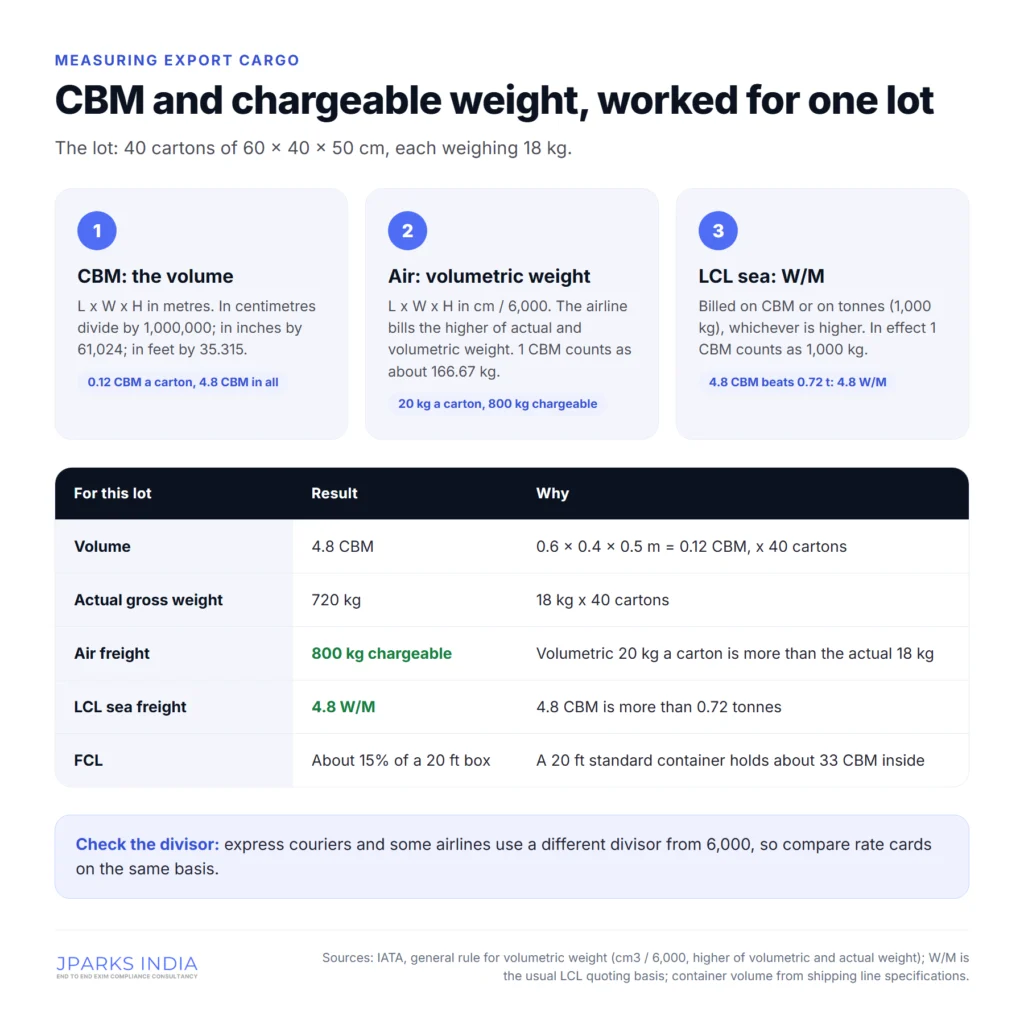
CBM (cubic metre) is the volume your cargo takes up. Sea freight, LCL charges and container planning all start from it.
Measure one packed carton or pallet at its longest points, including the pallet base and anything that sticks out.
Multiply length x width x height in metres. That is the CBM of one package.
Multiply by the number of packages of that size, then add the groups together for the total.
You measured in
CBM formula
Example (one carton)
Metres
L x W x H
0.6 x 0.4 x 0.5 = 0.12 CBM
Centimetres
L x W x H / 1,000,000
60 x 40 x 50 / 1,000,000 = 0.12 CBM
Inches
L x W x H / 61,024
24 x 16 x 20 / 61,024 = 0.126 CBM
Feet
L x W x H / 35.315
2 x 1.5 x 1.5 / 35.315 = 0.127 CBM
The divisors come from the units. A metre is 100 cm, so a cubic metre holds 1,000,000 cubic centimetres. An inch is 2.54 cm, so a cubic metre holds about 61,024 cubic inches, or about 35.3 cubic feet.
One CBM is a cube 1 metre on each side, which is 1,000 litres. It is a volume, not a weight, so “1 CBM in kg” has no single answer: it depends on how the carrier converts volume into weight for billing, which the next section explains.
Worked example: 40 cartons
You are shipping 40 cartons of 60 x 40 x 50 cm, each weighing 18 kg. One carton is 0.12 CBM, so the lot is 0.12 x 40 = 4.8 CBM, with a gross weight of 18 x 40 = 720 kg. The sections below use this lot to show how sea and air freight bill it.
Chargeable weight: how air and LCL freight are billed
Carriers charge for the space cargo takes as well as for its weight, so the freight bill uses a chargeable weight rather than the scale reading.
Air freight: volumetric weight
Volumetric weight (kg) = L x W x H in cm / 6,000. This is IATA’s general rule, and the chargeable weight is whichever is higher: the actual gross weight or the volumetric weight. At 6,000 cubic centimetres per kg, 1 CBM counts as about 166.67 kg in air freight.
For the 40 cartons: each carton is 120,000 cubic centimetres, and 120,000 / 6,000 = 20 kg, against an actual 18 kg. The airline bills 20 kg per carton, so 800 kg chargeable instead of 720 kg. Express couriers and some airlines work with a different divisor, so check the divisor on each rate card before you compare quotes.
LCL sea freight: weight or measure (W/M)
LCL rates are quoted per freight ton, written W/M: the consolidator bills your shipment’s CBM or its weight in tonnes (1,000 kg), whichever is higher. In effect, 1 CBM counts as 1,000 kg. For the 40 cartons, 4.8 CBM is more than 0.72 tonnes, so you pay for 4.8 W/M. Dense cargo works the other way: 1.5 CBM of machine parts weighing 2,400 kg is billed as 2.4 W/M.
LCL quotes usually add fixed charges per shipment on top of the W/M rate, so compare the total of each quote, not just the rate.
FCL: priced per container
An FCL shipment is priced per container, so CBM decides how many containers you need rather than the freight per cubic metre.
FCL vs LCL: meaning and how to choose
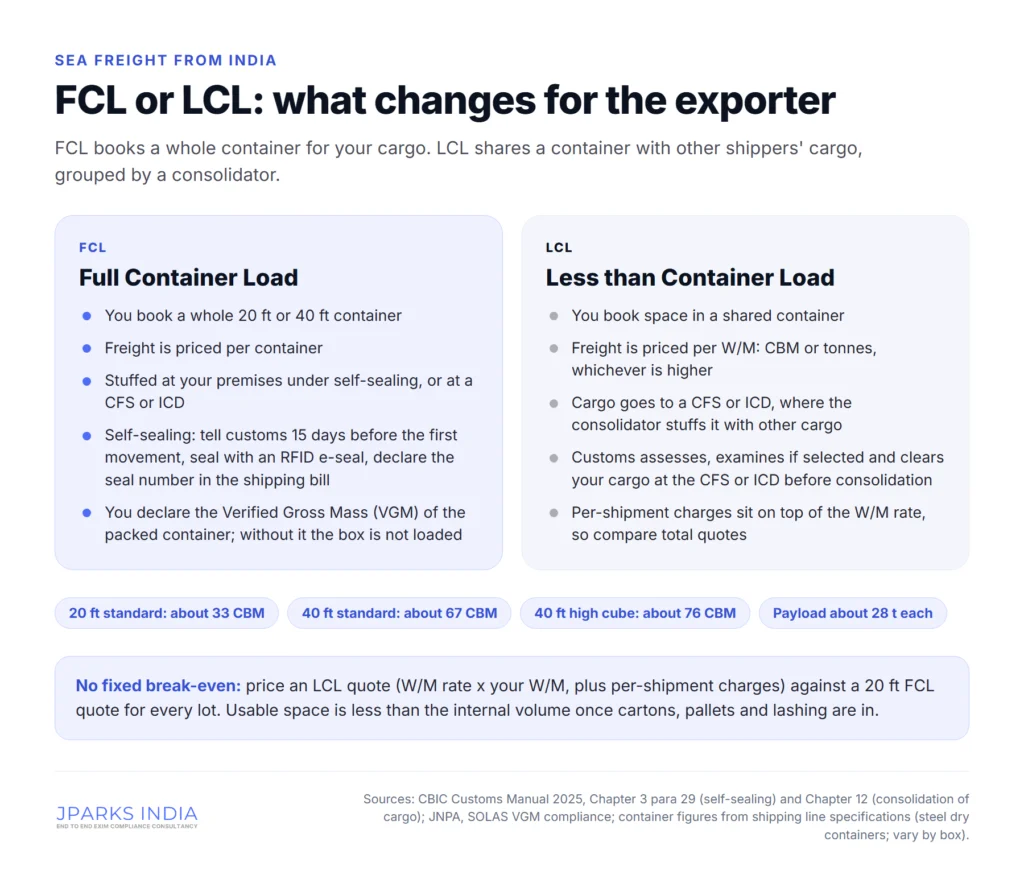
FCL (Full Container Load) means you book a whole container for your cargo. LCL (Less than Container Load) means your cargo shares a container with other shippers’ cargo, grouped by a consolidator at a container freight station (CFS) or inland container depot (ICD).
FCL
LCL
What you book
A whole 20 ft or 40 ft container
Space in a shared container
Freight basis
Per container
Per W/M: CBM or tonnes, whichever is higher
Where it is stuffed
At your premises under self-sealing, or at a CFS or ICD
At a CFS or ICD, by the consolidator
Customs
Self-sealed containers carry an RFID e-seal that customs checks at the port; examination on risk criteria
Cargo is assessed, examined if selected and cleared at the CFS or ICD before consolidation
Usually suits
Lots that fill most of a container, or goods you want sealed from your premises to destination
Small lots, first orders and trial shipments
Container sizes
Shipping lines publish the specification of each container type. Typical figures for steel dry containers:
20 ft standard: about 33 CBM inside, maximum payload about 28,200 kg;
40 ft standard: about 67 CBM, maximum payload about 28,800 kg;
40 ft high cube: about 76 CBM, maximum payload about 28,600 kg.
The figures vary by container and by line, and usable space is less than the internal volume once cartons, pallets and lashing are in.
How to choose between FCL and LCL
There is no fixed break-even volume: it moves with freight rates on your route. Ask for an LCL quote (W/M rate times your W/M, plus the per-shipment charges) and an FCL quote for a 20 ft container, and compare the totals. The 4.8 CBM lot in the example fills about 15% of a 20 ft container’s internal volume, so it is a typical LCL lot; as your lots grow, price both every time.
Two customs points matter for FCL. To stuff containers at your own premises, tell the jurisdictional customs officer at least 15 days before the first planned movement and get the Commissioner’s permission for self-sealing; you then seal each container with a tamper-proof RFID e-seal of the Board’s standard and declare its serial number in the shipping bill (Customs Manual 2025, para 29). And the shipper must declare the Verified Gross Mass of every packed container: a container without VGM details is not released for loading (JNPA, SOLAS VGM compliance).
Incoterms 2020: who pays and where risk passes
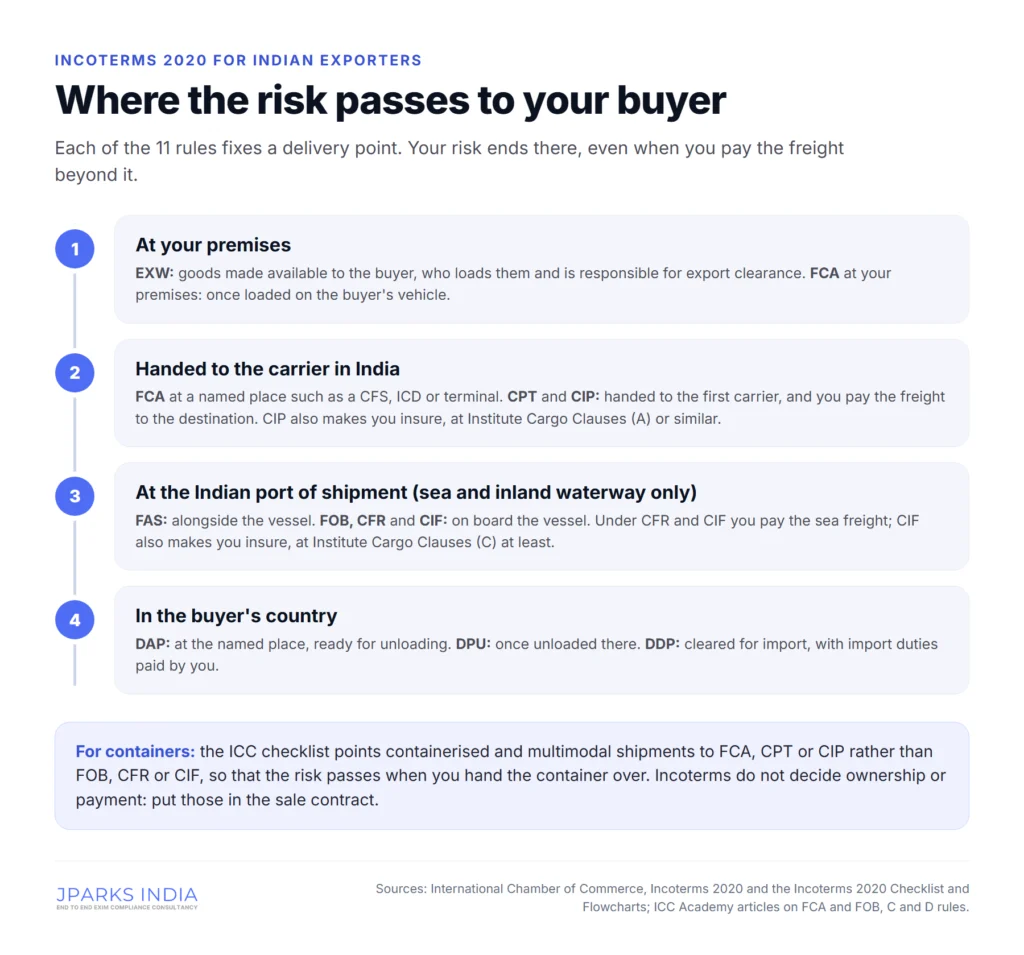
Incoterms 2020 are the International Chamber of Commerce’s 11 three-letter rules for sale contracts. Each rule says where the seller delivers, which is where risk passes to the buyer, and who pays for transport, insurance and customs formalities. Seven rules work for any mode of transport; four (FAS, FOB, CFR and CIF) are for sea and inland waterway only. Write the rule with a named place and the version, for example “FCA Nhava Sheva CFS, Incoterms 2020”.
Rule
Mode
Risk passes to the buyer
Main freight paid by
Seller must insure
EXW Ex Works
Any
When the goods are made available at your premises
Buyer
No
FCA Free Carrier
Any
When handed to the buyer’s carrier: loaded at your premises, or at a named place such as a terminal
Buyer
No
CPT Carriage Paid To
Any
When handed to the first carrier in India
Seller
No
CIP Carriage and Insurance Paid To
Any
When handed to the first carrier in India
Seller
Yes, Institute Cargo Clauses (A) or similar
DAP Delivered at Place
Any
At the named destination, ready for unloading
Seller
No
DPU Delivered at Place Unloaded
Any
At the named destination, once unloaded
Seller
No
DDP Delivered Duty Paid
Any
At the named destination, cleared for import
Seller
No
FAS Free Alongside Ship
Sea
Alongside the vessel at the port of shipment
Buyer
No
FOB Free on Board
Sea
On board the vessel at the port of shipment
Buyer
No
CFR Cost and Freight
Sea
On board the vessel at the port of shipment
Seller
No
CIF Cost, Insurance and Freight
Sea
On board the vessel at the port of shipment
Seller
Yes, Institute Cargo Clauses (C) at least
FOB vs CIF
Under both FOB and CIF the risk passes when the goods are on board the vessel at the Indian port. The difference is cost: under CIF you also pay the sea freight to the destination port and buy insurance for the buyer, at least Institute Cargo Clauses (C) unless you agree more cover. Under FOB the buyer books and pays for the vessel. A CIF price does not keep the risk with you until arrival: damage at sea is the buyer’s risk, which is why CIF makes you insure the goods for the buyer.
Use FCA, CPT or CIP for containers
FOB, CFR and CIF were built for cargo the seller loads on board. A container is handed over at a CFS, ICD or terminal, often days before it is lifted on board, and under FOB you keep the risk for that whole time. The ICC’s own checklist points containerised and multimodal shipments to FCA, or to CPT and CIP when you pay the freight, so that risk passes when you hand the container over. If your buyer’s letter of credit asks for an on-board bill of lading, FCA 2020 lets the parties agree that the buyer’s carrier issues one to you after loading.
EXW and DDP need care
The ICC advises exporters to use EXW, if at all, only for domestic sales. Under EXW the buyer is responsible for export clearance, but an export from India needs an IEC (FTP 2023 para 2.05) and the shipping bill is filed under it, so agree in writing whose IEC and which customs broker will be used before you accept EXW. DDP puts import clearance and duties in the buyer’s country on you, which you may not be able to arrange from India.
What Incoterms do not cover
Incoterms do not decide when ownership passes or how and when you are paid: those belong in the sale contract and the payment terms. For customs, export goods are valued at the price for delivery at the time and place of exportation (Customs Act, section 14), and the shipping bill records freight and insurance separately from the invoice value, so declare them on every C and D rule sale.
Export documents checklist
The Foreign Trade Policy 2023 (para 2.06) sets three mandatory documents for exporting goods: the transport document, the commercial invoice cum packing list, and the shipping bill or bill of export. Everything else depends on the product, the buyer, the payment terms and the Incoterm.
Document
Who issues it
When you need it
Commercial invoice cum packing list
You
Every shipment (mandatory); customs examines against the invoice and packing list
Shipping bill (sea or air), bill of export (land) or postal bill of export
You or your customs broker, on ICEGATE
Every shipment (mandatory)
Bill of lading (sea), airway bill (air), lorry or railway receipt (land), postal receipt
The carrier or its agent
Every shipment (mandatory)
Certificate of origin
An authorised issuing agency
When the buyer claims a trade agreement duty rate, or the buyer, bank or destination asks for it: see certificate of origin
Insurance certificate
Your insurer
CIF and CIP sales, or when the buyer or a letter of credit asks for it
VGM declaration
You, as the shipper
Every packed container going by sea
LUT acknowledgement, or IGST paid on the invoice
GST portal
Every export of goods: one or the other
Export authorisation or product certificates
DGFT or the product’s regulator
Restricted goods, and products for which a regulator has notified extra documents
Supporting documents are uploaded digitally on e-Sanchit, which has been extended to all ICES locations for all types of exports (Customs Manual 2025, para 17.3). Make the invoice, packing list and shipping bill agree on description, quantity and value: the exporter is answerable for the accuracy and completeness of the shipping bill and for the authenticity of every supporting document (Customs Act, section 50(3)).
Export customs clearance: shipping bill to Let Export Order
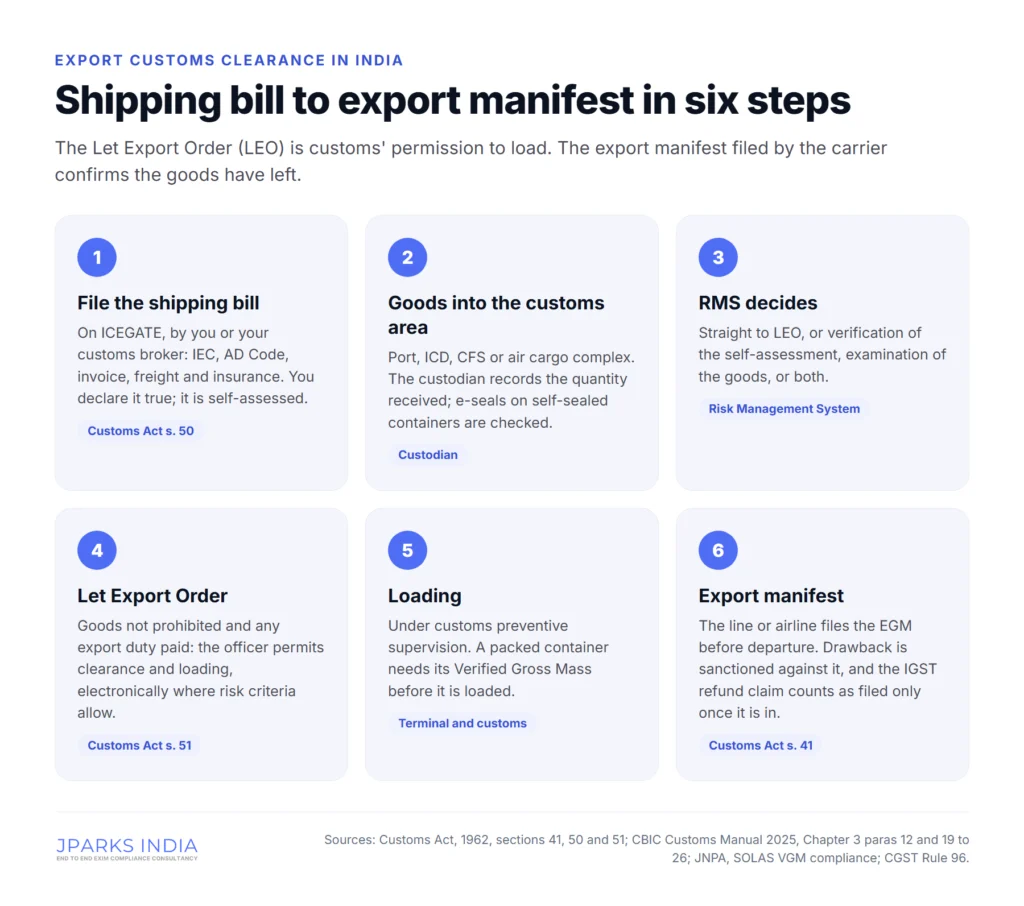
File the shipping bill on ICEGATE. The Customs Act puts the entry on the exporter (section 50). You can file it yourself on ICEGATE, whose Shipping Bill web form is open to exporters and customs brokers, or through a licensed customs broker. It carries your IEC, AD Code, invoice, freight and insurance details, you declare that its contents are true, and it is self-assessed.
Bring the goods into the customs area at the port, ICD, CFS or air cargo complex. The custodian records the quantity actually received (Customs Manual 2025, para 19.1). A self-sealed container arrives with its e-seal, which customs checks for tampering.
The Risk Management System decides. RMS sends each shipping bill either straight to the Let Export Order or for verification of the self-assessment, examination of the goods, or both (para 12.2). For a consignment picked for examination, the norm is at least two packages and at most 5% of the packages, up to 20 (para 21.3).
Let Export Order. Once the proper officer is satisfied that the goods are not prohibited and any export duty is paid, the officer makes an order permitting clearance and loading of the goods (section 51). That order is the LEO, and it can be given electronically on risk criteria.
Stuffing and loading. Stuffing at the dock and loading onto the vessel are done under customs preventive supervision, and the officer may endorse the shipping bill “shipped on board” (para 23.1). A packed container needs its VGM before it is loaded.
Export manifest. The shipping line or airline files the export manifest (EGM) electronically, shipping bill by shipping bill, before the vessel or aircraft leaves (section 41; para 26.1). The EGM confirms the export: drawback is sanctioned against it, and an IGST refund claim counts as filed only once it is filed and your GSTR-3B return is in (CGST Rule 96).
Documents and payment. The carrier issues the bill of lading or airway bill, and you send the documents to the buyer or through your bank as the payment terms require. When the money comes in, see our page on the Bank Realisation Certificate (eBRC).
Exports by land, courier and post
Goods leaving by road or rail to a neighbouring country are entered on a bill of export instead of a shipping bill (Customs Act, section 50), with a lorry or railway receipt as the transport document. Courier exports go on a courier shipping bill under the courier regulations, for consignments of up to Rs 10 lakh FOB value each (Customs Manual 2025, Chapter 17). Exports by post use a postal bill of export (FTP 2023 para 2.06).
Tracking the shipping bill and the shipment
ICEGATE’s public enquiry works without a login. Under Document Status, choose Shipping Bill, select the customs location and enter the shipping bill number and date: the result shows the current status, the EGM status, drawback queries and IGST invoice details. The same enquiry module shows the shipping bill’s status in RBI’s EDPMS and whether it has reached DGFT.
For the cargo itself, track the bill of lading or container number with the shipping line, or the airway bill number with the airline, or ask your freight forwarder.
Correcting a shipping bill
Who can approve a change depends on how far the shipping bill has gone (Customs Manual 2025, para 24):
Before the shipping bill number is generated: the check list can be corrected at the service centre.
After the number, before the LEO: the Assistant or Deputy Commissioner (Exports) can permit the amendment.
After the LEO: only the Additional or Joint Commissioner in charge of exports can permit it.
After the goods are exported: an amendment is allowed only on documentary evidence that existed at the time of export (Customs Act, section 149).
Once the goods have been presented to customs and the examination decision is made, changing a critical detail such as value, drawback or port means the consignment is examined (para 21.2).
Mistakes that hold up export shipments
IEC not updated, or no AD Code on ICEGATE. An IEC not updated between April and June is de-activated, and the shipping bill asks for your AD Code.
LUT not renewed for the new financial year. An LUT is valid for the financial year in which it is furnished, so file a fresh one each April or pay IGST.
CBM worked out on bare cartons when the cargo ships on pallets: the quote then rests on less volume than you ship.
FOB on a container you hand over inland. You carry the risk until the container is on board; FCA moves the risk point to the handover.
EXW accepted without agreeing who files the shipping bill. The export still needs an IEC and a filer in India.
Invoice, packing list and shipping bill that disagree on description, quantity or value. Customs examines against them, and correcting critical details after registration brings an examination.
No VGM for a packed container. The terminal will not plan it for loading.
What JPARKS INDIA does for exporters
JPARKS INDIA is an EXIM compliance consultancy in Vashi, Navi Mumbai, with 500+ clients and a 5.0 rating from 123 Google reviews. We are not a freight forwarder, shipping line or customs broker: we do not book cargo, file shipping bills or clear goods. Your forwarder books the space, and your licensed customs broker, or you on ICEGATE, files the shipping bill. What we do:
practical guidance on export shipping: CBM and chargeable weight, FCL or LCL, the Incoterm for your sale, and the documents your buyer, bank and customs will ask for;
Multiply the length, width and height of one packed carton or pallet in metres, then multiply by the number of packages of that size. If you measured in centimetres, divide L x W x H by 1,000,000; in inches, divide by 61,024.
How many kg is 1 CBM?
CBM is a volume, so it has no fixed weight. For billing, LCL sea freight treats 1 CBM like 1,000 kg (the higher of CBM and tonnes is charged), and air freight treats 1 CBM as about 166.67 kg under the IATA divisor of 6,000.
How is chargeable weight calculated for air freight?
Volumetric weight in kg is L x W x H in centimetres divided by 6,000, which is IATA's general rule. The airline charges whichever is higher, the actual gross weight or the volumetric weight. Some couriers use a different divisor, so check the rate card.
What is the difference between FCL and LCL?
FCL (Full Container Load) means you book a whole container and pay per container. LCL (Less than Container Load) means your cargo shares a container with other shippers' cargo, consolidated at a CFS or ICD, and you pay per W/M: the CBM or the weight in tonnes, whichever is higher.
When should I choose FCL instead of LCL?
There is no fixed break-even volume, because it depends on freight rates on your route. Compare a full LCL quote (W/M rate times your W/M, plus per-shipment charges) with a 20 ft FCL quote; a 20 ft standard container holds about 33 CBM inside.
What is the difference between FOB and CIF?
Under both, the risk passes to the buyer when the goods are on board the vessel at the Indian port. Under CIF the seller also pays the sea freight to the destination port and insures the goods for the buyer, at least on Institute Cargo Clauses (C); under FOB the buyer pays the freight.
Which Incoterm should I use for container shipments?
The ICC's Incoterms 2020 checklist points containerised and multimodal shipments to FCA, or to CPT or CIP when the seller pays the freight. Risk then passes when you hand the container over at your premises, a CFS, an ICD or a terminal, instead of when it is loaded on board.
What documents are required for export from India?
Foreign Trade Policy 2023 para 2.06 lists three mandatory documents: the bill of lading, airway bill, lorry receipt, railway receipt or postal receipt; the commercial invoice cum packing list; and the shipping bill, bill of export or postal bill of export. A certificate of origin, insurance certificate, VGM declaration and product certificates are added when the buyer, bank, mode or product needs them.
What is a Let Export Order?
The Let Export Order (LEO) is the customs order under section 51 of the Customs Act that permits the goods to be cleared and loaded for export. It is given once the officer is satisfied that the goods are not prohibited and any export duty is paid, and it can be given electronically on risk criteria.
Can I file a shipping bill without a customs broker?
Yes. Section 50 of the Customs Act puts the entry on the exporter, and ICEGATE's Shipping Bill web form is open to exporters as well as customs brokers, so you can file it with your own ICEGATE login. Many exporters use a licensed customs broker instead; JPARKS INDIA is not a customs broker.
How do I check my shipping bill status?
Use ICEGATE's public enquiry, which needs no login: under Document Status choose Shipping Bill, select the customs location and enter the shipping bill number and date. It shows the current status, the EGM status, drawback queries and IGST invoice details.
Can a shipping bill be amended after export?
Only on documentary evidence that existed at the time of export (Customs Act, section 149). Before the LEO the Assistant or Deputy Commissioner (Exports) can permit an amendment; after the LEO only the Additional or Joint Commissioner in charge of exports can.
Posted on Google
Vandana Bajaj
Trustindex verifies that the original source of the review is Google.
Very prompt and reliable service by Rahul Kolge and his team. Exceptional and happy experience.
Posted on Google
Supriya Shetye
Trustindex verifies that the original source of the review is Google.
Had a really good experience with JParks India. Rahul sir helped me a lot with my import work and were always active and responsive. Whatever documents or guidance was needed, they handled everything smoothly and explained things clearly. Felt stress-free throughout the process. Very helpful team, definitely recommend them if you’re doing import or export.
Posted on Google
dipali sakpal
Trustindex verifies that the original source of the review is Google.
Very nice people, get the work done in a very short time.
Posted on Google
Satish Bajaj
Trustindex verifies that the original source of the review is Google.
Excellent & Prompt services in all Import Export matters.
Great to work with you
Posted on Google
Bajaj VCPL
Trustindex verifies that the original source of the review is Google.
It was a great experience having work with you.
Posted on Google
Satish Bajaj
Trustindex verifies that the original source of the review is Google.
"Outstanding professiona services, efficient, and gets things done incredibly fast. Highly recommended for anyone needing reliable and prompt assistance
Posted on Google
Nishat fatima
Trustindex verifies that the original source of the review is Google.
excellent service
Posted on Google
farhan sayed
Trustindex verifies that the original source of the review is Google.
JParks Team is Super helpful! Thanks to Rahul and team!
Posted on Google
Sadik Inamdar
Trustindex verifies that the original source of the review is Google.
Good and personal service for import export code
Posted on Google
Maheshwar
Trustindex verifies that the original source of the review is Google.
Had a really good experience with JParks India. Rahul sir helped me a lot with my import work and were always active and responsive. Whatever documents or guidance was needed, they handled everything smoothly and explained things clearly. Felt stress-free throughout the process. Very helpful team, definitely recommend them if you’re doing import or export.
PIMS registration is mandatory before notified paper and paperboard imports arrive in India. We file it inside the 75-to-5-day window, so your URN matches the Bill of Entry and customs clears without fines.
As your Exporter of Record, we export goods out of India in our name, with the IEC, AD Code and filings the shipment needs, and our sister concern S. K. Agency clears it at the port.
Shipping fundamentals cover Incoterms freight mode export documents ICEGATE customs and tracking so you can reduce delays avoid penalties and ship faster from India
Star Export House is DGFT recognition for top Indian exporters that unlocks EPCG duty-free capital goods imports faster customs clearance and stronger buyer and bank credibility.
IGST Refund Status is the live tracking of your export IGST refund claim on the GST portal using ARN or shipping bill number to see if it is pending approved rejected or under scrutiny.
Deemed Exports are domestic supplies to EOU SEZ UN or government projects that qualify for export benefits like IGST refund and duty drawback even though goods stay in India.
Expert MOOWR scheme application support for importers & exporters in India. Complete guide on eligibility, process, benefits & compliance. Get approved fast.
Want to register on the IceGate portal? The smallest mistake can end up in a rejection. To avoid wasting time, get in touch with us and we'll help you get registered on IceGate within 2 to 3 working days!
As an importer of record we Import goods into India on your behalf & deliver them to your desired location. We handle everything from legal compliance to last mile delivery to ensure timely & safely clearance of your Imported goods. Ideal service if you are planning to import for the first time.
We check your goods against the notification, file IGCR-1 on ICEGATE, get your IIN, set up the continuity bond and keep your quarterly IGCR-3 returns on time.
Learn about SVB registration with our comprehensive guide to the Special Valuation Branch. Simplify the process and ensure compliance with our expert services.
Unable to Import or Export due to a deactivated IEC? We have helped 500+ Importers & Exporters renew their IEC within 24 hours of a complete document set.
Need to get CPCB EPR Plastic Waste registration for your business in 2026? We help you get it in a hassle free manner so you can stay compliant with the EPR laws! Get in touch now.
Need a Class 3 DSC Digital Signature Certificate for your business? Get it in 1 to 2 days. At JPARKS INDIA we are Emudhra Partners, and can get the DSC for your at the fastest and most affordable rates. Contact us now!
Get Certificate of Origin | Preferential & Non Preferential
Need a Certificate of Origin for your Export or Import? Look no further, at JPARKS we provide preferential and Non preferential COOs at the best rates. Contact us to know more!
Need to reactivate your IEC on the DGFT portal? The IEC Based DGFT DSC is what you need to move forward hassle free. Contact us now to get your DGFT DSC in 1 to 2 days.
Looking to start your Import Export Business? Getting an IEC is mandatory to get into EXIM trade. We help you apply IEC online and get started within 24 hours.
Want to claim benefits of duty drawback and various other schemes under FTP? You need to register your Bank Account for Export Promotion Incentives. Contact us now to register your Bank Account on IceGate Potal.
We use cookies to run this site, measure traffic, and track our ads. Essential cookies are always on. Accept all, reject non-essential, or set your preferences.
Cookie Preferences
Manage your cookie preferences below:
Essential cookies enable basic functions and are necessary for the proper function of the website.
Name
Description
Duration
Cookie Preferences
This cookie is used to store the user's cookie consent preferences.
30 days
Google reCAPTCHA helps protect websites from spam and abuse by verifying user interactions through challenges.
Name
Description
Duration
_GRECAPTCHA
Google reCAPTCHA sets a necessary cookie (_GRECAPTCHA) when executed for the purpose of providing its risk analysis.
179 days
Google Tag Manager simplifies the management of marketing tags on your website without code changes.
Name
Description
Duration
cookiePreferences
Registers cookie preferences of a user
2 years
td
Registers statistical data on users' behaviour on the website. Used for internal analytics by the website operator.
session
Statistics cookies collect information anonymously. This information helps us understand how visitors use our website.
Google Analytics is a web analytics service that tracks and reports website traffic. It collects anonymized data on how visitors use the site to help us understand and improve performance.