Certificate of Origin Format: Every Box, the HSN Code and What Must Match
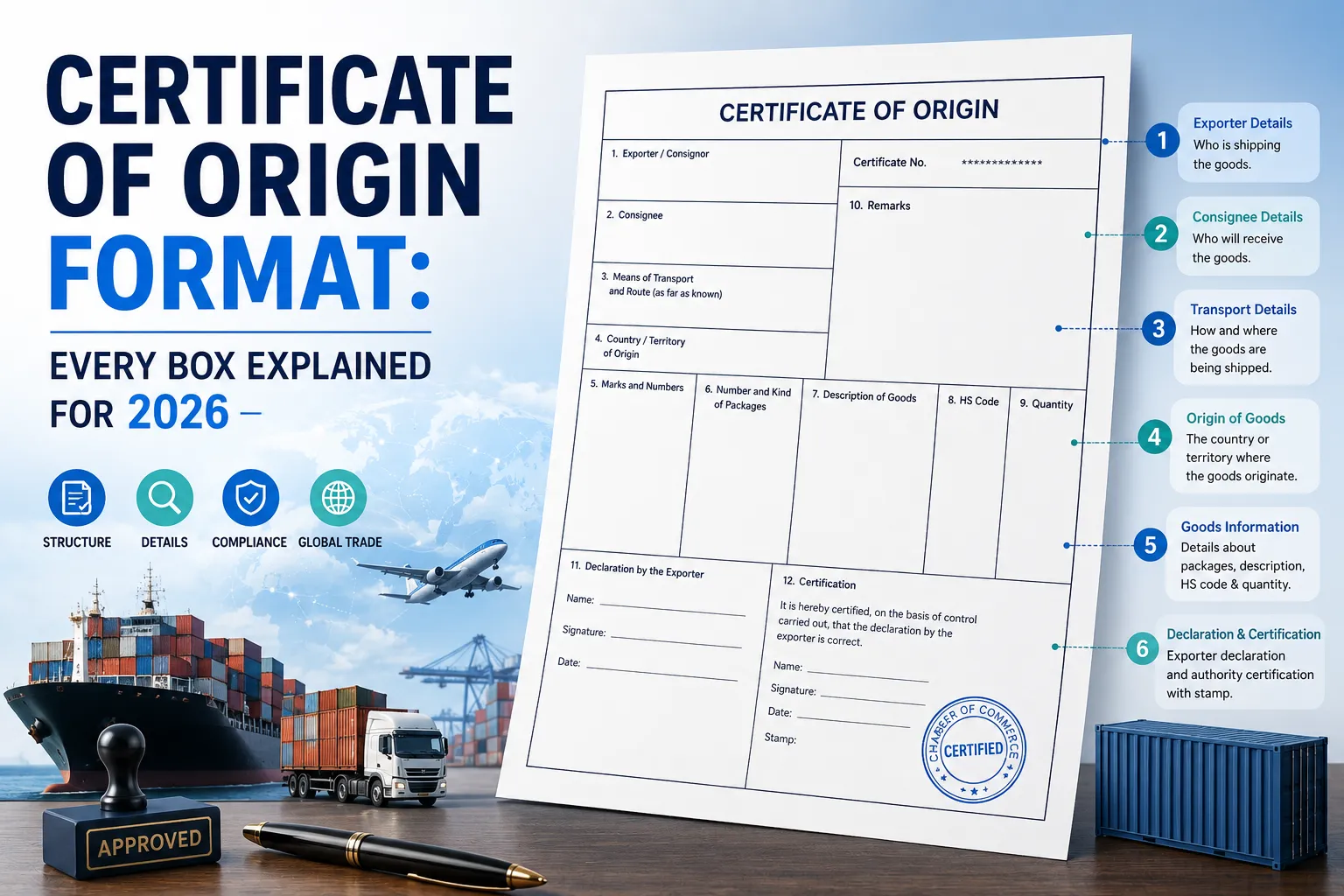
The certificate of origin format for a non-preferential certificate in India is the 12-box layout in Annexure II to Appendix 2E of DGFT’s Handbook of Procedures: exporter, consignee, transport and route, official use, item number, marks and numbers, packages and description of goods, origin criteria, gross weight or quantity, invoice number and date, the issuing agency’s certification, and your declaration. Preferential certificates follow the form each trade agreement prescribes, and their origin criteria and HSN code decide whether the buyer gets the lower duty.
You no longer type onto a printed blank. Applications are filed online on DGFT’s eCoO 2.0 platform at www.trade.gov.in, and the certificate is generated from what you enter there. In January 2025, DGFT Public Notice 43/2024-25 also deleted the Handbook rule that made the Export Inspection Council the printer of blank certificates. So the work is in getting each field right, and consistent with your invoice, packing list and shipping bill.
The 12 boxes of the certificate of origin format
Annexure II to Appendix 2E is headed “Certificate of Origin (Non Preferential)”, a combined declaration and certificate issued in India. These are its boxes and what each one needs:
Box
Official heading
What to enter
1
Goods consigned from
Exporter’s business name, address and country, exactly as in your IEC record. The platform takes these details from DGFT’s IEC data, so correct them on dgft.gov.in (Modify IEC) before you apply.
2
Goods consigned to
Consignee’s name, address and country. If the buyer and the consignee differ, name the consignee here and show the buyer on the invoice.
3
Means of transport and route (as far as known)
Sea or air, port of loading, port of discharge and any transhipment port. An unexplained third-country route invites verification.
4
For official use
Leave blank. The issuing agency uses it.
5
Item number
Number each line where the shipment has more than one product.
6
Marks and numbers of packages
Copy the marks exactly as they appear on the cartons and the packing list.
7
Number and kind of packages, description of goods
Package count and type, and a description in the words of the invoice and the tariff. This format has no separate HS code box, so if the buyer or the letter of credit wants the code, add it here.
8
Origin criteria
The basis on which the goods are of Indian origin (see the origin criteria section below).
9
Gross weight or other quantity
Must agree with the packing list and the shipping bill.
10
Number and date of invoices
The same invoice number that appears on the shipping bill. DGFT has required this since April 2026; it is no longer just good practice.
11
Certification
Completed by the issuing agency, which certifies “on the basis of control carried out” that your declaration is correct, with place, date, signature and stamp.
12
Declaration by the exporter
Your declaration that the details are correct, that all the goods were produced in India and that they meet the origin requirements for exports to the importing country you name.
The importing country in Box 12 is the field most often carried over wrongly from the previous shipment. Check it on every application.
How the preferential and self-certified formats differ
Feature
Non-preferential
Preferential
Layout
The 12-box format in Annexure II to Appendix 2E
The form prescribed by each agreement (Form A under GSP schemes)
Origin criteria box
Indian origin under HBP para 2.93(a)
The criterion of the agreement’s rules of origin, often product-specific
HS code
No separate box; added in the description when asked for
Central: the product-specific rule is chosen by the HS code
Supporting documents
Copy of invoice and packing list uploaded with the application
Cost sheet and origin workings, now prepared on the platform
Official fee
Rs 200 per certificate, including attestation of additional documents (HBP para 2.93(c))
Rs 600 per certificate (Appendix 2K)
Duty effect
None. It proves origin only
Reduced or zero duty at the destination if the claim is accepted
The self-certified non-preferential format in Annexure III to Appendix 2E has ten boxes: the same layout without the origin criteria and certification boxes. GSP certificates follow their own rules, covered in our certificate of origin GSP guide.
Origin criteria: what Box 8 has to show
For a non-preferential certificate, HBP para 2.93(a) treats goods as Indian origin when the exporting entity manufactures them, and, where imported inputs are used, when the processing goes beyond simple operations. The Handbook lists the operations that do not confer origin, including:
removing dust, sifting, sorting, classifying, matching, washing, painting or cutting;
changes of packing, and breaking up or assembly of consignments;
simple packing such as placing in bottles, bags or boxes, and affixing marks or labels;
simple mixing, simple assembly of parts into a complete product, and disassembly;
mere dilution with water or another substance that does not materially change the product.
For preferential certificates, HBP para 2.91(b) names the key criteria. The agreement’s product-specific rule decides which one your product must meet:
Criterion
What it means
Evidence you must hold
Wholly obtained
Grown, mined or produced entirely in India
Production records, procurement trail
Change in tariff classification
Imported inputs change heading or subheading through processing
Input HS codes, output HS code, process note
Value addition
Local content meets the agreement’s threshold
Costed bill of materials (the cost sheet)
Non-minimal operations
The work done in India goes beyond the agreement’s list of minimal operations
Process description, plant records
Some product-specific rules also name a process that must take place in India, or combine two of these tests.
Certificate of origin HSN code: which digits and why they matter
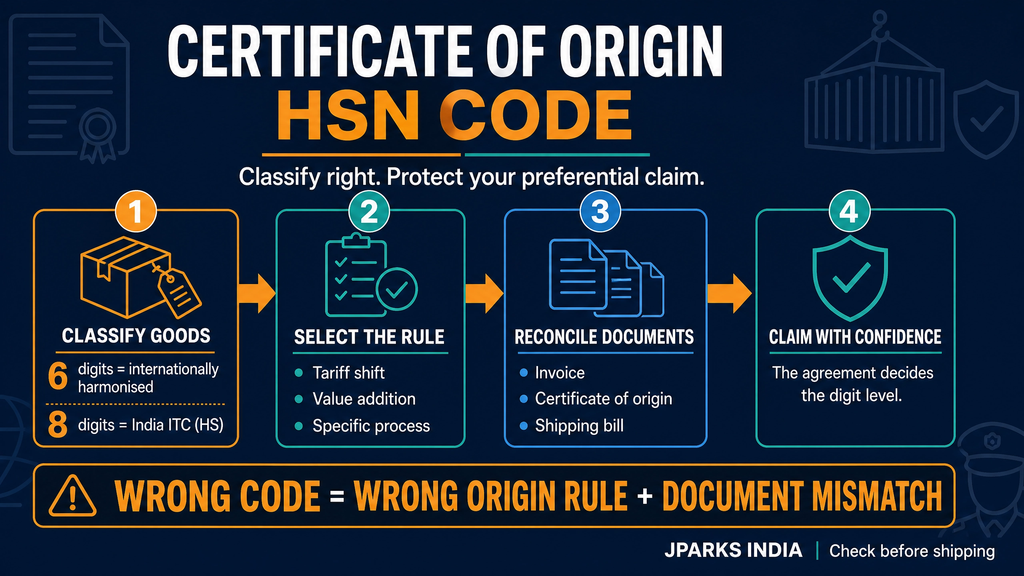
The HSN (Harmonized System of Nomenclature) code entered against your goods does more than describe them. On a preferential certificate it selects the product-specific rule of origin your claim is tested against, and it has to agree with the code on your invoice and shipping bill.
Level
Digits
Set by
Use
HS heading
4
World Customs Organization
Broad category, common to all HS countries
HS subheading
6
World Customs Organization
The internationally harmonised level
Indian tariff line
8
India: ITC (HS) and the Customs Tariff
The code on your shipping bill
The first six digits are international. Beyond six, countries diverge, so an Indian eight-digit code will not always map onto the buyer’s national code.
Most origin rules work at four or six digits. Product-specific rules in trade agreements are written against headings and subheadings, so the six-digit level usually decides your claim.
Enter what the agreement’s form asks for. Where it calls for six digits, classify at six deliberately. Cutting the last two digits off an eight-digit code is not the same thing, even when the result looks identical.
A change in tariff classification claim fails whenever the imported input already sits in the same heading as the finished good. Assembling components from heading 8409 into a product that also classifies in 8409 gives no tariff shift, however much work went into it. Our HSN code guide explains where to look up a code and how many digits each document needs.
Fields that must match your invoice and shipping bill
Since 7 April 2026, DGFT Notification 05/2026-27 requires exporters to use identical invoice numbers in certificates of origin and shipping bills, so that use of the certificate can be verified automatically. Build every document from one set of data:
Certificate field
Must agree with
Exporter name and address
IEC record, invoice, shipping bill
Consignee
Invoice, bill of lading
Goods description and HS code
Invoice, packing list, shipping bill
Gross weight and package count
Packing list, bill of lading
Invoice number and date
Commercial invoice, shipping bill
The code you cannot control is the one on the buyer’s bill of entry. The buyer’s broker may classify differently, and if that difference crosses a heading the origin rule changes with it. On any preference claim of real value, agree the classification with the buyer before you ship.
When the entries conflict, fix the document that is wrong. If it is the shipping bill, ask your customs broker to amend it before the certificate is used. If it is the certificate, apply online for an in-lieu certificate rather than a fresh one. If the buyer’s broker disagrees with your code, send the classification reasoning and the origin workings, not just the code. A note written when you classified carries more weight than the same argument rebuilt two years later.
Self-certification, back-to-back and in-lieu certificates
Self-certification. It exists, but each route is narrower than it sounds, and none removes the evidence burden:
Non-preferential: manufacturer exporters who are also status holders, on the Annexure III format (HBP para 2.93(e)).
Preferential, Approved Exporter Scheme: manufacturers who are status holders, and only where India has built the scheme into a specific agreement and DGFT has notified it (FTP para 2.62, as amended by Notification 05/2026-27).
India-EFTA TEPA and India-UK CETA: a certificate of origin may also be obtained on the exporter’s self-declaration, in addition to agency issuance (HBP para 2.91(e)).
Back-to-back certificates. Since Public Notice 43/2024-25 dated 27 January 2025, agencies may issue back-to-back non-preferential certificates for goods not of Indian origin that move through India for re-export, transhipment or merchanting trade (HBP para 2.93(f)). They are issued on documentary evidence of the foreign origin, and the certificate must state that evidence and the country of origin. Do not use a standard Indian-origin certificate for these goods.
In-lieu certificates. A correction to an issued eCoO is requested online as an in-lieu application to the issuing agency (HBP para 2.93(d)). For a certificate issued on the old coo.dgft.gov.in system, DGFT’s Trade Notice 23/2024-25 says the in-lieu request is filed on that legacy system.
Format errors that cause queries
Description too generic. “Spare parts” or “chemicals” will not survive scrutiny. Use the invoice and tariff wording.
Weight that disagrees with the packing list. Gross and net get swapped more often than you would think.
Wrong importing country in Box 12. Usually a copy from the previous shipment.
Origin criteria claimed without evidence. Especially value addition claimed without a costed bill of materials.
Invoice number different from the shipping bill. Now caught by automated verification.
A borrowed HS code. The supplier’s or buyer’s code is not yours beyond six digits, and it can point at the wrong origin rule.
Tariff shift claimed where inputs share the heading. The most common failed preference claim.
How JPARKS INDIA can help
JPARKS INDIA prepares and files certificates of origin, preferential and non-preferential, through our COO DGFT certificate of origin service, from Rs 2,000 + GST, in 1 to 2 days.
We check every box of the draft against your invoice and packing list before it is filed.
We check that the HS code, description and invoice number match the shipping bill your customs broker will file.
For preferential claims, we work out the origin criterion and build the cost sheet from your bill of materials.
We file with the right agency on eCoO 2.0 and handle in-lieu corrections.
JPARKS INDIA is not a customs broker and does not file shipping bills. To send a draft invoice for a format check, email [email protected] or call +91 91673 79073.
Frequently asked questions
Q1. How many boxes does the certificate of origin format have?
Twelve on the non-preferential format in Annexure II to Appendix 2E. The self-certified non-preferential format in Annexure III has ten. Preferential certificates follow the form of each agreement.
Q2. Is the format the same for preferential and non-preferential certificates?
No. Non-preferential uses the 12-box layout. Preferential uses the form the agreement prescribes, with the agreement’s origin criterion and, for value addition rules, workings from a cost sheet.
Q3. Do I need to put the HS code on the certificate?
The non-preferential format has no separate HS code box; add the code in the description when the buyer or the letter of credit asks for it. For a preferential claim the code is essential, because it selects the product-specific rule of origin.
Q4. Should I use six or eight digits?
Follow the agreement’s form. Six digits is the internationally common level; the eight-digit Indian code on your shipping bill will not always match the buyer’s tariff.
Q5. Does the certificate still need a physical stamp?
No. The issuing officer signs the eCoO digitally and the agency’s stamp image is applied on the platform. Anyone can check it on www.trade.gov.in under Get Certificate of Origin, Verify Certificate, using the CoO number, or by scanning the QR code on the certificate.
Q6. Who is responsible if the classification is wrong?
The exporter answers for the certificate and the importer for the bill of entry. Under Section 28DA of the Customs Act, presenting a certificate of origin does not release the importer from the duty of reasonable care. Our guide to the certificate of origin for import and CAROTAR covers the import side.
Tell us where you are stuck. We usually reply the same business day.
5.0 ★ · 123 Google reviews · Since 1990
Posted on Google
Vandana Bajaj
Trustindex verifies that the original source of the review is Google.
Very prompt and reliable service by Rahul Kolge and his team. Exceptional and happy experience.
Posted on Google
Supriya Shetye
Trustindex verifies that the original source of the review is Google.
Had a really good experience with JParks India. Rahul sir helped me a lot with my import work and were always active and responsive. Whatever documents or guidance was needed, they handled everything smoothly and explained things clearly. Felt stress-free throughout the process. Very helpful team, definitely recommend them if you’re doing import or export.
Posted on Google
dipali sakpal
Trustindex verifies that the original source of the review is Google.
Very nice people, get the work done in a very short time.
Posted on Google
Satish Bajaj
Trustindex verifies that the original source of the review is Google.
Excellent & Prompt services in all Import Export matters.
Great to work with you
Posted on Google
Bajaj VCPL
Trustindex verifies that the original source of the review is Google.
It was a great experience having work with you.
Posted on Google
Satish Bajaj
Trustindex verifies that the original source of the review is Google.
"Outstanding professiona services, efficient, and gets things done incredibly fast. Highly recommended for anyone needing reliable and prompt assistance
Posted on Google
Nishat fatima
Trustindex verifies that the original source of the review is Google.
excellent service
Posted on Google
farhan sayed
Trustindex verifies that the original source of the review is Google.
JParks Team is Super helpful! Thanks to Rahul and team!
Posted on Google
Sadik Inamdar
Trustindex verifies that the original source of the review is Google.
Good and personal service for import export code
Posted on Google
Maheshwar
Trustindex verifies that the original source of the review is Google.
Had a really good experience with JParks India. Rahul sir helped me a lot with my import work and were always active and responsive. Whatever documents or guidance was needed, they handled everything smoothly and explained things clearly. Felt stress-free throughout the process. Very helpful team, definitely recommend them if you’re doing import or export.
We use cookies to run this site, measure traffic, and track our ads. Essential cookies are always on. Accept all, reject non-essential, or set your preferences.
Cookie Preferences
Manage your cookie preferences below:
Essential cookies enable basic functions and are necessary for the proper function of the website.
Name
Description
Duration
Cookie Preferences
This cookie is used to store the user's cookie consent preferences.
30 days
Google reCAPTCHA helps protect websites from spam and abuse by verifying user interactions through challenges.
Name
Description
Duration
_GRECAPTCHA
Google reCAPTCHA sets a necessary cookie (_GRECAPTCHA) when executed for the purpose of providing its risk analysis.
179 days
Google Tag Manager simplifies the management of marketing tags on your website without code changes.
Name
Description
Duration
cookiePreferences
Registers cookie preferences of a user
2 years
td
Registers statistical data on users' behaviour on the website. Used for internal analytics by the website operator.
session
Statistics cookies collect information anonymously. This information helps us understand how visitors use our website.
Google Analytics is a web analytics service that tracks and reports website traffic. It collects anonymized data on how visitors use the site to help us understand and improve performance.