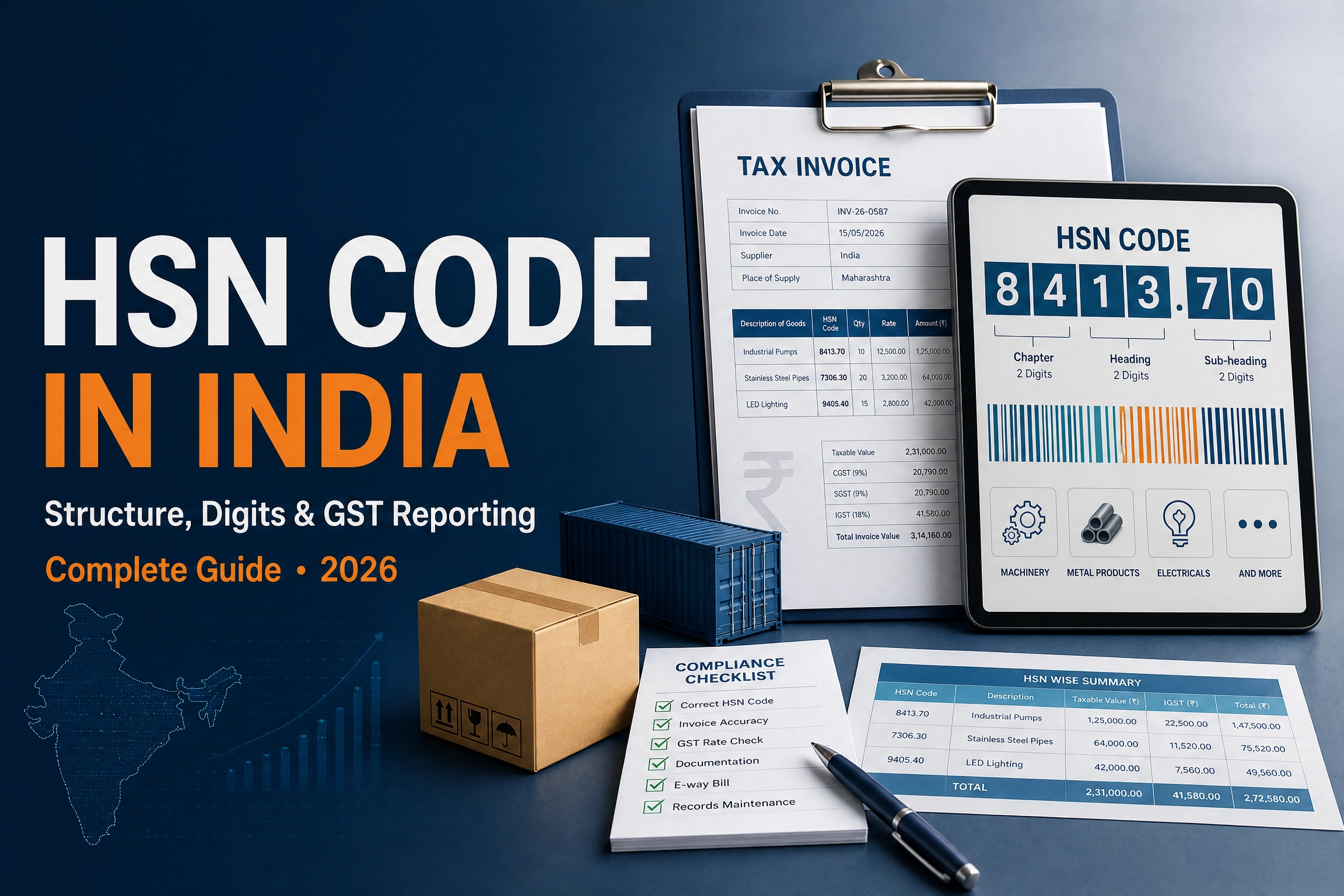
HSN Code in India: Complete Guide to Structure, Digits and GST Reporting (2026)
If you have ever stared at a GST invoice and wondered what that string of digits next to your product name means, you were looking at an HSN code. It is not optional paperwork. It decides your GST rate, and for importers and exporters it decides your customs duty too.
This guide explains what an HSN code is, why it exists, how the digit structure works, and how to find the correct code for your product without guessing. You will also learn how many digits your business needs to report based on turnover, how HSN differs from SAC, and where the GST 2.0 rate changes and the Finance Act 2026 tariff amendments affect your product master.
By the end you will be able to read any HSN code correctly, search for one confidently on the GST portal or ICEGATE, and avoid the classification errors that cause blocked input tax credit and customs delays.
What Is an HSN Code
HSN stands for Harmonised System of Nomenclature. It is a standardised numerical system for classifying traded goods, developed and maintained by the World Customs Organization (WCO) and applied by more than 200 countries and economies.
Think of it as a universal product ID. No matter which country a shipment moves through, the same core code identifies the same category of goods. This is what lets customs officers, tax authorities and trading partners understand what a product is without a language barrier.
India has been a member of the WCO, then called the Customs Cooperation Council, since February 1971. The Harmonised System itself came later. India aligned its Customs Tariff to the HS structure with effect from 28 February 1986, when the Customs Tariff (Amendment) Act, 1985 was brought into force. That was nearly two years before the HS Convention entered into force internationally on 1 January 1988. India then extended the international 6-digit HS structure to 8 digits for greater domestic precision, officially called the ITC-HS (Indian Trade Classification based on Harmonised System) code.
In plain terms: every physical product you buy, sell, import or export in India falls under one HSN code, and that code determines the GST rate applied to it.
Why It Matters
An incorrect HSN code is not a minor clerical slip. It has direct financial and compliance consequences.
Wrong GST rate: Each HSN code is mapped to a specific GST rate entry. Pick the wrong code and you either overcharge your customer or undercharge and fall short on tax paid.
Blocked input tax credit: If your supplier’s invoice carries a mismatched HSN code, your buyer’s input tax credit claim can be questioned or delayed.
Customs delays: For imports and exports an incorrect code can hold up clearance while officials verify the correct classification, with demurrage running in the meantime.
Penalties: A missing or incorrect HSN where one is mandatory is generally treated as a residuary contravention under Section 125 of the CGST Act, carrying a penalty of up to ₹25,000, with an equal maximum under the corresponding State or Union Territory GST Act.
Three qualifications on that penalty are worth knowing, because most online guides state ₹50,000 as if it were automatic:
The ₹25,000 is a discretionary ceiling, not a fixed levy. Section 125 reads “may extend to”.
Section 126 relieves minor breaches, including an omission or mistake in documentation that is easily rectifiable and not made with fraudulent intent, and breaches where the tax involved is under ₹5,000.
Where the wrong HSN actually causes short payment of tax, Section 125 is displaced entirely and Sections 73 or 74 apply, with tax, interest and a much larger penalty.
Consequence
Who Is Affected
Typical Impact
Wrong GST rate applied
Seller and buyer
Tax shortfall or overcharge, correction filings
Mismatched invoice codes
Buyer (ITC claimant)
Delayed or questioned input tax credit
Wrong customs classification
Importer or exporter
Shipment hold, demurrage costs
Missing HSN where mandatory
GST-registered business
General penalty under Section 125, CGST Act
Wrong HSN causing tax shortfall
Supplier
Demand under Section 73 or 74, with interest
How It Works: The HSN Code Structure
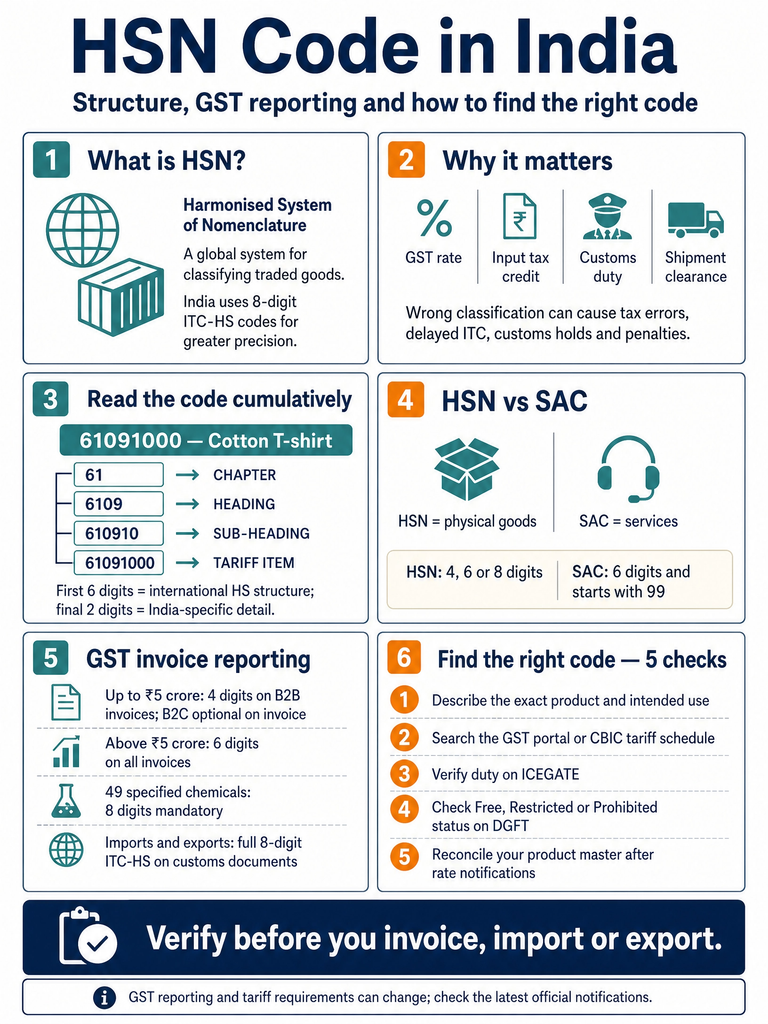
An HSN code is read cumulatively, not as four independent pairs. Each level is defined by all the digits up to that point. Here is a clean 8-digit example, a cotton T-shirt:
Digits
Level
Example (61091000)
First 2
Chapter
61 – Articles of apparel and clothing accessories, knitted or crocheted
First 4
Heading
6109 – T-shirts, singlets and other vests, knitted or crocheted
First 6
Sub-heading
6109 10 – Of cotton
All 8
Tariff item
6109 10 00 – Of cotton
Notice the trailing zeros. India did not create a national sub-division below the international sub-heading 6109.10, so the 8-digit tariff item is simply the 6-digit international code padded out. That is the clearest illustration of how the Indian 8-digit code works: six digits agreed globally, plus two digits India controls. Where India does sub-divide, the last two digits carry real meaning. Under 6109 90 (of other textile materials), for instance, India splits out 6109 90 10 for synthetic fibres, 6109 90 20 for artificial fibres, 6109 90 30 for silk and 6109 90 40 for wool.
Read the hierarchy downward from the heading, never from the tariff item alone. A tariff item’s description is often a fragment that means nothing on its own. Under heading 0902 (tea), tariff item 0902 30 10 reads simply “Content not exceeding 25 g”, which is meaningless until you carry down the sub-heading above it.
The international Harmonised System is organised into 21 sections and 97 chapters, of which Chapter 77 is reserved for future use, so 96 are in active use. The HS 2022 edition contains 1,228 headings and 5,612 sub-headings.
India’s First Schedule to the Customs Tariff Act, 1975 adds Chapter 98, covering project imports, laboratory chemicals, passengers’ baggage, personal importations by air or post, ship stores and, since October 2023, actionable claims such as betting, casinos and online money gaming. That gives the Indian tariff 21 sections and 98 chapters. Chapter 99 does not exist in the Customs Tariff. It appears in GST rate notifications as the heading under which all services and their SAC codes sit.
Chapters run broadly from raw materials to finished goods. Chapters 1 to 24 cover agricultural, food and related products, with the caveat that Chapter 24 is tobacco rather than food. Chapters 25 to 27 are mineral products including fuels. Chapters 28 to 38 are products of the chemical or allied industries, which is broader than “chemicals” and includes pharmaceuticals, fertilisers and cosmetics. The later chapters run through textiles, base metals, machinery, vehicles and instruments.
HSN vs SAC: What’s the Difference
This is one of the most common points of confusion for new business owners.
Feature
HSN Code
SAC Code
Applies to
Physical goods
Services
Digit length reported
4, 6 or 8 digits
6 digits
Starting digits
Varies by chapter (01 to 98)
Always starts with 99
Example
8517 (telephone sets, including smartphones and other telephones for cellular networks)
998313 (Information technology consulting and support services)
Note how close the service codes sit to one another. In the Scheme of Classification of Services annexed to Notification 11/2017-Central Tax (Rate), 998313 is “Information technology consulting and support services” while 998314 is “Information technology design and development services”. Picking the neighbouring code is a common error, and it is the same class of mistake that happens on the goods side.
If you sell a product that ships, it needs an HSN code. If you deliver a service, it needs a SAC code. Businesses that do both, say selling hardware and offering installation services, need to apply both codes correctly on the same invoice, split by line item.
Requirements: Who Needs to Report HSN Codes, and How Many Digits
Under Notification No. 78/2020-Central Tax dated 15 October 2020, effective 1 April 2021, the number of digits you must report on a GST invoice depends on your aggregate turnover in the preceding financial year, not on the type of product you sell.
Aggregate turnover (preceding FY)
HSN digits required on a tax invoice
Up to ₹5 crore
4 digits on B2B invoices; optional on supplies to unregistered persons (B2C)
Above ₹5 crore
6 digits on all invoices, B2B and B2C alike
49 specified chemical products (any turnover)
8 digits, mandatory
Imports and exports (customs documents, any turnover)
Full 8 digits (ITC-HS code)
Points worth noting, several of which are commonly got wrong:
The B2C relief applies only below the threshold. The proviso to Notification 78/2020 lets a registered person with turnover up to ₹5 crore omit the prescribed digits on supplies to unregistered persons. It carves out nothing for the above-₹5-crore class, so those taxpayers must carry 6 digits on B2C invoices too. Any source telling you “4 digits for B2C above ₹5 crore” is wrong.
The digits are a minimum, not a maximum. You may always declare more.
Chemicals override the turnover slabs upward.Notification No. 90/2020-Central Tax dated 1 December 2020 requires the full 8 digits on tax invoices for 49 specified products across Chapters 28, 29, 38 and 39, with no turnover reference at all.
The 8-digit rule for trade is a customs requirement, not a GST invoicing one. Duty rates in the Customs Tariff Act are specified at the 8-digit tariff-item level, and DGFT’s ITC(HS) attaches import and export policy conditions at that level, so a bill of entry or shipping bill cannot be assessed without 8 digits. An exporter with turnover under ₹5 crore is still only obliged to put 4 digits on the GST tax invoice. Aligning both to 8 digits anyway is sensible, because IGST refund matching runs off that data. That match is what you are looking at when you track the shipping bill status on ICEGATE, and it is where a mis-keyed tariff item usually surfaces.
Aggregate turnover is a PAN-level, all-India figure under Section 2(6) of the CGST Act, computed across every GSTIN and including exempt supplies and exports. Businesses close to the ₹5 crore line often forget the exempt and export component.
The invoice relief and the return obligation diverge. A taxpayer under ₹5 crore may legitimately omit HSN from a B2C tax invoice, yet must still populate the B2C tab of Table 12 in GSTR-1 with 4-digit HSN. “Small businesses do not need HSN for B2C” is only half true.
Phase 3 is the operative phase, live from the May 2025 return period. Under it:
Digit requirements mirror the invoice rules: 4 digits up to ₹5 crore, 6 digits above.
Table 12 is split into separate B2B and B2C tabs, filled independently.
HSN codes must be selected from a dropdown. Manual typing is disabled, and the description auto-populates.
The portal cross-checks Table 12 values against the corresponding outward supply tables. These validations currently run in warning mode, so a mismatch raises an alert but does not block filing. One rule is hard: if B2B supplies are reported elsewhere in GSTR-1, the B2B tab of Table 12 cannot be left empty.
Table 13 (documents issued) also became mandatory from the May 2025 return period.
A Phase 4 has been referred to by GSTN only as “to be announced later”. As of September 2026 nothing further has been notified, so treat Phase 3 as the current and complete position. The operative advisories sit on the GST portal news and updates feed.
Step-by-Step Process: How to Find Your HSN Code
Step 1: Identify the Exact Nature of Your Product
Before searching, be specific. “Plastic container” is too broad. Is it for food storage, industrial use, or cosmetics packaging? The intended use can affect the classification.
Apply the General Rules for the Interpretation of the Harmonised System, along with the relevant Section and Chapter Notes, when determining the correct classification.
The code you settle on does not stay on the invoice. It is quoted again on the shipping bill and on the Certificate of Origin, so the classification should remain consistent across documents. Our guide to the certificate of origin HSN code covers that overlap, and JPARKS INDIA issues a certificate of origin through DGFT in 24 hours.
Step 2: Search on the GST Portal or CBIC Tariff Schedule
The GST portal has a built-in HSN/SAC search tool where you can search by product description or code. It is free and does not require a login, making it a direct route for domestic GST classification.
Search using the generic product name, such as “cotton t-shirt,” rather than a brand or marketing name.
Step 3: Cross-Verify on ICEGATE for Import or Export Duty
For cross-border shipments, verify the code on ICEGATE, the Indian Customs Electronic Gateway run under the Central Board of Indirect Taxes and Customs (CBIC).
The current tool is the Custom Duty Calculator on the redesigned portal. Enter the 8-digit ITC-HS code to check the applicable levies, which can include:
Basic Customs Duty (BCD), under the Customs Act, 1962
Integrated GST (IGST)
Social Welfare Surcharge (SWS)
Agriculture Infrastructure and Development Cess (AIDC), where notified
Health Cess, Road and Infrastructure Cess, and NCCD, where applicable
Anti-dumping duty, countervailing duty, or safeguard measures, where applicable
These duties are calculated on the assessable value using the customs notified exchange rate in force on the relevant date.
If you are importing or exporting, confirm the item’s policy status—Free, Restricted, or Prohibited—on the DGFT ITC(HS) policy database using the same code.
A product can be duty-free but still restricted, or subject to other import requirements.
Step 5: Reconcile Your Product Master After Every Rate Notification
GST rates attached to HSN codes can change through Council notifications, while customs tariff codes and rates can change through Finance Act amendments and related notifications.
Review your product master regularly against the latest CBIC, GST, Customs, and DGFT updates to keep your HSN codes and applicable rates current.
Conclusion
An HSN code directly affects your GST rate, input tax credit, customs duty, and shipment clearance. Always verify the correct 8-digit code through the GST portal, ICEGATE, and DGFT, and review your product master when rates or tariff classifications change.
HSN stands for Harmonised System of Nomenclature, a global goods classification system developed and maintained by the World Customs Organization.
Q2. Is HSN code mandatory on GST invoices?
Yes, subject to your turnover. Businesses with aggregate turnover up to ₹5 crore in the preceding financial year must show at least 4 digits on B2B invoices, with HSN optional on B2C invoices. Businesses above ₹5 crore must show 6 digits on all invoices, B2B and B2C.
Q3. How many digits does an Indian HSN code have?
The full Indian tariff item is 8 digits. What you report is 4, 6 or 8 depending on the rule that applies to you. Imports and exports use the complete 8-digit ITC-HS code on customs documents regardless of turnover.
Q4. What is the difference between HSN and HS code?
They refer to the same classification family. “HS code” is the international term; “HSN” is the term commonly used in India, particularly in the GST context.
Q5. How do I find the HSN code for my product?
Search by product description on the GST portal’s HSN/SAC lookup tool, then cross-verify against the CBIC Customs Tariff schedule, and against ICEGATE for import or export shipments.
Q6. What happens if I use the wrong HSN code?
Where the code is simply missing or wrong, the general penalty under Section 125 of the CGST Act applies, up to ₹25,000 with an equal maximum under State GST. It is a discretionary ceiling and Section 126 can relieve minor, easily rectifiable errors. Where the wrong code causes short payment of tax, Sections 73 or 74 apply instead, with tax, interest and a larger penalty.
Q7. Do small businesses need to mention HSN codes?
Businesses with aggregate turnover up to ₹5 crore must show at least 4 digits on B2B invoices. HSN is optional on their B2C invoices. Note the divergence though: the B2C tab of Table 12 in GSTR-1 must still be filled with 4-digit HSN, so the relief applies to the invoice, not the return.
Q8. What is the difference between HSN and SAC codes?
HSN codes classify physical goods; SAC codes classify services. SAC codes are 6 digits and always start with 99, which is the services chapter in the GST scheme of classification.
Need this handled for you?
Tell us where you are stuck. We usually reply the same business day.
5.0 ★ · 123 Google reviews · Since 1990
Posted on Google
Vandana Bajaj
Trustindex verifies that the original source of the review is Google.
Very prompt and reliable service by Rahul Kolge and his team. Exceptional and happy experience.
Posted on Google
Supriya Shetye
Trustindex verifies that the original source of the review is Google.
Had a really good experience with JParks India. Rahul sir helped me a lot with my import work and were always active and responsive. Whatever documents or guidance was needed, they handled everything smoothly and explained things clearly. Felt stress-free throughout the process. Very helpful team, definitely recommend them if you’re doing import or export.
Posted on Google
dipali sakpal
Trustindex verifies that the original source of the review is Google.
Very nice people, get the work done in a very short time.
Posted on Google
Satish Bajaj
Trustindex verifies that the original source of the review is Google.
Excellent & Prompt services in all Import Export matters.
Great to work with you
Posted on Google
Bajaj VCPL
Trustindex verifies that the original source of the review is Google.
It was a great experience having work with you.
Posted on Google
Satish Bajaj
Trustindex verifies that the original source of the review is Google.
"Outstanding professiona services, efficient, and gets things done incredibly fast. Highly recommended for anyone needing reliable and prompt assistance
Posted on Google
Nishat fatima
Trustindex verifies that the original source of the review is Google.
excellent service
Posted on Google
farhan sayed
Trustindex verifies that the original source of the review is Google.
JParks Team is Super helpful! Thanks to Rahul and team!
Posted on Google
Sadik Inamdar
Trustindex verifies that the original source of the review is Google.
Good and personal service for import export code
Posted on Google
Maheshwar
Trustindex verifies that the original source of the review is Google.
Had a really good experience with JParks India. Rahul sir helped me a lot with my import work and were always active and responsive. Whatever documents or guidance was needed, they handled everything smoothly and explained things clearly. Felt stress-free throughout the process. Very helpful team, definitely recommend them if you’re doing import or export.
Verified by Trustindex
Trustindex verified badge is the Universal Symbol of Trust. Only the greatest companies can get the verified badge who has a review score above 4.5, based on customer reviews over the past 12 months. Read more
We use cookies to run this site, measure traffic, and track our ads. Essential cookies are always on. Accept all, reject non-essential, or set your preferences.
Cookie Preferences
Manage your cookie preferences below:
Essential cookies enable basic functions and are necessary for the proper function of the website.
Name
Description
Duration
Cookie Preferences
This cookie is used to store the user's cookie consent preferences.
30 days
Google reCAPTCHA helps protect websites from spam and abuse by verifying user interactions through challenges.
Name
Description
Duration
_GRECAPTCHA
Google reCAPTCHA sets a necessary cookie (_GRECAPTCHA) when executed for the purpose of providing its risk analysis.
179 days
Google Tag Manager simplifies the management of marketing tags on your website without code changes.
Name
Description
Duration
cookiePreferences
Registers cookie preferences of a user
2 years
td
Registers statistical data on users' behaviour on the website. Used for internal analytics by the website operator.
session
Statistics cookies collect information anonymously. This information helps us understand how visitors use our website.
Google Analytics is a web analytics service that tracks and reports website traffic. It collects anonymized data on how visitors use the site to help us understand and improve performance.