ICEGATE Duty Calculator: How Import Duty Is Worked Out and Which Exchange Rate Applies
The ICEGATE duty calculator estimates customs duty on goods you import or export from the tariff heading, value and origin you enter. For a typical import, duty is Basic Customs Duty on the assessable value, Social Welfare Surcharge at 10% of that duty, then IGST on the total of all three. The value is converted to rupees at the customs exchange rate in force on the date the Bill of Entry is filed, not at your bank’s rate.
What does the ICEGATE duty calculator do?
ICEGATE, the CBIC’s customs portal, publishes a Customs Duty Calculator page. Its service description says it helps the trade “calculate applicable custom duty on goods imported or exported by them.” Some people search for it as “know your duty” on ICEGATE, after the older import duty enquiry.
It gives an estimate. The duty you actually pay is what is assessed on your Bill of Entry. The tool’s screens may also change, so we do not list its fields here. The next section lists what every duty calculation needs, whichever calculator you use.
Which inputs decide your customs duty?
Input
What it means
Where to get it right
1. Tariff heading (CTH)
The 8-digit Customs Tariff item for the goods. It fixes the BCD and IGST rates. For specific duties, the unit and quantity also matter
Transaction value plus freight and insurance to the Indian port, converted to rupees at the customs exchange rate
Invoice, freight bill, insurance certificate
3. Country of origin
Decides whether a trade agreement (preferential) rate can apply
Certificate of origin from the supplier
4. Exemption notification
The notification and serial number that give a lower rate, or an SWS exemption
The notification text, and its conditions
5. Relevant date
Fixes the rate of duty and the exchange rate
The date you file the Bill of Entry. For warehoused goods, the rate of duty is fixed on the ex-bond date
In practice, most gaps between a calculator figure and the final assessment come from inputs 1 and 4: a different tariff item, or an exemption claimed without meeting its condition.
How is import duty calculated in India?
Work it out in this order. Each step uses the result of the one before.
Assessable value (AV). Take the transaction value of the goods, add freight and insurance up to the Indian port of import, and convert to rupees at the customs exchange rate. If freight is not known, Rule 10(2) uses 20% of FOB. If insurance is not known, it uses 1.125% of FOB.
Basic Customs Duty (BCD). AV multiplied by the BCD rate for your tariff item, after any exemption notification.
Agriculture Infrastructure and Development Cess (AIDC), only if your goods attract it.
Social Welfare Surcharge (SWS). 10% of the customs duties in step 2 and step 3, unless the goods are exempt.
IGST. The IGST rate applied to AV + BCD + AIDC + SWS. Anti-dumping or safeguard duty, where levied, also goes into this base.
GST compensation cess, only for goods that attract it, on the same base. IGST is not added to the cess base.
Section 110 of the Finance Act, 2018 sets SWS at 10% of the aggregate customs duties. It leaves out anti-dumping duty, safeguard duty, countervailing duty and SWS itself. The IGST base comes from Section 3 of the Customs Tariff Act, which the CBIC guidance note for importers and exporters explains with worked examples.
ICEGATE duty calculator worked example
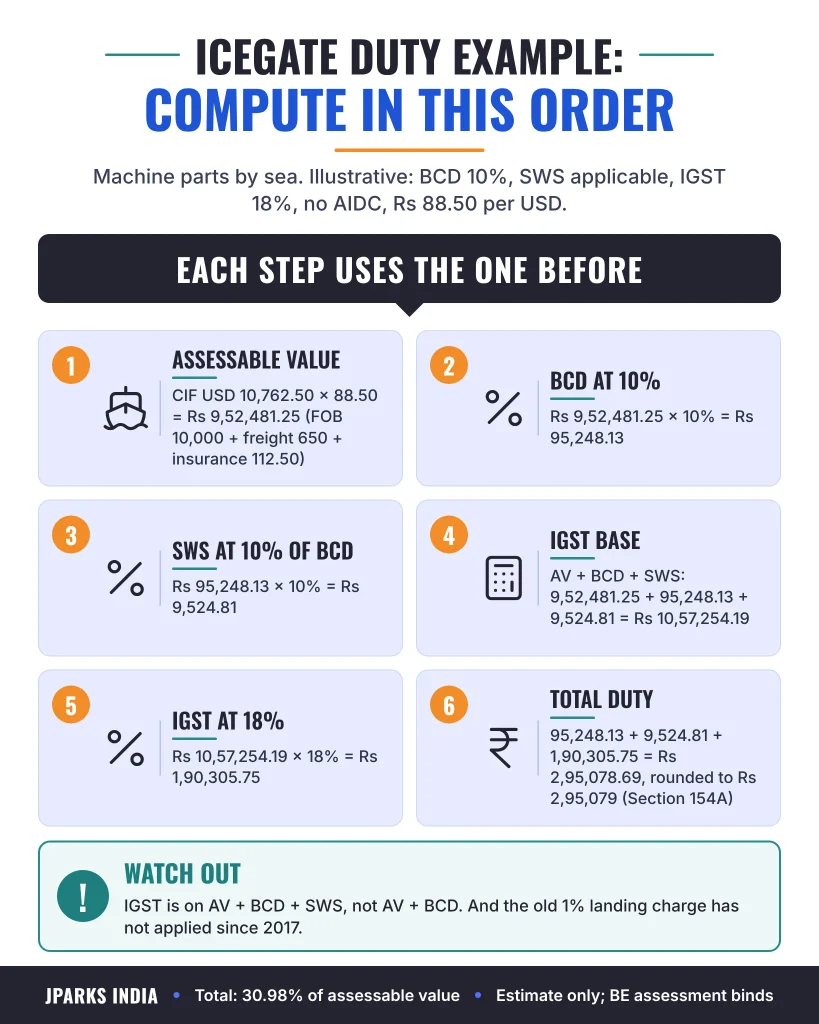
Take machine parts imported by sea. The rates below are illustrative: BCD 10%, SWS applicable, IGST 18%, no AIDC. The exchange rate of Rs 88.50 per USD is also an assumed figure. Use the rate published for your filing date, as explained in the exchange rate section below.
Line
Working
Amount
FOB value
Invoice
USD 10,000.00
Freight
Freight bill
USD 650.00
Insurance
Not known, so 1.125% of FOB (10,000 x 1.125%)
USD 112.50
CIF value
10,000.00 + 650.00 + 112.50
USD 10,762.50
Assessable value (AV)
10,762.50 x 88.50
Rs 9,52,481.25
BCD at 10%
9,52,481.25 x 10%
Rs 95,248.13
SWS at 10% of BCD
95,248.13 x 10%
Rs 9,524.81
IGST base
9,52,481.25 + 95,248.13 + 9,524.81
Rs 10,57,254.19
IGST at 18%
10,57,254.19 x 18%
Rs 1,90,305.75
Total duty
95,248.13 + 9,524.81 + 1,90,305.75
Rs 2,95,078.69
Total duty, rounded
Section 154A, nearest rupee
Rs 2,95,079
The total works out to 30.98% of the assessable value. You can check it quickly: 10% + 1% + (18% x 1.11) = 30.98%.
If the same goods were exempt from SWS, the IGST base would fall to Rs 10,47,729.38. IGST would be Rs 1,88,591.29 and total duty Rs 2,83,839.42, about Rs 11,239 less. Most importers can claim back the IGST as input tax credit, but BCD and SWS are a real cost. So check SWS status before you price a deal.
Which date fixes the duty rate and exchange rate?
The rate of duty is the rate in force on the date you present the Bill of Entry. If the vessel’s entry inwards comes later, that later date applies (Section 15 of the Customs Act). For goods cleared from a warehouse, the rate of duty is fixed on the date of the ex-bond Bill of Entry.
The exchange rate is the one in force on the date the Bill of Entry is presented under Section 46, or for exports, the date the Shipping Bill or bill of export is presented under Section 50 (Section 14 of the Customs Act). The invoice date and the shipment date do not decide it. An estimate run today can differ from next month’s filing if the exchange rate or a notification changes in between.
ICEGATE exchange rate: how customs sets it and where to see it
The ICEGATE exchange rate is the rate customs uses to convert your invoice, freight and insurance into rupees. Under Section 14, it is the rate determined by CBIC, or ascertained in the manner CBIC directs. Until July 2024, CBIC issued these rates as notifications twice a month. Under CBIC Circular No. 07/2024-Customs dated 25 June 2024, the process moved to the Exchange Rate Automation Module (ERAM) from 4 July 2024:
Rates for 22 currencies come from the State Bank of India by direct message to ICEGATE, adjusted to the nearest five paise.
They are published on ICEGATE at 6 pm on the first and third Thursday of each month and apply from 00:00 hours the next day, until the next revision.
If a currency moves more than 5% against the published rate on a given day, its rate is revised from the following day, so an interim change is possible.
Past rates stay on ICEGATE, so you can look up the rate for an earlier filing date.
To see them, open View Exchange Rate under Quick Links on ICEGATE. Choose a Currency Code, or All for the 22 currencies, pick the Exchange Rate Date and enter the captcha. ICEGATE’s exchange rate user manual shows each screen. Customs sets separate rates for imported goods and export goods, so read the right column.
When the Bill of Entry is filed, the customs system applies the rate itself. Your own lookup matters for quotes, costing and checking the assessment, so make sure your ERP or spreadsheet does not carry a stale rate.
Customs exchange rate or bank rate: which one applies?
Your bank’s rate and the customs rate will rarely match, and that is expected. They do different jobs.
Point
Customs exchange rate
Your bank’s rate
Used for
Assessable value, duty and IGST
Paying your supplier
Set by
CBIC, published on ICEGATE
Your bank
How often it changes
Twice a month, or in between for a move above 5%
Through the day
Valid for customs duty
Yes, the only rate that counts
No
Because the customs rate holds for about two weeks, it can lag the market. On a large or time-sensitive shipment, budget landed cost at the customs rate you expect on the filing date, not today’s bank quote. Keep a record of the date, currency, import or export rate and figure used for each shipment.
Are landing charges still added to the assessable value?
No. Before September 2017, customs added a notional 1% of CIF as landing charges. In the example above, that would have added Rs 9,524.81 to the assessable value.
Notification No. 91/2017-Customs (N.T.), dated 26 September 2017, rewrote Rule 10(2) of the Customs Valuation (Determination of Value of Imported Goods) Rules, 2007, as JNCH Public Notice 132/2017 explains. Loading, unloading and handling charges are no longer added to CIF at a flat rate. The value now includes actual transport, loading, unloading and handling costs up to the place of importation, plus insurance.
A few points still catch people. Ship demurrage on chartered vessels, lighterage and barge charges count as transport cost. For air shipments, freight added to the value cannot exceed 20% of FOB. Costs of moving goods within India after arrival, such as trans-shipment to an ICD, are not added. Any calculator or spreadsheet that still adds 1% overstates your duty.
When does Social Welfare Surcharge not apply?
SWS does not apply to goods listed in Notification No. 11/2018-Customs, dated 2 February 2018. The original list had 52 entries, covering many electronics, telecom and IT headings, some food items and goods under specific conditions. The list has been amended many times since. Notification No. 03/2026-Customs of 1 February 2026 changed several entries with effect from April and May 2026, so check the current consolidated text on CBIC before you assume either way.
Where AIDC applies, SWS is calculated on it as well. The exception is gold and silver (CTH 7106 and 7108), where JNCH Public Notice 14/2021 records that Notification No. 13/2021-Customs exempts SWS on the AIDC amount.
Does the calculator work for export duty?
Yes, ICEGATE describes the tool as covering exported goods too. Most exports carry no export duty at all. Export duty applies only to goods listed in the Second Schedule to the Customs Tariff Act, with rates often cut to nil by notification. If your goods are not in that schedule, the export figure will be zero.
Mistakes to avoid when using a duty calculator
Using the wrong tariff item. A change in the last two digits can change BCD and IGST.
Claiming an exemption without its condition. Many notifications need a certificate, end-use or registration. IGCR is one example.
Leaving out freight or insurance. Rule 10(2) adds 20% of FOB for unknown freight, which is usually more than the real cost.
Adding the old 1% landing charge. It has not applied since 2017.
Forgetting SWS in the IGST base. IGST is on AV + BCD + SWS, not AV + BCD.
Converting at the wrong rate. Using the invoice date, or your bank’s rate, instead of the customs rate for the filing date.
Mixing up import and export rates. An import rate applied to an export, or the reverse, throws off the value.
Trusting a copied rate. Third-party sites mirror the rates but are not official. Check View Exchange Rate on ICEGATE for the filing date.
JPARKS INDIA is an EXIM compliance consultancy in Vashi, Navi Mumbai. Duty is assessed on the Bill of Entry that your licensed customs broker files; we do not file Bills of Entry or clear goods. We handle the registrations that change what you pay, or when: IGCR, where a concessional rate depends on end use, and the MOOWR scheme, which lets a manufacturer defer import duty on goods brought into a bonded unit.
Q1. Is the ICEGATE duty calculator result binding?
No, it is only an estimate. The binding figure is the duty assessed on your Bill of Entry. If you need certainty on classification before importing, the Customs Act provides for an advance ruling.
Q2. Do I need to log in to use the ICEGATE customs duty calculator?
ICEGATE lists the calculator among its services for the trade on its public site, and the tool shows what it needs when you open it. Filing the Bill of Entry is separate and needs a registered ICEGATE user, usually your customs broker.
Q3. Why is my Bill of Entry duty higher than the calculator figure?
Usually because the inputs differed. Common causes are a different tariff item at assessment, an exemption that was not allowed, a revised value, or a rate or exchange rate change between your estimate and the filing date.
Q4. Can I claim back the IGST paid at import?
Yes, in most cases, if you are GST-registered and the goods are for business use. IGST paid on the Bill of Entry is available as input tax credit once the BE details reach the GST system. BCD and SWS are not creditable.
Q5. Is customs duty charged on the freight and insurance?
Yes. Freight and insurance up to the Indian port form part of the assessable value. If you do not know them, the valuation rules use 20% of FOB for freight and 1.125% of FOB for insurance.
Q6. How often does the ICEGATE exchange rate change?
Twice a month. Rates are published on ICEGATE on the evening of the first and third Thursday and apply from midnight. A currency that moves more than 5% against the published rate can be revised in between.
Q7. Which exchange rate applies: the invoice date, the shipment date or the filing date?
The filing date. Customs uses the rate in force on the date the Bill of Entry is presented, or for exports the Shipping Bill. The invoice date and shipment date do not decide it.
Q8. Can I use my bank’s exchange rate for customs duty?
No. Only the rate set under Section 14 of the Customs Act counts for the assessable value and duty, even if your bank’s rate is more current.
Tell us where you are stuck. We usually reply the same business day.
5.0 ★ · 123 Google reviews · Since 1990
Posted on Google
Vandana Bajaj
Trustindex verifies that the original source of the review is Google.
Very prompt and reliable service by Rahul Kolge and his team. Exceptional and happy experience.
Posted on Google
Supriya Shetye
Trustindex verifies that the original source of the review is Google.
Had a really good experience with JParks India. Rahul sir helped me a lot with my import work and were always active and responsive. Whatever documents or guidance was needed, they handled everything smoothly and explained things clearly. Felt stress-free throughout the process. Very helpful team, definitely recommend them if you’re doing import or export.
Posted on Google
dipali sakpal
Trustindex verifies that the original source of the review is Google.
Very nice people, get the work done in a very short time.
Posted on Google
Satish Bajaj
Trustindex verifies that the original source of the review is Google.
Excellent & Prompt services in all Import Export matters.
Great to work with you
Posted on Google
Bajaj VCPL
Trustindex verifies that the original source of the review is Google.
It was a great experience having work with you.
Posted on Google
Satish Bajaj
Trustindex verifies that the original source of the review is Google.
"Outstanding professiona services, efficient, and gets things done incredibly fast. Highly recommended for anyone needing reliable and prompt assistance
Posted on Google
Nishat fatima
Trustindex verifies that the original source of the review is Google.
excellent service
Posted on Google
farhan sayed
Trustindex verifies that the original source of the review is Google.
JParks Team is Super helpful! Thanks to Rahul and team!
Posted on Google
Sadik Inamdar
Trustindex verifies that the original source of the review is Google.
Good and personal service for import export code
Posted on Google
Maheshwar
Trustindex verifies that the original source of the review is Google.
Had a really good experience with JParks India. Rahul sir helped me a lot with my import work and were always active and responsive. Whatever documents or guidance was needed, they handled everything smoothly and explained things clearly. Felt stress-free throughout the process. Very helpful team, definitely recommend them if you’re doing import or export.
We use cookies to run this site, measure traffic, and track our ads. Essential cookies are always on. Accept all, reject non-essential, or set your preferences.
Cookie Preferences
Manage your cookie preferences below:
Essential cookies enable basic functions and are necessary for the proper function of the website.
Name
Description
Duration
Cookie Preferences
This cookie is used to store the user's cookie consent preferences.
30 days
Google reCAPTCHA helps protect websites from spam and abuse by verifying user interactions through challenges.
Name
Description
Duration
_GRECAPTCHA
Google reCAPTCHA sets a necessary cookie (_GRECAPTCHA) when executed for the purpose of providing its risk analysis.
179 days
Google Tag Manager simplifies the management of marketing tags on your website without code changes.
Name
Description
Duration
cookiePreferences
Registers cookie preferences of a user
2 years
td
Registers statistical data on users' behaviour on the website. Used for internal analytics by the website operator.
session
Statistics cookies collect information anonymously. This information helps us understand how visitors use our website.
Google Analytics is a web analytics service that tracks and reports website traffic. It collects anonymized data on how visitors use the site to help us understand and improve performance.