An Importer of Record (IOR) is the person or company named as the importer on the Bill of Entry. It holds the IEC the goods come in under, pays the customs duty and IGST, and answers to Customs for everything declared. If you sell into India without an Indian entity, JPARKS INDIA can be your Importer of Record: the goods are imported in our name, under our IEC, GSTIN and ICEGATE registration, and a licensed customs broker files the Bill of Entry.
Our IOR fee is from Rs 10,000 + GST, or 5% of the CIF value, whichever is higher, quoted per shipment. Customs duty and IGST are billed to you at actual cost. We have served 500+ clients, are rated 5.0 from 123 Google reviews, and come from a family that has worked in EXIM since 1990.
What an Importer of Record is in India
Indian customs law defines the importer, not the “importer of record”. Under Section 2(26) of the Customs Act, 1962, the importer of goods, until they are cleared for home consumption, includes any owner, beneficial owner or person holding himself out to be the importer. The party that presents the Bill of Entry (Section 46) and self-assesses the duty (Section 17) is what the trade calls the Importer of Record.
IOR is simply the short form of Importer of Record, in shipping and in customs. There is no separate “importer of record number” in India. The importer is identified by its Importer Exporter Code (IEC), a 10-character code that is the same as the entity’s PAN, and the Foreign Trade Policy says no import of goods may be made without an IEC unless specifically exempted.
The IOR is not always the consignee. The consignee is the party the goods are delivered to; the importer is the party named on the Bill of Entry and liable to Customs. Our guides explain what IOR means in India and importer of record vs consignee in detail.
Who needs an IOR in India
Anyone who has to get goods into India but has no Indian importer able or willing to stand on the Bill of Entry:
Foreign sellers with no Indian entity. An IEC needs a PAN, a bank account in the applicant’s name and a valid address, a large step for a market you are still testing.
Sellers on DDP terms. You agreed to deliver duty paid, so the import duty is yours, but you cannot present a Bill of Entry in India yourself.
Project imports. Machinery, tools and spares for an Indian project site, before or without an Indian entity of your own.
Samples. Bona fide technical and trade samples of restricted items need no DGFT authorisation, except defence and security items, seeds, bees and new drugs, but they still need an importer with an IEC.
Demo and test equipment that is later sent back out.
IT hardware for an Indian office or data centre (see “IOR for IT equipment” below).
Indian businesses importing once in a while, who would rather not learn customs compliance on a live consignment.
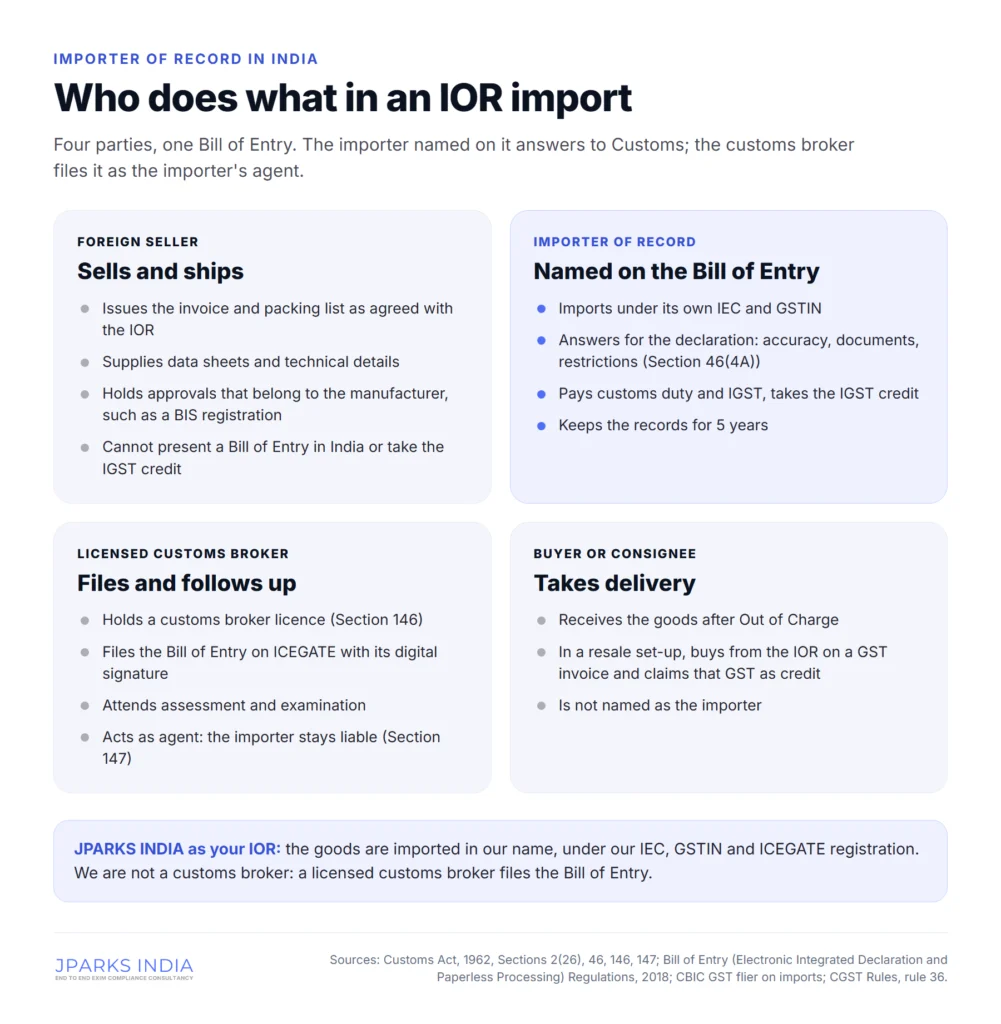
Four parties, each with its own job; Customs verifies the self-assessment, examines goods when selected and orders clearance.
Party
What it does
What it does not do
Foreign seller
Sells and ships the goods; issues the invoice and packing list as agreed with the IOR; supplies technical data; holds the approvals that belong to the manufacturer, such as a BIS registration
Present a Bill of Entry in India or take the import IGST credit
Importer of Record
Is named on the Bill of Entry under its IEC; answers for the accuracy of the declaration; pays duty and IGST; keeps the records; takes the IGST credit as the importer
Act as a customs broker, unless it holds a broker licence
Licensed customs broker
Files the Bill of Entry on the customs system with its digital signature, as the importer’s authorised agent; attends assessment and examination
Take over the importer’s liability: under Section 147 the importer stays liable for what its agent does
Buyer or consignee
Takes delivery after clearance; in a resale structure, buys from the IOR on a GST invoice
Appear as the importer on the Bill of Entry
What the IOR is legally responsible for
The obligations sit on the importer, so they sit on the IOR. Under the Customs Act, 1962 and the rules made under it, the importer must:
present the Bill of Entry electronically on the customs automated system (Section 46(1)) and sign a declaration as to the truth of its contents, supported by the invoice (Section 46(4));
ensure the accuracy and completeness of the information, the authenticity and validity of every supporting document, and compliance with any restriction or prohibition on the goods under the Customs Act or any other law (Section 46(4A));
self-assess the duty (Section 17(1)), which Customs may verify, and pay it within the time Section 47(2) sets;
hold the origin information if it claims a preferential duty rate under a trade agreement (Section 28DA);
keep the assessed Bill of Entry and all supporting documents for 5 years from the date the Bill of Entry was presented, and produce them to Customs when asked (Bill of Entry Regulations, 2018, regulation 6), including in a customs audit under Section 99A.
The liability outlasts the delivery. Customs can demand short-paid duty within two years, or five years for collusion, wilful misstatement or suppression (Section 28), with interest (Section 28AA). Goods that do not match the Bill of Entry in value or any other particular are liable to confiscation (Section 111(m)), with penalties under Sections 112 and 114A. More on this in importer of record responsibilities and liability.
How an IOR shipment works, step by step
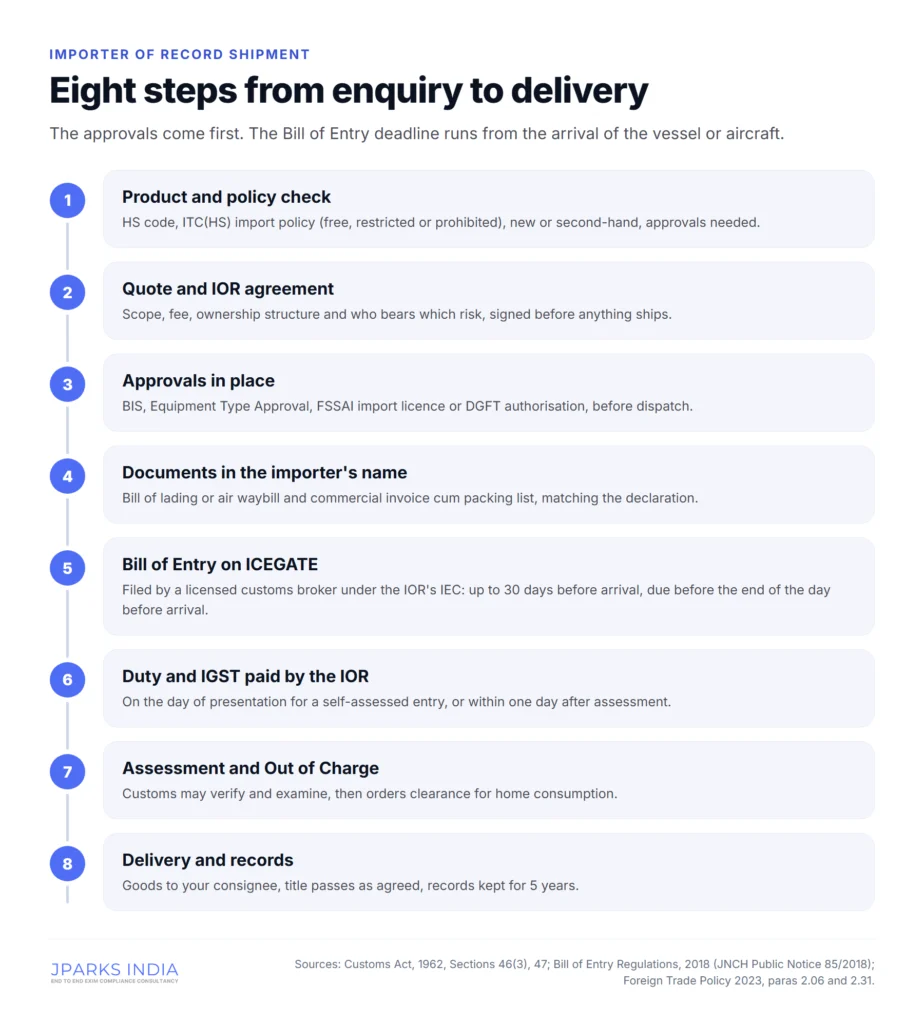
Product and policy check. HS code, ITC(HS) import policy (free, restricted or prohibited), new or second-hand, and the approvals that apply.
Quote and IOR agreement. Scope, fee, ownership structure and who bears what risk, signed before anything ships.
Approvals in place before dispatch, not at the port.
Shipping documents in the importer’s name. The bill of lading or air waybill and the commercial invoice cum packing list must match what will be declared.
Bill of Entry. A licensed customs broker files it on ICEGATE under the IOR’s IEC. It can go in up to 30 days before the expected arrival and is due before the end of the day before the vessel, aircraft or vehicle arrives (Section 46(3)).
Duty and IGST. The IOR pays them on the day the Bill of Entry is presented, for a self-assessed entry, or within one day (excluding holidays) after Customs returns it for payment on assessment (Section 47(2)).
Assessment and Out of Charge. Customs may verify the assessment and examine the goods, then orders clearance once the goods are not prohibited and the duty is paid, also electronically on risk evaluation (Section 47(1)). You can follow the stages with our bill of entry status guide.
Delivery, title and records. The goods go to your consignee, title passes as the agreement says, and the Bill of Entry and documents stay on file for five years, with copies to you.
Documents for an IOR import
For every shipment
The Foreign Trade Policy lists three mandatory documents for any import into India: the bill of lading, air waybill or other transport document; the commercial invoice cum packing list (separate invoice and packing list are accepted); and the Bill of Entry. Supporting documents are entered on the customs automated system with a digital signature.
When the goods or the deal need more
Regulated goods: the approval, licence or registration the goods need (next section). The Policy lets the regulator concerned notify extra documents for goods under restrictions or product-specific compliance.
Restricted goods: the DGFT authorisation.
A trade-agreement duty rate: the certificate of origin and the origin information Section 28DA expects the importer to hold.
A supplier related to the Indian buyer: valuation may need review; see SVB registration.
What we need from you for a first look
The goods with quantity, value and HS code if known; a data sheet, and whether they are new, used or refurbished; the supplier’s invoice and packing list; the Incoterm, origin and port of arrival; any approval the goods already have; the consignee’s address and whether the goods are sold or stay yours; and your company details for the agreement.
Approvals your goods may need before import
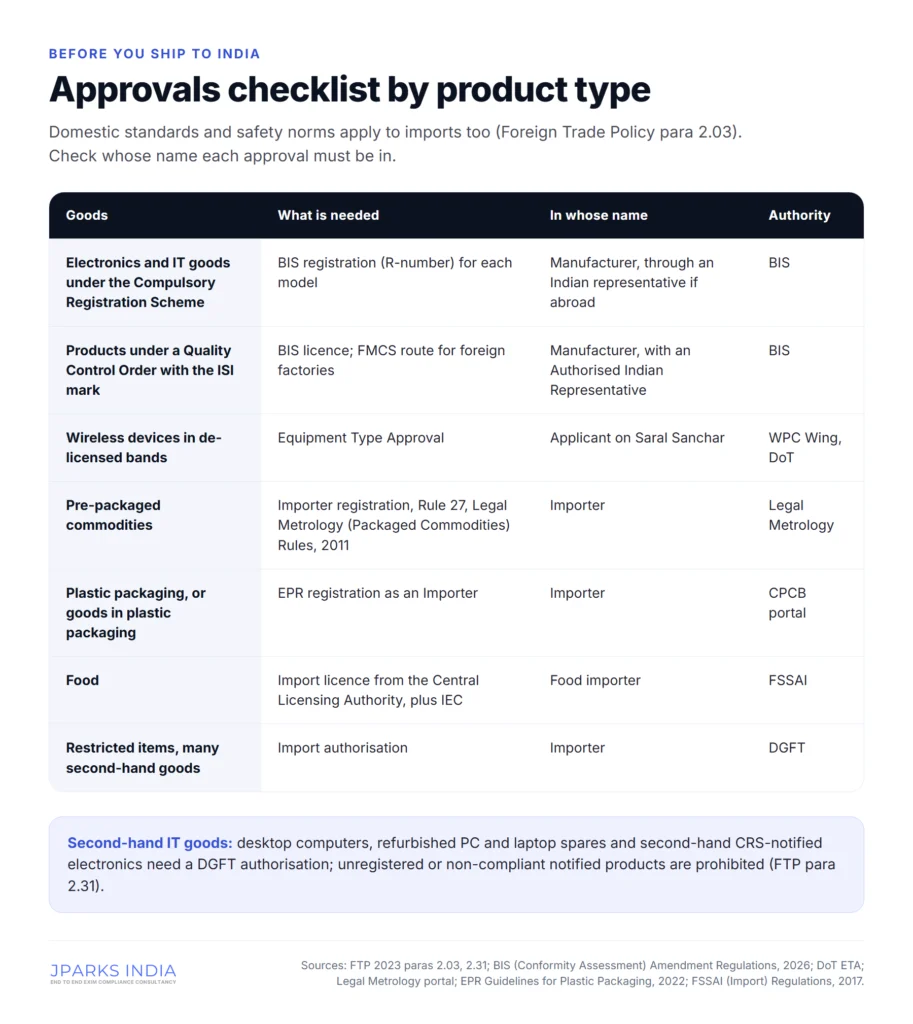
An IEC lets you import; it does not make every product importable. The Foreign Trade Policy (para 2.03) applies the domestic laws, rules, orders, technical specifications and safety and health norms that bind goods made in India to imports as well, unless specifically exempted. Section 46(4A)(c) then makes the importer responsible for compliance. The common ones:
Goods
What is needed
Whose name it is in
Electronics and IT goods notified under BIS’s Compulsory Registration Scheme
BIS registration (R-number) for each model
The manufacturer; a foreign factory acts through an Indian representative
Products under a BIS Quality Control Order with the ISI mark
BIS licence (for foreign factories, the FMCS route with an Authorised Indian Representative)
The manufacturer
Wireless devices in de-licensed bands or with RF transmission
Equipment Type Approval from the WPC Wing, Department of Telecommunications
The applicant on the Saral Sanchar portal
Pre-packaged commodities
Registration under Rule 27 of the Legal Metrology (Packaged Commodities) Rules, 2011
The importer
Plastic packaging, or products imported in plastic packaging
EPR registration as an Importer on CPCB’s centralised portal
The importer
Food
FSSAI import licence from the Central Licensing Authority, plus an IEC
The food importer
Restricted items, including many second-hand goods
DGFT import authorisation
The importer
The last column matters with an IOR: a manufacturer’s approval stays with your factory and must cover the exact models shipped, while an importer’s approval has to be in the IOR’s name. We arrange BIS certification, WPC approval and plastic EPR registration as separate services.
IOR for IT equipment
IT hardware is where IOR imports most often go wrong, for three reasons:
BIS registration. If the product is notified under the Compulsory Registration Scheme, the exact model must carry its manufacturer’s BIS registration, just as it would if it were made in India.
Second-hand status. Under Foreign Trade Policy para 2.31, second-hand desktop computers, refurbished PC and laptop spares, and second-hand electronics and IT goods notified under the Compulsory Registration Order need a DGFT authorisation; unregistered or non-compliant notified products are prohibited. Goods imported for repair are free if re-exported.
Wireless parts. Equipment that transmits on radio frequencies also needs an Equipment Type Approval.
Customs duty and IGST: who pays and who claims the credit
Imports are treated as inter-State supplies, so imported goods attract IGST on top of basic customs duty, levied under the Customs Act read with the Customs Tariff Act, 1975 and collected with the duty on the Bill of Entry. It is charged on the assessable value plus the customs duty and any other duty charged on the goods. CBIC’s own worked example, scaled up:
Item
Amount
Creditable under GST?
Assessable value
Rs 1,00,000
Basic customs duty at 10%
Rs 10,000
No: a cost
Value for IGST (Rs 1,00,000 + Rs 10,000)
Rs 1,10,000
IGST at 18%
Rs 19,800
Yes, to a GST-registered importer
Total paid on the Bill of Entry
Rs 29,800
Rates are illustrative; yours depend on the HS code. In an IOR import:
Who pays: the importer pays duty and IGST on the Bill of Entry (Section 47(2)). As IOR we pay them, and bill them to you at actual cost.
Who claims the IGST credit: “input tax” includes IGST on imported goods, and CBIC states the credit is available to the importer against tax on its outward supplies, taken on the Bill of Entry (CGST Rules, rule 36(1)(d)). So it sits with the IOR, not the foreign seller. Basic customs duty is never creditable.
Your Indian customer: when the IOR buys and resells, it charges GST on its sale invoice, and a GST-registered buyer takes credit on that invoice in the normal way.
Which State: the place of supply of imported goods is the importer’s location (Section 11, IGST Act).
Timelines and deadlines
The official time limits that shape every IOR shipment:
Stage
Official time limit
Source
Filing the Bill of Entry
Up to 30 days before expected arrival; due before the end of the day before arrival. Late filing without sufficient cause attracts late presentation charges
Customs Act, Section 46(3)
Paying duty and IGST
Self-assessed: on the day of presentation. After assessment: within one day, excluding holidays. Late payment carries interest
Section 47(2)
Clearing the goods
Goods not cleared within 30 days of unloading, or such further time as allowed, may be sold after notice to the importer
Section 48
Keeping records
5 years from presentation of the Bill of Entry
Bill of Entry Regulations, 2018
Later duty demands
2 years; 5 years for collusion, wilful misstatement or suppression
Section 28
Re-export of duty-paid goods
Within 2 years of paying duty for 98% drawback on unused goods; lower rates for used goods
Section 74
Our side has no fixed turnaround: it depends on the goods and their approvals, so the plan comes with the quote.
IOR fee and charges
Every IOR quote has two layers, and it helps to keep them apart:
Government charges: basic customs duty, IGST and any cess, anti-dumping or safeguard duty on your HS code. These are the same whichever IOR you use, and we bill them at actual cost.
The IOR service fee: what the Importer of Record charges for taking the liability and doing the compliance work. Ours is from Rs 10,000 + GST, or 5% of the CIF value, whichever is higher.
CIF value of the shipment
5% of CIF
Starting IOR fee
Rs 1,50,000
Rs 7,500
Rs 10,000 + GST
Rs 4,00,000
Rs 20,000
Rs 20,000 + GST
What changes a quote
the goods: electronics, IT hardware, wireless devices, food and other regulated items need more checks;
approvals to be arranged, such as BIS or WPC, which are separate services;
the number of product lines to classify and document;
freight, warehousing, local transport, packing and delivery, if you want us to arrange them.
How to compare IOR quotes
If one quote is far cheaper, the difference is almost never in the duty. Check whether duty and IGST pass through at actual cost, which approvals are covered, how the IGST credit is treated, whether delivery is included, and who files the Bill of Entry.
What an IOR cannot do
Make prohibited goods importable, or bring restricted goods in without the DGFT authorisation.
Hold approvals that belong to the manufacturer. A BIS registration under the Compulsory Registration Scheme is your factory’s, not the IOR’s.
Pass the import IGST credit to a foreign seller. The credit is the importer’s, and only a GST-registered person can take it.
Act as a customs broker without a licence. Section 146 bars anyone from carrying on business as a customs broker at a customs station without a licence. JPARKS INDIA does not hold one; a licensed customs broker files the Bill of Entry.
Declare a lower value or a different HS code to cut duty. Customs can verify the self-assessment, and goods that do not match the entry are liable to confiscation.
Take every customs risk off you. The definition of importer includes the owner and the beneficial owner, the person on whose behalf goods are imported or who controls them (Sections 2(26) and 2(3A)). A principal that controls the goods can still be treated as an importer.
Leave goods at the port indefinitely. After 30 days uncleared they can be sold after notice (Section 48).
Your own importer or an IOR: two routes
Point
Become your own importer
Appoint a third-party IOR
Who it suits
An Indian entity that imports regularly and wants direct control
A foreign company with no Indian entity, a one-off import, a DDP sale or a market test
What you need
IEC, GSTIN, a customs broker and the approvals your goods need
An IOR agreement and your product and shipment details
Who is liable to Customs
You
The IOR named on the Bill of Entry, with the owner and beneficial owner still inside the definition of importer
Who takes the IGST credit
You
The IOR
To become your own importer:
get an IEC from the DGFT: we file IEC registration for Rs 2,860 all inclusive, within 24 hours of a complete document set;
register for GST, so the import IGST can be taken as credit;
appoint a licensed customs broker; you need your own ICEGATE registration only to file or track yourself (Rs 3,500 + GST, 2 to 3 working days), with a Class 3 DSC (Rs 3,700 + GST, 1 to 2 days);
put the product approvals in place before the first shipment.
Many clients start with an IOR and move to their own IEC once volumes justify it; we set up both.
What goes into an IOR agreement
The contract under which the IOR imports for you, in writing, signed by both sides and preferably reviewed by your lawyer. It covers:
Scope: the goods and shipments, compliance work, duty payment, approvals and delivery.
Fees and duties: the IOR fee, how duty and IGST are billed, and how the IGST credit is treated.
Ownership: whether the IOR buys and resells, or imports on your behalf while you keep title (common for project or demo equipment), and when title passes.
Liabilities: who bears a later duty demand, penalty, delay or loss. This clause matters most, because the importer answers to Customs for up to five years.
Parties, governing law and dispute resolution.
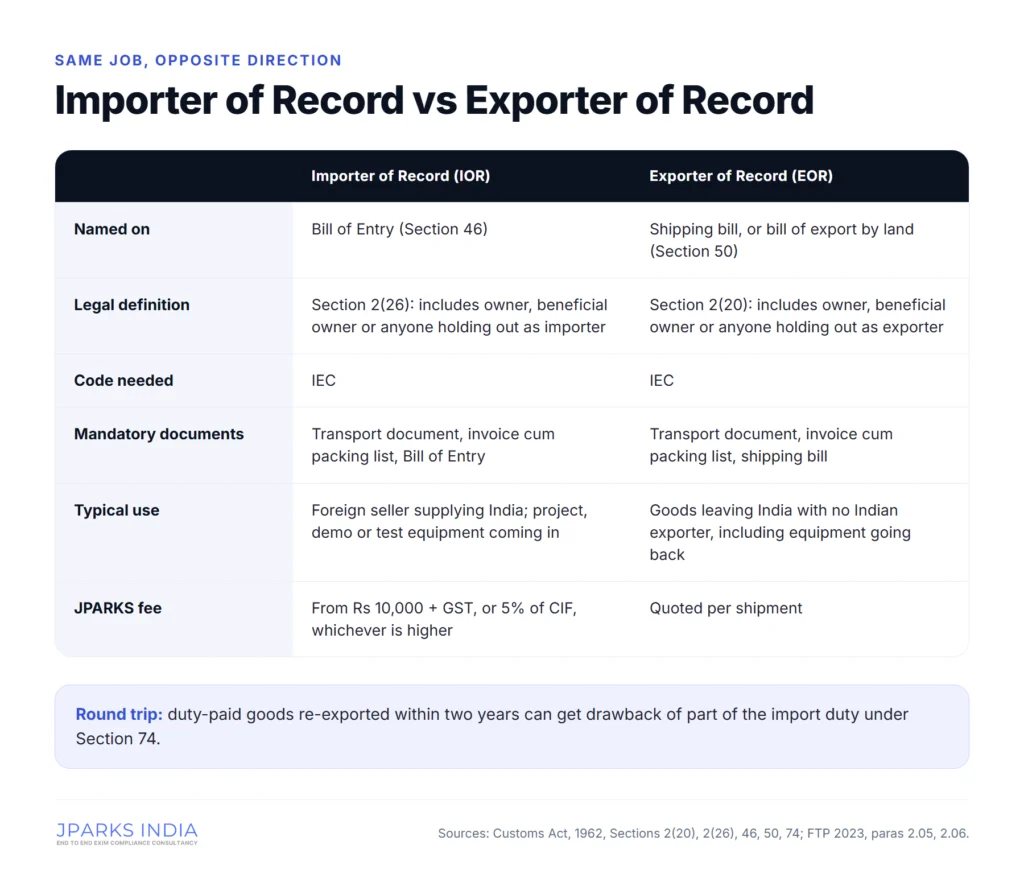
Importer of Record vs Exporter of Record
Same job, opposite direction. The Importer of Record is named on the Bill of Entry for goods coming into India; the Exporter of Record is named on the shipping bill for goods leaving India.
Point
Importer of Record
Exporter of Record
Named on
Bill of Entry (Section 46)
Shipping bill, or bill of export by land (Section 50)
Legal definition
Section 2(26): includes owner, beneficial owner, anyone holding out as importer
Section 2(20): includes owner, beneficial owner, anyone holding out as exporter
Mandatory documents
Transport document, invoice cum packing list, Bill of Entry
Transport document, invoice cum packing list, shipping bill
Typical use
Foreign seller supplying India; project, demo or test equipment coming in
Goods leaving India with no Indian exporter, including equipment going back
JPARKS fee
From Rs 10,000 + GST, or 5% of CIF, whichever is higher
Quoted per shipment
Many foreign companies need both: equipment comes in through an IOR for a project or trial and goes back out when the work is done. If duty-paid goods are re-exported within two years, Section 74 allows drawback of part of the import duty. Our Exporter of Record services handle the export side the same way, in our name.
What JPARKS INDIA does as your Importer of Record
JPARKS INDIA is an EXIM compliance consultancy in Vashi, Navi Mumbai, with 500+ clients and a 5.0 rating from 123 Google reviews. We are not a customs broker: our sister concern S. K. Agency, a licensed customs broker, clears the cargo, while we stand on the Bill of Entry as the importer. As your IOR we:
import the goods in our name, under our IEC, GSTIN and ICEGATE registration;
check the HS code, import policy, approvals and documents before anything ships;
pay the duty and IGST on the Bill of Entry and bill them at actual cost;
hand the goods to your consignee, pass title as agreed and keep the records for five years;
arrange freight, warehousing and delivery, if you want them.
Jawaharlal Nehru Custom House, Public Notice 85/2018, on the Bill of Entry (Electronic Integrated Declaration and Paperless Processing) Regulations, 2018 (Notification 36/2018-Customs (N.T.))
The Importer of Record is the person or company named as the importer on the Bill of Entry. It imports under its own IEC, pays the customs duty and IGST, and answers to Customs for the accuracy of the declaration and the approvals the goods need.
What is the full form of IOR in shipping?
IOR stands for Importer of Record. Indian customs law does not use the term; it defines the importer in Section 2(26) of the Customs Act, 1962, and the IOR is the importer named on the Bill of Entry.
Who can be the Importer of Record in India?
Any person or entity that holds an IEC, or is specifically exempt from needing one. Under Section 2(26) of the Customs Act, the importer includes any owner, beneficial owner or person holding himself out to be the importer.
Is there an Importer of Record number in India?
No separate number exists. The importer is identified by its Importer Exporter Code (IEC), a 10-character code issued by DGFT that is the same as the entity's PAN.
Can a foreign company import into India without an Indian entity?
Yes, through an Importer of Record. The Bill of Entry is filed under the IOR's IEC, so you do not need an Indian company or an IEC of your own for the shipment.
Is the Importer of Record the same as the consignee?
Not always. The consignee is the party the goods are delivered to, while the Importer of Record is the party named on the Bill of Entry and liable to Customs for the declaration, duty and approvals.
Who pays customs duty and IGST in an IOR import, and who gets the input tax credit?
The IOR pays the duty and IGST on the Bill of Entry, and JPARKS INDIA bills them to you at actual cost. The IGST credit is available to the importer on the strength of the Bill of Entry, so it sits with the IOR; basic customs duty is not creditable.
Is JPARKS INDIA a customs broker?
No. JPARKS INDIA acts as Importer of Record in its own name, under its IEC, GSTIN and ICEGATE registration, but does not hold a customs broker licence. A licensed customs broker files the Bill of Entry.
How much do your IOR services cost?
Our IOR fee is from Rs 10,000 + GST, or 5% of the CIF value, whichever is higher, with a custom quote for each shipment. Customs duty and IGST are charged separately at actual cost.
Does the Importer of Record own the goods?
Not necessarily. The IOR can buy the goods and resell them to your Indian customer, or import them on your behalf while you keep title, for example for project or demo equipment. The structure is agreed in writing before anything ships.
Can an IOR import second-hand or refurbished IT equipment?
Only within the Foreign Trade Policy. Under para 2.31, second-hand desktop computers, refurbished PC and laptop spares and second-hand electronics notified under the Compulsory Registration Order need a DGFT authorisation, and unregistered or non-compliant notified products are prohibited.
What is the difference between an Importer of Record and an Exporter of Record?
The Importer of Record is named on the Bill of Entry for goods coming into India; the Exporter of Record is named on the shipping bill for goods leaving India. Both need an IEC, and JPARKS INDIA offers both services.
Posted on Google
Vandana Bajaj
Trustindex verifies that the original source of the review is Google.
Very prompt and reliable service by Rahul Kolge and his team. Exceptional and happy experience.
Posted on Google
Supriya Shetye
Trustindex verifies that the original source of the review is Google.
Had a really good experience with JParks India. Rahul sir helped me a lot with my import work and were always active and responsive. Whatever documents or guidance was needed, they handled everything smoothly and explained things clearly. Felt stress-free throughout the process. Very helpful team, definitely recommend them if you’re doing import or export.
Posted on Google
dipali sakpal
Trustindex verifies that the original source of the review is Google.
Very nice people, get the work done in a very short time.
Posted on Google
Satish Bajaj
Trustindex verifies that the original source of the review is Google.
Excellent & Prompt services in all Import Export matters.
Great to work with you
Posted on Google
Bajaj VCPL
Trustindex verifies that the original source of the review is Google.
It was a great experience having work with you.
Posted on Google
Satish Bajaj
Trustindex verifies that the original source of the review is Google.
"Outstanding professiona services, efficient, and gets things done incredibly fast. Highly recommended for anyone needing reliable and prompt assistance
Posted on Google
Nishat fatima
Trustindex verifies that the original source of the review is Google.
excellent service
Posted on Google
farhan sayed
Trustindex verifies that the original source of the review is Google.
JParks Team is Super helpful! Thanks to Rahul and team!
Posted on Google
Sadik Inamdar
Trustindex verifies that the original source of the review is Google.
Good and personal service for import export code
Posted on Google
Maheshwar
Trustindex verifies that the original source of the review is Google.
Had a really good experience with JParks India. Rahul sir helped me a lot with my import work and were always active and responsive. Whatever documents or guidance was needed, they handled everything smoothly and explained things clearly. Felt stress-free throughout the process. Very helpful team, definitely recommend them if you’re doing import or export.
PIMS registration is mandatory before notified paper and paperboard imports arrive in India. We file it inside the 75-to-5-day window, so your URN matches the Bill of Entry and customs clears without fines.
As your Exporter of Record, we export goods out of India in our name, with the IEC, AD Code and filings the shipment needs, and our sister concern S. K. Agency clears it at the port.
Shipping fundamentals cover Incoterms freight mode export documents ICEGATE customs and tracking so you can reduce delays avoid penalties and ship faster from India
Star Export House is DGFT recognition for top Indian exporters that unlocks EPCG duty-free capital goods imports faster customs clearance and stronger buyer and bank credibility.
IGST Refund Status is the live tracking of your export IGST refund claim on the GST portal using ARN or shipping bill number to see if it is pending approved rejected or under scrutiny.
Deemed Exports are domestic supplies to EOU SEZ UN or government projects that qualify for export benefits like IGST refund and duty drawback even though goods stay in India.
Expert MOOWR scheme application support for importers & exporters in India. Complete guide on eligibility, process, benefits & compliance. Get approved fast.
Want to register on the IceGate portal? The smallest mistake can end up in a rejection. To avoid wasting time, get in touch with us and we'll help you get registered on IceGate within 2 to 3 working days!
As an importer of record we Import goods into India on your behalf & deliver them to your desired location. We handle everything from legal compliance to last mile delivery to ensure timely & safely clearance of your Imported goods. Ideal service if you are planning to import for the first time.
We check your goods against the notification, file IGCR-1 on ICEGATE, get your IIN, set up the continuity bond and keep your quarterly IGCR-3 returns on time.
Learn about SVB registration with our comprehensive guide to the Special Valuation Branch. Simplify the process and ensure compliance with our expert services.
Unable to Import or Export due to a deactivated IEC? We have helped 500+ Importers & Exporters renew their IEC within 24 hours of a complete document set.
Need to get CPCB EPR Plastic Waste registration for your business in 2026? We help you get it in a hassle free manner so you can stay compliant with the EPR laws! Get in touch now.
Need a Class 3 DSC Digital Signature Certificate for your business? Get it in 1 to 2 days. At JPARKS INDIA we are Emudhra Partners, and can get the DSC for your at the fastest and most affordable rates. Contact us now!
Get Certificate of Origin | Preferential & Non Preferential
Need a Certificate of Origin for your Export or Import? Look no further, at JPARKS we provide preferential and Non preferential COOs at the best rates. Contact us to know more!
Need to reactivate your IEC on the DGFT portal? The IEC Based DGFT DSC is what you need to move forward hassle free. Contact us now to get your DGFT DSC in 1 to 2 days.
Looking to start your Import Export Business? Getting an IEC is mandatory to get into EXIM trade. We help you apply IEC online and get started within 24 hours.
Want to claim benefits of duty drawback and various other schemes under FTP? You need to register your Bank Account for Export Promotion Incentives. Contact us now to register your Bank Account on IceGate Potal.
We use cookies to run this site, measure traffic, and track our ads. Essential cookies are always on. Accept all, reject non-essential, or set your preferences.
Cookie Preferences
Manage your cookie preferences below:
Essential cookies enable basic functions and are necessary for the proper function of the website.
Name
Description
Duration
Cookie Preferences
This cookie is used to store the user's cookie consent preferences.
30 days
Google reCAPTCHA helps protect websites from spam and abuse by verifying user interactions through challenges.
Name
Description
Duration
_GRECAPTCHA
Google reCAPTCHA sets a necessary cookie (_GRECAPTCHA) when executed for the purpose of providing its risk analysis.
179 days
Google Tag Manager simplifies the management of marketing tags on your website without code changes.
Name
Description
Duration
cookiePreferences
Registers cookie preferences of a user
2 years
td
Registers statistical data on users' behaviour on the website. Used for internal analytics by the website operator.
session
Statistics cookies collect information anonymously. This information helps us understand how visitors use our website.
Google Analytics is a web analytics service that tracks and reports website traffic. It collects anonymized data on how visitors use the site to help us understand and improve performance.